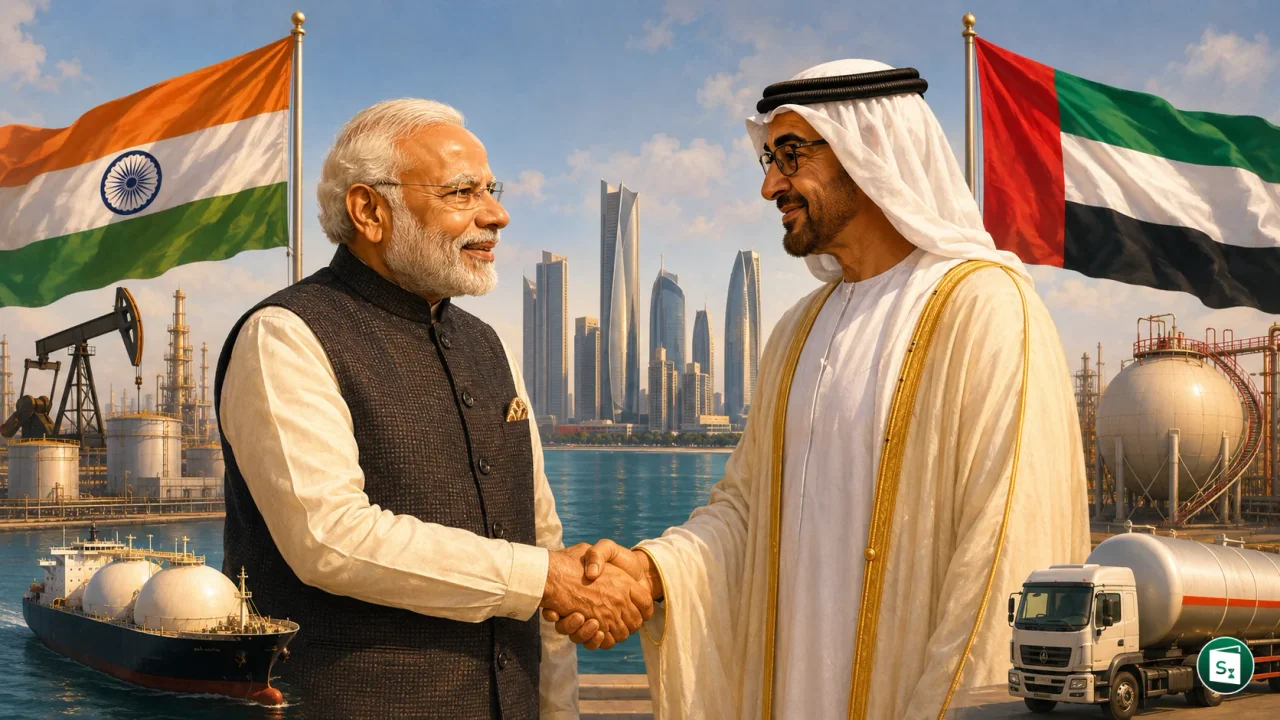
Prime Minister Narendra Modi concluded a high-level visit to Abu Dhabi on May 23, 2026, where he held bilateral talks with UAE President Sheikh Mohamed bin Zayed Al Nahyan to deepen the India-UAE Comprehensive Strategic Partnership. The visit resulted in a massive $5 billion investment pledge from the UAE and critical agreements in the energy sector to bolster India’s long-term resource security. These developments mark a significant shift from a traditional trade relationship toward a more integrated strategic and economic alliance.
Strengthening India’s Energy Security: The ISPRL-ADNOC MoU
A pivotal outcome of the visit was the Memorandum of Understanding (MoU) signed between Indian Strategic Petroleum Reserves Limited (ISPRL) and the Abu Dhabi National Oil Company (ADNOC). ISPRL, a special purpose vehicle under the Ministry of Petroleum and Natural Gas, is responsible for managing India’s emergency crude oil storage. The new agreement seeks to significantly expand the existing cooperation where ADNOC already stores oil at the Mangalore facility in Karnataka.
Under the 2026 MoU, the two nations explored increasing ADNOC’s storage capacity in India to a total of 30 million barrels. This expansion is planned across multiple strategic locations, including Visakhapatnam in Andhra Pradesh and Chandikhole in Odisha. In a reciprocal arrangement, the agreement also discusses the possibility of India storing its own strategic crude reserves at the Fujairah facility in the UAE, which is strategically located outside the volatile Strait of Hormuz.
The Strategic Hybrid Model
The partnership follows a unique commercial-strategic model. While ADNOC bears the cost of storing the oil, India retains the first right of refusal to use the crude during national emergencies. This ensures that India has a guaranteed energy buffer without the massive upfront capital expenditure usually required to fill such large-scale reserves. For ADNOC, the arrangement provides a regional hub to supply other markets in South Asia, enhancing its operational flexibility.
Securing Long-Term LPG Supply: IOCL and ADNOC Collaboration
Furthering the energy partnership, Indian Oil Corporation Limited (IOCL) signed a strategic collaboration agreement with ADNOC for the long-term supply of Liquefied Petroleum Gas (LPG). This agreement builds on the successful execution of an existing LPG term contract that has been operational since 2023. The new framework aims to move toward a formal Sale and Purchase Agreement (SPA), ensuring a stable and reliable supply of cooking fuel to India.
The collaboration will be supported by ADNOC Global Trading, which will facilitate smoother supply chain management and shipping logistics. For India, securing a long-term LPG supply is vital for the success of social welfare initiatives like the Pradhan Mantri Ujjwala Yojana, which has significantly increased domestic LPG consumption. By locking in supplies with a dependable partner like the UAE, India reduces its exposure to the volatility of global spot market prices.
Boosting Economic Ties: The $5 Billion Investment Pledge
In a major boost to India’s financial and infrastructure sectors, the UAE committed to a $5 billion investment package to be deployed through various prominent entities. This commitment follows the enforcement of the Bilateral Investment Treaty (BIT) on August 31, 2024, which provides a stable legal framework for Emirati investors in India.
| Investor Entity | Investment Amount | Target Sector / Entity |
|---|---|---|
| Emirates NBD (ENBD) | $3 Billion | Strategic investment in RBL Bank |
| Abu Dhabi Investment Authority (ADIA) | $1 Billion | Infrastructure projects via National Investment and Infrastructure Fund (NIIF) |
| International Holding Company (IHC) | $1 Billion | Support for Sammaan Capital (Housing Finance) |
The Emirates NBD investment is particularly significant as it represents one of the largest foreign capital infusions into an Indian private sector bank. Meanwhile, ADIA, which is one of the world’s largest sovereign wealth funds, continues its long-term partnership with NIIF to fund large-scale greenfield and brownfield infrastructure projects. The investment by IHC into Sammaan Capital (formerly Indiabulls Housing Finance) aims to provide much-needed liquidity to the housing finance sector, supporting India’s goal of “Housing for All.”
The Broader Strategic Context: CEPA and Beyond
The recent agreements are a direct outcome of the Comprehensive Economic Partnership Agreement (CEPA), which was signed in February 2022 and came into force on May 1, 2022. The CEPA has been a catalyst for bilateral trade, which crossed the $100 billion mark for the first time in the 2024-25 fiscal year. Both nations have now set an ambitious target to double this figure to $200 billion by 2032.
This deepening relationship is also reflected in diverse areas such as food security, where the UAE is investing $2 billion in developing food parks in India, and technology, including a landmark partnership between the UAE’s G42 and India’s C-DAC for AI supercomputing. The current visit by Prime Minister Modi reinforces the UAE’s position as India’s third-largest trading partner and a critical partner in India’s journey toward becoming a $5 trillion economy.
Key Takeaways
- India and the UAE signed a Memorandum of Understanding to expand strategic petroleum reserves to 30 million barrels across Mangalore, Visakhapatnam, and Chandikhole.
- Indian Strategic Petroleum Reserves Limited (ISPRL), which manages India’s emergency oil storage, operates under the Ministry of Petroleum and Natural Gas.
- Indian Oil Corporation Limited (IOCL) signed a strategic collaboration agreement with ADNOC for the long-term supply of Liquefied Petroleum Gas (LPG).
- The UAE pledged a $5 billion investment in India, including $3 billion from Emirates NBD into RBL Bank.
- The Bilateral Investment Treaty (BIT) between India and the UAE came into force on August 31, 2024, replacing the earlier 2013 agreement.
- The Comprehensive Economic Partnership Agreement (CEPA) between the two nations has been in effect since May 1, 2022.
”