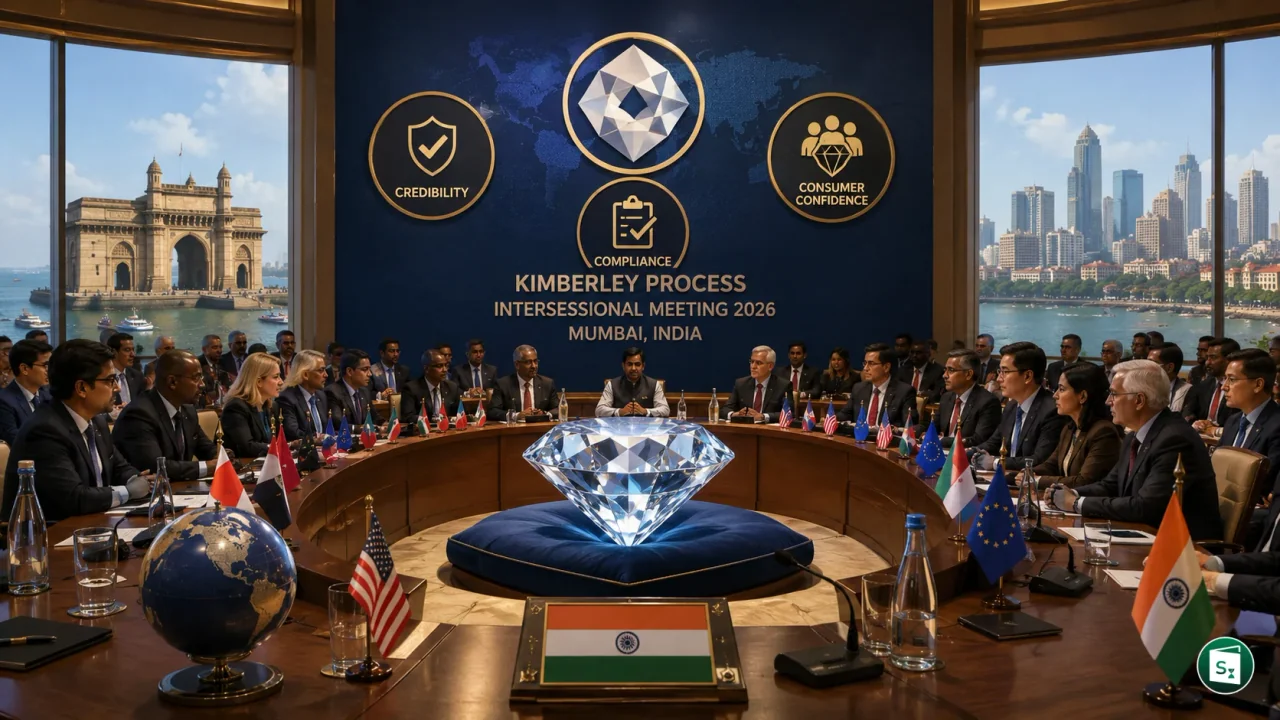
India hosted the Kimberley Process (KP) Intersessional Meeting 2026 in Mumbai under its 2026 Chairship, marking a significant step in shaping the future of the global diamond trade. Led by the Department of Commerce, the meeting focused on the 3Cs framework to enhance transparency and ensure that natural diamonds are sourced responsibly. As the world’s leading hub for diamond cutting and polishing, India’s leadership is central to maintaining the integrity of the international diamond supply chain.
What is the Kimberley Process Certification Scheme?
The Kimberley Process Certification Scheme (KPCS) is a multilateral trade regime established to prevent the flow of conflict diamonds, also known as blood diamonds. These are rough diamonds used by rebel movements or their allies to finance armed conflict aimed at undermining legitimate governments. The process began in May 2000 when diamond-producing states in Southern Africa met in Kimberley, South Africa, to discuss ways to stop this illicit trade.
The scheme was officially launched in 2003 following the United Nations General Assembly Resolution 55/56 adopted in December 2000. It operates through a tripartite structure involving governments, the diamond industry, and civil society observers. Currently, the KP has 60 participants representing 86 countries, with the European Union participating as a single bloc. Together, these members account for approximately 99.8% of the global production of rough diamonds. For a country to trade in rough diamonds, it must meet the minimum requirements of the KPCS, which include national legislation, internal controls, and the use of tamper-resistant certificates.
India’s 2026 Chairship and the Mumbai Intersessional
India assumed the Chairship of the Kimberley Process on January 1, 2026, marking the third time the country has led this global initiative after previous terms in 2008 and 2019. The Intersessional Meeting, held in Mumbai from May 11 to May 14, 2026, served as a platform for mid-year reviews and technical discussions before the final Plenary session scheduled for later this year in New Delhi.
The proceedings were chaired by Suchindra Misra, Special Secretary in the Department of Commerce, under the Ministry of Commerce and Industry. India’s leadership comes at a time when the global diamond industry is navigating complex challenges, including shifting consumer preferences and the need for greater supply chain visibility. During the meeting, delegates from the three pillars—governments, industry, and civil society—collaborated to refine monitoring mechanisms and peer-review processes. The focus was not just on regulation but also on ensuring that the diamond trade continues to support sustainable development and livelihoods in producing nations, particularly in Africa.
The 3Cs Framework: Credibility, Compliance, and Consumer Confidence
Central to India’s 2026 Chairship is the 3Cs framework, a strategic initiative designed to modernize the Kimberley Process and align it with contemporary market expectations. The framework is built on three foundational pillars:
| Pillar | Focus Area |
|---|---|
| Credibility | Strengthening the global reputation of the KP as a trusted, consensus-driven mechanism for diamond regulation. |
| Compliance | Enhancing adherence to standards through rigorous monitoring, data transparency, and the adoption of digital technologies. |
| Consumer Confidence | Ensuring that natural diamonds are recognized as ethically sourced and sustainable to maintain trust among global buyers. |
Digitalization and Traceability
A key highlight of the Mumbai deliberations was the push for digitalization of the Kimberley Process certificates. By replacing paper-based systems with tamper-proof digital certificates, the KP aims to reduce the risk of forgery and administrative delays. India has advocated for the integration of blockchain-based traceability, which would allow for a secure and unalterable record of a diamond’s journey from the mine to the consumer.
Strengthening Monitoring Mechanisms
Compliance under the 3Cs framework involves improving the peer-review mechanism, where member nations evaluate each other’s internal controls. India emphasized the need for real-time statistical reporting and better data sharing among participants to identify and prevent potential leakages in the supply chain. These steps are crucial for ensuring that the “conflict-free” status of natural diamonds remains a verifiable fact rather than just a claim.
Strategic Significance for the Indian Diamond Industry
Hosting the Kimberley Process Intersessional in Mumbai is of immense strategic importance to India, which is the world’s undisputed leader in diamond processing. Approximately 90% of the world’s rough diamonds are cut and polished in India, primarily in the industrial hub of Surat, Gujarat. The diamond sector is a major contributor to India’s economy, accounting for over 45% of the total Gems and Jewellery exports.
The Department of Commerce acts as the nodal agency for the Kimberley Process in India, working closely with the Gem & Jewellery Export Promotion Council (GJEPC). By holding the global Chairship, India is in a unique position to safeguard its domestic industry against the entry of illicit stones, which could damage the reputation of Indian exports. Furthermore, India’s advocacy for digital certificates and blockchain traceability directly benefits Indian manufacturers by streamlining the import of rough diamonds and ensuring that finished products meet the high ethical standards demanded by luxury markets in the US, EU, and UAE. This leadership role ensures that India remains at the forefront of policy making, protecting the livelihoods of millions of artisans and workers engaged in the diamond value chain.
Key Takeaways
- India is serving as the Chair of the Kimberley Process (KP) for the year 2026, marking its third term in this leadership role.
- The Kimberley Process Intersessional Meeting 2026 was held in Mumbai and chaired by Suchindra Misra, Special Secretary in the Department of Commerce.
- India’s strategic roadmap for its Chairship is the 3Cs framework, focusing on Credibility, Compliance, and Consumer Confidence.
- The Kimberley Process Certification Scheme (KPCS) was officially launched in 2003 following the UN General Assembly Resolution 55/56 to eliminate the trade of conflict diamonds.
- The KP currently includes 60 participants representing 86 countries, covering more than 99% of global rough diamond production.
- India processes approximately 90% of the world’s polished diamonds, with the industry concentrated in Surat, Gujarat.