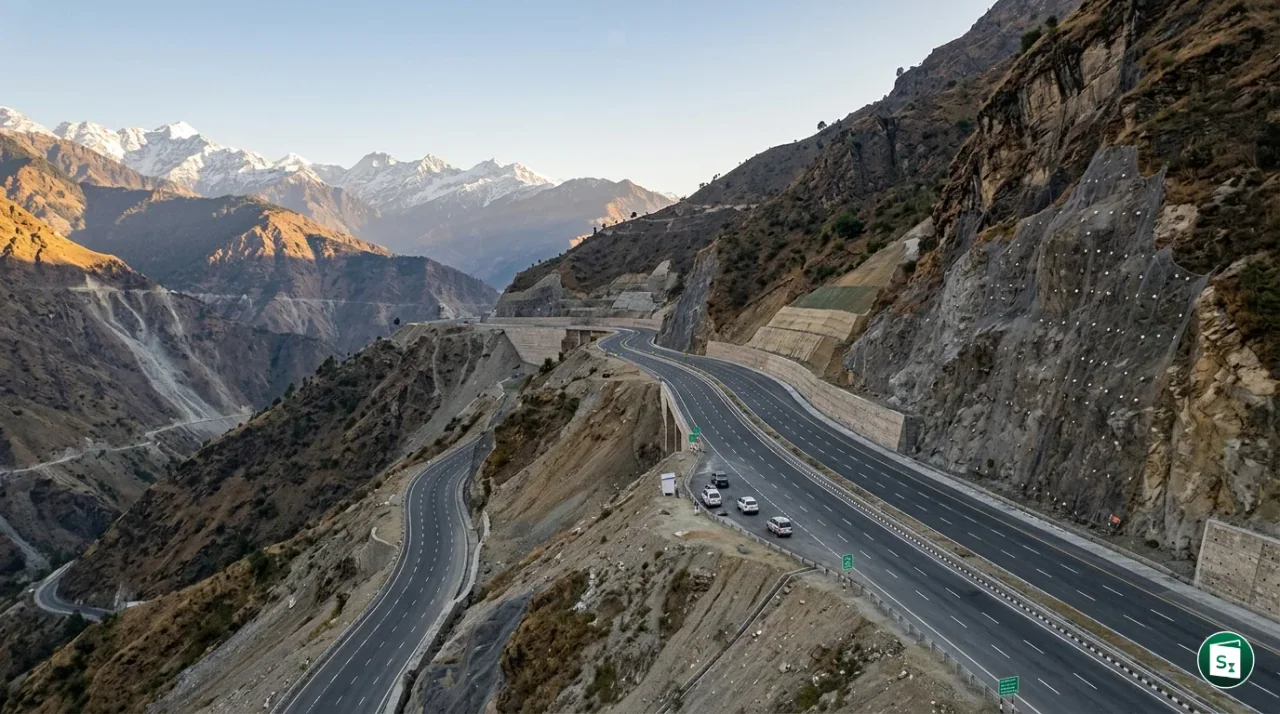
The National Highways Authority of India (NHAI) signed a Memorandum of Understanding (MoU) with the Norwegian Geotechnical Institute (NGI) on May 23, 2026, to strengthen its geotechnical engineering capabilities. This collaboration aims to leverage Norwegian expertise in natural hazard mitigation, particularly for infrastructure projects in geologically sensitive regions like the Himalayas. The partnership focuses on ensuring the safety and resilience of national highways through advanced monitoring and disaster-prevention technologies.
Scope of the Five-Year Collaboration
The agreement between NHAI and NGI is set for an initial duration of five years. It establishes a framework for technical cooperation on a non-exclusive and project-based basis. This allows both organizations to collaborate on specific highway projects while maintaining the flexibility to work with other global entities. The primary objective is to bring international best practices in geotechnical engineering to India’s vast road network.
The partnership includes joint research and development initiatives, technical training for engineers, and institutional knowledge exchange. Through specialized workshops and seminars, NHAI personnel will gain insights into the latest global standards for infrastructure development in mountainous and disaster-prone areas. This capacity-building effort is designed to minimize project delays often caused by unforeseen geological challenges.
Focus on Tunnel Engineering and Slope Stability
A significant portion of the collaboration targets tunnel engineering, a critical component of India’s highway expansion in the Himalayan region. NGI will provide technical advisory for site characterization, feasibility studies, and the preparation of Detailed Project Reports (DPRs) for upcoming tunnels. The expertise of the Norwegian institute in “hard rock” tunnelling is particularly valuable for navigating the complex geology of India’s northern mountains.
In addition to new projects, the agreement includes structural assessments and safety audits of existing operational tunnels. This is intended to identify potential vulnerabilities and prevent structural failures. Furthermore, the collaboration addresses slope stability by conducting advanced hazard mapping. By identifying landslide-prone zones early, NHAI can implement effective mitigation measures, such as soil nailing and rock bolting, to safeguard commuters and infrastructure.
Advanced Monitoring and Early Warning Systems
To enhance disaster preparedness, the partnership emphasizes the use of Advanced Monitoring Technologies. One key area is the interpretation of Interferometric Synthetic Aperture Radar (InSAR) data. This satellite-based technology allows for high-precision monitoring of ground movements, enabling engineers to detect subtle changes in slopes before they lead to catastrophic landslides.
The collaboration also focuses on the development of Early Warning Systems (EWS). By integrating real-time sensor data with predictive modelling, these systems can provide timely alerts for geological hazards. This proactive approach is expected to significantly improve the resilience of national highways in high-risk zones, such as the Western Ghats and the North Eastern Region, where extreme weather events often trigger landslides.
Background: Addressing Geological Challenges in India
India’s push for infrastructure development in mountainous regions has often been met with significant geological challenges. The Himalayas, being young fold mountains, are geologically unstable and prone to landslides, seismic activity, and cloudbursts. Recent incidents, such as the Silkyara tunnel collapse in Uttarakhand, have highlighted the urgent need for advanced geotechnical expertise and rigorous safety audits.
By partnering with Norway, a global leader in “hard rock” tunnelling and mountain engineering, India aims to adopt climate-adaptive and resilient construction techniques. Norway’s Norwegian Method of Tunnelling (NMT) is recognized worldwide for its cost-effectiveness and safety in difficult terrains. This MoU represents a strategic step toward minimizing “geological surprises” and ensuring that national highway projects are both safe and sustainable.
About the National Highways Authority of India (NHAI)
The National Highways Authority of India (NHAI) was established by the NHAI Act, 1988. It is an autonomous body under the Ministry of Road Transport and Highways (MoRTH) and is headquartered in New Delhi. NHAI is responsible for the development, maintenance, and management of National Highways across the country. It plays a pivotal role in implementing major infrastructure initiatives such as the Bharatmala Pariyojana, which aims to improve road connectivity and freight efficiency in India.
Key Takeaways
- NHAI signed a five-year MoU with the Norwegian Geotechnical Institute (NGI) on May 23, 2026, for geotechnical engineering collaboration.
- The partnership focuses on natural hazard mitigation, tunnel engineering, and slope stability in geologically sensitive areas.
- Advanced Monitoring Technologies, including satellite-based InSAR data, will be used to detect ground movements and prevent landslides.
- The collaboration aims to develop Early Warning Systems (EWS) for timely alerts on geological hazards like avalanches and rockfalls.
- NHAI was established in 1988 and operates as an autonomous body under the Ministry of Road Transport and Highways.
- NGI is a global leader in geotechnical research and is headquartered in Oslo, Norway.