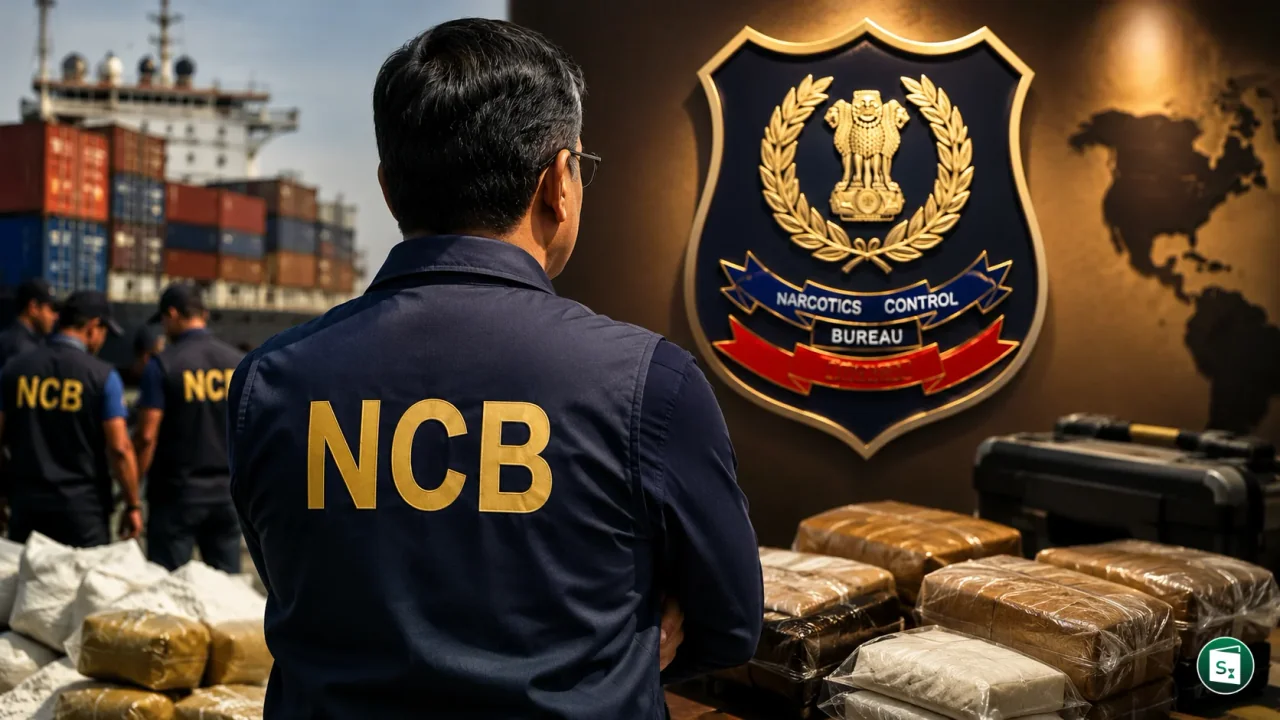
The Appointments Committee of the Cabinet has extended the tenure of senior IPS officer Anurag Garg as the Director General of the Narcotics Control Bureau (NCB) until July 31, 2027. This decision ensures continuity in India’s premier drug law enforcement agency as it intensifies its crackdown on international narcotics syndicates and narco-terrorism. The extension aligns with his date of superannuation, allowing him to lead the government’s mission for a Drug-Free India through the final phase of his service.
Details of the Tenure Extension
The Appointments Committee of the Cabinet (ACC) approved the proposal for the extension following a recommendation from the Ministry of Home Affairs (MHA). The ACC is a high-level body chaired by the Prime Minister and includes the Union Home Minister as its member. It is responsible for making all senior-level appointments and deciding on the tenure of top officials in the central government and security agencies.
The official order, processed through the Department of Personnel and Training (DoPT), specifies that the extension is valid until July 31, 2027, which is the date of Anurag Garg’s superannuation (retirement). His initial deputation tenure was set to conclude on May 23, 2026. This move ensures that the agency remains under stable leadership as it transitions through several long-term strategic initiatives aimed at curbing the drug menace.
Anurag Garg: Profile and Career Highlights
Anurag Garg is a distinguished officer of the 1993 batch of the Indian Police Service (IPS), belonging to the Himachal Pradesh cadre. He is an alumnus of the Indian Institute of Technology (IIT) Delhi, where he completed his B.Tech in Electrical Engineering in 1988. His academic credentials also include a Post Graduate Diploma in Public Policy and training at the National Defence College (NDC) in New Delhi.
Garg’s career highlights reflect his expertise in complex investigations and national security:
- Investigative Excellence: During his tenure in Himachal Pradesh, he served as the Additional Director General of Police (ADGP) of the State Vigilance and Anti-Corruption Bureau. His ability to solve sensitive cases earned him the nickname “Sherlock Holmes” of the state.
- CBI Tenure: He served two significant stints in the Central Bureau of Investigation (CBI) as a Superintendent of Police and later as a Deputy Inspector General (DIG). He is credited with investigating over 200 cases involving high-profile corruption and special crimes.
- Border Security: Before taking over the leadership of the Narcotics Control Bureau in September 2024, he served as the Additional Director General (ADG) at the Border Security Force (BSF) headquarters.
His extensive experience in both border management and criminal investigation is considered a major asset in his current role, where he must manage both domestic distribution networks and cross-border drug smuggling.
The Narcotics Control Bureau: India’s Apex Drug Agency
The Narcotics Control Bureau (NCB) was established on March 17, 1986, following the enactment of the Narcotic Drugs and Psychotropic Substances (NDPS) Act, 1985. It was constituted under Section 4(3) of the Act to enable the central government to effectively combat drug trafficking and fulfill India’s treaty obligations under international conventions. Headquartered in New Delhi, the NCB functions under the administrative control of the Ministry of Home Affairs (MHA).
As India’s premier federal intelligence and law enforcement agency for narcotics, the NCB has a broad mandate:
- National Coordination: It acts as the nodal agency for coordinating the actions of state governments and other central agencies like the Central Bureau of Investigation (CBI), Customs, and Central Excise.
- International Liaison: The NCB serves as the national contact point for international bodies such as the United Nations Office on Drugs and Crime (UNODC), INTERPOL, and the International Narcotics Control Board (INCB).
- Modern Warfare: In recent years, the bureau has shifted its focus towards the “darknet” narcotics trade and dismantling complex financial networks used for narco-terrorism.
The bureau operates through several zonal and sub-zonal offices across the country, ensuring a nationwide network for intelligence gathering and enforcement operations.
Strategic Coordination and NCORD Mechanism
The NCB plays a central role in the Narco-Coordination Centre (NCORD) mechanism, which was established by the MHA in 2016 and restructured in 2019 to enhance inter-agency cooperation. NCORD operates through a four-tier structure to ensure that narcotics control is addressed from the highest policy levels down to the district level. The levels are:
- Apex Level: Chaired by the Union Home Secretary.
- Executive Level: Chaired by the Special Secretary (Internal Security), MHA.
- State Level: Chaired by the State Chief Secretary.
- District Level: Chaired by the District Magistrate (DM).
The Director General of the NCB chairs the Joint Coordination Committee (JCC), which monitors the investigation of significant drug seizures and complex cases. Under Anurag Garg’s leadership, the bureau has achieved several major milestones:
- Captagon Seizure: India recently recorded its first-ever seizure of Captagon, a synthetic stimulant frequently associated with international conflict zones. The bureau recovered 227 kg of the drug, valued at nearly ₹182 crore.
- Digital Initiatives: The agency has increasingly used the NIDAAN portal (National Integrated Database on Arrested Narco-Offenders) to integrate criminal records and fingerprints of drug offenders across India, making it easier to track recurring syndicates.
- MANAS Helpline: The MANAS (1933) toll-free helpline has been promoted as a key tool for citizens to report drug trafficking and seek help for substance abuse.
These initiatives align with the national goal of “Nasha Mukt Bharat” (Drug-Free India), which emphasizes a two-pronged strategy of Supply Reduction through strict enforcement and Demand Reduction through social awareness and rehabilitation.
Key Takeaways
- Anurag Garg, a 1993-batch IPS officer of the Himachal Pradesh cadre, has received a tenure extension as the Director General of the Narcotics Control Bureau (NCB) until July 31, 2027.
- The extension was approved by the Appointments Committee of the Cabinet (ACC), which is chaired by the Prime Minister and includes the Union Home Minister.
- The Narcotics Control Bureau (NCB) was established on March 17, 1986, under Section 4(3) of the Narcotic Drugs and Psychotropic Substances (NDPS) Act, 1985.
- The NCB is headquartered in New Delhi and functions under the administrative control of the Ministry of Home Affairs (MHA).
- The Narco-Coordination Centre (NCORD) uses a four-tier structure to streamline drug law enforcement from the Union Home Secretary level to the District Magistrate level.
- Under the current leadership, India recorded its first-ever seizure of Captagon (the “Jihadi Drug”), recovering 227 kg valued at ₹182 crore.
- The government has integrated digital tools like the NIDAAN portal and the MANAS (1933) helpline to strengthen the Nasha Mukt Bharat Abhiyan.