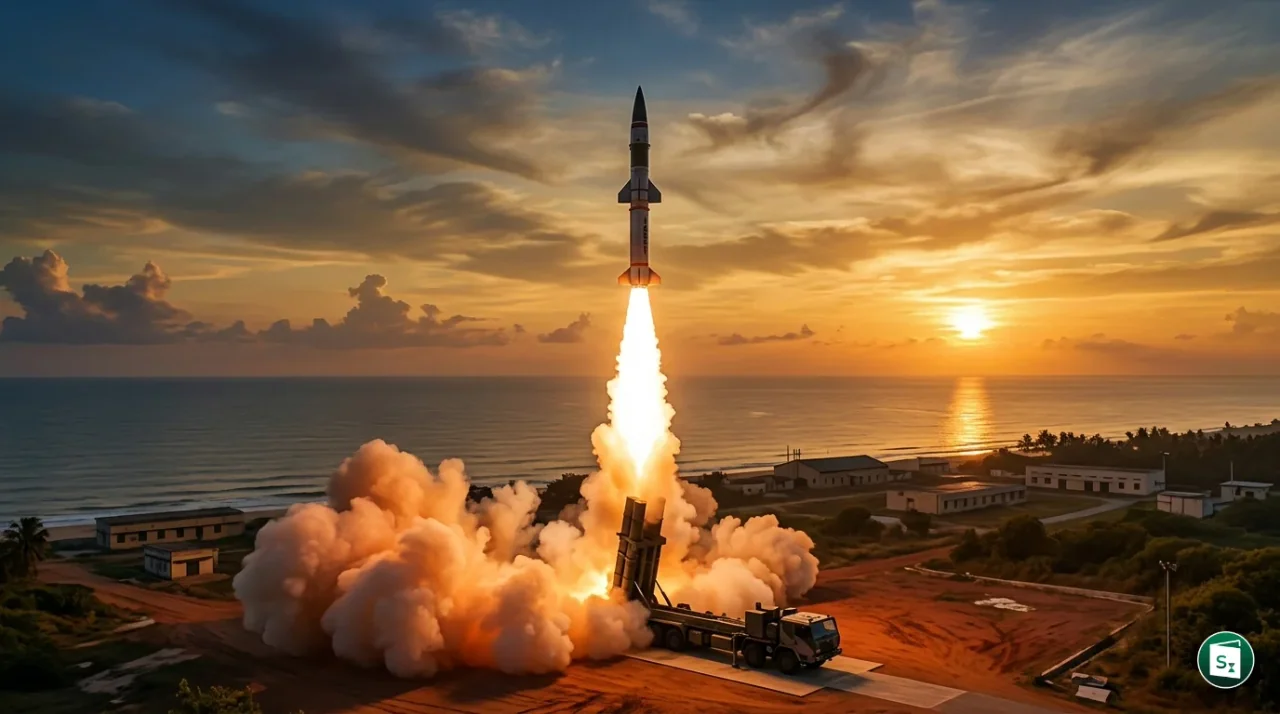
India successfully test-fired the indigenous Agni-1 short-range ballistic missile from the Integrated Test Range in Chandipur, Odisha, on May 23, 2026. The trial, conducted by the Strategic Forces Command, validated all technical and operational parameters of the weapon system under real-world conditions. This successful launch reinforces India’s regional deterrence capabilities and ensures the high readiness of its strategic assets.
Technical Specifications and Capabilities
The Agni-1 is a sophisticated Short-Range Ballistic Missile (SRBM) that serves as a vital component of India’s land-based nuclear triad. Developed by the Defence Research and Development Organisation (DRDO), the missile is a single-stage system powered by solid propellants. The use of solid fuel is a significant advantage, as it allows the missile to be stored for long periods and prepared for launch in a matter of minutes, unlike liquid-fueled systems that require time-consuming fueling procedures.
One of the defining features of the Agni-1 is its high mobility. It is designed to be deployed via road-mobile transporter-erector launchers (TEL) or rail-mobile platforms. This mobility ensures that the missile can be hidden and moved across the country, making it extremely difficult for an adversary to target in a preemptive strike. The missile’s guidance system utilizes a Ring Laser Gyro-based Inertial Navigation System (RLG-INS), ensuring high accuracy and reliability in hitting its intended targets.
| Feature | Details |
|---|---|
| Missile Type | Short-Range Ballistic Missile (SRBM) |
| Operational Range | 700 to 900 km |
| Payload Capacity | Approximately 1,000 kg |
| Propulsion | Single-stage Solid Rocket Motor |
| Warhead Type | Conventional or Strategic (Nuclear) |
| Launch Platform | Road and Rail-mobile Launchers |
Strategic Significance in India’s Defence
The successful validation of the Agni-1 system is more than just a routine military exercise. It represents the continued maturation of India’s strategic deterrence and its ability to maintain a credible defense posture in a complex regional security environment.
Bridging the Strategic Gap
The Agni-1 was conceptualized and developed following the 1999 Kargil War. During that conflict, India recognized a critical gap in its missile arsenal. The existing Prithvi-II missile had a limited range of about 250 km, while the Agni-II was designed for much longer intermediate ranges of over 2,000 km. There was no dedicated system to handle targets in the 700 to 1,000 km range. The Agni-1 was specifically engineered to fill this vacuum, providing a tailored solution for regional threats and ensuring that India possesses a flexible response capability.
Role in Credible Minimum Deterrence
India’s nuclear doctrine is built on the principles of Credible Minimum Deterrence (CMD) and a No First Use (NFU) policy. This means that India will never use nuclear weapons first, but it maintains a robust capability to retaliate if attacked. For this doctrine to be effective, India’s strategic assets must be survivable.
The Agni-1’s solid-fuel propulsion and road-rail mobility are central to this survivability. Because it can be quickly deployed and launched from various locations, it ensures that India retains a second-strike capability. The high precision of the missile ensures that it remains a credible deterrent, as it can reliably strike high-value targets with minimal collateral risk.
The Agni Missile Family: An Overview
The Agni series is the backbone of India’s land-based nuclear deterrence. These missiles were born out of the Integrated Guided Missile Development Programme (IGMDP), which was launched in 1983 under the visionary leadership of Dr. APJ Abdul Kalam. While the IGMDP initially aimed to develop five different missile systems (Prithvi, Agni, Trishul, Nag, and Akash), the Agni series eventually evolved into a standalone strategic programme.
Over the decades, the Agni family has expanded from short-range systems to Intercontinental Ballistic Missiles (ICBMs) like the Agni-V. Each variant is designed to address specific security challenges and provide a comprehensive shield across different ranges.
| Missile Variant | Category | Approximate Range |
|---|---|---|
| Agni-I | Short-Range (SRBM) | 700 to 1,200 km |
| Agni-II | Medium-Range (MRBM) | 2,000 to 3,500 km |
| Agni-III | Intermediate-Range (IRBM) | 3,000 to 5,000 km |
| Agni-IV | Intermediate-Range (IRBM) | 3,500 to 4,000 km |
| Agni-V | Intercontinental (ICBM) | 5,000 to 7,000 km |
| Agni-P (Prime) | New-Gen Medium-Range | 1,000 to 2,000 km |
The newer Agni-P (Agni Prime) is a canisterized missile that incorporates advanced technologies from the Agni-IV and Agni-V programmes. It is intended to eventually replace the older Agni-I and Agni-II missiles, offering better accuracy and even faster deployment times.
Strategic Forces Command: The Operational Arm
The Strategic Forces Command (SFC) is the specialized agency responsible for the operational management of India’s strategic and tactical nuclear weapons. Established on January 4, 2003, it was created to ensure that India’s nuclear deterrent is managed with the highest level of professional oversight and command efficiency.
The SFC is a tri-service command, meaning it integrates personnel and expertise from the Indian Army, Navy, and Air Force. It operates as the functional arm of the Nuclear Command Authority (NCA). While the Political Council of the NCA, led by the Prime Minister, is the only authority that can authorize a nuclear strike, the SFC is tasked with the actual delivery and management of these assets.
The command is headed by a Commander-in-Chief (CinC), who is a three-star officer (Lieutenant General, Vice Admiral, or Air Marshal). The position rotates among the three branches of the armed forces to promote inter-service cooperation. The CinC SFC reports directly to the Chief of Defence Staff (CDS), ensuring that strategic planning is closely aligned with national security priorities.
Key Takeaways
- India successfully test-fired the Agni-1 short-range ballistic missile from Chandipur, Odisha, on May 23, 2026.
- The Agni-1 is an indigenous, single-stage missile powered by solid propellants with an operational range of 700 to 900 km.
- The test was conducted by the Strategic Forces Command (SFC), which was established in 2003 to manage India’s nuclear arsenal.
- The missile is designed for high mobility and can be launched from both road-mobile and rail-mobile platforms.
- The Agni series was developed under the Integrated Guided Missile Development Programme (IGMDP), which began in 1983.
- The Agni-1 bridges the strategic gap between the Prithvi-II and the intermediate-range Agni-II missile systems.