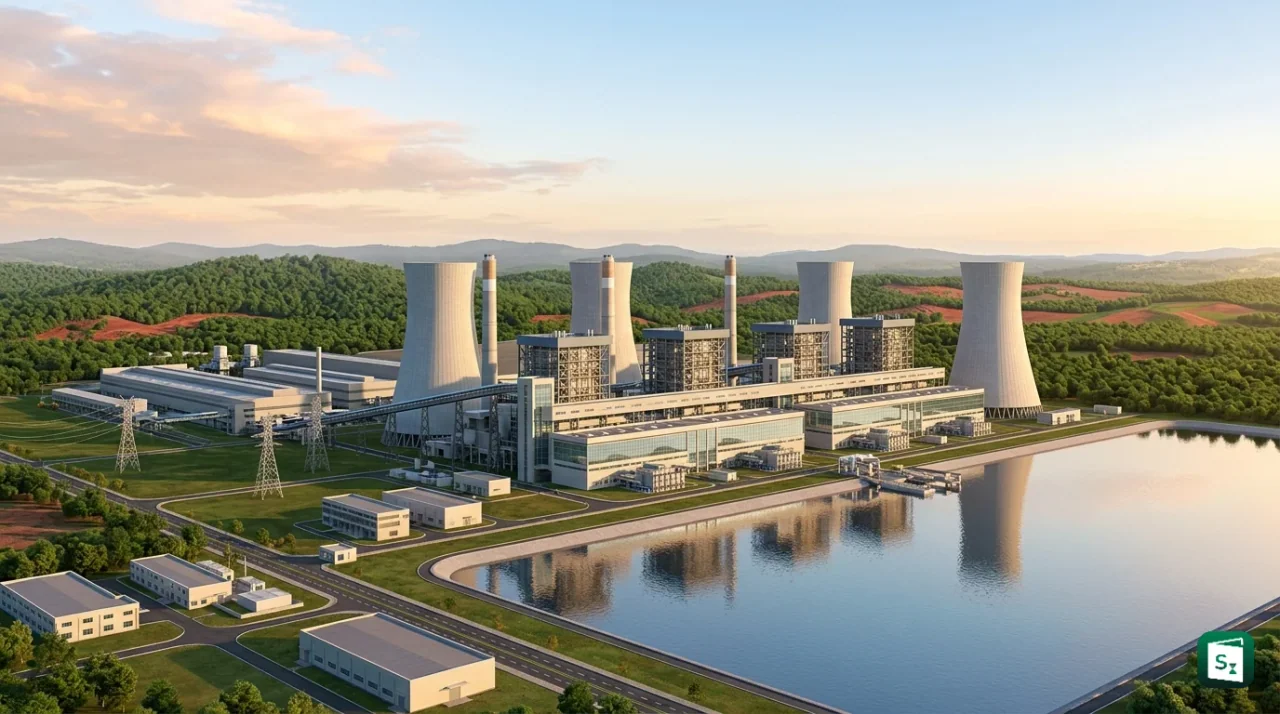
National Aluminium Company Limited (NALCO) and NLC India Limited (NLCIL) signed a Joint Venture-cum-Shareholders’ Agreement on July 8, 2026, to set up a 1,080 MW thermal captive power plant at Anugola in Angul district, Odisha. The agreement, executed in the presence of Union Minister of Coal and Mines G Kishan Reddy in New Delhi, creates a 50:50 joint venture company that will build the plant in four units of 270 MW each. This project is central to NALCO’s ambitious plan to expand its aluminium smelting capacity by 0.5 million tonnes per annum (MTPA) at the same location.
About NALCO and NLC India: The Two Navratna CPSEs
NALCO is a Navratna Central Public Sector Enterprise (CPSE) under the administrative control of the Ministry of Mines. It was incorporated on January 7, 1981, with its registered office in Bhubaneswar, Odisha. NALCO is one of India’s largest integrated aluminium producers, with operations spanning bauxite mining, alumina refining, aluminium smelting, and power generation. Its key assets include the Panchpatmali bauxite mines and the alumina refinery at Damanjodi in Koraput district, and the aluminium smelter and captive power plant at Angul. The company currently operates a 1,200 MW captive power plant alongside a 0.46 MTPA smelter at Angul. The Government of India holds a 51.28% equity stake in the company.
NLC India Limited (NLCIL), also a Navratna CPSE, functions under the Ministry of Coal. Originally incorporated as Neyveli Lignite Corporation on November 14, 1956, the company has over six decades of experience in lignite and coal mining as well as thermal and renewable power generation. Its headquarters is located in Neyveli, Tamil Nadu. NLCIL operates lignite mines with a total capacity of 30 MTPA at Neyveli and Barsingsar (Rajasthan), and coal mines including the Machhakata coal mine in Odisha, which is in close proximity to the proposed power plant site at Angul. The company also has a growing renewable energy portfolio, having crossed 1 GW of installed solar capacity, making it the first CPSE to achieve this milestone.
The Joint Venture Agreement: Key Terms
The agreement signed on July 8, 2026, establishes a Joint Venture Company (JVC) that will be equally owned by NALCO and NLCIL, with each holding 50% equity. The JVC will be incorporated under the Companies Act, 2013, with its registered office in Chennai and corporate office in Bhubaneswar.
The JVC will develop a 4x270 MW thermal captive power plant as a brownfield expansion within NALCO’s existing captive power plant premises at Anugola. This means the new plant will be built on land already under NALCO’s possession, leveraging existing infrastructure and reducing project costs and timelines. The plant will come up in a phased manner.
| Parameter | Detail |
|---|---|
| Total Capacity | 1,080 MW (4 units of 270 MW each) |
| JV Equity Structure | 50:50 (NALCO : NLC India) |
| Location | Anugola, Angul district, Odisha |
| Nature | Brownfield expansion within NALCO’s existing CPP premises |
| Power Offtake | 25-year Power Purchase Agreement (PPA) with NALCO for 100% offtake |
| Legal Framework | PPA under Section 62 of the Electricity Act, 2003 |
| Fuel Supply | Long-term Fuel Supply Agreement with NLCIL at Coal India notified prices |
| Renewable Energy | 200-250 MW of firm Renewable Energy (RE-RTC) to be explored |
| Registered Office | Chennai |
| Corporate Office | Bhubaneswar |
The commercial structure provides long-term certainty for all parties. NALCO gets assured power supply at predictable costs for its smelter expansion, while NLCIL secures a long-term coal off-take arrangement through its Machhakata coal mine. This follows a non-binding Memorandum of Understanding signed between the two companies on February 14, 2026, in Chennai, which laid the groundwork for collaboration in thermal and renewable energy projects.
Why Captive Power for Aluminium Smelting?
Aluminium smelting is among the most energy-intensive industrial processes in the world. Electricity accounts for roughly 35% to 40% of the total cost of producing aluminium. This makes access to reliable and affordable power the single most important factor determining the competitiveness of an aluminium producer.
A captive power plant (CPP) is a generating unit set up by an industrial user primarily for its own consumption. Under Section 2(8) of the Electricity Act, 2003, a captive generating plant is defined as a power plant set up by any person to generate electricity primarily for his own use. Captive users must hold at least 26% of the equity and consume at least 51% of the electricity generated annually.
For NALCO, having its own captive power is not a matter of choice but a structural necessity. The company’s existing 1,200 MW captive plant currently powers its 0.46 MTPA smelter at Angul. However, the planned expansion of 0.5 MTPA will require an additional 800 MW of assured power supply. The new 1,080 MW plant is sized to meet this requirement while also providing some operating flexibility.
Building the plant as a brownfield project within existing premises brings several advantages. It reduces land acquisition hurdles, allows sharing of common facilities such as coal handling and water systems, shortens construction timelines, and lowers overall project costs. The phased development approach also allows NALCO to match power availability with the progressive commissioning of the smelter expansion.
The Bigger Picture: NALCO’s Expansion Strategy
The joint venture is part of a much larger growth plan that NALCO has set in motion. The company has finalised a ₹30,000 crore capital expenditure plan, its biggest in recent decades, to be executed by FY2030. Of this, ₹17,000-18,000 crore is allocated for a new 0.5 MTPA aluminium smelter at Angul with commissioning targeted by 2030-31. Another ₹12,000 crore is for the captive power plant now structured through the JV with NLCIL. The company is also expanding its alumina refinery’s fifth stream to raise capacity to 3.1 MTPA by June 2026, entering downstream products such as aluminium foil and wire rods, and exploring critical minerals through Khanij Bidesh India Ltd (KABIL), a joint venture with Hindustan Copper and MECL.
The company, which is debt-free as of now, plans to fund this expansion through a mix of debt and internal accruals, targeting a debt-equity ratio of 70:30. NALCO has on-boarded Rio Tinto Canada as a technology partner for the smelter project, and Engineers India Ltd (EIL) has been engaged to prepare the project framework.
This expansion is driven by India’s growing aluminium demand, which is projected to rise from the current 6.2 MTPA to about 8 MTPA by 2030. The country’s per capita aluminium consumption of around 2.5 kg is still far below the global average of 11 kg, indicating substantial room for growth, especially from sectors such as electric vehicles, construction, power transmission, and aerospace.
Key Takeaways
- NALCO and NLC India Limited (NLCIL) signed a 50:50 Joint Venture-cum-Shareholders’ Agreement on July 8, 2026, to develop a 1,080 MW (4x270 MW) thermal captive power plant at Anugola, Angul, Odisha.
- The agreement was executed in the presence of Union Minister of Coal and Mines G Kishan Reddy in New Delhi.
- The plant will supply captive power to NALCO’s 0.5 MTPA aluminium smelter expansion at Angul, which is expected to be commissioned by 2030-31.
- NALCO is a Navratna CPSE under the Ministry of Mines, established on January 7, 1981, with headquarters in Bhubaneswar.
- NLC India Ltd is a Navratna CPSE under the Ministry of Coal, incorporated on November 14, 1956, with headquarters in Neyveli, Tamil Nadu.
- The JVC will enter a 25-year Power Purchase Agreement with NALCO for 100% offtake under Section 62 of the Electricity Act, 2003, and a long-term Fuel Supply Agreement with NLCIL.
- The new plant will be a brownfield expansion within NALCO’s existing captive power plant premises, with the JVC also exploring 200-250 MW of firm renewable energy.
- This JV is part of NALCO’s larger ₹30,000 crore expansion plan, its biggest capital expenditure in recent decades.