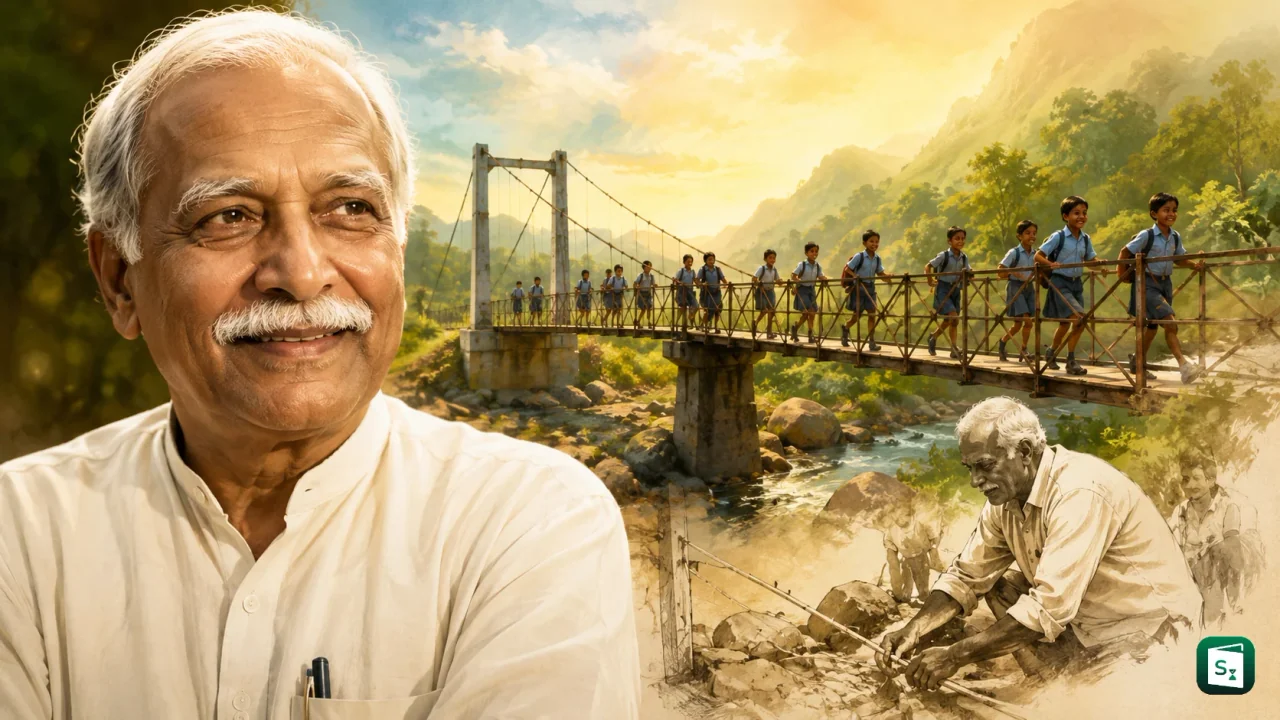
Padma Shri awardee Girish Bharadwaj, popularly known as the Bridge Man of India, passed away on 7 July 2026 at a private hospital in Sullia, Karnataka, following a cardiac illness. He was 76. A mechanical engineer by training, Bharadwaj built over 140 low-cost suspension footbridges across Karnataka, Kerala, Telangana, Andhra Pradesh and Odisha over three decades, transforming rural connectivity for thousands of people in remote villages.
Who Was Girish Bharadwaj?
Born on 2 May 1950 in Aletty, a remote village in Sullia taluk of Dakshina Kannada district, Karnataka, Girish Bharadwaj grew up in a farming family. His father, Balekkala Krishna Bhat, was an engineer who had served in the Central Public Works Department (CPWD). After four years of home schooling, Bharadwaj was given lateral entry into Class 5. He went on to earn a mechanical engineering degree in 1973 from P.E.S. College of Engineering in Mandya.
After graduating, Bharadwaj initially struggled to find a job in a city. At his father’s insistence, he returned to his village and set up Rational Engineering Works in Sullia in 1975, a small fabrication workshop that repaired farm machinery and undertook general steel work. He named his firm Ayas Shilpa, Sanskrit for “structures of steel.” For over a decade, he ran this workshop, building a reputation as a skilled fabricator in the region.
The Journey from Mechanic to Bridge Builder
The First Bridge Across Payaswini
The turning point in Bharadwaj’s life came in 1989. Residents of Aramburu village in Sullia, his native village, had long depended on a country boat to cross the Payaswini River. Whenever the boat developed a hole, the entire village would be cut off from the mainland. Fed up with this recurring problem, the villagers approached Bharadwaj and asked him to build a footbridge.
Despite having no experience in bridge design or construction, Bharadwaj agreed after repeated pleas. He studied suspension bridge technology from books and consulted professors from the Regional Engineering College, Suratkal (now NITK). Using simple technology and active community participation, he completed an 87-metre long hanging footbridge in three months at a cost of less than ₹2 lakh. The villagers contributed through shramdaan (voluntary labour) and pooled funds. The bridge opened to emotional scenes with residents walking across it for hours in celebration.
The success of the Aramburu bridge caught the attention of Karnataka government officials. From 1993, Bharadwaj began receiving government contracts to build similar suspension bridges across remote parts of Karnataka, Kerala, Andhra Pradesh, Telangana and Odisha. He eventually built over 140 bridges in three decades, with the highest concentration in Karnataka (over 95 bridges) and Kerala (over 30 bridges).
The Engineering Behind the Bridges
Bharadwaj’s bridges were remarkable for their simplicity and cost-effectiveness. He adapted the technology of world-famous suspension bridges such as San Francisco’s Golden Gate Bridge and Japan’s Akashi Kaikyo to suit local conditions. His suspension footbridges cost roughly one-tenth of conventional concrete bridges and could be completed in three to six months, compared to years for standard government designs.
The typical design used reinforced concrete pylons on both banks, multi-strand industrial steel ropes as suspension cables, steel verticals, and a wooden plank deck. Many bridges also had ducts for power and telephone lines, bringing communication infrastructure to remote areas. Some bridges were designed with lightweight construction by using sturdy trees as pylons instead of concrete, further cutting costs.
Bharadwaj’s bridges typically had a lifespan of 10 to 20 years, but many stood in good condition well beyond their estimated life. Over the years, he incorporated improvements in load-carrying capacity, safety, and provision for two-wheeler movement. His longest bridge, spanning 220 metres, was built across the Ghataprabha River near Belgaum.
He faced several non-engineering challenges along the way. While executing projects in Odisha, he faced threats from Naxalites. When community-funded projects ran short of money, he often waived his professional fees and spent his own money to ensure completion. He personally supervised every project, staying at construction sites until the bridge was finished.
Recognition and Legacy
The Government of India conferred the Padma Shri, the country’s fourth-highest civilian award, on Girish Bharadwaj in 2017 for his contribution to social work and rural connectivity. Prime Minister Narendra Modi acknowledged his Sethu Bandhu initiative in a personal letter, describing his work as an inspiring example of engineering in the service of society.
Bharadwaj also received an honorary doctorate from the University of Mysuru. Grateful villagers across Karnataka called him “Sullia’s Visvesvaraya”, comparing him to the legendary engineer and statesman Sir M. Visvesvaraya. A biopic titled Sethu Bandhu on his life’s work was announced by filmmaker Santhosh Kodenkeri.
Former President APJ Abdul Kalam had inspired Bharadwaj with his vision that physical connectivity between places paves the way for development. Bharadwaj often said that the happiness in the eyes of villagers after a bridge opened was his greatest motivation.
His son Pathanjali Bharadwaj, an M.Tech graduate in civil engineering, has been carrying forward his father’s bridge-building legacy. The Karnataka government, mourning his death, announced a state funeral for the pioneering engineer.
At the time of his death, Bharadwaj was survived by two sons and a daughter. His wife Usha had predeceased him.
Key Takeaways
- Girish Bharadwaj (2 May 1950 - 7 July 2026), known as the Bridge Man of India, was a Padma Shri awardee (2017) who built over 140 low-cost suspension footbridges across rural India.
- His first bridge was constructed in 1989 across the Payaswini River at Aramburu in Sullia, Karnataka, at a cost of less than ₹2 lakh.
- He adapted technology from San Francisco’s Golden Gate Bridge and Japan’s Akashi Kaikyo to create affordable suspension bridges costing roughly one-tenth of conventional concrete bridges.
- His longest bridge, spanning 220 metres, was built across the Ghataprabha River near Belgaum.
- He was awarded an honorary doctorate by the University of Mysuru and was called “Sullia’s Visvesvaraya” by local villagers.
- His son Pathanjali Bharadwaj continues his bridge-building legacy. The Karnataka government announced a state funeral in his honour.