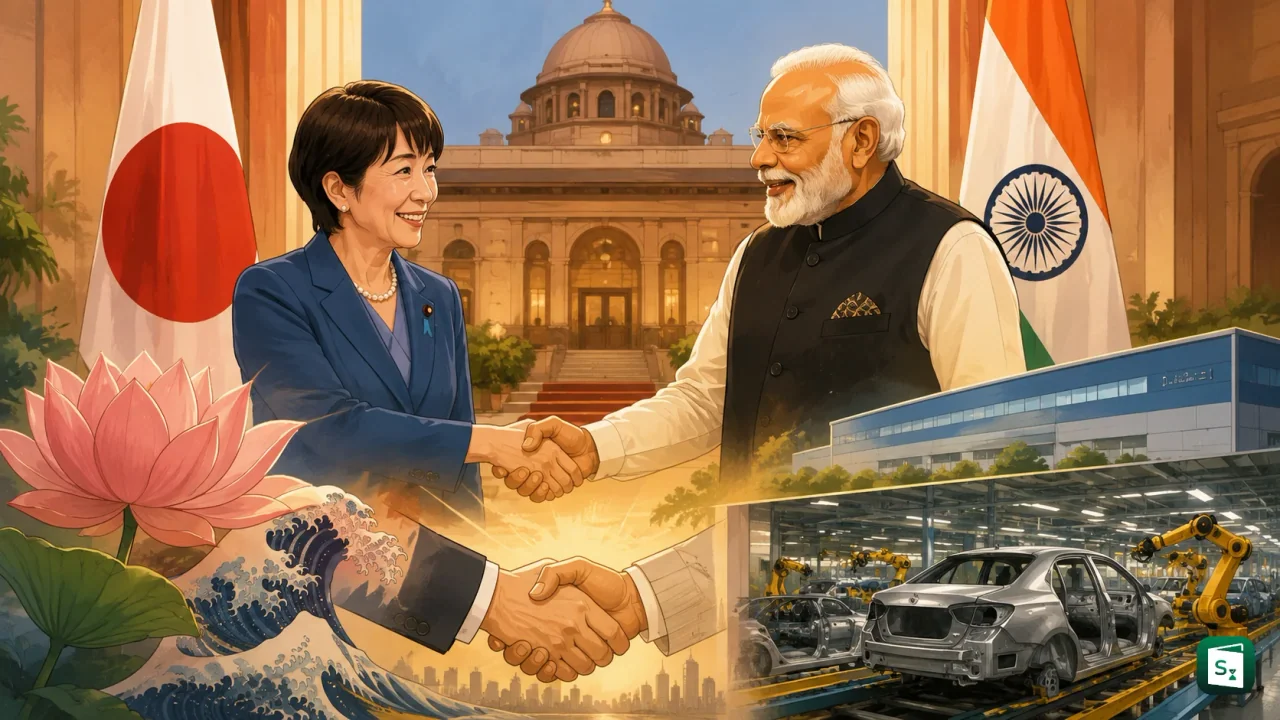
Japanese Prime Minister Sanae Takaichi, the first woman to hold the office in Japan’s history, arrived in New Delhi for a three-day official visit to attend the 16th India-Japan Annual Summit with Prime Minister Narendra Modi. The two leaders held talks at Hyderabad House and announced 16 key outcomes spanning artificial intelligence, economic security, defence co-development, energy resilience and next-generation mobility. The summit also featured the Japan-India Joint Economic Forum, where the fourth vehicle manufacturing facility of Maruti Suzuki in Kharkhoda, Haryana, was inaugurated.
The 16th India-Japan Annual Summit: A Broadening Partnership
The relationship between the two countries stands on the foundation of the Special Strategic and Global Partnership, which was established in 2014 during Prime Minister Modi’s first visit to Japan. The partnership was upgraded from the earlier Strategic and Global Partnership (2006) and the Global Partnership (2000). India and Japan have held annual summits regularly since 2006, making Japan one of only two countries (alongside Russia) with which India conducts such a leader-level dialogue every year.
Takaichi, who hails from Nara Prefecture in Japan, was warmly welcomed by PM Modi. He referred to her as his “younger sister” and noted the deep Buddhist linkages between Nara and India. Modi also acknowledged that India and Japan are the two largest democracies in Asia, sharing a vision of a free, open and rules-based Indo-Pacific.
The summit came in the backdrop of the 15th Annual Summit held in Tokyo in August 2025, where a target of ¥10 trillion (approximately $67 billion) in Japanese private investment in India over the next decade was set. The 16th summit reviewed progress on this goal and noted that more than ¥2 trillion in investment commitments had already been made since then. The Indian delegation included External Affairs Minister S Jaishankar, National Security Advisor Ajit Doval, and Foreign Secretary Vikram Misri.
The 16 Outcomes: Three Key Joint Statements
The 16 outcomes consisted of one joint declaration, two joint statements, six Memoranda of Cooperation (MoCs), five MoUs, one exchange of letters, and a plan to celebrate the 75th anniversary of diplomatic relations in 2027.
The three most significant policy documents issued at the summit were the India-Japan Joint Declaration on Economic Security, the Joint Statement on Cooperation in Artificial Intelligence, and the Joint Statement on Energy Resilience.
Joint Declaration on Economic Security
The Joint Declaration on Economic Security identified economic security as a foundational pillar of the bilateral partnership. It promotes project-based collaboration across five priority sectors: semiconductors, critical minerals, information and communication technology (ICT) including AI, clean energy, and pharmaceuticals.
Both countries expressed shared concern over economic coercion, arbitrary export restrictions, and non-market practices that disrupt global supply chains. In semiconductors, both sides agreed to diversify supply chains and encourage greater participation of Japanese companies in India’s Semiconductor Mission 2.0. On critical minerals, the Geological Survey of India and Japan’s JOGMEC (Japan Organization for Metals and Energy Security) will deepen technical cooperation. The agreement also includes developing an ecosystem for e-waste recycling to recover critical minerals. A Track 1.5 Economic Security Dialogue involving governments, industry, and experts will be established to monitor progress.
Joint Statement on Artificial Intelligence
For the first time, India and Japan elevated AI cooperation into a strategic research and development partnership. The joint statement covers the entire AI technology stack: secure digital infrastructure, semiconductors, GPUs, computing resources, multilingual and open-source AI models, AI governance, and cybersecurity.
Key institutional agreements include a collaboration between IIT Bombay’s BharatGen Technology Foundation and Japan’s National Institute of Informatics (NII) on multilingual scientific large language models, and an MoU between Sarvam AI and Japan’s Preferred Networks on foundational AI models. The IndiaAI Mission signed an MoU with Japan’s Ministry of Economy, Trade and Industry (METI) to promote business matchmaking and shared computing resources.
Both countries reaffirmed the goal of bringing 500 highly skilled Indian AI professionals to Japan by 2030, expanding joint research, internships, and industry partnerships.
Joint Statement on Energy Resilience
The Joint Statement on Energy Resilience, signed between India’s Ministry of Petroleum and Natural Gas and Japan’s METI, aims to strengthen cooperation on strategic petroleum reserves, crude oil stockpiling, and maritime energy transport. Both sides agreed to share best practices on stockpiling systems and emergency response mechanisms. Japan also reaffirmed its support for India’s membership in the International Energy Agency (IEA), where India currently holds only Association country status.
Defence Co-Development: The UNICORN Project
One of the most significant outcomes of the summit was the launch of the first defence co-development project between India and Japan: the UNICORN (Unified Complex Radio Antenna) mast for Indian Navy warships.
The UNICORN mast is an integrated stealth mast that consolidates multiple exposed antennas and electronic warfare arrays into a single Fibre-Reinforced Plastic (FRP) radome. This drastically reduces the warship’s Radar Cross-Section (RCS), making it significantly harder for enemy radar to detect. The technology is already deployed on Japan’s advanced Mogami-class frigates.
Under the agreement, the design and core technology will come from Japanese firms including NEC Corporation, Sampa Kogyo K.K., and The Yokohama Rubber Co., Ltd., while Bharat Electronics Limited (BEL), a defence public-sector undertaking, will manufacture and integrate the system in India under the Make in India framework. This is based on a Memorandum of Implementation signed on November 15, 2024, between India’s Ambassador to Japan and Japan’s Acquisition, Technology and Logistics Agency (ATLA), operating under the India-Japan Defence Equipment and Technology Transfer Agreement of 2015.
The project marks Japan’s first transfer of advanced defence equipment to India and represents a significant shift from Japan’s historic post-war ban on arms exports. The review of Japan’s Three Principles on Transfer of Defence Equipment and Technology (adopted in 2014) has enabled this co-development.
Maruti Suzuki’s Fourth Plant: A Symbol of Manufacturing Ties
At the Japan-India Joint Economic Forum hosted by JETRO (Japan External Trade Organisation), PM Modi and PM Takaichi virtually inaugurated Maruti Suzuki’s fourth vehicle manufacturing facility in Kharkhoda, Haryana. JETRO, established in 1958, is a Japanese government-related organization that promotes trade and investment between Japan and the world.
The 800-acre Kharkhoda plant currently has an installed annual capacity of 500,000 vehicles, with plans to scale up to 1 million units in phases, making it one of the largest car manufacturing plants in the world. The project involves a total investment of ₹35,000 crore and is expected to generate over 21,000 direct and indirect jobs.
Maruti Suzuki’s production has already started at the facility. The first production line of 250,000 units was commissioned in February 2025, and a second line of similar capacity became operational earlier in 2026. The plant is designed as a zero liquid discharge facility, with nearly two-thirds of its water requirements met through recycled water and rainwater harvesting. An in-plant railway siding will be developed to reduce road transportation and fuel consumption.
With this plant, Maruti Suzuki now operates manufacturing facilities in Gurugram, Manesar, Kharkhoda (all in Haryana) and Hansalpur (Gujarat). The company’s total annual production capacity is currently 2.65 million units, expected to reach 2.9 million units during FY2026-27.
The forum also saw the announcement of around 120 cooperation documents between Indian and Japanese companies, involving ¥2 trillion in new investments. More than 150 Japanese companies participated in the forum.
The Way Forward: Strengthening Strategic Convergence
Several institutional mechanisms will deepen bilateral cooperation going forward. The next India-Japan 2+2 Ministerial Meeting (involving foreign and defence ministers of both countries) will be held in Tokyo by the end of 2026. Both countries will celebrate 2027 as the India-Japan Year of Shared Horizons, marking 75 years of diplomatic relations with cultural festivals, youth exchanges, business roadshows, and science and technology collaborations.
On the Mumbai-Ahmedabad High-Speed Rail project, Japan’s flagship engagement in India, both leaders reviewed progress. India aims to start commercial operations on priority sections in 2027 using Japan’s advanced E10 series Shinkansen (bullet train) technology. The two countries also committed to exploring future high-speed rail corridors as part of India’s vision of a 7,000 km national high-speed rail network.
The Next Generation Mobility Partnership (NGMP) framework will drive cooperation in railways, automobiles, aviation, shipbuilding, ports, and logistics, positioning India as a Make in India for the World export hub.
Both countries reaffirmed their shared vision of a Free and Open Indo-Pacific (FOIP) under the Quad framework, with India’s MAHASAGAR vision aligning with Japan’s FOIP strategy. They condemned cross-border terrorism and expressed grave concern over the situation in the East and South China Seas, calling for peaceful resolution of disputes in accordance with UNCLOS (United Nations Convention on the Law of the Sea).
Key Takeaways
- The 16th India-Japan Annual Summit was held in New Delhi on July 2, 2026, with PM Modi and Japan’s PM Sanae Takaichi, who is Japan’s first female Prime Minister.
- The two countries announced 16 key outcomes, including the Joint Declaration on Economic Security, the Joint Statement on AI, and the Joint Statement on Energy Resilience.
- The UNICORN (Unified Complex Radio Antenna) project marks the first defence co-development project between India and Japan, involving BEL and Japan’s NEC Corporation.
- Maruti Suzuki’s fourth vehicle manufacturing facility at Kharkhoda, Haryana (800 acres, ₹35,000 crore investment) was inaugurated, with an eventual capacity of 1 million vehicles per year.
- The India-Japan Special Strategic and Global Partnership was established in 2014 and annual summits have been held since 2006.
- A target of ¥10 trillion (approximately $67 billion) in Japanese private investment in India over the next decade was reaffirmed.
- The Japan External Trade Organisation (JETRO), established in 1958, hosted the Japan-India Joint Economic Forum alongside the summit.