Uttarakhand has been declared India’s sixth fully literate state after its literacy rate crossed 98%, meeting the adult literacy benchmarks prescribed under the National Education Policy (NEP) 2020 and the ULLAS (Understanding Lifelong Learning for All in Society) programme. Governor Lieutenant General (Retd.) Gurmeet Singh approved the proposal on July 9, 2026, following the state cabinet’s earlier clearance on June 19. The achievement places Uttarakhand among a select group of five other states Mizoram, Goa, Tripura, Himachal Pradesh, and Sikkim that have attained this status.
What Does ‘Fully Literate State’ Mean?
Under the ULLAS framework, a state is considered fully literate when at least 95% of its eligible population aged 15 years and above can read, write, and perform basic arithmetic. The benchmark deliberately stops short of 100% because practical constraints such as advanced age, severe health conditions, and intellectual disabilities make universal literacy unattainable for any society.
The assessment for full literacy is conducted through the Foundational Literacy and Numeracy Assessment Test (FLNAT), administered by the National Institute of Open Schooling (NIOS) . This test evaluates whether learners have acquired functional literacy skills equivalent to the Class 3 level in reading, writing, and numeracy. States must also demonstrate sustained efforts to educate previously non-literate individuals through structured adult education campaigns and community outreach.
The ULLAS Programme: Framework for Full Literacy
The ULLAS (Understanding Lifelong Learning for All in Society) programme, also called the Nav Bharat Saaksharta Karyakram (New India Literacy Programme or NILP) , is a centrally sponsored scheme launched by the Ministry of Education in 2022 for implementation from 2022-23 to 2026-27. It replaces the earlier adult education framework and aligns with the recommendations of the National Education Policy (NEP) 2020.
The programme targets all non-literate individuals aged 15 years and above who missed formal schooling. Unlike previous literacy missions that focused purely on basic reading and writing, ULLAS adopts a broader approach with five key components:
| Component | Focus Area |
|---|---|
| Foundational Literacy and Numeracy | Basic reading, writing, and arithmetic skills |
| Critical Life Skills | Health, hygiene, nutrition, environment, and gender equality |
| Basic Education | Equivalency programmes for Class 3, 5, and 8 levels |
| Vocational Skills | Skill training for improved livelihood opportunities |
| Continuing Education | Libraries, reading rooms, and lifelong learning avenues |
The scheme promotes a volunteer-based model rooted in the principle of Kartavya Bodh (sense of duty). Volunteers include students from schools, higher education institutions, and teacher training colleges who teach through Samajik Chetna Kendras established in schools, community halls, and other public spaces. Digital content is available in 26 Indian languages through the DIKSHA portal and the ULLAS mobile app. The scheme has a total outlay of ₹1,037.90 crore.
Uttarakhand’s Journey to Full Literacy
Uttarakhand’s literacy journey is one of the most dramatic turnarounds among Indian states. At the time of its formation in 2000, the state had a literacy rate of just 71.6% as per the 2001 Census. By the 2011 Census, this had improved to 78.82%, still above the national average of 74.04% but far from the full literacy threshold.
Remarkable Literacy Leap in Two Years
What makes Uttarakhand’s achievement remarkable is the speed of improvement in recent years. According to state government data, the literacy rate surged from 83.8% in 2023-24 to 98.7% in 2025, a jump of nearly 14.9 percentage points in just two years. This is one of the fastest literacy improvements recorded by any Indian state.
The ULLAS assessment for 2025 estimated Uttarakhand’s eligible population (excluding children below 7 years) at approximately 1.23 crore. Of this, only 1.31 lakh individuals, or just 1.3% of the eligible population, remain in the non-literate category. The state’s effective literacy rate now stands at 98.7%, comfortably exceeding the 95% benchmark.
Targeted Outreach in Challenging Terrain
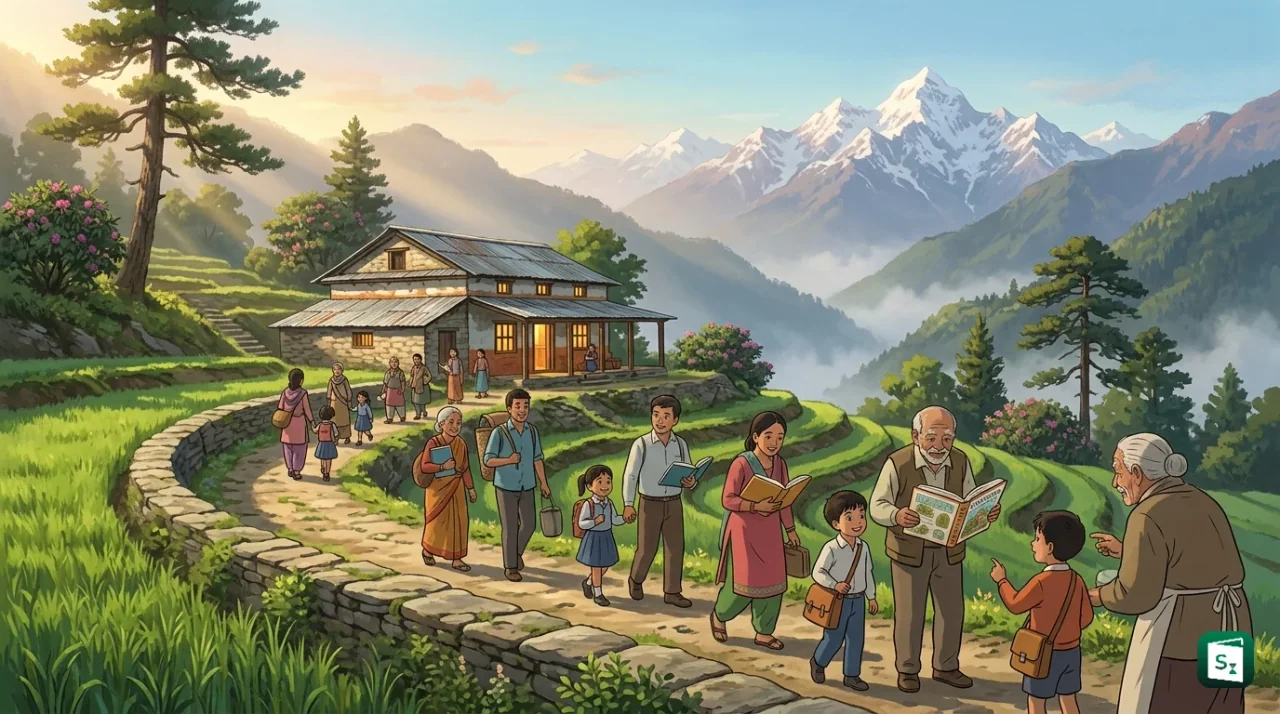
Uttarakhand’s geography posed a significant challenge to literacy efforts. The state’s mountainous terrain, scattered hamlets, and remote high-altitude villages made it difficult to reach every citizen through conventional schooling. The education department adopted a multi-pronged strategy that included door-to-door surveys to identify non-literate individuals, establishment of adult literacy centres, and deployment of volunteer teachers to remote locations.
Education Minister Dhan Singh Rawat credited the success to the coordinated efforts of the education department, local bodies, voluntary organisations, and citizens. Special attention was given to women and girls, communities in remote hill districts, and marginalised groups that traditionally faced barriers to education. Schools served as the primary implementation units for the ULLAS programme, with volunteer teachers drawn from local communities conducting literacy classes.
The formal proposal for declaring the state fully literate was submitted by the Directorate of Secondary Education on May 25, 2026, following which the state cabinet, chaired by Chief Minister Pushkar Singh Dhami, approved it on June 19, 2026. Governor Gurmeet Singh gave the final approval on July 9, 2026, officially certifying Uttarakhand as a fully literate state.
The Six Fully Literate States of India
With Uttarakhand’s inclusion, India now has six fully literate states and one fully literate union territory under the ULLAS framework. The achievement chronology is as follows:
| Order | State/UT | Year Declared | Key Highlight |
|---|---|---|---|
| 1st State | Mizoram | 2025 | First state in India to achieve full literacy under ULLAS; literacy rate of 98.2% |
| 2nd State | Goa | 2025 | Second state to achieve the milestone |
| 3rd State | Tripura | 2025 | Third state; literacy rate of 95.6% |
| 4th State | Himachal Pradesh | September 2025 | Literacy rate of 99.3%; declared on International Literacy Day |
| 5th State | Sikkim | May 2026 | First in the northeast to achieve this after Mizoram and Tripura |
| 6th State | Uttarakhand | July 2026 | Fastest literacy leap: 14.9 percentage point rise in two years |
| 1st UT | Ladakh | June 2024 | First and only union territory to achieve full literacy |
Notably, Mizoram was the first state in the country to be declared fully literate under the ULLAS framework, while Ladakh holds the distinction of being the first union territory to achieve this recognition in June 2024.
Significance and the Way Forward
Uttarakhand’s achievement is significant for several reasons. It demonstrates that even states with challenging mountainous terrain and scattered rural populations can achieve rapid literacy gains through focused policy interventions and community participation. The jump from 71.6% at statehood to 98.7% in just over two and a half decades is among the fastest literacy transformations in India.
Chief Minister Pushkar Singh Dhami described the achievement as a milestone that brings the state closer to the national vision of a Viksit Bharat (Developed India) by 2047. He announced that the government would now focus on digital literacy, financial literacy, continuing education, and life skills to ensure that every citizen can participate in the modern economy.
The emphasis will shift from literacy attainment to literacy sustainability. This means strengthening libraries, skill development centres, and online learning platforms to prevent relapse into illiteracy and to equip citizens with skills relevant to employment and entrepreneurship. For Uttarakhand, where tourism and horticulture are major economic drivers, linking literacy with vocational training in these sectors could unlock significant economic potential.
Key Takeaways
- Uttarakhand became India’s sixth fully literate state with a literacy rate of over 98%, approved by Governor Gurmeet Singh on July 9, 2026.
- The achievement was met under the ULLAS (Understanding Lifelong Learning for All in Society) programme, which considers states with at least 95% literacy among those aged 15 years and above as fully literate.
- Uttarakhand’s literacy rate jumped from 83.8% in 2023-24 to 98.7% in 2025, a 14.9 percentage point rise in just two years, one of the fastest literacy improvements in India.
- The five other fully literate states are Mizoram, Goa, Tripura, Himachal Pradesh, and Sikkim. Ladakh is the only fully literate Union Territory under the ULLAS framework.
- The ULLAS programme is a centrally sponsored scheme implemented from 2022-23 to 2026-27 with a total outlay of ₹1,037.90 crore, aligned with NEP 2020, and covering five components: foundational literacy, critical life skills, basic education, vocational skills, and continuing education.
- The assessment for full literacy is conducted through the Foundational Literacy and Numeracy Assessment Test (FLNAT) administered by the National Institute of Open Schooling (NIOS) .