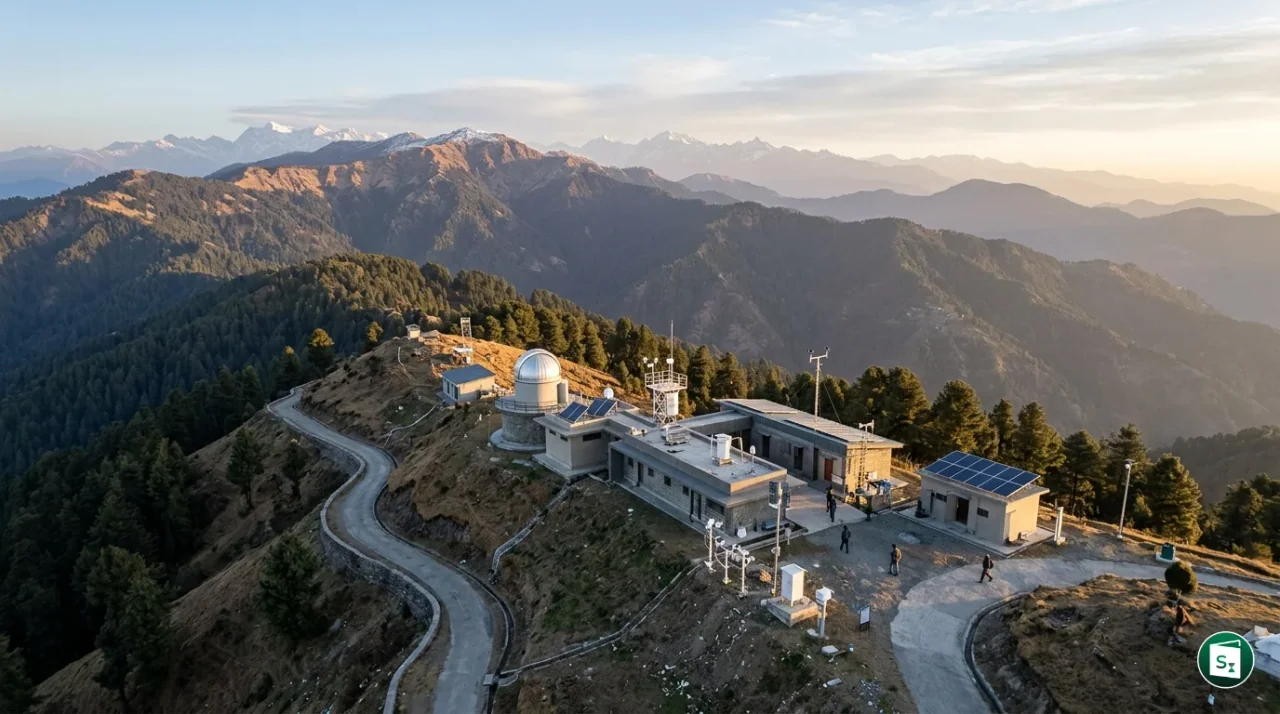
The Indian Institute of Tropical Meteorology Pune and the Aryabhatta Research Institute of Observational Sciences Nainital signed a Memorandum of Understanding on June 18, 2026, to conduct joint research on climate change. Under this agreement, the partner institutions will establish a state-of-the-art climate observation station at Devasthal in Uttarakhand. The new facility will function as a key node of the national Bharat Climate Observation Network to provide long-term monitoring of critical atmospheric variables.
Collaboration for Climate Research at Devasthal
The collaborative research initiative is centered on the establishment of a long-term climate monitoring facility at Devasthal in the Nainital district of Uttarakhand. Situated at an altitude of approximately 2,450 metres, the Devasthal site offers a pristine atmospheric environment that is relatively free from local human activities and industrial pollution. This unique high-altitude setting makes it highly suitable for capturing background atmospheric signatures and establishing a baseline for regional climate studies.
The observation station will focus on monitoring critical environmental parameters, including greenhouse gases, aerosols, and key atmospheric trace gases. By studying the movement and concentrations of these climate-relevant pollutants, scientists aim to understand the atmospheric dynamics and climate processes that affect the Himalayan mountain range. The Memorandum of Understanding was signed by Dr. A. Suryachandra Rao, Director of the Indian Institute of Tropical Meteorology, and Dr. Manish Kumar Naja, Director of the Aryabhatta Research Institute of Observational Sciences.
Role of the Collaborating Institutions
The climate project combines the specialized expertise of two of India’s leading scientific research bodies. Each institution brings distinct capabilities to the partnership, leveraging their historic backgrounds and research infrastructures.
Indian Institute of Tropical Meteorology (IITM) Pune
The Indian Institute of Tropical Meteorology (IITM) serves as a premier center for research in atmospheric sciences and tropical meteorology. Established in 1962 as the Institute of Tropical Meteorology, it became an autonomous body in 1971 and was placed under the newly formed Ministry of Earth Sciences in 2006. Headquartered in Pune, Maharashtra, the institute is dedicated to expanding the understanding of the monsoons, ocean-atmosphere interactions, and global climate dynamics.
Aryabhatta Research Institute of Observational Sciences (ARIES) Nainital
The Aryabhatta Research Institute of Observational Sciences (ARIES) is an autonomous research organization specializing in astronomy, astrophysics, and atmospheric sciences. Founded in 1954 as the State Observatory in Uttar Pradesh, it was relocated to Manora Peak in Nainital in 1961 and reorganized under the federal Department of Science and Technology in 2004. Its Devasthal campus is a globally recognized astronomical site, hosting prominent instruments such as the 3.6-metre Devasthal Optical Telescope and the 4-metre International Liquid Mirror Telescope, which benefit from the region’s clear skies and low light pollution.
Understanding the Bharat Climate Observation Network (BCON)
The Bharat Climate Observation Network (BCON) is a national-level climate monitoring network designed to establish high-precision climate reference stations across different geographic and climatic zones in India. Conceptualized and implemented by the Indian Institute of Tropical Meteorology, the network aims to gather long-term, high-quality data to address gaps in the country’s atmospheric monitoring infrastructure. BCON stations monitor essential variables, including short-lived climate forcers, greenhouse gases, and local meteorological patterns.
The Devasthal station marks the second major site under the BCON expansion plan, following a series of institutional agreements:
| Station Location / Partner Institution | Agreement Date | Focus Area |
|---|---|---|
| Bikaner Technical University, Rajasthan | February 2026 | Arid and semi-arid desert environment monitoring |
| Central University of Jammu, Jammu | May 2026 | Himalayan high-altitude atmospheric research |
| ARIES Devasthal, Uttarakhand | June 2026 | Baseline atmospheric tracking and Himalayan climate dynamics |
Synergy with Mission Mausam and Earth System Models
The network operates as a key component of Mission Mausam, a national programme launched by the Union Cabinet in September 2024 with a budget of ₹2,000 crore to modernize weather and climate forecasting. In the Union Budget presented in February 2026, the government allocated ₹1,342 crore specifically for Mission Mausam to upgrade observation systems and computing capabilities.
The data gathered from the Devasthal station will be vital for verifying and refining the IITM Earth System Model (IITM-ESM). Developed as India’s first indigenous climate model, the system is used to simulate future climate trends and monsoon behavior. High-altitude observations from the pristine Devasthal site will help scientists validate these simulations, leading to more accurate projections of climate change impacts across the subcontinent.
Key Takeaways
- The Indian Institute of Tropical Meteorology (IITM) Pune signed an MoU with the Aryabhatta Research Institute of Observational Sciences (ARIES) Nainital on June 18, 2026, to establish a new Climate Observation Station.
- Located at Devasthal in Nainital district of Uttarakhand, the station will operate at an altitude of approximately 2,450 metres to observe baseline atmospheric features.
- The station functions under the Bharat Climate Observation Network (BCON), a national climate monitoring network managed by IITM Pune under the Ministry of Earth Sciences.
- BCON is a core project of Mission Mausam, a national weather and climate modernization programme launched in September 2024 with a budget of ₹2,000 crore.
- High-altitude observations from Devasthal will be used to calibrate and improve the IITM Earth System Model (IITM-ESM), which is India’s first indigenous climate model.
- IITM Pune was established in 1962 and is headquartered in Pune, while ARIES was reorganized in 2004 as an autonomous institute under the federal Department of Science and Technology.