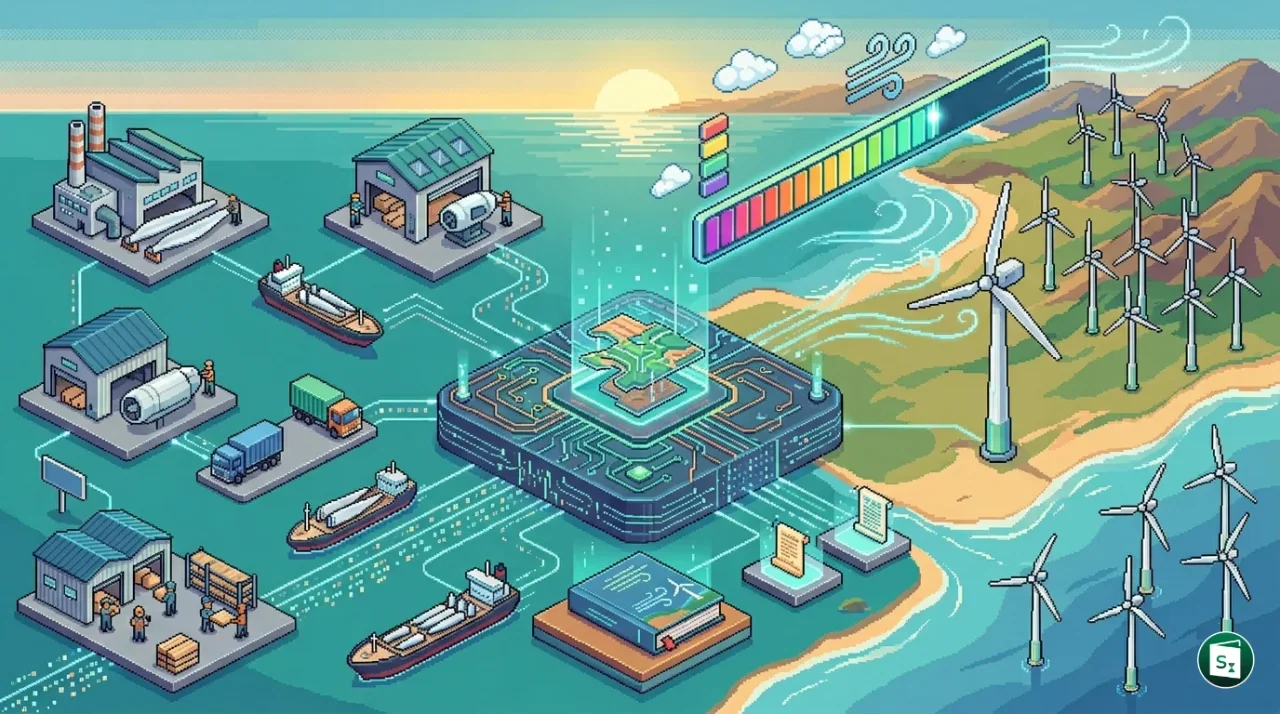
Union Minister for New and Renewable Energy Pralhad Joshi launched the WT-MARUT portal on 15 June 2026 at the Global Wind Day Conference in Goa, marking India’s first dedicated digital platform for wind turbine supply chain management. Developed by the Ministry of New and Renewable Energy with support from the Indian Wind Turbine Manufacturers Association, the portal aims to bring transparency to component sourcing and strengthen domestic manufacturing. The launch comes at a pivotal moment when India added a record 6.1 GW of wind capacity in FY26 and is racing towards a 100 GW target by 2030.
What Is the WT-MARUT Portal?
WT-MARUT stands for Wind Turbine Materials and Resources Utility Tracker. It is a digital platform designed to bring end-to-end visibility to the wind energy supply chain, from component sourcing to final assembly. The portal has been developed under the Ministry of New and Renewable Energy (MNRE), the nodal ministry responsible for India’s renewable energy policies and programmes, with technical support from the Indian Wind Turbine Manufacturers Association (IWTMA).
IWTMA, established in 1998, is the apex industry body representing wind turbine manufacturers in India. It has played a central role in policy advocacy and regulatory engagement for the wind sector over the past two and a half decades. The association’s involvement in building the portal ensures that the platform addresses real-world industry requirements around supplier discovery, quality compliance, and data security.
The portal’s name draws from the Sanskrit word “Marut”, which means wind or storm, reflecting its purpose as a force that drives the wind energy ecosystem forward.
India’s Wind Energy Push: A Record Year
India added 6.1 GW of new wind power capacity in FY 2025-26, the highest annual installation ever recorded by the country. This represents a 46% jump over the previous year and signals a sharp acceleration in wind deployment after years of relatively modest growth.
With this addition, India’s total installed wind energy capacity has crossed 56.1 GW, making it the fourth-largest wind energy market in the world, behind China, the United States, and Germany. Yet, this is only a fraction of the potential. According to estimates from the National Institute of Wind Energy (NIWE), India’s wind power potential at a hub height of 150 metres stands at a massive 1,164 GW, of which less than 5% has been tapped so far.
The export story is equally encouraging. Wind turbine and component exports crossed Rs 12,000 crore in FY26, a near 50% increase over the previous year. A joint report by IWTMA and PwC projects that India could account for 10% of global wind turbine exports by 2030 and as much as 20% by 2040.
India’s domestic wind manufacturing ecosystem is already well developed. The country has an annual manufacturing capacity of nearly 24 GW, with indigenous content levels of 70-80% across blades, towers, gearboxes, and other critical components. This strong industrial base positions India as the third-largest wind equipment manufacturing hub globally.
The 100 GW Target and the Bigger Picture
India has set a target of 500 GW of non-fossil fuel-based electricity capacity by 2030, a commitment announced by Prime Minister Narendra Modi at COP26 in Glasgow. Wind energy is expected to contribute 100 GW of this goal, with the remaining share coming largely from solar, hydro, and nuclear sources. The government has also set an interim target of 155 GW of wind capacity by 2035.
Industry stakeholders, including the Central Electricity Authority (CEA), The Energy and Resources Institute (TERI), and NIWE, have all recommended that India needs at least 100 GW of wind power by 2030 to ensure a least-cost, affordable energy transition. The Global Wind Energy Council (GWEC) in its 2025 India Wind Report projected that India could actually reach 107 GW of wind capacity by 2030, exceeding the official target.
Wind power plays a unique role in India’s grid. Unlike solar, which generates primarily during daylight hours, wind generation peaks in the evening and night, overlapping with India’s peak electricity demand periods. Nearly 45% of wind generation occurs during peak demand hours, making it a natural complement to solar energy. This complementarity is critical as India integrates larger shares of renewable energy into its grid.
The 100 GW wind target is part of India’s broader commitment to achieving net-zero emissions by 2070, as announced at COP26. India has already crossed a major milestone: more than 50% of its total installed electricity capacity now comes from non-fossil fuel sources, a target it achieved five years ahead of its 2030 Nationally Determined Contribution pledge under the Paris Agreement.
Key Features of the WT-MARUT Portal
The WT-MARUT portal addresses several long-standing gaps in India’s wind energy supply chain. Its key features include:
Supply chain transparency. The portal provides manufacturers and project developers with real-time visibility into component availability, pricing, and lead times. This reduces information asymmetry and helps project planners avoid delays caused by supply bottlenecks.
ALMM compliance support. The Approved List of Models and Manufacturers (ALMM) is a regulatory framework under which only listed models and manufacturers can supply wind turbines and components for projects in India. WT-MARUT helps manufacturers comply with ALMM requirements by digitally tracking sourcing and certification data.
Supplier discovery and qualification. Domestic suppliers, especially small and medium enterprises, can register on the platform and showcase their capabilities to turbine manufacturers. This opens up new business opportunities and reduces dependence on imports for critical components.
Export readiness. The portal includes features designed to help Indian manufacturers meet international quality standards and documentation requirements, making it easier to tap into growing global demand for wind equipment.
Data security. All industry data hosted on the portal is stored securely within India, addressing concerns around data sovereignty and intellectual property protection.
Collaboration and coordination. The platform brings together all stakeholders in the wind energy value chain, including manufacturers, suppliers, project developers, financial institutions, and government agencies, enabling better coordination and faster project execution.
Speaking at the launch, Pralhad Joshi noted that as India enters its next phase of growth, unlocking global opportunities will be critical, and initiatives like the WT-MARUT portal will strengthen supply chain visibility, boost domestic manufacturing, and enhance India’s competitiveness in global markets.
Other Key Announcements at the Conference
Alongside the WT-MARUT portal, the Union Minister also launched the Wind Domestic Content Requirement (DCR) Portal, a digital platform designed to monitor and enforce domestic content requirements in wind energy projects. The DCR portal complements the ALMM framework by ensuring that a minimum percentage of components used in wind projects are sourced domestically, in line with the government’s Atmanirbhar Bharat vision.
A coffee table book titled ‘Pawan Urja’ was also unveiled at the event. The book documents India’s wind energy journey, highlighting key milestones, policy developments, and the sector’s contribution to the country’s energy security.
The conference also saw the release of a series of knowledge reports and state-wise policy reports, prepared by leading industry and knowledge partners. These reports provide a comprehensive assessment of wind energy potential, policy frameworks, and investment opportunities across Indian states.
In recognition of outstanding performance, the government felicitated states, developers, and manufacturers who contributed significantly to India’s record wind capacity addition in FY26. Telangana was conferred the Inclusive Enterprise and Ecosystem Development Award for its ecosystem-driven approach to renewable energy development.
The Global Wind Day Conference 2026 was held on the theme “Wind Energy: From Ambition to Acceleration” at the ITC Grand Goa. The event brought together nearly 250 participants, including policymakers, industry leaders, developers, manufacturers, financial institutions, and academia. It was organised by MNRE in association with IWTMA, the Wind Independent Power Producers Association (WIPPA), and the Indian Wind Power Association (IWPA).
Key dignitaries at the event included Shripad Yesso Naik, Union Minister of State for New and Renewable Energy; Sudin Dhavalikar, Minister for New and Renewable Energy, Government of Goa; and Santosh Kumar Sarangi, Secretary, MNRE. Several other senior officials from central and state renewable energy agencies also participated.
Key Takeaways
- Union Minister Pralhad Joshi launched the WT-MARUT (Wind Turbine Materials and Resources Utility Tracker) portal, India’s first wind turbine supply chain management platform, on 15 June 2026 at the Global Wind Day Conference in Goa.
- The portal was jointly developed by the Ministry of New and Renewable Energy (MNRE) and the Indian Wind Turbine Manufacturers Association (IWTMA), which was established in 1998.
- India added a record 6.1 GW of wind power capacity in FY 2025-26, a 46% year-on-year increase, taking total installed wind capacity to over 56.1 GW, the fourth-highest globally.
- India’s wind energy potential is estimated at 1,164 GW at 150 metres hub height, of which less than 5% has been utilised so far.
- The government has set a target of 100 GW of wind capacity by 2030 and 155 GW by 2035, as part of the broader goal of 500 GW non-fossil fuel capacity by 2030 and net-zero emissions by 2070.
- Wind turbine and component exports surpassed Rs 12,000 crore in FY26, with India targeting 10% of global wind exports by 2030 and 20% by 2040.