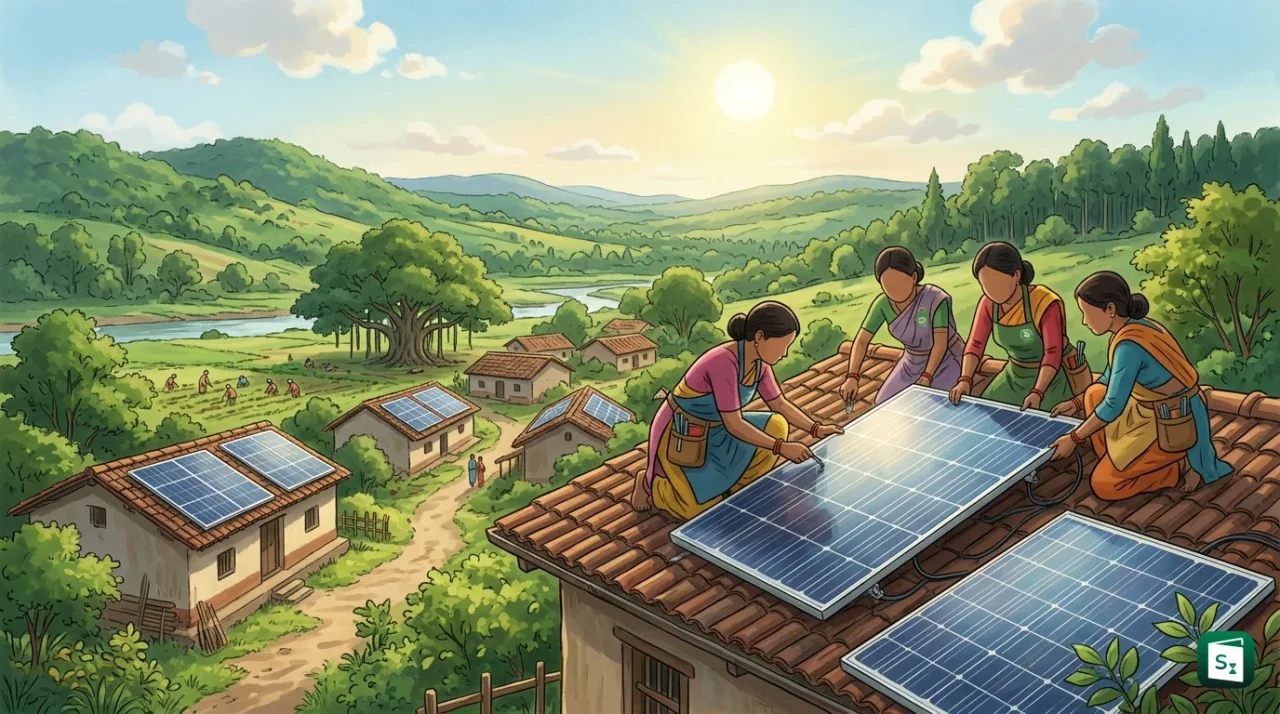
The Chhattisgarh government has launched the DWEEPTI Yojana, formally the Decentralised Women Empowerment on Energy and Policy for Transformative Inclusion, making the state the first in India to adopt a women-led distributed renewable energy policy. The scheme trains rural Self-Help Group (SHG) members to work as solar vendors, technicians and entrepreneurs rather than remain passive consumers of electricity. With technical support from Tata, the first batch of 35 women in Kabirdham district has been trained in rooftop solar installation, forming the state’s inaugural cadre of Solar Didis.
What Is the DWEEPTI Yojana?
The DWEEPTI Yojana is a state-level initiative of the Panchayat and Rural Development Department of Chhattisgarh, developed in collaboration with Transform Rural India (TRI), a non-profit organisation working on rural livelihoods, under the Green Economy Transition Mission. The scheme is planned for the period 2026-2031.
The core idea is to place women-led Self-Help Groups (SHGs) at the centre of the distributed solar energy ecosystem. SHGs are small voluntary groups of about 10-20 women who save money together and lend it among themselves, and under the National Rural Livelihoods Mission they form the backbone of rural women’s financial inclusion in India. Under DWEEPTI, these groups are trained and registered to install, manage, operate and promote rooftop solar systems, earning income as vendors, technicians, installers and managers.
The policy sets ambitious targets for the next five years: establishing 5,000 women-led energy enterprises, generating 50,000 green jobs, and extending clean energy access to 5 lakh families and 10,000 institutions across the state.
Analogy · From Consumers to Owners Expand analogy
The scheme works like a cooperative that villagers already understand. Just as a SHG pools small monthly savings to give its members affordable loans, DWEEPTI pools the skills of the same women to build and service solar assets in their villages. The group that once collected small sums every month now earns an income as a village’s trusted solar power provider, keeping the money and the expertise within the community.
Who Are the Solar Didis?
The Solar Didis are women from rural SHGs who have been trained in the technical skills of rooftop solar installation, operation, maintenance and community awareness. The title “Didi” (elder sister in Hindi) deliberately borrows from the popular vocabulary of women’s collectives such as the Lakhpati Didi initiative, giving the programme an instantly recognisable identity.
Kabirdham district has been chosen as the flagship district for the pilot phase of the scheme. Working with the Zila Panchayat and the local Bihan SHG network, the state’s women’s livelihood mission, the Vande Mataram Cluster Level Federation of Kawardha was registered as the first authorised solar vendor. With technical support from Tata, nearly 35 women from local SHGs received hands-on training in rooftop solar installation, creating the district’s first cohort of Solar Didis.
The state’s first rooftop solar system under the initiative was installed in Samnapur village of Kabirdham. Early demand has been encouraging, with nearly 40 rooftop solar installation orders received from SHG members and other villagers within weeks of the launch.
How the Scheme Works
DWEEPTI runs on four interconnected pillars: authorised vendor registration, financing, skills training, and a stable pipeline of work.
Cluster Level Federations as Solar Vendors
At the heart of the model are Cluster Level Federations (CLFs), the district-level collectives of SHGs. Under the programme, 13 CLFs across 12 districts have already been registered as authorised vendors under the PM Surya Ghar Muft Bijli Yojana, the central scheme that subsidises rooftop solar for households. This registration was done in partnership with the Chhattisgarh State Power Distribution Company Limited (CSPDCL), the state’s power distribution utility. As registered vendors, these federations are now formally entitled to install rooftop solar systems and claim the central subsidy on behalf of households.
Flexible Loans for Rooftop Solar
To make solar affordable, SHG members are offered flexible loans for installing rooftop solar systems, with repayment schedules designed around rural incomes. Households linked to SHGs can therefore go solar without a large upfront payment, while the instalments fund the Solar Didis’ work.
Training and Certification
Women are trained as technicians, vendors and managers of solar assets, including systems such as solar irrigation pumps, flour mills and cold storages. The programme also reserves 25 per cent of panchayat maintenance contracts for these women-led energy groups, guaranteeing a stable stream of local income and a reason for the trained women to stay in their villages.
The Financing Model: Pay-per-Use
To make the model financially sustainable in rural areas, the scheme proposes pay-per-use and pay-as-you-go systems, under which villagers pay only for the energy they actually consume rather than making a large upfront investment. This is a key innovation for places where a family’s ability to pay in one lump sum is limited.
The Policy Context: Why This Matters
DWEEPTI sits at the intersection of two of India’s biggest policy pushes: the clean energy transition and women-led economic empowerment.
PM Surya Ghar Muft Bijli Yojana
The PM Surya Ghar: Muft Bijli Yojana, launched by the Union Cabinet in February 2024 with a total outlay of ₹75,021 crore, aims to install rooftop solar in one crore households and give them up to 300 units of free electricity every month. The scheme offers a central financial assistance of 60 per cent of the system cost for a 2 kW system and 40 per cent for systems between 2 and 3 kW, with subsidies capped at ₹78,000 for a 3 kW system. It is projected to add 30 GW of solar capacity, generate about 1,000 billion units of electricity and create around 17 lakh direct jobs over the lifetime of the systems. By mid-2026, India had crossed 41 lakh rooftop solar installations under the scheme, with a record 3.16 lakh installations in a single month in May 2026.
The DWEEPTI Yojana plugs directly into this demand by creating a local, trained, women-led workforce to serve these installations, especially in rural areas.
The Lakhpati Didi Initiative
The Lakhpati Didi initiative, anchored in the Deendayal Antyodaya Yojana-National Rural Livelihoods Mission (DAY-NRLM), defines a Lakhpati Didi as a SHG member whose household earns an annual income of ₹1 lakh or more, sustained over at least four agricultural seasons or business cycles. The government has already enabled over one crore SHG women to reach this status and set a target of three crore Lakhpati Didis. The DWEEPTI financing model is explicitly designed to align with this vision, moving SHG members from traditional activities such as savings-linked lending into skilled, higher-income green livelihoods.
Chhattisgarh’s Energy Transition
The strategic significance is sharpest within Chhattisgarh itself. The state, formed on 1 November 2000 with Raipur as its capital, is often described as the power hub of India because of its abundant coal reserves and thermal power plants. However, roughly 80 per cent of the state’s energy-related revenue comes from fossil fuels, leaving it heavily exposed to a global shift away from coal. Distributed renewable energy offers a pathway to diversify this dependence while creating local livelihoods. Energy transition studies have recommended exactly such a shift: redirecting electricity subsidy savings into rooftop solar and small-scale renewables while planning a just transition for coal-dependent districts.
What Is Distributed Renewable Energy?
Distributed Renewable Energy (DRE) refers to renewable energy systems that generate power at or near the point of consumption, independent of the large centralised grid. Examples include rooftop solar panels, solar mini-grids, solar irrigation pumps and biomass plants that serve a single household, a village or a small cluster of users.
DRE matters for rural India for three reasons. First, it reaches communities where extending the grid is costly or slow, such as remote forest and tribal belts. Second, it is more resilient, since a failure in one part does not black out the whole area. Third, it creates local economic activity, since the installation and maintenance jobs stay within the village.
The national target of installing 500 GW of non-fossil fuel capacity by 2030, announced at the COP26 summit in 2021, has traditionally been pursued through large utility-scale solar parks and wind farms. DWEEPTI represents a deliberate push in the opposite direction: building capacity through thousands of small, women-owned systems at the village level, what the state calls a bottom-up green revolution.
Significance of the DWEEPTI Yojana
From Beneficiaries to Owners
The most significant shift the scheme brings is a change in the identity of rural women in the energy sector. Historically, women have been treated as consumers or recipients of government schemes, not as participants in energy value chains. Under DWEEPTI, women become vendors who install systems, technicians who service them, managers who run village energy assets and entrepreneurs who own solar enterprises. The Panchayat and Rural Development Department has described this as the defining break from the past: women moving from the periphery of the renewable energy sector to its centre.
Solving the Last-Mile Maintenance Problem
A recurring problem in remote villages is that solar and other public infrastructure falls into disuse because no one local knows how to repair it. A minor fault can leave a solar pump or street light non-functional for weeks while waiting for a technician from a distant town. By training village women in operation and maintenance, DWEEPTI creates a local repair ecosystem that keeps energy assets running, directly improving the returns on public investment.
Creating Green Livelihoods at Scale
The scheme is explicitly designed as an income-generation programme. The reservation of 25 per cent of panchayat maintenance contracts for women-led energy groups, the flexible loan product for rooftop solar, and the pay-per-use revenue model together create multiple streams of income for the Solar Didis and their federations. This makes the scheme a genuine green-jobs programme rather than a symbolic gesture.
A Template for Other States
As the first women-led distributed renewable energy policy in the country, DWEEPTI is being watched as a possible template. The state government plans to expand the scheme from Kabirdham to all remaining districts of Chhattisgarh, and the model of registering SHG federations as vendors under a central scheme could be replicated by other states looking to combine the Lakhpati Didi and rooftop solar agendas.
Challenges and the Way Forward
Challenges
The scheme faces a few practical hurdles. First, scaling from a pilot of 35 trained women in one district to a state-wide cadre will require a large and sustained training pipeline, and retaining skilled women in the programme depends on whether the promised income actually materialises. Second, the market for rooftop solar in rural Chhattisgarh is still young, and demand generation, through awareness campaigns and reliable financing, will decide whether the trained workforce stays busy. Third, the dependence on a coal-linked revenue base means the state must manage a politically sensitive just transition for mining districts even as it promotes renewables. Finally, the pay-per-use model depends on reliable collection mechanisms, which need strong local governance to work.
The Way Forward
The immediate roadmap is clear: the state government has committed to expanding the DWEEPTI framework from Kabirdham to all remaining districts of Chhattisgarh. The registration of more Cluster Level Federations as authorised vendors, the expansion of flexible loan products, and the deepening of the Tata-supported training programme will determine the pace of this scale-up. If the pilot’s early traction holds, DWEEPTI could demonstrate at the state level how the national rooftop solar and women-led development agendas can be merged into a single, replicable model.
Key Takeaways
- The DWEEPTI Yojana, India’s first women-led distributed renewable energy policy, was launched by the Chhattisgarh government and is planned for 2026-2031.
- The scheme is implemented by the Panchayat and Rural Development Department in collaboration with Transform Rural India (TRI) under the Green Economy Transition Mission.
- 13 Cluster Level Federations across 12 districts have been registered as authorised vendors under the PM Surya Ghar Muft Bijli Yojana in partnership with CSPDCL.
- The first cohort of 35 Solar Didis was trained in Kabirdham district with technical support from Tata, and the first rooftop installation came up in Samnapur village.
- The scheme targets 5,000 women-led energy enterprises, 50,000 green jobs, and clean energy access for 5 lakh families over five years, aligning with the central Lakhpati Didi initiative.
- Chhattisgarh, formed on 1 November 2000 with Raipur as its capital, is a coal-based power hub, making its energy transition a test case for a just transition in India.