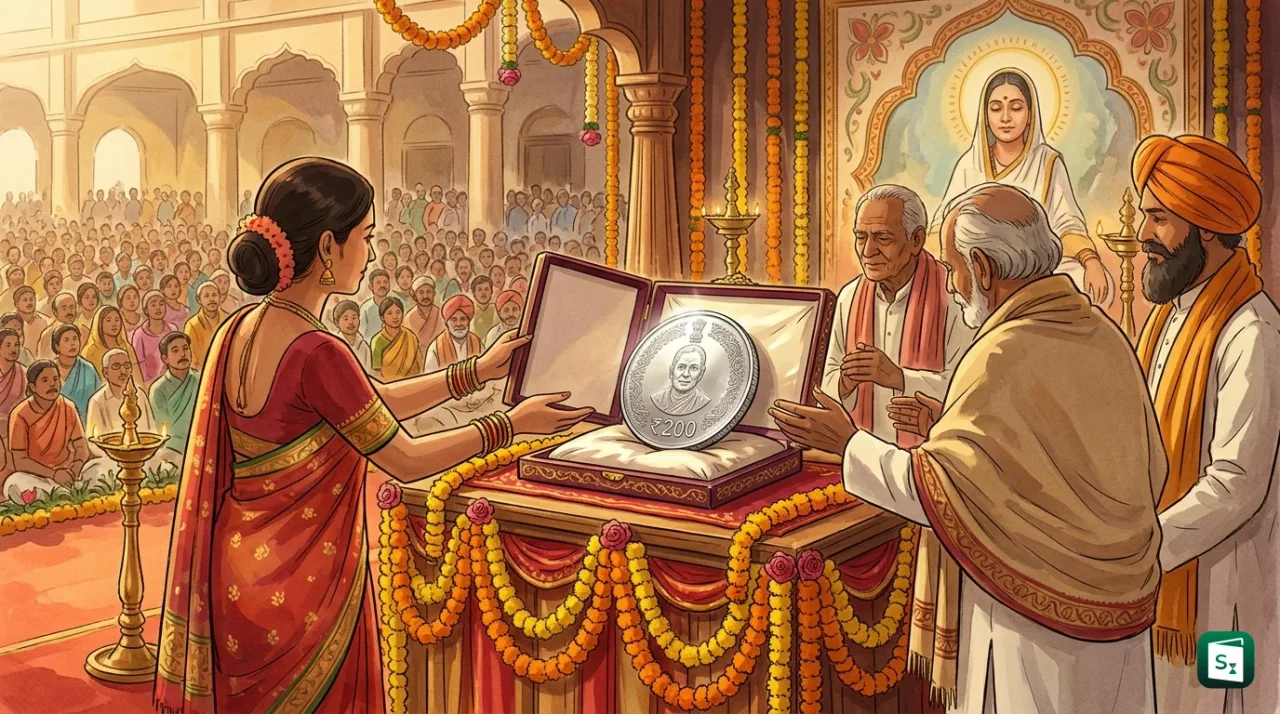
President Droupadi Murmu released a ₹200 commemorative coin at Chhattisgarh Mandapam in Lok Bhavan, Raipur on 22 October 2026. The coin, issued by the Union Finance Ministry, marks the 200th birth anniversary of Mata Sahib Hasi Devi Ji, the fifth head of Shadani Darbar. Governor Ramen Deka and Chief Minister Vishnu Deo Sai attended the ceremony with hundreds of members of the Sindhi community.
What Is a Commemorative Coin?
A commemorative coin is a special coin issued by the central government to honour a personality, institution, historic event or anniversary. It carries a special design with portrait, logo or theme on one face, while the other face shows the Lion Capital, value and India inscriptions. It is different from regular coins used in daily shopping.
Regular circulation coins are made for daily buying and selling. Commemorative coins are made in limited numbers for remembrance and collection. Many people never spend them. They keep them as keepsakes or add them to a coin collection.
Are Commemorative Coins Legal Tender?
Yes. Commemorative coins are legal tender in India. The Coinage Act, 2011, which governs all coins in India, clearly defines a commemorative coin as a coin stamped by the government to commemorate any specific occasion or event and expressed in Indian currency. The Reserve Bank of India (RBI), which is the central bank of India established in 1935 and headquartered in Mumbai, puts these coins into circulation. Shopkeepers cannot refuse them on grounds of design. In practice, most collectors do not spend high value proof coins because their collector value is higher than their face value.
The 200 Rupee Coin Release at Lok Bhavan, Raipur
President Droupadi Murmu unveiled the ₹200 commemorative coin at Chhattisgarh Mandapam in Lok Bhavan, Raipur on 22 October 2026. The Ministry of Finance issued the coin. The President arrived in Raipur the same afternoon for a two day visit to Chhattisgarh from 22 to 23 October.
Governor Ramen Deka and Chief Minister Vishnu Deo Sai received the President at Swami Vivekananda Airport in Raipur. They were present on stage during the coin release. The President also attended the Seva Samman Parv and Yuva Prabodhan programmes for the Nuakhai festival in Raipur on the same day and visited Jagdalpur the next day.
The coin design follows the standard pattern for Indian commemorative coins. One face carries the portrait of Mata Sahib Hasi Devi Ji with her name and the 200th birth anniversary inscription. The other face shows the Lion Capital of the Ashoka Pillar with the motto Satyameva Jayate (truth alone triumphs) below it, flanked by the words Bharat and INDIA and the denomination of ₹200. The release was described as a historic occasion for the Sindhi community and a matter of pride for millions of Sindhis in India and abroad. After the unveiling, devotees and coin collectors were informed that they could book the coin through various branches and units of Shadani Darbar.
Who Was Mata Sahib Hasi Devi Ji?
Mata Sahib Hasi Devi Ji was the fifth spiritual head of Shadani Darbar. A spiritual head is called Peethadheesh or Gaddisar in this tradition. The word means the holder of the holy seat or throne of the shrine.
Mata Hasi Devi was born in 1826 at Khanpur Mehar in Sindh, a region that is now in Pakistan. In 1846 she married Sant Tansukhram Sahib, the fourth head of Shadani Darbar. After his passing in 1852, she assumed the holy seat at the age of 26. She led the Darbar for 57 years until 1909, when she handed over charge to Sant Manglaram Sahib on 30 April 1909.
Followers remember her as a quiet and pious teacher who spent her time in prayer, bhajan (devotional songs) and service to visitors. Two stories from Darbar accounts explain her influence. During a famine in Sindh, she is said to have fed hungry visitors for six months from a single iron vessel of wheat that did not run empty. During the construction of Darbar Sahib at Hayat Pitafi in 1856, the Collector of Shikarpur objected to building material kept on the street. Tradition holds that he fell from his horse and injured his nose the same day, later apologised at the Darbar and was forgiven. The coin and related honours aim to preserve her message of service, compassion and human welfare for future generations.
Shadani Darbar: History, Centres and Cultural Role
Shadani Darbar is a historic Hindu shrine and one of the most important spiritual centres for the Sindhi community. The main historic shrine stands at Hayat Pitafi in Mirpur Mathelo, Ghotki district of Sindh, Pakistan. It is often described as the largest Hindu temple in Sindh.
The Darbar was founded in 1786 by Sant Shadaram Sahib. Sant Shadaram was born in October 1708 in Lahore into a Lohana Khatri family. Followers regard him as an avatar (divine incarnation) of Lord Shiva and trace his ancestry to Lav, son of Lord Ram. After visiting holy places such as Haridwar, Yamunotri, Gangotri, Amarnath and Ayodhya, he reached Mathelo in 1768. Mathelo was then the capital of Sindh under Raja Nand. There he built a Shiva temple and lit the sacred holy fire known as Dhuni Sahib. He later shifted to nearby Hayat Pitafi, dug a sacred well and laid the foundation of Shadani Darbar. He passed away in 1793.
After Sant Shadaram, eight more heads carried the tradition forward. The present ninth head is Sant Yudhishterlal Ji Maharaj of Raipur (as of October 2026).
| Order | Head | Period |
|---|---|---|
| 1st | Sant Shadaram Sahib | Founder, 1786 to 1793 |
| 2nd | Sant Tulsidas Sahib | 1793 to 1799 |
| 3rd | Sant Takhatlal Sahib | 1799 to 1839 |
| 4th | Sant Tansukhram Sahib | 1839 to 1852 |
| 5th | Mata Sahib Hasi Devi Ji | 1852 to 1909 |
| 6th | Sant Manglaram Sahib | 1909 to 1932 |
| 7th | Sant Rajaram Sahib | 1932 to 1960 |
| 8th | Sant Gobindram Sahib | 1960 to 2003 |
| 9th | Sant Yudhishterlal Ji Maharaj | 2003 to present |
The Raipur centre took shape after Partition. After the Partition of India in 1947, lakhs of Sindhi Hindus moved to India and kept their link with the original shrine through faith, pilgrimage and new centres. Sant Gobindram Sahib set up the new Shadani Darbar on 20 January 1988 on Dhamtari Road, about 9 km from Raipur town, spread over 12 acres. He also set up a Darbar at Amravati in Maharashtra in April 1989. Shadani centres also function at Haridwar, Delhi and other places, while the birthplace of Mata Hasi Devi at Khanpur Mehar continues to draw devotees.
Each year the Darbar holds a three day celebration for the birth anniversary of Sant Shadaram. The programme includes Agni Puja (fire worship), recitation of the Bhagavad Gita and the Guru Granth Sahib, and mass weddings for poor Hindu couples. The shared respect for the Gita and the Granth Sahib reflects the inclusive Sindhi religious culture. In October 2026, Pakistan Post also issued two special postage stamps and a souvenir sheet for the 200th birth anniversary of Mata Hasi Devi to promote interfaith harmony.
How Commemorative Coins Are Issued in India
Coins in India Are Minted By Whom?
Coins in India are minted by the central government. The Department of Economic Affairs in the Ministry of Finance decides the theme, denomination and design and issues a formal notification. Actual production is done by the Security Printing and Minting Corporation of India Limited (SPMCIL). SPMCIL was formed on 13 January 2006 after corporatisation of nine units that earlier worked directly under the Finance Ministry. It is a Miniratna Category-I public sector company wholly owned by the government.
SPMCIL runs four India Government Mints at Mumbai, Kolkata, Hyderabad and Noida. Mumbai is the oldest among them with a legacy going back to the 19th century. Kolkata traces its roots to the Calcutta Mint of 1757. Hyderabad was set up in 1903. Noida, which started regular production in 1988, is the only mint built after Independence and the first to make stainless steel coins in India. Each coin carries a small mint mark that shows where it was made.
The RBI does not mint coins. The RBI, acting under the Coinage Act, puts coins into circulation after they are minted. So the chain is simple. The Finance Ministry approves, the Government Mints produce, and the RBI releases for circulation.
How Many Commemorative Coins Are There in India?
The number keeps rising because new coins are announced every year. India has issued well over a hundred commemorative designs since Independence, in denominations from 5 paise to ₹1,000. Recent examples familiar to collectors include coins for the 125th birth anniversary of Jawaharlal Nehru, the birth centenary of Acharya Tulsi, Sri Aurobindo, and Saint Alphonsa. The ₹200 coin for Mata Hasi Devi Ji belongs to this higher denomination collector series. These coins are not meant for daily market use.
How to Buy Commemorative Coins From RBI?
Collectors often ask how to buy commemorative coins from the RBI. The RBI does not sell them directly to the public. Booking is done through the India Government Mint portal at indiagovtmint.in and through designated Mint counters at Mumbai, Kolkata, Hyderabad and Noida. Proof coins (mirror finish in a presentation case) and Uncirculated coins (sealed in a pouch) are priced above face value because of metal, minting and packaging costs.
Buyers must give a Permanent Account Number (PAN) on the portal. Normally only one coin per person is allowed for a particular type, though a buyer can apply for one coin each of different series. Orders are shipped only within India. For special releases like the Mata Hasi Devi Ji coin, the government sometimes allows booking through the honouring institution as well. In this case, devotees were told they could book through Shadani Darbar branches after the presidential release.
Key Takeaways
- President Droupadi Murmu released the ₹200 commemorative coin on 22 October 2026 at Lok Bhavan, Raipur.
- The coin marks the 200th birth anniversary of Mata Sahib Hasi Devi Ji, the fifth head of Shadani Darbar.
- Mata Hasi Devi was born in 1826 at Khanpur Mehar in Sindh and led Shadani Darbar from 1852 to 1909.
- Shadani Darbar was founded in 1786 by Sant Shadaram Sahib at Hayat Pitafi, Ghotki district in present day Pakistan.
- Commemorative coins are legal tender under the Coinage Act, 2011 and are minted at four India Government Mints in Mumbai, Kolkata, Hyderabad and Noida.