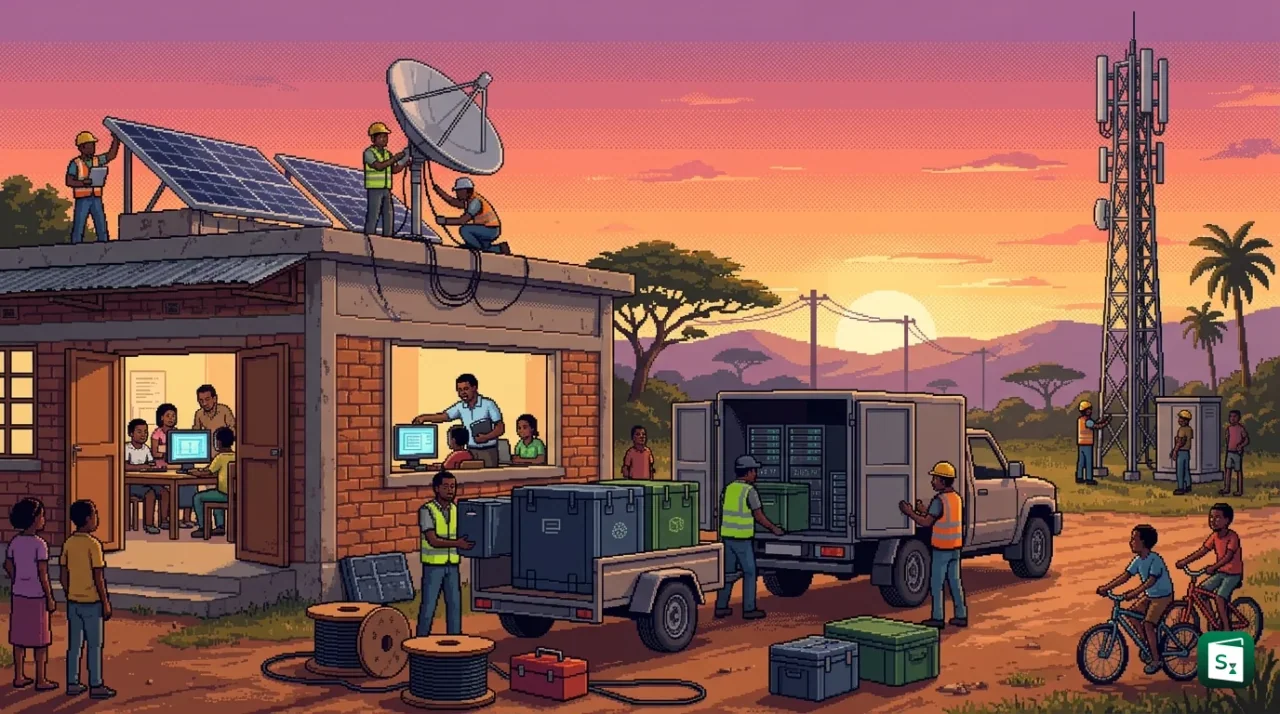
The World Bank Group launched its first digital strategy on 20 October 2026 at the inaugural Global AI and Digital Summit in Seoul, South Korea. The plan aims to bring digital opportunity to one billion people by 2030 through better connectivity, cheaper devices and stronger AI readiness in developing countries. The World Bank Group also announced a shared computing initiative with Cassava Technologies and NVIDIA to give Africa and Latin America affordable access to AI computing power.
What Is the World Bank and How Does It Work?
The World Bank is an international development lender that gives money, advice and technical help to low and middle income countries to cut poverty and raise incomes. The World Bank works by funding government projects, offering policy guidance and pulling in private investment with loans, grants and guarantees.
In simple terms, a digital strategy is a written plan that sets goals, tools and timelines for using digital technology. The World Bank functions include lending for roads, schools, health systems and power, plus research such as the World Bank data portal, flagship reports like the Global Economic Prospects and the World Development Report 2026 on artificial intelligence. The World Bank gets money mainly by selling bonds in global markets to investors, by repayments from borrowing countries and by contributions from richer member governments. The World Bank gives loans after agreeing with a government on a project plan, reform steps and results to be tracked.
The World Bank Group adopted a new vision under President Ajay Banga to create a world free of poverty on a livable planet. That change links poverty work with climate, jobs and digital access. The new digital plan follows the same logic. It brings public loans, policy advice, private investment from its business arm and risk cover together around one country plan, so connectivity leads to higher output and better public services.
Where Is the World Bank Located and When Was It Established?
The World Bank is located in Washington, D.C. in the United States, at 1818 H Street NW. The World Bank was established in 1944 at the Bretton Woods Conference and began operations in 1946. The World Bank was first created to rebuild Europe after the Second World War.
In July 1944, delegates from 44 countries met at the Mount Washington Hotel in Bretton Woods, New Hampshire, for the United Nations Monetary and Financial Conference. Around 730 delegates attended. The meeting produced the Articles of Agreement for the International Bank for Reconstruction and Development (IBRD), the original World Bank. The Articles were ratified on 27 December 1945, and the Bank opened with 38 members in 1946.
The same Bretton Woods meeting also created the International Monetary Fund (IMF). Both sit in Washington, D.C., across the street from each other. Today the World Bank Group has 189 member countries, staff from more than 170 countries and offices in over 130 locations. A country must first join the IMF before it can join the World Bank.
What Is the World Bank Group?
The World Bank Group is a family of five development institutions that work as one system to end poverty. The World Bank Group includes IBRD, IDA, IFC, MIGA and ICSID. Together they lend to governments, fund private firms, insure investors and settle investment disputes.
The term World Bank on its own usually means IBRD plus IDA, the two arms that deal directly with governments. IBRD, the International Bank for Reconstruction and Development, lends to middle income and creditworthy low income countries. IDA, the International Development Association set up in 1960, gives low interest loans and grants to the poorest countries. The other three arms support private business.
| Institution | Full Name | Set Up | Core Role |
|---|---|---|---|
| IBRD | International Bank for Reconstruction and Development | 1944 | Loans and advice to middle income governments |
| IDA | International Development Association | 1960 | Cheap loans and grants to poorest countries |
| IFC | International Finance Corporation | 1956 | Investment in private companies in developing countries |
| MIGA | Multilateral Investment Guarantee Agency | 1988 | Political risk insurance and credit cover for investors |
| ICSID | International Centre for Settlement of Investment Disputes | 1966 | Settlement of disputes between governments and foreign investors |
Leadership sits with the President. Ajay Banga is the 14th President of the World Bank Group (as of October 2026). He began a five year term on 2 June 2023. Before this role, Ajay Banga was President and CEO of Mastercard and later Vice Chairman at General Atlantic. He also served as Chairman of the International Chamber of Commerce from 2020 to 2022. Day to day digital work is led by Sangbu Kim, Vice President for Digital and AI since September 2024, who earlier helped design national digital plans in Korea on e government, broadband and cyber security.
What Is the New Digital Strategy Launched in Seoul?
The World Bank digital strategy is the Group first plan to connect one billion people to digital opportunity by 2030. The World Bank digital strategy covers reliable connectivity, cheap devices and data, useful digital services and skills, and AI readiness with safeguards for privacy and security.
The World Bank Group President Ajay Banga launched the strategy in Seoul on 20 October 2026. The idea behind the plan is simple. Digital tools can help a farmer reach buyers, a student join online classes and a small shop get a loan. But tools help only when the basics are in place. That means a steady signal, a phone a family can afford, services in a local language and skills to use them safely.
The strategy is backed by the Digital and AI Implementation Plan for FY26 to FY30 and branded as @A Billion, which means reaching a billion people through access and services by 2030. It joins the Group lending, policy advice, private investment and guarantees around each country own priorities. It also invites tech firms, development partners and philanthropies to co invest, especially in places private capital avoids on its own.
| Priority Area | What the World Bank Group Will Support |
|---|---|
| Expand reliable connectivity | International cables, national fibre, last mile links to homes, schools and clinics, shared towers, more competition, guarantees to draw private money, joint planning of power and internet |
| Make devices and data affordable | Lower cost entry smartphones, cheaper broadband, tie ups with makers and mobile operators, safe instalment plans and refurbished phones |
| Expand services and skills | Digital ID, fast payments, secure data sharing for public services, digital literacy and job linked training for people and small firms |
| Build readiness for AI | Better links, access to computing, usable local language data, worker skills, practical small AI tools for farming, health and inventory |
Small AI is a key phrase in the Seoul plan. It means modest AI tools built for one clear task and local conditions, such as spotting crop disease from a phone photo, helping a health worker triage patients or helping a shop track stock. The model is offline first and portable where the internet is weak. Privacy, cyber security and fraud protection run through all four areas.
What Is the AI Infrastructure and Readiness Initiative?
The AI Infrastructure and Readiness Initiative is a World Bank plan to give governments shared, pay as you go access to GPU computing. The initiative starts in Africa and Latin America with knowledge partners Cassava Technologies and NVIDIA as an alternative to costly standalone data centres.
A GPU, or graphics processing unit, is a special chip that can handle many calculations at once. AI models need this power to train and to answer queries. Building a full national data centre takes large funds, steady power, skilled staff and long lead time. Many low income countries cannot meet those needs alone. The shared model lets several governments rent the same regional capacity and pay only for what they use.
The first focus is Africa and Latin America. Data centre demand in Africa is rising fast, with estimates pointing from about 400 MW today toward 1.5 GW to 2.2 GW by 2030. The initiative pairs this hardware access with help on data, skills and rules, so small AI tools can be put to real use in clinics, farms and small factories.
Knowledge partners advise on design and technology but do not replace government funding. Cassava Technologies is a digital infrastructure group of African heritage, headquartered in the United Kingdom with presence across Africa, the Middle East, Latin America and the United States. Founder and Executive Chairman Strive Masiyiwa built the group from Econet telecom roots. Its units include Liquid Intelligent Technologies, Africa Data Centres, Cassava AI and fintech services, operating in more than 90 countries. Cassava is building AI factories powered by NVIDIA platforms, starting in South Africa with plans for Nigeria, Kenya, Egypt and Morocco, with a stated goal of up to about 12,000 GPUs over three to four years.
NVIDIA, a United States technology company, is a global leader in AI computing and graphics chips. Its hardware and software stack powers much of the current AI training worldwide. In this initiative, NVIDIA brings know how on computing design, while Cassava brings experience in running fibre, data centres and cloud services in developing markets.
Global AI and Digital Summit 2026 in Seoul: Key Details
The Global AI and Digital Summit 2026 took place at the Grand Hyatt Seoul in Yongsan, Seoul, from 19 to 22 October 2026. The World Bank Group hosted the summit with the Republic of Korea Ministry of Science and ICT and Ministry of Economy and Finance. The first day held a ministerial meeting co chaired by Deputy Prime Minister Bae Kyung-hoon and World Bank Vice President Sangbu Kim.
The Seoul gathering was the inaugural edition under this name. It drew about 900 participants from around 160 countries, including ministerial and vice ministerial delegates from more than 50 countries, plus firms, academics and civil society groups. Policy talks ran on 20 and 21 October under the theme From Vision to Action, with a focus on digital inclusion, better public services and jobs. An exhibition of Korean and foreign firms ran alongside, followed by study visits on 22 October to institutions such as the Korea Water Resources Corporation and Seoul National University Bundang Hospital.
| Summit Fact | Detail |
|---|---|
| Name | Global AI and Digital Summit 2026, theme Small AI Big Impact |
| Venue and dates | Grand Hyatt Seoul, 19 to 22 October 2026 |
| Hosts | World Bank Group with Korea Ministry of Science and ICT and Ministry of Economy and Finance |
| Scale | About 900 participants from about 160 countries, 50 plus countries at ministerial level |
| Main launch | World Bank Group first digital strategy and AI Infrastructure and Readiness Initiative on 20 October 2026 |
The Seoul summit sits in a busy global AI summit cycle. The India AI Impact Summit 2026 held in February 2026 drew very high search and policy attention, while the Global AI Summit 2026 keyword cluster peaked in the same month. Korea used the Seoul stage to pitch its own strengths in broadband, e government and digital health, and to propose an AI hub that links cooperation centres of six multilateral development banks in Korea. For developing countries, the value lay in practical exchange on real time systems, low cost access models and job linked skilling.
Why the Strategy Matters for Jobs and Development
The jobs math explains the urgency. The World Bank Group notes that about 1.2 billion young people in developing countries will reach working age over the next 10 to 15 years, while those economies are set to create only about 420 million jobs on current paths. Digital access cannot close that gap alone, but it can raise output per worker and lower the cost of reaching customers and delivering services.
The plan links digital work to five job rich sectors, namely infrastructure and energy, agribusiness, health care, tourism and value added manufacturing. A cold chain sensor can cut food loss. A digital ID and payment stack can speed hospital claims and school stipends. An online catalogue can take a small manufacturer beyond its home town. Each gain is small on its own, but spread across millions of firms it lifts incomes.
The barriers are stark. More than 2 billion people were offline globally in 2025. Only 23 percent of people in low income countries used the internet, compared with 94 percent in high income countries. Even where signal exists, many families cannot afford a smartphone or data pack, lack basic digital skills or find little useful content in their language. The Seoul strategy attacks all three gaps at once, instead of funding cables alone.
India shows why lending scale matters. The World Bank loan to India portfolio makes India one of the largest clients of IBRD and IDA, with support across roads, power, water, education, health and digital public infrastructure. The World Bank on the Indian economy is tracked through regular updates such as the Global Economic Prospects and India development reports that give GDP forecasts and poverty estimates. The World Bank poverty line and income classification work, which sorts countries by income per person, shapes who can borrow on IDA terms. Affordable access and AI readiness therefore fit directly into the next round of projects in countries such as India, where mobile data is cheap but skills and local AI tools still lag.
Difference Between World Bank and IMF
The World Bank and the IMF are often confused because both were born at Bretton Woods in 1944 and both sit in Washington, D.C. Their jobs are distinct. The World Bank funds long term development in poor and middle income countries, such as schools, dams, health systems and now digital networks. The IMF watches the global money system and gives short term help to any member facing a balance of payments crisis, when foreign payments run ahead of earnings.
| Point | World Bank | IMF (International Monetary Fund) |
|---|---|---|
| Main goal | End extreme poverty and raise shared prosperity | Keep global monetary cooperation and financial stability |
| Who it lends to | Mainly developing country governments and private firms via IFC and MIGA | All member countries, rich or poor, with payment troubles |
| Type of help | Project loans, cheap IDA credits, grants, guarantees, advice | Short term loans, policy surveillance, training |
| Members and base | 189 members, Washington base, must join IMF first | 191 members (as of August 2025), Washington base |
| Current use in this news | Digital roads, devices, skills and AI computing | Not a party to the Seoul digital plan |
Understanding this split helps in reading the difference between IMF and World Bank in one line. The Bank builds, the Fund stabilises. The Seoul digital strategy is a Bank task because it needs years of investment in cables, phones, IDs and skills. IMF work would matter if a currency shock or debt stress threatened the same countries during rollout.
Key Takeaways
- The World Bank Group first digital strategy was launched on 20 October 2026 at the Global AI and Digital Summit 2026 in Seoul.
- The strategy targets digital opportunity for one billion people by 2030 under the @A Billion plan.
- The AI Infrastructure and Readiness Initiative offers shared, pay as you go GPU access, starting in Africa and Latin America with Cassava Technologies and NVIDIA.
- The World Bank was established in 1944 at Bretton Woods and is headquartered in Washington, D.C. with 189 members.
- Ajay Banga is the 14th President of the World Bank Group, in office since 2 June 2023 after leading Mastercard.
- More than 2 billion people were offline in 2025, with only 23 percent internet use in low income countries against 94 percent in high income countries.