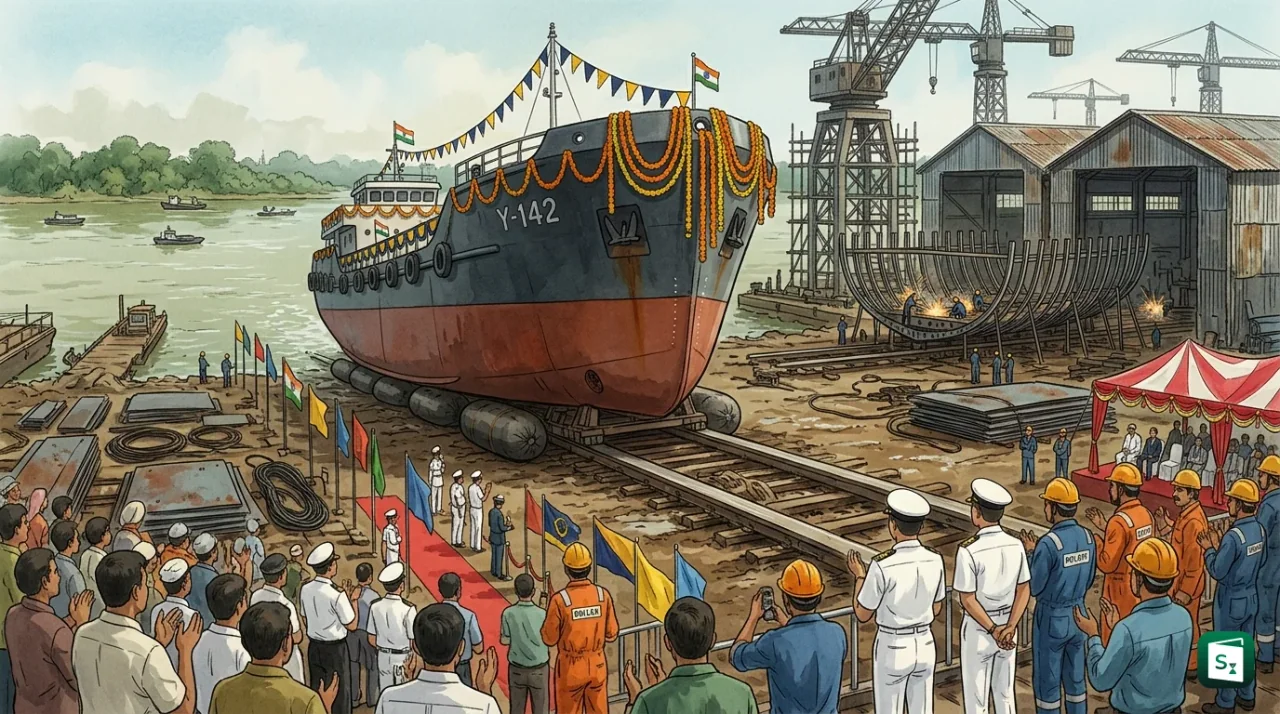
The Indian Navy launched its first 300-tonne Sullage Barge, Yard 142, and laid the keels for Yard 144 and Yard 148 at Suryadipta Projects Pvt Ltd in Thane on 26 October 2026. Rear Admiral Kapil Mehta, Assistant Controller of Warship Production and Acquisition, presided over the joint ceremony as chief guest. The three vessels form part of a seven-barge indigenous order that strengthens the Navy’s support fleet and its green compliance at sea.
What Happened at Thane on 26 October 2026?
The Indian Navy combined three construction milestones into a single ceremony at the Thane facility of Suryadipta Projects Pvt Ltd on 26 October 2026. The Navy launched Yard 142, the first 300-tonne Sullage Barge under the current production line. On the same day, the Navy laid the keel for Yard 144, the third Sullage Barge of the class, and for Yard 148, the first Bottom Opening Dumb Barge.
A launch means the hull is complete enough to enter water for the first time. A keel laying is different. It marks the formal start of structural assembly on the building berth. So Yard 142 is now ready for outfitting and trials, while Yards 144 and 148 have just begun taking shape.
The contracts behind these seven Indian Navy ships were signed in two stages. The Indian Navy signed the contract for four 300-tonne Sullage Barges in November 2024. It then signed the contract for three 200-tonne Bottom Opening Non-Propelled Barges on 16 January 2026. Both orders went to Suryadipta Projects, a Micro, Small and Medium Enterprise (MSME) shipyard based in Thane, Maharashtra.
What Is a Sullage Barge and What Is a Dumb Barge?
These are auxiliary vessels. They do not fight. They help fighting ships stay at sea longer by handling waste, fuel, ammunition, mud and stores near jetties and anchorages.
What is sullage?
Sullage is liquid waste that collects on ships and in dockyards, mainly dirty water from kitchens, washrooms, laundry and workshops, mixed with oily residues from machinery spaces. Sullage water is different from sewage because sewage refers specifically to human toilet waste, while sullage covers the wider stream of grey water and wash waste that must still be collected and treated before discharge.
The 300-tonne Sullage Barge is a specialised collection vessel. It moves alongside a warship or naval jetty, receives stored waste water and oil residues, and carries them to a shore treatment facility. This stops ships from releasing polluted water directly into harbour waters.
What is barge in shipping?
A barge in shipping is a flat-bottomed vessel with a large open or enclosed hold that carries bulk material at low speed over short coastal or harbour distances. The Indian Navy uses barges as floating workhorses. Fuel barges carry furnace oil and diesel. Ammunition barges carry missiles and torpedoes. Sullage barges carry liquid waste. Most naval barges work inside harbours and roadsteads.
What is a dumb barge?
A dumb barge is a barge without its own engine or propeller, so it cannot move on its own and must be pushed or towed by a tug. The Bottom Opening Dumb Barge ordered by the Indian Navy is a 200-tonne non-propelled hopper barge with doors in its bottom. The barge carries dredged mud, sand or gravel, opens its bottom doors over a disposal area, and drops the load by gravity.
| Feature | Sullage Barge (Yard 142, 144) | Bottom Opening Dumb Barge (Yard 148) |
|---|---|---|
| Capacity | 300 tonnes | 200 tonnes |
| Propulsion | Non-propelled, tug assisted | Non-propelled, tug assisted |
| Main cargo | Liquid waste, sullage water, oily residues | Dredged material, sand, gravel |
| Discharge method | Pumping to shore facility | Bottom doors open by gravity |
| Primary purpose | Harbour cleanliness and pollution control | Dredging support and harbour maintenance |
What does keel laying mean in shipbuilding?
Keel laying is the formal ceremony that marks the start of a ship’s hull assembly on the building berth when the first structural blocks are placed and joined. The Indian Navy treats the keel laying date as the official start of construction for Yard 144 and Yard 148. Launch, outfitting, trials and delivery follow in sequence after this point.
Indian Navy Ships and the Role of the Auxiliary Fleet
The Indian Navy operates a layered fleet. Combat ships like aircraft carriers, destroyers, frigates and submarines get the most attention. Behind them sits a large group of Indian Navy ships classified as auxiliaries. These include tugs, ferries, fuel barges, diving support craft, survey vessels and now sullage and dumb barges.
Auxiliary ships handle the daily work that keeps a naval base running. They tow disabled vessels. They ferry personnel. They deliver fuel, water and ammunition from shore depots to ships at anchorage. They clear silt so channels remain navigable. Without them, a warship must leave its operational station for routine needs. That costs time and fuel.
The seven barges under construction at Thane belong to this support layer. The four Sullage Barges will serve naval jetties and ships alongside and at outer harbours. The three Bottom Opening Dumb Barges will support dredging and underwater works around naval harbours. Both types free larger yard craft for more complex tasks.
This programme follows an earlier success at the same yard. Suryadipta Projects built eleven Ammunition Cum Torpedo Cum Missile (ACTCM) Barges for the Navy under a contract signed on 5 March 2021. The last vessel of that series, LSAM 25, was inducted in October 2025. The Navy then entrusted the same MSME yard with the four Sullage Barges, a clear sign of confidence in small-yard delivery.
Indigenous Shipbuilding Ecosystem Behind Yards 142, 144 and 148
The Indian Navy says Yards 142, 144 and 148 have been indigenously designed and built by the Thane shipyard in collaboration with an Indian ship design firm. That phrase matters. It means hull lines, stability calculations and structural drawings were prepared in India, not bought from a foreign designer. The model for the earlier ACTCM barges was even tested at the Naval Science and Technological Laboratory (NSTL) in Visakhapatnam to confirm seaworthiness.
Suryadipta Projects describes itself as a heavy engineering and shipbuilding company with facilities to build vessels up to 100 to 120 metres in length. The yard is small compared to public sector giants like Mazagon Dock Shipbuilders in Mumbai, Garden Reach Shipbuilders and Engineers in Kolkata and Hindustan Shipyard in Visakhapatnam. Its strength is specialised small craft built in series.
This approach fits two national plans. The first is the Make in India and Aatmanirbhar Bharat push for domestic defence production. The second is the Maritime India Vision 2030, which calls for growth of Indian shipyards, stronger MSME participation and a larger domestic vessel pipeline. The Navy has publicly linked the January 2026 dumb barge contract to that vision.
India’s shipbuilding industry is still modest by global tonnage. The country is working to scale output through the Shipbuilding Financial Assistance Scheme and a proposed Maritime Development Fund, with a long term target of entering the top five shipbuilding nations by 2047 under the Maritime Amrit Kaal Vision 2047. Small, repeat orders for barges, tugs and support craft give MSME yards steady work, train welders and fitters, and keep supply chains for pumps, valves and steel within the country.
Indian Register of Shipping and Regulatory Compliance
The Indian Register of Shipping (IRS) is the classification partner for this programme. Classification means independent checking of design, steel, welding and safety systems against published rules. IRS was established in 1975 as a non-profit public company and is headquartered at Powai in Mumbai. It is a full member of the International Association of Classification Societies (IACS) since 2010 and works as a Recognised Organisation for more than 40 flag administrations.
For naval barges, IRS applies its Naval Rules and Regulations. Surveyors approve drawings, inspect construction at the yard and confirm that load, stability and pollution prevention fittings meet the standard. The Sullage Barges and the Bottom Opening Dumb Barges are being built under IRS classification rules.
The operational reason is compliance with MARPOL. MARPOL stands for the International Convention for the Prevention of Pollution from Ships, 1973, as modified by the Protocol of 1978. The convention was adopted under the International Maritime Organization (IMO), the United Nations body headquartered in London that sets global shipping safety and environment rules. India is a party to all six MARPOL annexes covering oil, chemicals, packaged goods, sewage, garbage and air emissions.
Warships must meet the same harbour discharge discipline as merchant ships while in port waters. Sullage barges give naval bases a legal collection path for grey water and oily waste. Instead of pumping waste overboard, a ship transfers it to the barge for treatment ashore. The dumb barges support the other side of harbour health by helping remove silt and keep berths usable for large ships.
Significance for Maritime Capability and the Way Forward
The immediate gain is operational. Clean berths reduce corrosion and infection risks on ships. Quick waste collection shortens turnaround time alongside jetties. Timely dredging support keeps channels open for submarines and large surface ships that need precise depth margins. Small craft deliver these gains at a fraction of the cost of a destroyer or frigate.
The wider gain is industrial. The Indian Navy has deliberately spread auxiliary orders to MSME yards. Titagarh in Kolkata builds diving support craft. Suryadipta in Thane builds ammunition, sullage and dumb barges. This creates a second tier of naval suppliers beyond the large defence shipyards. It also keeps design skills alive in Indian firms.
Launch is not delivery. Yard 142 will now go through outfitting, harbour trials and machinery tests before the Navy accepts it. Yards 144 and 148 must complete hull assembly, launch, and the same test cycle. The Navy has not announced delivery dates for these seven barges. Progress will be tracked through future launch and induction announcements, as was done for the eleven ACTCM barges between 2022 and 2025.
Key Takeaways
- The Indian Navy launched Yard 142, the first 300-tonne Sullage Barge, and laid keels for Yard 144 and Yard 148 at Thane on 26 October 2026.
- The programme covers four Sullage Barges ordered in November 2024 and three 200-tonne Bottom Opening Dumb Barges ordered on 16 January 2026.
- All seven vessels are being built by MSME yard Suryadipta Projects Pvt Ltd, Thane with an Indian design firm under Indian Register of Shipping rules.
- Sullage refers to grey liquid waste from ships, while a dumb barge is a non-propelled barge moved by tugs.
- The barges support Navy operations and compliance with the MARPOL Convention of 1973/1978 under the International Maritime Organization.