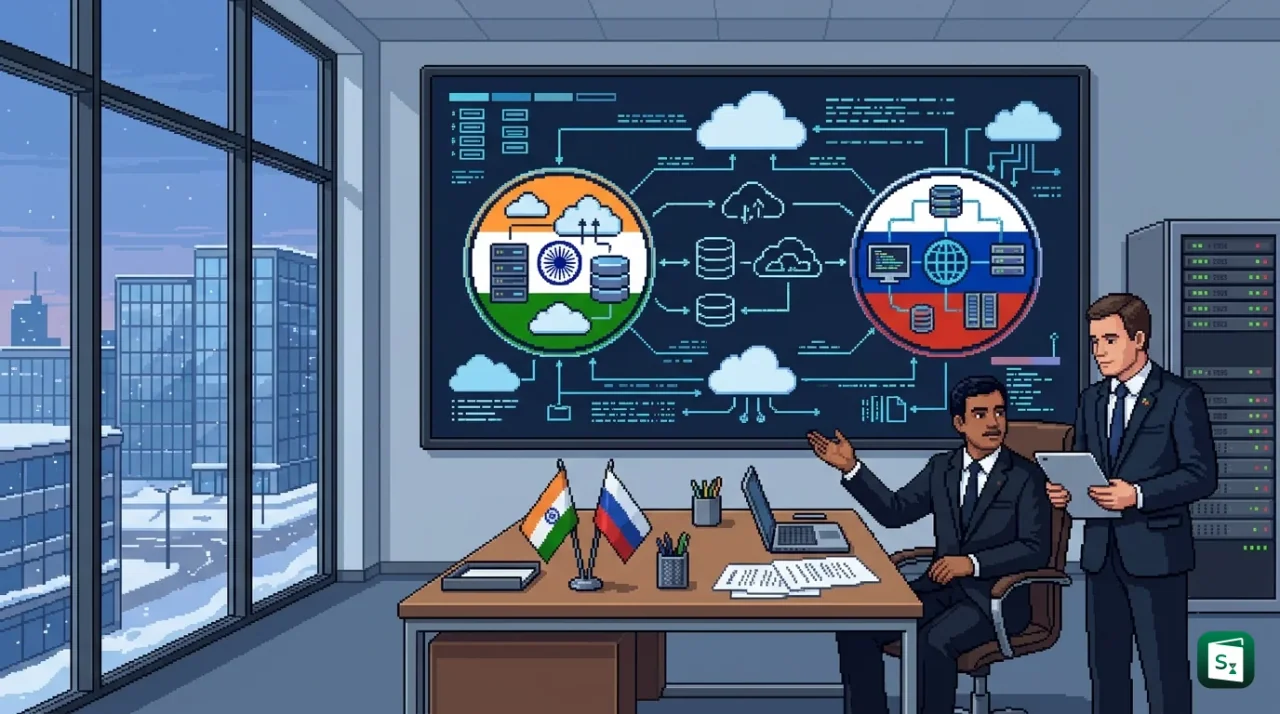
Hyderabad-based BharathCloud has signed a Memorandum of Understanding (MoU) with the High-Technology Technopark IT Park in Kazan, Republic of Tatarstan in Russia, to work together on artificial intelligence (AI) and cloud infrastructure. The MoU was signed at the second Russia India Business Forum TIME in Kazan in October 2026. The pact also creates a framework for investment and cross business collaboration between Indian and Russian technology firms.
What Is Tatarstan and Where Is It Located in Russia?
The Republic of Tatarstan is a federal subject of Russia located about 800 km east of Moscow at the meeting point of the Volga and Kama rivers. Tatarstan has Kazan as its capital, covers about 67,800 sq km, and had a population of about 4.01 million at the start of 2026.
Tatarstan lies in the centre of the Volga Federal District. The republic shares borders with eight federal subjects of Russia, including the Republic of Bashkortostan, the Udmurt Republic, Chuvash Republic, Mari El Republic and the oblasts of Kirov, Orenburg, Ulyanovsk and Samara. Administratively, Tatarstan is divided into 43 districts and 14 cities of republican importance. Major cities other than Kazan are Naberezhnye Chelny, Nizhnekamsk, Almetyevsk and Zelenodolsk.
The population mix reflects a long shared history. Tatars form about 53 percent of the population and Russians form about 40 percent, with Chuvash, Udmurt, Mordvin, Mari, Ukrainian and Bashkir communities among more than 170 ethnic groups. Kazan itself has a population of about 1.3 million (as of early 2026) and hosts Kazan Federal University along with major technical universities. The city marked its 1,000th anniversary in 2005 and later hosted the 2013 Summer Universiade, the 2015 World Aquatics Championship, matches of the 2018 FIFA World Cup and the BRICS Summit in 2024.
| Tatarstan Fact File | Detail |
|---|---|
| Status | Republic and federal subject of the Russian Federation |
| Federal district | Volga Federal District |
| Capital | Kazan on the left bank of the Volga River |
| Area | About 67,800 sq km |
| Population | About 4.01 million, about 77 percent urban |
| Established | Tatar Autonomous Soviet Socialist Republic in 1920, renamed Republic of Tatarstan in 1992 |
| Economic base | Oil production and refining, petrochemicals, KAMAZ trucks, Kazanorgsintez chemicals |
| Investment zones | Alabuga Special Economic Zone for industry and Innopolis Special Economic Zone for IT |
Is Tatarstan a Country or Part of Russia?
Tatarstan is not an independent country. Tatarstan is a republic within the Russian Federation with its own constitution, president and official languages of Tatar and Russian, while foreign policy, defence and currency remain under the federal government in Moscow. The Russian rouble is the legal currency.
The confusion arises because Tatarstan has many features of statehood. The head of the republic long carried the title of president, with Rustam Minnikhanov holding the post in recent years. The republic adopted a declaration of sovereignty in 1990 and signed a power sharing treaty with Moscow in 1994. A second treaty signed in 2007 lapsed after ten years without renewal. Officials in Kazan now clearly describe Tatarstan as an integral part of Russia.
History explains the distinct identity. The area was home to Volga Bulgaria in the ninth and tenth centuries, where ancestors of the Kazan Tatars adopted Islam. The region later became part of the Golden Horde and then the Kazan Khanate from 1438. Troops of Ivan IV captured Kazan in 1552. Kazan became the capital of a large Russian governorate in 1708. Soviet authorities created the Tatar Autonomous Soviet Socialist Republic in 1920. The present name Republic of Tatarstan came into use in 1992 after the breakup of the Soviet Union.
Religion and culture in Tatarstan reflect coexistence. Most Tatars follow Islam and most ethnic Russians follow Orthodox Christianity. Kazan has about 70 mosques, 45 Orthodox churches and places of worship of other faiths. The Kazan Kremlin, which contains both the Kul Sharif Mosque and Orthodox cathedrals, is listed as a UNESCO World Heritage Site. Tatarstan is often described as rich because of large oil reserves, a strong petrochemical complex built around Tatneft and TANECO, truck maker KAMAZ and a growing IT sector.
Kazan and the Tatarstan IT Park Ecosystem
The High-Technology Technopark IT Park in Kazan is the partner on the Russian side of the MoU. The IT Park works under the Ministry of Digital Development of the Republic of Tatarstan and is led by Director Ruslan Vlasov (as of October 2026).
Kazan IT Park opened in October 2009 under the Russian state programme for high technology technoparks. The park was the first of its kind in Russia to focus on IT entrepreneurship. The technopark started with a 30,000 sq m complex in central Kazan near leading universities and the Kazan international airport. The building offered open offices, a business incubator, a data centre with 2.5 MW of assured power supply, conference halls, coworking space, a business hotel and support services for resident firms.
The ecosystem has grown sharply since then. The IT Park now operates three large sites in Kazan and Naberezhnye Chelny with a total area of about 105,000 sq m, along with a network of 21 municipal branches. The number of resident companies is reported at more than 500, with recent Tatarstan government data placing the figure at 567 resident companies employing about 6,500 specialists. Units inside the park include the data centre, business incubator, IT Academy, Children IT Park, Cyberpark Arena for esports and gaming, IT hotel and the Boiling Point coworking space.
Kazan provides a wider digital setting for this growth. The nearby Innopolis Special Economic Zone hosts more than 330 companies, including residents, partners and startups, and houses Innopolis University for IT talent. Tatarstan regularly hosts the annual KazanForum on Russia and the Islamic world, the BRICS related events and industry exhibitions. This background made Kazan a natural venue for the second TIME Forum, which stands for Tatarstan India Mutual Efficiency.
What Does the BharatCloud Tatarstan IT Park MoU Cover?
The BharatCloud Tatarstan IT Park MoU is a framework agreement for cooperation in AI and cloud infrastructure, investment and cross business collaboration. The MoU was signed at the second Russia India Business Forum TIME in Kazan in October 2026. The signatories were the State Autonomous Institution IT Park, BharatCloud and the Bharath Digital Infrastructure Association (BDIA).
BDIA is an industry grouping that brings together cloud and digital infrastructure players. The Chamber for Indo Russo Technology Collaboration also supported discussions around the forum. On the Tatarstan side, Deputy Minister of Digital Development Bulat Gabdrakhmanov and IT Park Director Ruslan Vlasov took part in the proceedings. On the Indian side, BharatCloud Co-Founder Rahul Takkallapalli was invited by the Government of the Republic of Tatarstan to speak at the session titled IT Bridge Technologies Connecting Russia and India.
The MoU does not itself create a joint venture. The document sets the terms for the two sides to explore joint ventures, link businesses from both markets and identify projects in digital infrastructure. The focus is on AI and cloud solutions tailored for companies of different sizes and across sectors such as manufacturing, healthcare, finance and public services.
| Area of Cooperation | What the Partners Plan to Do |
|---|---|
| Joint business development | Identify joint ventures and cross border partnerships between Indian and Russian firms |
| Support for residents | Help IT Park resident companies find Indian partners and help Indian firms enter Tatarstan |
| Knowledge exchange | Hold industry events, training programmes, workshops and business delegations |
| Technical support | Discuss infrastructure support, expert assistance and collaborative projects |
| Policy and networks | Work with BDIA, investment agencies and government bodies to ease entry and compliance |
The partners said the MoU will open new channels for contact building, experience sharing and growth. The idea is to connect the industry networks of Tatarstan and India so that small pilot projects can grow into long term cooperation in AI, cloud and digital infrastructure.
BharatCloud Company Profile and Sovereign AI Cloud Push
BharatCloud, also written as BharathCloud, is a Hyderabad-based sovereign AI cloud services provider. Sovereign cloud in this context means cloud infrastructure where data stays within India, operations are managed by an Indian company and customers have clear control over storage, encryption and legal jurisdiction. The company was founded in Hyderabad in 2021 and has its head office at Tarnaka in Telangana, with presence in Mumbai, Kolkata, Delhi NCR, Bengaluru and Chennai.
The business model centres on predictable pricing and data residency. Global hyperscalers operate large regions in India, including Amazon Web Services regions with multiple availability zones in Mumbai and Hyderabad. BharatCloud positions itself as an Indian alternative for workloads that need local compliance, steady costs and freedom from vendor lock in. The company reports more than 1,000 clients across about 20 sectors, with a focus on small and medium enterprises, healthcare, digital first firms and startups.
BharatCloud offers public cloud, private cloud, hybrid cloud and managed services. Its service stack includes Infrastructure as a Service (IaaS), which provides virtual servers and storage, Platform as a Service (PaaS), which provides tools to build and run applications, and Software as a Service (SaaS), which delivers ready to use software over the internet. Other offerings include High Performance Computing (HPC) for heavy scientific and AI tasks, Artificial Intelligence and Machine Learning (AI and ML) platforms, backup and disaster recovery, cloud migration, monitoring and Security Operations Centre services. Two flagship platforms are Bharat Big Bucket (B3) for secure object storage and KaaS for Kubernetes as a Service, which helps firms run containerised applications at scale.
The company claims compliance with global standards such as ISO 27001 for information security, TPN for media content security and HIPAA for health data protection. In May 2026 BharatCloud opened its first AI ready Cloud Centre at the CtrlS Datacenters Hyderabad DC1 facility. Property consultant JLL acted as exclusive adviser for the site selection. The centre is part of a plan to invest about $100 million, or about ₹950 crore, over five years to build sovereign and AI ready infrastructure across metros such as Mumbai, Hyderabad, Bengaluru, Chennai, Delhi NCR, Kolkata and Pune, and later in tier two and tier three cities. The expansion covers edge data centres closer to users, GPU ready compute for AI training and high performance connectivity built with partners such as DE-CIX India.
AI and Cloud Infrastructure Scope and the Cloud Embassy Idea
AI cloud computing refers to cloud platforms that combine storage and networking with powerful processors such as Graphics Processing Units (GPUs) to train and run AI models. Such workloads need large data centres, assured power, fast networks and strong backup systems. Cloud infrastructure in India is therefore expanding beyond traditional metro regions into edge data centres in smaller cities to cut delay in data transfer and support Digital Public Infrastructure, finance, manufacturing and public services.
BharatCloud has proposed the concept of cloud embassies as part of the Tatarstan collaboration. A cloud embassy, also called a data embassy or digital embassy, is a secure data centre or cloud zone located in another country but governed by the laws of the home country under a bilateral pact. The host country agrees to protect the inviolability of the data, in the spirit of the Vienna Convention on Diplomatic Relations, which protects physical embassies. Control is secured through encryption keys held by the home country, clear rules on operations and choice of software stack.
Estonia provides the best known example. After testing commercial cloud storage in 2014, Estonia signed a pact with Luxembourg in 2017 to host a backup of its government cloud in a Luxembourg data centre. Monaco set up a similar e-embassy in Luxembourg in 2021. In India, the Finance Minister announced in the Budget that India would facilitate data embassies, with GIFT City in Gandhinagar seen as a possible host site. In January 2026 India and the United Arab Emirates discussed mutual digital embassies linked to plans for large compute capacity and dedicated data centre capacity. Policy debate in India in 2026 has stressed that true sovereign cloud needs more than local servers. Policymakers point to control over hardware, encryption, operations and legal jurisdiction, along with alignment with the Digital Personal Data Protection Act.
| Model | Where Data Sits | Who Controls Law and Access |
|---|---|---|
| Standard public cloud region in India | Data centre in Mumbai or Hyderabad run by a global provider | Provider and host country laws may both apply |
| Sovereign cloud centre in India | Data centre in India run by an Indian provider | Data stays in India under Indian law and customer held keys |
| Cloud embassy abroad | Secure zone in partner country for backup and continuity | Home country law applies under bilateral pact, host assures inviolability |
For the Tatarstan deal, the cloud embassy idea is still at the concept stage. The MoU allows talks on infrastructure support and joint data centre development. Practical work would need detailed pacts on jurisdiction, security standards, access rights and dispute settlement, along with compliance on both sides. Kazan is two and a half hours behind Indian Standard Time, which helps teams in both countries coordinate support and monitoring during an extended working day.
India Russia Agreement in Wider Trade and Investment Context
The BharatCloud pact sits inside a larger push to widen India Russia economic ties beyond energy. Leaders of India and Russia have set targets of $100 billion in annual bilateral trade by 2030 and $50 billion in two way investment. Commerce and Industry Minister Piyush Goyal repeated these goals at the INNOPROM India 2026 plenary in New Delhi with Russian Minister of Industry and Trade Anton Alikhanov in September 2026.
Trade has grown fast but remains uneven. Bilateral goods trade rose from about $13 billion in 2021-22 to a record $68.7 billion in 2024-25 and stood at about $59.86 billion in 2025-26. Indian exports were about $4.88 billion while imports from Russia were about $55.36 billion, leaving a large trade deficit of more than $50 billion. Oil and petroleum products, fertilisers, coking coal, vegetable oils and precious stones dominate imports. Pharmaceuticals, chemicals, iron and steel and marine products lead exports from India. This gap explains why reducing the deficit and widening non energy trade are central goals for both governments.
The main government channel for this work is the India Russia Inter Governmental Commission on Trade, Economic, Scientific, Technological and Cultural Cooperation (IRIGC-TEC). External Affairs Minister S Jaishankar and Russian First Deputy Prime Minister Denis Manturov co-chair the body. The 26th session took place in Moscow in August 2025 and the 27th session took place in Moscow in August 2026. Talks covered tariffs, logistics, connectivity, payment systems and early conclusion of a free trade pact between India and the Eurasian Economic Union of Russia, Belarus, Kazakhstan, Armenia and the Kyrgyz Republic.
On investment, the India Russia Priority Investment Projects mechanism tracks about 40 live projects in manufacturing, energy, mining, railways and emerging tech. India is fast tracking a new Bilateral Investment Treaty to give investors legal certainty. New Delhi has urged Moscow to open doors for Indian investment in pharmaceuticals, information technology, AI, services, engineering and railways. The BRICS Summit in New Delhi on 12 and 13 September 2026, where Prime Minister Narendra Modi and Russian President Vladimir Putin reviewed ties, added momentum to this agenda. Technology MoUs such as the Kazan deal show how private firms and regional hubs now supplement central diplomacy, especially in AI, cloud and digital infrastructure.
Key Takeaways
- The BharatCloud Tatarstan IT Park MoU was signed at the second TIME Forum in Kazan in October 2026 for AI, cloud, investment and cross business cooperation.
- Tatarstan in Russia is a republic with capital Kazan, area of about 67,800 sq km and population of about 4.01 million.
- Tatarstan is part of Russia, not an independent country, and uses the Russian rouble as its currency.
- The Kazan IT Park, opened in October 2009, hosts more than 500 resident companies and is led by Director Ruslan Vlasov.
- BharatCloud is a Hyderabad-based sovereign AI cloud provider founded in 2021 with a planned $100 million investment for AI ready cloud centres.
- India and Russia target $100 billion in trade and $50 billion in investment by 2030, with goods trade at about $59.86 billion in 2025-26.