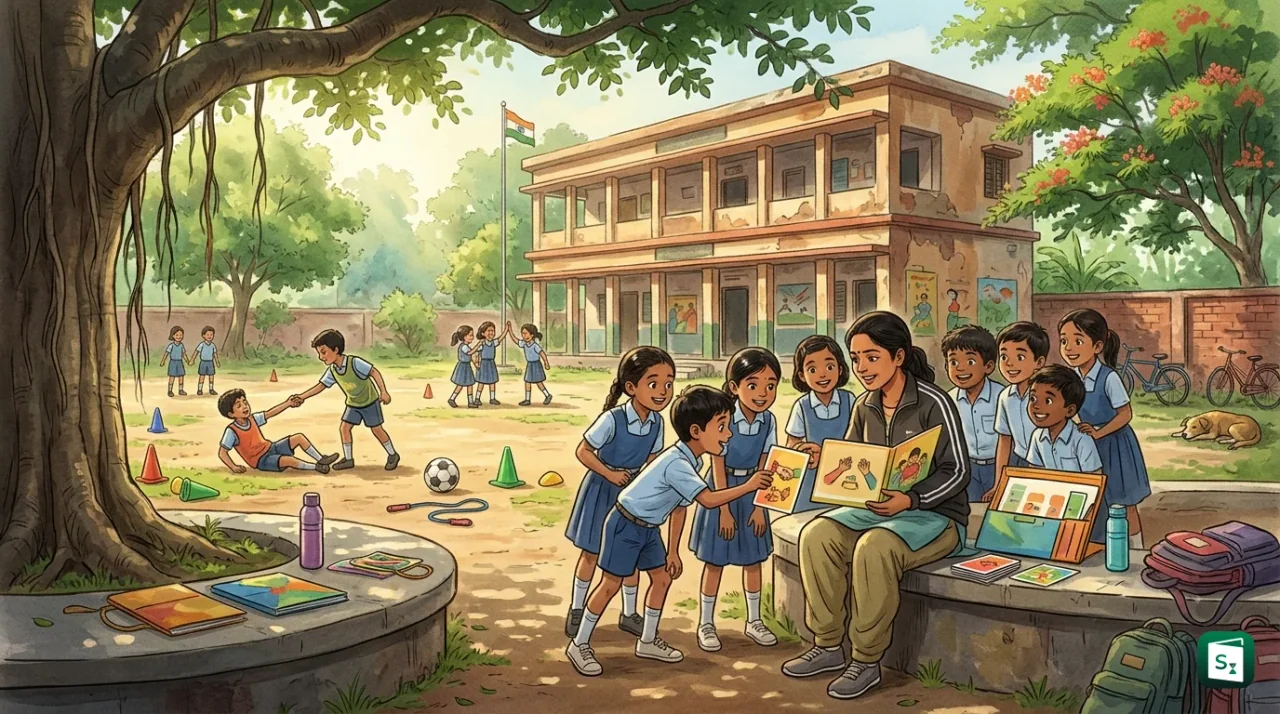
The Ministry of Youth Affairs and Sports and the Ministry of Education exchanged a Memorandum of Understanding (MoU) with UNESCO on 28 October 2026 to take clean sport values to classrooms across India. The pact was exchanged at the National Anti-Doping Agency (NADA) India’s Clean Sport Conclave in New Delhi and will roll out the Sports Values in Every Classroom Toolkit in 13 Indian languages. The move links school education directly with India’s fight against doping under the Khelo Bharat Niti 2025.
What Is Clean Sport?
Clean sport means competing without using banned drugs or banned methods and respecting the rules, fellow players and officials. The World Anti-Doping Agency (WADA), the global body that sets anti-doping rules, defines clean sport through its World Anti-Doping Code and the annual Prohibited List of substances and methods that athletes must not use.
Promoting clean sport is important because doping harms the health of athletes and destroys trust in competition. An athlete who uses steroids or stimulants gains an unfair edge. The damage goes beyond one medal. It discourages honest young players, misleads the public and exposes children to unsafe practices like untested supplements. Starting this lesson in school helps children learn to play fairly even when nobody is watching.
What Is UNESCO?
The United Nations Educational, Scientific and Cultural Organization (UNESCO) is an agency of the United Nations that builds peace through cooperation in education, science, culture and communication. The UNESCO constitution was signed on 16 November 1945 and came into force on 4 November 1946. UNESCO is headquartered in Paris, France.
UNESCO works with 194 Member States to set standards, share knowledge and run country programmes in schools, science and heritage. The UNESCO Regional Office for South Asia, based in New Delhi, handles UNESCO programmes in India and the neighbourhood. The Director of this office is Tim Curtis, who was present at the MoU exchange in New Delhi.
UNESCO also leads the global legal fight against doping. The International Convention Against Doping in Sport was adopted by UNESCO on 19 October 2005 and came into force on 1 February 2007. India signed the Convention in 2005 and ratified it on 7 November 2007. The Convention asks governments to pass anti-doping laws, limit trafficking of banned substances, support testing and run education programmes. It accepts the WADA Code as the common rulebook and attaches two WADA documents as annexes, the Prohibited List and the Standards for Granting Therapeutic Use Exemptions.
What Is the Sports Values in Every Classroom Toolkit?
The Sports Values in Every Classroom Toolkit is a free, cross-curricular teaching resource that helps teachers build ethical behaviour through movement-based lessons. UNESCO published the toolkit in 2019 after a pilot run in 2018 to 2019 through the UNESCO Associated Schools Network in countries including Bangladesh, Brazil, Cuba, Greece, Mexico, Nigeria and Spain. The original version was designed for students aged 8 to 12 years, though teachers have also used it with slightly younger and older groups.
The toolkit focuses on three core values. Respect means showing dignity for self and others. Equity means giving every child a fair chance to achieve. Inclusion means ensuring everyone can take part. In the Indian classroom context, the same ideas are described as respect, integrity and fairness, which link directly to clean sport and daily conduct in school and on the playground.
Six international sport and education partners created the toolkit together. UNESCO led the work with the World Anti-Doping Agency (WADA), the Olympic Foundation for Culture and Heritage, the Agitos Foundation linked to Paralympic sport, the International Fair Play Committee and the International Council of Sport Science and Physical Education.
| Toolkit Component | What It Contains |
|---|---|
| 30 Activity Cards | Complete lesson plans that can be used in a classroom, gymnasium or outdoor space, alone or with the existing syllabus |
| Quick Guide | A short introduction to the values and how to use the cards |
| Teacher’s Companion | Academic background, reflection questions and sample rubrics for assessing values |
| Greeting Cards and Folder | Ready material to organise lessons and encourage discussion |
The activities are flexible by design. Teachers can change equipment and rules to suit local conditions. A lesson might ask children to spot respectful words, solve an ethical dilemma in a game or redesign a play activity so a child with a disability can join fully.
What the New MoU Will Do
The Ministry of Youth Affairs and Sports, the Ministry of Education and UNESCO exchanged the MoU on 28 October 2026 at the Clean Sport Conclave organised by NADA India in New Delhi. Union Minister of Youth Affairs and Sports Mansukh Mandaviya and Union Minister of Education Pralhad Joshi were present with UNESCO Regional Director Tim Curtis. Senior officials including School Education Secretary T K Anil Kumar, Sports Secretary Hari Ranjan Rao and NADA Director General Anant Kumar attended the event with international delegates who had taken part in UNESCO anti-doping meetings a day earlier.
The MoU puts the Sports Values in Every Classroom Toolkit into Indian schools. Video modules will be made available in 13 Indian languages so the lessons reach students across states. Teachers will use the material in regular classes, sports periods and everyday classroom activities to build habits of respect, integrity and fairness from an early age. The focus is on classroom practice. Teachers bring the values alive in how children talk, share equipment and behave in the schoolyard.
The partnership directly supports the Khelo Bharat Niti 2025. The Union Cabinet approved this policy on 1 July 2025 to replace the National Sports Policy 2001. The Niti treats integration of sports with education as a central pillar in line with the National Education Policy (NEP) 2020. It calls for sports in school curricula, trained physical education teachers and schools that act as feeder centres for sporting talent.
Why Clean Sport Education Matters for India
India’s sporting results have improved sharply. India finished fourth in the medal tables at both the Asian Games and the Asian Para Games, which reflects a larger pool of athletes and stronger support systems. The same growth has increased the pressure to win. Doping cases among Indian athletes have stayed high, and India has ranked among the countries with the largest number of anti-doping rule violations in WADA reports in recent years. Easy access to steroids and poorly labelled supplements adds to the risk.
When Was NADA India Established?
The National Anti-Doping Agency (NADA) India was set up as a registered society on 24 November 2005 to promote, coordinate and monitor doping control in Indian sport. NADA India is headquartered in New Delhi and functions under the Ministry of Youth Affairs and Sports. Parliament later gave NADA India statutory backing through the National Anti-Doping Act, 2022.
NADA India implements the national anti-doping programme. Its work covers sample collection, result management, education and awareness, research, and intelligence and investigations. During 2025 to 2026, NADA India conducted more than 7,000 tests and over 350 education and awareness sessions for 27,000 participants. To curb accidental violations, supplement testing facilities have been created at the National Forensic Sciences University in Gandhinagar and the National Institute of Pharmaceutical Education and Research in Hyderabad.
The legal framework comes from the National Anti-Doping Act, 2022, which received assent on 12 August 2022. The Act constitutes NADA India as a body corporate and gives effect to the UNESCO Anti-Doping Convention that India ratified in 2007. The government has stated that the Act came into force in 2026 and that provisions to criminalise organised doping activities are being prepared for Parliament. Early value education in schools is meant to support this system of testing, law and investigation by reducing demand for banned methods at the start of an athlete’s journey.
Ministry of Youth Affairs and Sports and the Larger Sports Push
The Ministry of Youth Affairs and Sports is the nodal ministry for sports development in India. It runs the Khelo India Scheme for grassroots talent search, training and infrastructure, the Target Olympic Podium Scheme (TOPS) for elite athletes and assistance to National Sports Federations. NADA India works as an autonomous body under this ministry.
Two national missions give context to the classroom move. The Fit India Movement, launched on 29 August 2019 on National Sports Day, encourages daily fitness and mass participation through schools, colleges and workplaces. The Khelo India Youth Games, held every year, provide a national stage for young athletes. The 2026 edition keeps the focus on early talent spotting. By adding the UNESCO toolkit to schools, the government wants the same young population to combine performance with integrity as India prepares for larger goals including the bid for the 2036 Olympic Games.
Key Takeaways
- The Ministry of Youth Affairs and Sports, the Ministry of Education and UNESCO exchanged an MoU on 28 October 2026 at NADA India’s Clean Sport Conclave in New Delhi.
- The MoU will roll out the Sports Values in Every Classroom Toolkit in 13 Indian languages to teach respect, integrity and fairness to school children.
- The toolkit was published by UNESCO in 2019 for students aged 8 to 12 years and contains 30 activity cards, a Quick Guide and a Teacher’s Companion.
- UNESCO, the United Nations Educational, Scientific and Cultural Organization, was created in 1945 and is headquartered in Paris with 194 Member States.
- NADA India was set up on 24 November 2005 and became a statutory body under the National Anti-Doping Act, 2022, conducting over 7,000 tests in 2025 to 2026.