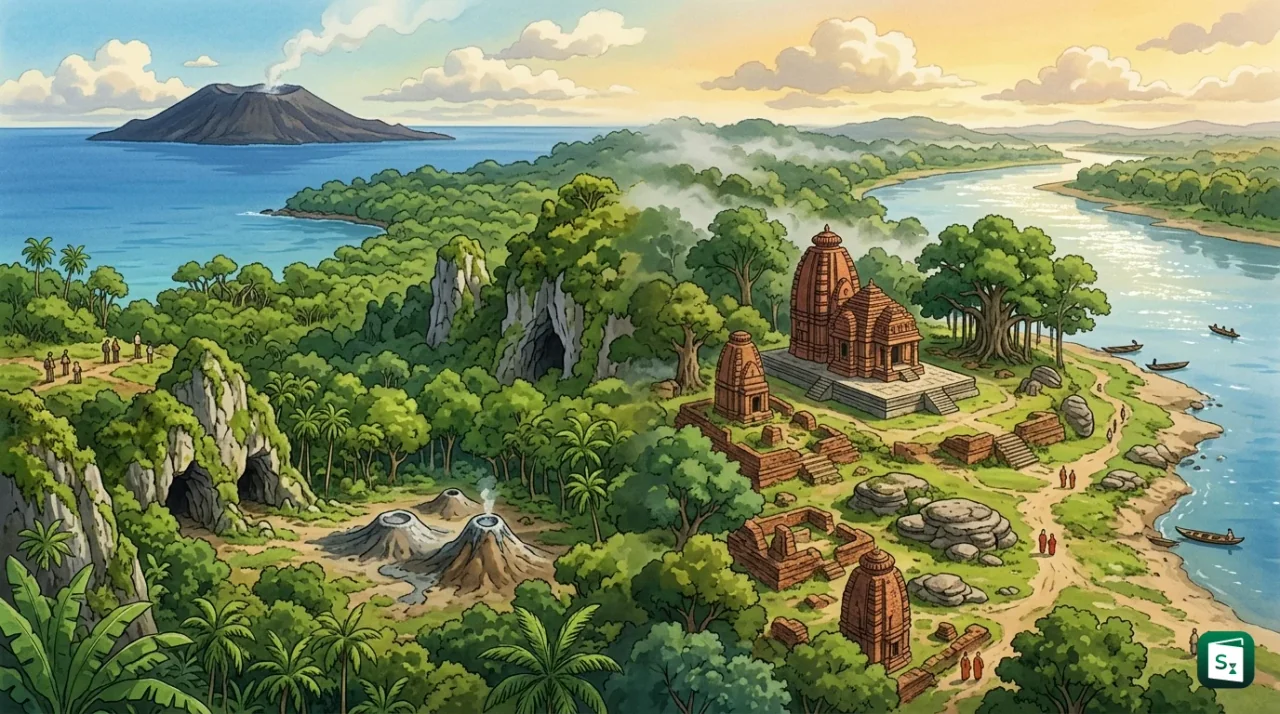
The Permanent Delegation of India to UNESCO in Paris announced on 20 October 2026 the addition of three Indian sites to the UNESCO World Heritage Tentative List. The new entries are the Karst-mud-volcano Complex of Baratang and the Andaman Subduction Volcanoes in the Andaman and Nicobar Islands, and the Sirpur Cultural and Archaeological Landscape in Chhattisgarh. With this addition, India’s tentative count has risen to 81 sites, the compulsory waiting list from which future World Heritage nominations must be chosen.
What Is the UNESCO Tentative List?
The UNESCO Tentative List is an official inventory of properties within a country that the country considers suitable for future nomination to the UNESCO World Heritage List. A site must appear on this inventory before the World Heritage Committee can examine its nomination dossier, and the inventory broadly signals what a country may propose in the next five to ten years.
The United Nations Educational, Scientific and Cultural Organization (UNESCO) was established in 1945 and is headquartered in Paris, France. The World Heritage Convention, adopted in 1972, is the legal treaty that creates the World Heritage system. The World Heritage Centre in Paris manages the tentative lists and nomination files, while the intergovernmental World Heritage Committee takes the final decision on inscription. Only countries that have signed the Convention, called States Parties, can submit tentative list entries and nominations.
Inclusion on the Tentative List does not give World Heritage status. It only opens the door. The country must then prepare a detailed nomination dossier that proves Outstanding Universal Value, authenticity and integrity, and a strong protection and management plan. The dossier is checked by advisory bodies, the International Council on Monuments and Sites (ICOMOS) for cultural sites and the International Union for Conservation of Nature (IUCN) for natural sites, before the Committee votes at its annual session.
Three New Sites Take India’s Tentative Count to 81
The Permanent Delegation of India to UNESCO submitted the three proposals on 28 September 2026. The Delegation announced their acceptance on 20 October 2026 and thanked the Archaeological Survey of India (ASI) for preparing the documentation and research. ASI, established in 1861 by Alexander Cunningham and headquartered in New Delhi, functions under the Ministry of Culture as the nodal agency for archaeological heritage in India.
With these additions, India’s Tentative List now holds 81 entries, comprising 59 Cultural, 3 Mixed and 19 Natural sites. The balance shows the weight of India’s built heritage, while the two new natural entries strengthen the smaller natural portfolio from island geology.
| New Entry | Location | Category and Proposed Criteria |
|---|---|---|
| Karst-mud-volcano Complex of Baratang | South-west Baratang Island, Andaman and Nicobar Islands | Natural, criteria (viii), (ix), (x) |
| Andaman Subduction Volcanoes (Barren and Narcondam Islands) | Andaman Sea, Andaman and Nicobar Islands | Natural, criteria (vii), (viii), (ix), (x) |
| Sirpur Cultural and Archaeological Landscape | Mahasamund district, Chhattisgarh, east bank of Mahanadi River | Cultural, criteria (ii), (iv) |
The criteria numbers refer to UNESCO’s ten selection tests. Cultural criteria (i) to (vi) cover human creativity, interchange of values and architectural ensembles. Natural criteria (vii) to (x) cover natural beauty, earth history, ecological processes and biodiversity habitats. A site must meet at least one criterion along with conditions of protection and management.
Sirpur Cultural and Archaeological Landscape in Chhattisgarh
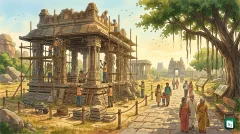
The Sirpur Cultural and Archaeological Landscape is a riverine urban settlement on the eastern bank of the Mahanadi River in Mahasamund district, about 78 km from Raipur. Ancient inscriptions call the town Shripura or Sripura. It served as the capital of the Kosala or Dakshina Kosala kingdom, first under the Sharabhapuriya dynasty and later under the Panduvamshi and Somavamshi rulers, and flourished between the 5th and 12th centuries CE. The site is already a nationally protected monument.
Sirpur matters because three faiths grew together inside one planned town. Excavations have revealed 22 Shiva temples, 5 Vishnu temples, 10 Buddhist viharas and 3 Jain viharas, along with stupas, meditation cells, a palace complex, a market, residential quarters, ghats and a water management system. Shaiva and Vaishnava shrines stand close to Buddhist monasteries and Jain structures. This mix shows sustained religious tolerance and artistic exchange rather than separate phases of occupation. The Mahanadi acted as a trade corridor linking central India, eastern India, the Deccan and the Bay of Bengal region, so merchants, pilgrims and artisans moved through Sirpur and shaped its growth.
The headline monument is the Lakshmana Temple, dated to 595 to 605 CE. It is a brick temple dedicated to Vishnu and ranks among the finest early brick temples in India. The sanctum doorway shows Vishnu reclining on the serpent Sesha, known as Anantasayana, with bands of the ten avatars of Vishnu. The Surang Tila complex stands on a high terrace reached by 37 steps and follows the panchayatana plan, which means one central shrine with four smaller shrines around it. The Tivaradeva Mahavihara preserves a large Buddha image and copper plate records of King Mahashivagupta Balarjuna, a Shaiva ruler who still patronised Buddhist monasteries. The proposed core zone groups nine components, including the Lakshmana Temple, Rama Temple, Gandheshwar Temple, Anandaprabhu Kuti Vihara, Swastik Vihara, Market Complex, Rajmahal palace, Harshagupta and Tivaradeva Viharas, and the Baleshwar group.
The natural setting adds another layer. Sirpur lies inside the Proterozoic Chhattisgarh Basin, shaped by the Raipur Limestone Group. The landscape contains stromatolites, layered rocks formed over a billion years by cyanobacteria, which are tiny organisms that trap sediment in shallow water. Builders used this local stromatolitic stone in temples and monasteries, so geology and architecture share the same material. The buffer zone includes living villages with about 300 houses and communities such as the Gond and Baiga tribes, plus the nearby Barnawapara Wildlife Sanctuary, which links ancient remains with a living cultural and natural setting.
History records Sirpur’s fame early. The Chinese pilgrim Xuanzang visited in 639 CE and described nearly 100 monasteries housing about 10,000 Mahayana monks alongside more than 100 temples. Alexander Cunningham, the first Director General of ASI, documented the Lakshmana Temple in 1882 and brought Sirpur to global attention. Systematic digging began in 1953 to 1956 under M. G. Dixit, followed by major campaigns in 1999 to 2003 and 2004 to 2012 that uncovered mounds, the sixth century market and bath house, coins, statues and bronze images. UNESCO records the proposal under criterion (ii) for interchange of human values in architecture, town planning and sacred art, and criterion (iv) for an outstanding ensemble that illustrates a major stage in early medieval Indian urban life.
Karst Mud Volcano Complex of Baratang
The Karst-mud-volcano Complex of Baratang combines two landforms in one compact area on Baratang Island in the Andaman and Nicobar Islands. Baratang covers 299.57 sq km and sits about 100 km north of Sri Vijaya Puram on the Great Andaman chain, between South Andaman and Middle Andaman. The proposed complex lies in the south western part of the island and pairs a one sq km limestone cave system with a 1.23 hectare mud volcano field near Jarawa Creek.
Karst is a landscape formed when rainwater slowly dissolves soluble rock such as limestone. The Baratang limestone built up over millions of years from compacted shells, corals and skeletal fragments of marine life. Dissolution created a rugged surface with deep clefts, narrow fissures and hidden caverns up to 76 metres above sea level. Below lie tunnels and caverns decorated with speleothems, which are mineral deposits such as stalactites hanging from roofs and stalagmites rising from floors. Most caves remain hard to reach, which has kept them largely intact for science.
The mud volcanoes, called Jalki by local people, work very differently from lava volcanoes. A mud volcano is a vent that pushes out cool slurry of mud, water and gases, mainly methane and hydrogen sulphide, without magma. At Baratang, overpressured shale layers move upward along fault zones that run mainly north east to south west, a process called diapiric movement. The field holds four clusters of small vents that build low cones about two metres high, bubbling pools and dried crater fields. The mud fluid is weakly alkaline, with surface temperature between 29.39 and 30.07 degrees Celsius and pH between 8.0 and 8.3. After about 20 years of quiet, the volcanoes erupted again in 2025. Researchers study changes in vent gases as a possible tool for earthquake prediction, because the vents respond to tectonic stress.
The tectonic setting explains why both features occur together. The Andaman and Nicobar Islands form an outer arc accretionary wedge, which is a pile of sea floor sediment scraped off a sinking plate, created as the Indian Plate slides beneath the Burma microplate. The ridge also exposes Upper Cretaceous ophiolites, which are slices of ocean crust and mantle pushed onto land, linking the islands to the Arakan Yoma and Indo Burman ranges. The site is protected inside the Baratang Reserve Forest and Jarawa Tribal Reserve, managed under the Forest Department Working Plan, and the Geological Survey of India (GSI), established in 1851 and headquartered in Kolkata, recognised the mud volcano as a Geo Heritage Site in 2025. UNESCO lists the complex under criteria (viii) for earth history and landforms, (ix) for ongoing ecological processes and (x) for habitats and biodiversity.
Andaman Subduction Volcanoes: Barren and Narcondam Islands
The Andaman Subduction Volcanoes proposal groups Barren Island and Narcondam Island in the Andaman Sea. The two islands are the only Quaternary period subduction volcanoes, meaning volcanoes formed in the last about 2.6 million years, in the inner arc of the 5,000 km long Burma Andaman Java complex. Here the oceanic part of the Indian Plate sinks beneath the Burma microplate. That steady collision feeds magma and shapes island ecology. Early scientists Hobday and Mallet first described the pair in 1885, and isolation has kept both islands valuable as natural laboratories.
Barren Island shows the active side of the story. The island covers 8.34 sq km and lies about 138 km north east of Sri Vijaya Puram. It rises to 354 metres above sea level and holds a two km wide caldera, which is a large basin left when a volcano summit collapses. The lavas are mainly basalt and basaltic andesite. Barren Island is South Asia’s only active volcano and India’s only confirmed active volcano. Its first recorded eruption dates to 1787. After nearly 150 years of quiet, it erupted in 1991, 1994 to 1995 and 2005 to 2007, with the last phase possibly linked to the 2004 Indian Ocean earthquake. Mild activity followed in 2008 to 2010, ash emissions in 2017, gas release in 2022, two mild eruptions in September 2025 and an ash plume rising to 1.2 km on 10 January 2026. The island is uninhabited and protected as the Barren Island Wildlife Sanctuary. Frequent eruptions reset life, so the island demonstrates primary succession, where pioneer plants and animals colonise fresh lava. Feral goats left by British sailors in 1891 survived on springs and sparse plants, while surrounding clear waters support corals and attract divers.
Narcondam Island shows the dormant side. The island covers 6.8 sq km and lies about 240 km north east of Sri Vijaya Puram. Its name comes from Naraka Kundam, which means a pit of hell. The cone rises sharply from deep water to 710 metres, with steep forested slopes, rocky shores and caverns. There is no summit crater today, only three hummocks left from older eruptions. The rocks are dacite, andesite and rhyolite with signs of mantle and crustal mixing, and the crust below is continental to transitional, unlike the oceanic crust under Barren Island. Dormancy over an estimated 18,000 to 20,000 years has allowed climax forest to develop.
Narcondam’s isolation created unique wildlife. The island is the only home of the Narcondam hornbill (Rhyticeros narcondami), which has the smallest range among Asian hornbills. About 1,000 birds survive. The species is listed as Vulnerable on the IUCN Red List and receives the highest protection under Schedule I of the Wild Life (Protection) Act, 1972. The Narcondam shrew (Crocidura narcondamica), discovered in 2021, is also found only here. Around 50 bird species, eight reptiles and several spiders and butterflies have been recorded. The island is recognised as an Important Bird Area and a Key Biodiversity Area, and it lies on the East Asian Australasian Flyway used by migratory birds. People never settled here. A small police post with about 20 personnel was set up in 1968, tourism is not allowed, and research visits remain limited. UNESCO records this pair under criteria (vii) for natural beauty, (viii) for earth history, (ix) for ongoing evolution and (x) for conservation of threatened species.
UNESCO World Heritage Sites in India and How Nomination Works
India currently holds 45 UNESCO World Heritage Sites, comprising 37 Cultural, 7 Natural and 1 Mixed site. The Mixed site is Khangchendzonga National Park in Sikkim, recognised for both nature and Tibetan Buddhist sacred landscape. This tally places India sixth in the world and second in the Asia Pacific region. The first Indian inscriptions came in 1983 with the Ajanta Caves, Ellora Caves, Agra Fort and Taj Mahal. The latest inscription is the Ancient Buddhist Site of Sarnath in Uttar Pradesh, added on 25 July 2026 at the 48th session of the World Heritage Committee in Busan, South Korea. Sarnath preserves the Deer Park where the Buddha gave his first sermon in the sixth century BCE. The previous addition was the Maratha Military Landscapes in Maharashtra and Tamil Nadu at the 47th session in Paris.
| Level | India’s Position (as of October 2026) |
|---|---|
| World Heritage Sites inscribed | 45 (37 Cultural, 7 Natural, 1 Mixed) |
| Tentative List entries | 81 (59 Cultural, 3 Mixed, 19 Natural) |
| Global rank | 6th, 2nd in Asia Pacific |
| Nominations allowed per year | One site per country |
The path from tentative list to inscription is long. The country first revises its tentative inventory, ideally every ten years, with participation of site managers, local governments, communities and experts. The World Heritage Centre must receive the tentative entry before any further step. The country then seeks a mandatory Preliminary Assessment to test whether Outstanding Universal Value is plausible. A full nomination dossier follows and must reach the Centre by 1 February of Year One. ICOMOS and IUCN evaluate the file over about 14 months, visit the site and issue recommendations in May or June of Year Two. The World Heritage Committee then decides to inscribe, defer, refer or reject. Each country may normally put forward only one nomination per annual cycle.
For India, the three new entries widen both science and heritage policy. The Baratang caves and mud volcanoes support geotourism that already provides income to local operators, while strict Reserve Forest rules protect the caves and the Jarawa Tribal Reserve. Barren and Narcondam islands offer rare field sites for volcanology, island biogeography and climate linked succession studies. Sirpur connects monument conservation with riverine landscape planning, village livelihoods and wildlife buffer management around Barnawapara. All three will now need upgraded management plans, monitoring of integrity and community participation before any of them can move to a full nomination.
Key Takeaways
- India’s UNESCO Tentative List rose to 81 sites on 20 October 2026 after three new entries were accepted.
- The Sirpur Cultural and Archaeological Landscape in Mahasamund, Chhattisgarh is a 5th to 12th century capital of Dakshina Kosala proposed under criteria (ii) and (iv).
- The Karst-mud-volcano Complex of Baratang pairs limestone caves with Jalki mud volcanoes that erupted again in 2025 after 20 years of dormancy.
- The Andaman Subduction Volcanoes combine Barren Island, South Asia’s only active volcano, with dormant Narcondam Island, home to the Narcondam hornbill.
- India holds 45 World Heritage Sites (37 Cultural, 7 Natural, 1 Mixed), with Sarnath inscribed in July 2026 as the latest addition.
- A site must appear on the Tentative List before nomination, with dossiers judged by ICOMOS and IUCN and decided by the World Heritage Committee.