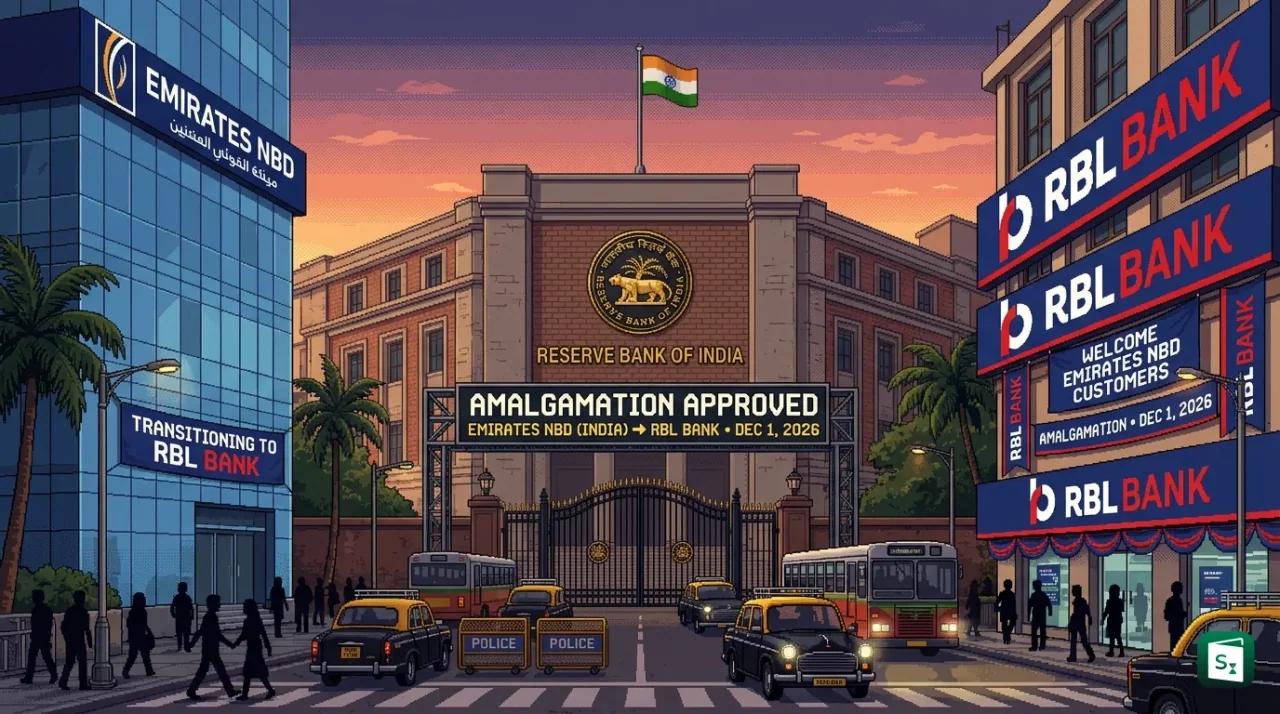
The Reserve Bank of India has sanctioned the amalgamation of the Indian branches of Emirates NBD Bank PJSC with RBL Bank Ltd, effective December 1, 2026. From that date, all three Emirates NBD branches in India will function as branches of RBL Bank. The approval completes the consolidation that began when Emirates NBD acquired a 60 percent stake in RBL Bank in June 2026 for about ₹26,000 crore.
What Is the RBI Approval for the Emirates NBD RBL Bank Amalgamation?
The Emirates NBD RBL Bank merger is the amalgamation of the India branches of Emirates NBD Bank PJSC with RBL Bank Ltd, sanctioned by the Reserve Bank of India on 16 October 2026 with an effective date of December 1, 2026. From that date, all Emirates NBD branches in India will operate as RBL Bank branches.
The Reserve Bank of India issued the sanction under sub-section (4) of Section 44A of the Banking Regulation Act, 1949. The order names Emirates NBD Bank PJSC India branches as the Transferor Bank and RBL Bank Ltd as the Transferee Bank. Transferor means the entity giving its business. Transferee means the entity receiving it. Once the order takes effect, the property, assets and liabilities of the India branches will vest in RBL Bank as a going concern.
The scope is small in branch numbers but large in policy meaning. Emirates NBD operates only three branches in India, located in Mumbai, Gurugram and Chennai. All three will become part of the RBL Bank network on December 1, 2026. RBL Bank, by contrast, operated 603 branches at the end of March 2026 and 628 branches as of 30 June 2026 across 28 states and union territories. The addition does not materially change RBL Bank branch count. It ends dual presence.
What Is Amalgamation and How Does RBI Approve Bank Mergers?
Amalgamation is the legal combination where one banking company transfers its entire business, including assets, deposits and liabilities, into another banking company and ceases to operate separately. A Scheme of Amalgamation is the written document that sets out the terms, including the appointed date, valuation and share consideration.
Bank mergers in India between two banking companies are governed by Section 44A of the Banking Regulation Act, 1949. The Act is the principal law for regulation of banks in India. The process has three clear stages. First, the boards of both banks must approve the draft scheme by a two-thirds majority of total board members. The boards must examine valuation, due diligence, swap ratio, impact on profitability and capital adequacy, and board composition.
Second, shareholders of each bank must approve the draft scheme by a resolution passed by a majority in number representing two-thirds in value of shareholders present in person or by proxy. The ceiling on voting rights under Section 12(2) applies when votes are counted on poll. Any shareholder who votes against the scheme can claim the value of shares as determined by the Reserve Bank of India within three months of sanction. That determination is final.
Third, the approved scheme is submitted to the Reserve Bank of India for sanction. If the Reserve Bank of India sanctions it by a written order, the order is binding on both banks and all shareholders. The property vests in the acquiring bank by virtue of the order itself. Detailed procedure is laid down in the Reserve Bank of India (Amalgamation of Private Sector Banks) Directions, 2016 and now consolidated in the Reserve Bank of India (Commercial Banks, Voluntary Amalgamation) Directions, 2025.
Bank mergers generally happen to gain scale, strengthen capital, widen branch and customer reach, and remove duplication. In the case of a foreign bank that buys a stake in an Indian bank, amalgamation also enforces the single mode of presence principle. The principle requires a foreign bank to operate in India either through branches or through a subsidiary, not both at the same time.
RBL Bank: From Ratnakar Bank to a Foreign Bank Subsidiary
RBL Bank stands for Ratnakar Bank Limited. The bank was incorporated on 14 June 1943 as The Ratnakar Bank Limited under the Indian Companies Act, 1913, and began operations on 6 August 1943 with two branches in Kolhapur and Sangli in Maharashtra. It served small enterprises and traders in the Kolhapur Sangli belt. The bank became a scheduled commercial bank in 1959 and received a banking licence from the Reserve Bank of India in 1970. Its name was changed to RBL Bank Limited on 24 November 2014.
RBL Bank is a private sector scheduled commercial bank headquartered in Mumbai. It is listed on the BSE and NSE under the symbol RBLBANK. On whether RBL Bank is private or government, it is private and not a public sector bank. It offers corporate banking, commercial banking, branch banking, retail assets, treasury and digital payments. The bank is widely known for its credit card portfolio, including co-branded cards, and for its net banking and mobile banking platforms.
The bank now operates as a foreign bank in subsidiary mode. After the June 2026 transaction, Emirates NBD holds 60 percent of the expanded share capital of RBL Bank and has been recognised as its promoter. RBL Bank reported more than 15 million customers, 603 branches and 1,339 business correspondent branches as of 31 March 2026. R Subramaniakumar is the Managing Director and Chief Executive Officer (as of October 2026).
Emirates NBD: From National Bank of Dubai to India
Emirates NBD Bank PJSC is a public joint stock company headquartered in Deira, Dubai, United Arab Emirates. PJSC means Public Joint Stock Company, a company whose shares can be held by the public. The full form of NBD is National Bank of Dubai.
The history begins in 1963. The National Bank of Dubai was established on 19 June 1963 by the then ruler of Dubai, Sheikh Rashid bin Saeed Al Maktoum. It was the first national bank established in the country. Emirates Bank International was established in 1977. On 6 March 2007, the two banks merged to form Emirates NBD. Shares of Emirates NBD were listed on the Dubai Financial Market in October 2007. The largest shareholder is the Investment Corporation of Dubai, which held about 40.92 percent at the end of December 2024.
Emirates NBD is now the leading banking group in the MENAT region. MENAT means Middle East, North Africa and Turkiye. The group serves more than 9 million customers across 13 countries, including the UAE, Egypt, India, Turkiye, Saudi Arabia, Singapore and the United Kingdom. It offers retail, corporate, Islamic, investment, private and treasury services.
In India, Emirates NBD has operated in branch mode with three branches. It entered India much later than its Gulf operations. The 2026 transaction changes that model. Instead of growing through a few foreign branches, Emirates NBD will grow through a large Indian subsidiary bank.
Timeline of the Emirates NBD Acquisition and Branch Merger
The branch amalgamation is the final step of a larger acquisition. The two steps are different. The acquisition gave Emirates NBD ownership in RBL Bank. The amalgamation merges its own India branches into that bank.
The investment agreement was signed on 18 October 2025 between Emirates NBD and RBL Bank. Emirates NBD agreed to subscribe to up to 959,045,636 equity shares of RBL Bank at ₹280 per share through a preferential issue. A preferential issue is a fresh allotment of shares to a selected investor. The agreement also required a mandatory open offer to public shareholders for up to 26 percent of expanded voting capital under the SEBI (Substantial Acquisition of Shares and Takeovers) Regulations, 2011.
Regulatory approvals followed in sequence. The Competition Commission of India (CCI), which examines combinations that could affect competition and is headquartered in New Delhi, approved the combination on 20 January 2026. The Reserve Bank of India gave approval on 1 April 2026 for Emirates NBD to acquire up to 74 percent and hold at least 51 percent of paid up capital. The Government of India gave its approval for investment beyond 49 percent in May 2026. All approvals were received by 15 May 2026.
| Date | Milestone |
|---|---|
| 18 October 2025 | Investment agreement for up to 60 percent stake via preferential issue at ₹280 per share plus open offer |
| 20 January 2026 | CCI approves proposed acquisition of up to 74 percent and not less than 51 percent |
| 1 April 2026 | RBI approves acquisition of up to 74 percent, minimum 51 percent, subsidiary mode, promoter status |
| 15 May 2026 | All regulatory and governmental approvals received |
| 18 June 2026 | Transaction completed, Emirates NBD holds 60 percent after primary infusion of about USD 2.75 billion |
| 16 October 2026 | RBI sanctions Scheme of Amalgamation of India branches with RBL Bank |
| 1 December 2026 | Amalgamation becomes effective, three branches become RBL Bank branches |
The transaction was completed on 18 June 2026 through a primary capital infusion of about USD 2.75 billion, or about ₹26,000 crore. Emirates NBD acquired 60 percent of the expanded share capital. The deal is described as the largest foreign direct investment in the Indian banking sector and the largest equity fund raise in the sector. It is also the first acquisition of a majority interest in a profitable Indian bank by a foreign bank.
The Reserve Bank of India approval of April 2026 set three important conditions. First, RBL Bank will be classified as a foreign bank in subsidiary mode with Emirates NBD as its parent foreign bank. Second, Emirates NBD voting rights will remain capped at 26 percent under Section 12(2) of the Banking Regulation Act, 1949, even though its shareholding is higher. Third, Emirates NBD was exempted from the single mode requirement only until its India branches are amalgamated, or within one year, whichever is earlier. The December merger satisfies that condition.
Under the draft scheme, the appointed date is 1 April 2026. RBL Bank will issue 8,70,89,286 equity shares of face value ₹10 each to Emirates NBD UAE as consideration for transfer of the branch undertaking, based on independent valuation.
What Changes for Customers and Depositors?
A common question is RBL Bank merged with which bank. The answer is that RBL Bank has not been merged into another bank. The India branches of Emirates NBD have merged into RBL Bank. Customers of those three branches will become customers of RBL Bank from December 1, 2026. Their branch name will change to RBL Bank. The Reserve Bank of India order of October 2026 did not announce any immediate change to account numbers, cards, interest rates or charges. Customers should follow notices from RBL Bank for any change in IFSC, internet banking login or branch procedures.
On whether RBL Bank is safe for fixed deposits, RBL Bank is a scheduled commercial bank regulated by the Reserve Bank of India. All commercial banks, including branches of foreign banks, are insured by the Deposit Insurance and Credit Guarantee Corporation (DICGC). DICGC is a wholly owned subsidiary of the Reserve Bank of India, established in 1961 and headquartered in Mumbai. It insures savings, fixed, current and recurring deposits up to a maximum of ₹5,00,000 per depositor in the same right and capacity, covering principal and interest. The limit applies across all branches of the same bank combined.
For RBL Bank credit card, net banking and corporate banking users, continuity is expected. RBL Bank has a large card base and its RBL Bank net banking, RBL Bank BillDesk payment facility and mobile app MyCard remain central to retail servicing. The capital infusion of about ₹26,000 crore has strengthened the capital base. Credit rating agencies including CRISIL, ICRA and CARE have assigned AAA stable ratings to RBL Bank instruments. A stronger capital position helps lending growth, branch expansion and digital investment. RBL Bank has stated a plan to add 200 branches in FY27 to cross 800 branches.
Key Takeaways
- The Scheme of Amalgamation of Emirates NBD Bank PJSC India branches with RBL Bank Ltd becomes effective on December 1, 2026.
- The sanction was issued by the Reserve Bank of India on 16 October 2026 under Section 44A(4) of the Banking Regulation Act, 1949.
- Three Emirates NBD branches in Mumbai, Gurugram and Chennai will function as RBL Bank branches after the merger.
- Emirates NBD completed acquisition of 60 percent of RBL Bank on 18 June 2026 for about ₹26,000 crore at ₹280 per share.
- RBL Bank stands for Ratnakar Bank Limited, founded in 1943 in Maharashtra and renamed in 2014, and is now a private bank in foreign subsidiary mode.
- Deposits in RBL Bank remain insured by the DICGC up to ₹5,00,000 per depositor.