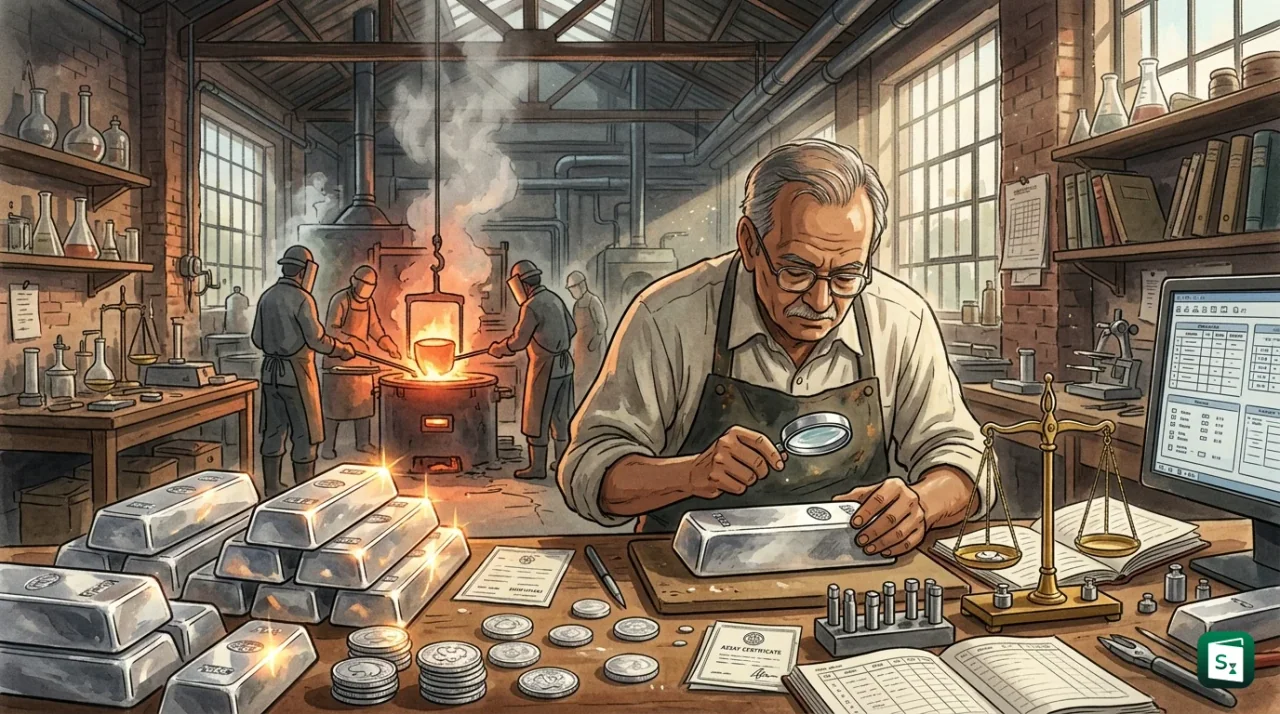
Union Minister Pralhad Joshi launched the BIS Silver Refinery Scheme at the World Standards Day 2026 event in New Delhi on 14 October 2026. The scheme brings silver bullion and coins under a national BIS hallmark framework with assured purity grades of 999.9, 999.5 and 999.0. At the same event, the BIS Digital Standard Reader and seven new Indian Standards were also unveiled.
What Is the BIS Silver Refinery Scheme?
The BIS Silver Refinery Scheme is a certification scheme for silver refineries and mints. The Bureau of Indian Standards (BIS), the national standards body of India working under the Ministry of Consumer Affairs, Food and Public Distribution and headquartered in New Delhi, will operate the scheme. It creates a single national framework for silver purity and extends structured purity assurance and hallmarking to silver bullion and coins across India.
The Bureau of Indian Standards framed the scheme on the pattern of the existing Gold Refinery Scheme. Under the scheme, the Bureau of Indian Standards will grant a licence to a qualified silver refinery or mint after checking its technical competence, refining process and testing infrastructure. Only a licensed refinery or mint can apply the official BIS hallmark to silver bullion and coins that meet the prescribed requirements. A refinery that wants licences for both gold and silver must apply separately for each metal.
The legal base for the scheme is Amendment No. 1 to Indian Standard IS 2112:2025, which covers silver and silver alloys, jewellery and artefacts, fineness and marking. After the gazette notification of this amendment, fine silver bullion and coins were brought within the scope of IS 2112:2025. The standard also lays down strict sampling and testing rules for refineries and mints, including gravimetric testing under IS 2113, the ICP-OES difference method under IS 16900 and the Spark-OES difference method under IS 19563.
What Is BIS Hallmark Silver? Purity Grades and Silver Purity Chart
BIS hallmark silver is silver whose fineness has been tested and officially marked by a Bureau of Indian Standards licensed facility. Silver purity means the amount of pure silver present in 1,000 parts of the metal, expressed as parts per thousand. A grade of 999.9 therefore means 999.9 parts of pure silver in every 1,000 parts.
For silver bullion and coins, the Bureau of Indian Standards has notified only three high purity grades for fine silver. These grades represent 99.9 percent purity and above, which is the level expected in investment grade bars and coins. Jewellery uses lower and wider grades because it needs added metals for strength.
| Silver Product Type | Applicable Purity Grades in Parts Per Thousand | Meaning in Percent |
|---|---|---|
| Silver bullion and coins under Silver Refinery Scheme | 999.9, 999.5, 999.0 | 99.99 percent, 99.95 percent, 99.9 percent |
| Silver jewellery and artefacts under IS 2112:2025 | 800, 835, 925, 958, 970, 990, 999 | 80 percent to 99.9 percent |
Each hallmarked silver bar or coin will carry a standard set of marks for authenticity and traceability. The bar or coin will show the BIS Standard Mark with the word SILVER, the purity grade, the manufacturer identification mark and a unique batch serial number. The serial number allows a specific batch to be traced back through the supply chain. This format is different from silver jewellery hallmarking, where the Bureau of Indian Standards uses a six digit alphanumeric Hallmark Unique Identification (HUID) code that buyers can verify on the BIS CARE App.
How to Check BIS Hallmark on Silver Bullion and Coins
The Bureau of Indian Standards advises buyers to read all four parts of the silver bullion mark before purchase. Buyers should look for the BIS Standard Mark with the word SILVER, the purity grade of 999.9, 999.5 or 999.0, the maker identification mark and the batch serial number. If any of these parts is missing or unclear, the bar or coin should not be accepted as hallmarked silver.
Silver is hallmarked in India, but the rules differ by product. Hallmarking of gold jewellery has been compulsory in a phased manner since 23 June 2021 and now covers 392 districts. Hallmarking of silver jewellery with HUID was introduced on a voluntary basis from 1 September 2025 under the revised IS 2112:2025, though any silver article sent for hallmarking must carry the HUID mark. The new Silver Refinery Scheme for bullion and coins also works through licensing and does not make hallmarking compulsory for every silver bar sold in the market.
Simple home methods cannot confirm exact silver purity. Visual checks, magnet tests or reading the stamp can give hints, but only laboratory assay can prove fineness in parts per thousand. Buyers can get purity verified at any Bureau of Indian Standards recognised Assaying and Hallmarking Centre. There are about 230 such centres for silver across 87 districts, and more than 32 lakh silver jewellery articles were hallmarked in 2024 to 25. For jewellery, the six digit HUID can be checked through the Verify HUID feature on the BIS CARE App, which shows the article type, purity, hallmarking centre and jeweller registration details.
Why a National Framework Was Needed for Silver Bullion
Silver bullion covers large bars, small bars and coins bought for investment, gifting and festive use. Demand rises sharply around the October festive season, when search interest for silver coin prices, 100 gram bars, 1 kilogram bars and bullion prices also peaks. Until now, buyers of bars and coins had no uniform national hallmark to rely on, unlike buyers of gold jewellery who could look for a standard mark and HUID.
The gap mattered because small differences in fineness change value by a large amount when weights are high. A uniform mark reduces disputes over purity, protects buyers from mislabelling and helps honest refineries stand out. Batch serial numbers add traceability across the supply chain, from refining and minting to wholesale dealers and retail sale. This traceability also supports better price discovery for silver bullion price in India and stronger trust in resale.
The framework draws strength from the Bureau of Indian Standards Act, 2016, which came into force on 12 October 2017 and replaced the 1986 Act. The 2016 Act designates the Bureau of Indian Standards as the National Standards Body, allows hallmarking of precious metal articles to be made compulsory and provides for recall of non conforming products and compensation to buyers. Under the BIS Rules, 2018, a buyer who receives a hallmarked article of lower purity than marked is entitled to twice the value of the shortfall plus testing charges. The Silver Refinery Scheme applies this consumer protection logic to the high value bullion segment.
BIS Digital Standard Reader Converts XML Standards Into SMART Standards
The BIS Digital Standard Reader is a web based platform that converts Indian Standards written in XML format into interactive SMART standards. XML means eXtensible Markup Language, a structured digital format for documents. SMART means Standards Machine Applicable, Readable and Transferable, a format that both humans and machines can search, link and reuse.
The Reader is designed to make long technical documents easy to use. Users can search within the text, jump through hyperlinked cross references to related clauses and standards, consult an in built dictionary and translate content into Indian languages. The platform works on mobile phones, tablets and desktops. It also includes an analytics dashboard to track usage trends and creates an AI ready repository for future digital services.
Bureau of Indian Standards Director General Sanjay Garg said the Bureau of Indian Standards is among the first national standards bodies in the world to make both standards development and access completely digital for all stakeholders. The move supports ease of doing business because industry, laboratories, regulators and students can find, understand and apply standards faster. It also fits the wider shift by global bodies such as the International Organization for Standardization toward digitally enhanced content.
Seven New Indian Standards and Roadmaps on World Standards Day 2026
World Standards Day is observed every year on 14 October. The date recalls the first meeting of delegates from 25 countries in London in 1946, which led to the formation of the International Organization for Standardization (ISO) in 1947. The day is jointly promoted by ISO, the International Electrotechnical Commission (IEC) and the International Telecommunication Union (ITU). The first celebration was held in 1970. The 2026 theme was Shared Vision for a Better World with focus on SDG 7 for Affordable and Clean Energy, which links quality standards to safe and efficient energy systems.
The national event in New Delhi was addressed by Union Minister Pralhad Joshi along with Ministers of State B. L. Verma and Nimuben Bambhaniya and Consumer Affairs Secretary Nidhi Khare. The Bureau of Indian Standards released seven new Indian Standards covering textiles, clean mobility, healthcare, robotics and building materials.
| New Indian Standard | Sector and Purpose |
|---|---|
| IS 19967:2026 for cables for electric vehicle charging systems | Defines construction, insulation, thermal management and testing for flexible charging cables up to 1,100 V AC and 1,500 V DC for AC Modes 1 to 3 and DC Mode 4 |
| IS 19891:2026 for pedal assisted bicycles | Sets design, circuit safety, short circuit and overheat protection and anti tampering rules for cycles with continuous power up to 0.25 kW and speed cut off at 25 km per hour |
| IS 17192 Part 6:2026 for wearable lower limb service robots | Adopts global test criteria using anthropomorphic dummies to check motion, stability and performance of assistive and rehabilitation robots |
| IS 19960:2026 for paediatric Panchakarma Droni | Sets safety, stability, non toxic coating and oil resistance norms for treatment tables for infants up to 2 years and children from 2 to 10 years |
| IS 19956:2026 for therapeutic footwear | Sets clinical and mechanical norms for footwear for diabetic and neuropathic patients, covering pressure relief, internal depth, moisture control and antifungal protection |
| IS 19952:2026 for flexible plywood | Sets classification, glue bond grades and formaldehyde emission limits for curved wood panels used in interiors |
| IS 19825:2026 for PVC coated fibreglass insect screens | Sets strength, UV resistance, flame propagation and durability norms for screens used in homes and commercial buildings |
The Bureau of Indian Standards also released standardisation roadmaps for sustainable agriculture and sustainable manufacturing. The agriculture roadmap covers 15 categories including soil, water use, inputs, emerging technologies and climate resilience. It is aligned with the National Action Plan on Climate Change and sets short term goals of one year, medium term goals of two to three years and long term goals of four to five years. The manufacturing roadmap focuses on low carbon technologies, resource efficiency, circular economy practices, product design, sustainability reporting and supply chain management. Sixteen technical committees received the Best Technical Committee Award for their work.
Key Takeaways
- The BIS Silver Refinery Scheme was launched on 14 October 2026 at the World Standards Day event in New Delhi by Union Minister Pralhad Joshi.
- Fine silver bullion and coins are covered in three purity grades of 999.9, 999.5 and 999.0 parts per thousand under Amendment No. 1 to IS 2112:2025.
- Hallmarked silver bullion bears the BIS Standard Mark with the word SILVER, purity grade, manufacturer mark and unique batch serial number.
- The BIS Digital Standard Reader converts XML formatted standards into interactive SMART Standards with search, cross references, dictionary and Indian language translation.
- Seven new Indian Standards including IS 19967:2026 for EV charging cables and IS 19891:2026 for pedal assisted bicycles were released at the same event.
- The Bureau of Indian Standards, established under the BIS Act, 2016 and headquartered in New Delhi, is India’s National Standards Body under the Ministry of Consumer Affairs, Food and Public Distribution.