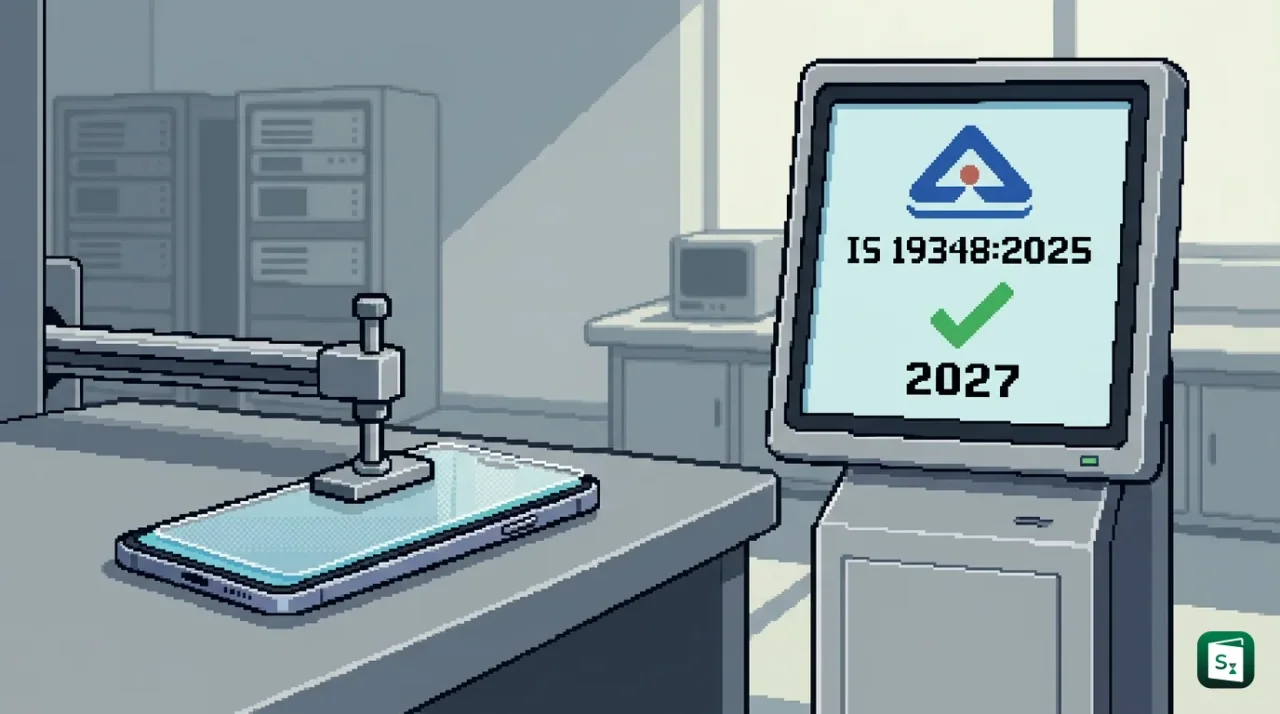
The Ministry of Electronics and Information Technology (MeitY) has brought smartphone screen protectors under mandatory BIS certification through a notification dated 21 September 2026. From 1 April 2027, no screen protector for smartphones can be manufactured, imported or sold in India unless it meets Indian Standard IS 19348:2025 and carries CRS registration. The move makes screen protectors the 66th product category under the Compulsory Registration Scheme and shifts a vast unorganised market toward quality checked, Made in India production.
What Is Mandatory BIS Certification for Screen Protectors?
Mandatory BIS certification means every smartphone screen protector sold in India must be tested, registered and marked as per Indian law. The Bureau of Indian Standards (BIS) is the national standards body of India. BIS certification under the Compulsory Registration Scheme (CRS) allows a manufacturer to use the BIS Standard Mark with a unique registration number, called the R-number, after proving that the product meets the relevant Indian Standard.
The Ministry of Electronics and Information Technology issued the change through a Gazette notification on 21 September 2026. The notification amends the Electronics and Information Technology Goods (Requirement of Compulsory Registration) Order, 2021, which is commonly called the CRO, 2021. It adds one entry to the schedule of the Order, namely Screen Protectors for smartphones, with corresponding standard IS 19348:2025.
The legal effect starts on 1 April 2027. From that date, no person can manufacture or store for sale, import, sell or distribute a smartphone screen protector that does not conform to IS 19348:2025 and does not carry valid CRS registration. The period up to 31 March 2027 is a transition window of more than six months. During this window, makers and importers must get their products tested in BIS recognised laboratories, apply on the BIS CRS portal and obtain registration. The gazette does not order an instant ban or removal of existing stock before that date. It sets a future quality gate that all fresh manufacture, import and sale must cross after the deadline.
Why Is BIS Certificate Required for Screen Protectors?
BIS certificate is required to protect buyers from poor quality products, to ensure safety and clear vision, and to create fair rules for all makers. A screen protector sits directly on the display that a user touches and views for hours each day. If the glass is weak, uneven or optically poor, it can crack easily, reduce touch response, distort colour and brightness, or break into sharp splinters that can injure fingers.
The Indian market is flooded with tempered glass and plastic guards at widely different prices. Many low cost and unbranded protectors enter through imports and grey channels without testing for strength, clarity or safe breakage. The government has taken the view that such unchecked supply is against public interest because it harms consumers and blocks honest domestic producers who invest in quality.
Mandatory certification under the BIS Act, 2016 allows the central government to fix compulsory standards where public interest demands it. For screen protectors, the stated aims are to stop the sale of substandard goods, to give buyers reliable protection against scratches, impact and cracks, and to push the industry toward tested quality. Industry bodies have also supported the step because a common standard creates a level field where Indian factories and global brands follow the same tests and labelling rules.
What Is Indian Standard IS 19348:2025?
Indian Standard IS 19348:2025 is the national specification titled Glass Screen Protector Specification. The Bureau of Indian Standards developed the standard to define quality, sampling and test methods for glass screen protectors used as added protection on electronic displays. The standard covers chemically tempered protectors valued for durability, scratch resistance and clear vision.
The scope of IS 19348:2025 is broad and mentions smartphones, tablets, laptops, PC screens and e-readers. The compulsory order, however, applies the standard at present only to screen protectors for smartphones. Other devices will come under the mandate only if the government adds them separately to the CRO schedule in future.
The standard sets clear goals. It seeks better defence against scratches, impact and cracks through compliant glass. It seeks stable optical clarity so the screen stays bright, responsive and true to colour. It seeks safety by lowering the risk of splinters if the glass breaks. It also seeks trusted quality through certified products that extend device life and reduce repair cost.
| Test Area | What IS 19348:2025 Checks |
|---|---|
| Glass quality | Size, dimensions, glass strength, chemical tempering, surface finish and freedom from warping |
| Optical clarity | Light transmission, haze, visible defects, bubbles, scratches and edge black border uniformity |
| Mechanical strength | Compression, flexural strength, impact resistance and safe breakage with anti shatter behaviour |
| Functional layers | Adhesive quality, anti shatter film, oleophobic coating for smudge resistance, anti glare and blue light filtering where claimed, and privacy film performance where applicable |
| Packaging and marking | Manufacturer name, batch number, thickness, model details and care instructions on the pack |
Manufacturers must meet these requirements and test each model family in BIS recognised laboratories before sale. The pack must disclose key facts such as maker, batch and thickness so buyers and inspectors can trace the product.
How Does the Compulsory Registration Scheme Work?
The Compulsory Registration Scheme, usually shortened to CRS, is a system of self declaration with government oversight for electronics and IT goods. The Ministry of Electronics and Information Technology notifies the products that must comply. The Bureau of Indian Standards tests the system through registration, laboratory checks and use of the Standard Mark.
The legal base is the BIS Act, 2016. Section 16 of the Act lets the central government make the use of the Standard Mark compulsory in public interest after consulting BIS. MeitY first used this power through the Compulsory Registration Order, 2012 for 15 categories such as laptops, tablets and televisions. The list grew in phases in 2014, 2017 and 2020. In March 2021, MeitY replaced the 2012 order with the CRO, 2021 to consolidate and expand coverage. Screen protectors for smartphones now join that order as the 66th category. Other goods already in the schedule include smartphones, laptops, chargers, LED televisions, microwave ovens, printers, set top boxes, CCTV cameras, smart watches and Bluetooth speakers.
BIS operates CRS under Scheme II of the BIS (Conformity Assessment) Regulations, 2018. The process is fully online on the BIS CRS portal. The maker gets the product tested in a BIS recognised lab, submits the test report within 90 days of issue, files Form VI with an affidavit of conformity, pays the fee and receives registration with a unique R-number. Foreign makers without an Indian office must appoint an Authorised Indian Representative. Registration is normally granted for two years and must be renewed every two years. Registered makers can add new models of the same product and brand under the same registration by following series guidelines. Normal processing takes about 20 working days after complete documents reach BIS.
BIS itself has a long history. Standardisation work began with the Indian Standards Institution (ISI), set up on 6 January 1947. The Certification Marks Scheme started in 1955 to 1956 and allowed use of the ISI Mark. Parliament passed the Bureau of Indian Standards Act in 1986, and BIS came into being on 1 April 1987 at Manak Bhavan in New Delhi. BIS now works under the Ministry of Consumer Affairs, Food and Public Distribution. It deals with standards formulation, product certification, compulsory registration, hallmarking of gold and silver jewellery, laboratory services and consumer outreach.
A common doubt concerns BIS, ISI and ISO. The three terms are not the same. The table below states the difference in simple words.
| Term | Full Form and Meaning | Role in This News |
|---|---|---|
| BIS | Bureau of Indian Standards, the national standards body of India | Authority that registers screen protectors and issues the R-number |
| ISI Mark | Indian Standards Institution mark, now the BIS Standard Mark for certified products | The quality mark buyers will see on compliant packs, often with the R-number |
| ISO | International Organization for Standardization, a global body that publishes international standards | Not a product certificate for this order. ISO certificates deal with systems or global norms, while BIS registration proves compliance with the Indian Standard |
Screen Protector Versus Tempered Glass and Common Product Types
A screen protector is a thin added layer fixed on a display to guard against scratches, smudges and breakage. The phrase screen guard is widely used in Indian shops with the same meaning and usually refers to a low cost plastic or glass layer for mobile phones. Tempered glass is one specific type of screen protector. It is glass that has been strengthened by heat or chemical treatment so it resists scratches and absorbs impact better than ordinary glass.
The market sells several variants that will all need to meet IS 19348:2025 if they are sold as smartphone screen protectors. Matte tempered glass has a frosted finish that reduces glare and fingerprints. Privacy tempered glass narrows the viewing angle so neighbours cannot read the screen. Anti glare and anti reflective guards cut reflections in bright light. UV tempered glass uses ultraviolet curing glue for curved displays. Hydrogel and PET film protectors are soft plastic films that resist scratches but offer less impact strength than tempered glass. Camera protectors and full body films are related accessories but the present order names only screen protectors for smartphones.
Buyer interest remains strong in tempered glass for mobiles, matte finish, privacy glass and protectors for laptops and tablets. The compulsory rule at present covers only the mobile phone segment. Laptop screens, tablets, smartwatches and television screens remain outside the mandate until the government extends the schedule. Buyers should therefore check the pack wording. A product labelled for smartphones must carry CRS registration after 1 April 2027, while a film sold only for laptops does not yet need it.
What the New Rule Means for Make in India, Imports and Buyers
The Bureau of Indian Standards lists the order as due for implementation on 1 April 2027 on its upcoming Quality Control Orders page. For domestic manufacturing, the timing links directly to new capacity in Noida. Optiemus Infracom, in partnership with Corning of the United States, has set up tempered glass processing at Noida. Corning supplies the glass while Optiemus carries out chemical processing and finishing. The first plant was built with an initial investment of about ₹70 crore and an annual capacity of 2.5 crore units, with over 600 direct jobs. The company has announced plans for additional capacity of 2 crore units, with shipments expected from January 2027, and a larger second phase to reach 20 crore units with further investment. Its brands RhinoTech and Optisafe target premium and mass buyers and promise BIS compliant marking.
Industry estimates underline why the government sees large stakes. India sells more than 500 million screen protector units in a year. The tempered glass segment alone is placed at about 400 million pieces with a retail value of about ₹20,000 crore in 2025. The India Cellular and Electronics Association has said the certified segment could become a ₹12,000 to ₹16,000 crore quality driven industry, generate about 60,000 direct and indirect jobs and add about ₹2,000 crore in Goods and Services Tax revenue. The shift also supports micro, small and medium enterprises in packaging, logistics, distribution and retail, and opens export scope once Indian plants meet a clear national standard.
For imports, the rule raises the bar. After the deadline, customs and market surveillance can block smartphone protectors without a valid R-number and Standard Mark. Low quality imports, largely sourced through cheap and grey channels, will need testing and registration or will have to exit the smartphone segment. For buyers, quality should improve through tested strength, better light transmission and safer breakage. Prices may see some pressure because testing, registration and better glass add cost, but the gazette itself does not fix prices or name brands for removal. Buyers will gain clearer packs, traceable batches and the option to seek replacement under brand warranties already offered in the premium segment.
How to Check BIS Mark and Verify Certification?
BIS certificate is valid for two years at first and must be renewed every two years. Buyers do not need to remember the dates for each brand. They only need to check the mark and verify it through official tools.
After 1 April 2027, a compliant smartphone screen protector must show the BIS Standard Mark with the R-number on the pack and, where feasible, on the product or leaflet. The pack must also show the maker name, batch number, thickness and model details as required by IS 19348:2025. The BIS logo is the assurance sign. The R-number links that specific factory, brand and product to BIS records.
Buyers can verify the claim in three simple ways. They can search the registration on the BIS CRS portal under registered manufacturers. They can use the BIS Care app, available in Hindi and English on Android and iOS, to check ISI marked and registered products and to file complaints. They can also use BIS certificate check and licence verification pages to confirm the R-number, factory and validity. If a pack shows no mark, shows a fake number or fails verification, buyers should avoid the product and may report it through the BIS Care app.
Key Takeaways
- MeitY added Screen Protectors for smartphones to the CRO, 2021 on 21 September 2026 with effect from 1 April 2027.
- Screen protectors are the 66th product category under the Compulsory Registration Scheme and must meet IS 19348:2025.
- IS 19348:2025 is the Glass Screen Protector Specification covering strength, clarity, safe breakage and pack marking.
- CRS registration is granted for two years and allows use of the BIS Standard Mark with R-number after testing in BIS recognised labs.
- BIS was formed on 1 April 1987 after the BIS Act, 1986, succeeding the Indian Standards Institution set up in 1947, with headquarters at Manak Bhavan, New Delhi.
- Industry estimates point to over 500 million units a year, a potential ₹12,000 to ₹16,000 crore quality industry, about 60,000 jobs and about ₹2,000 crore in GST revenue.