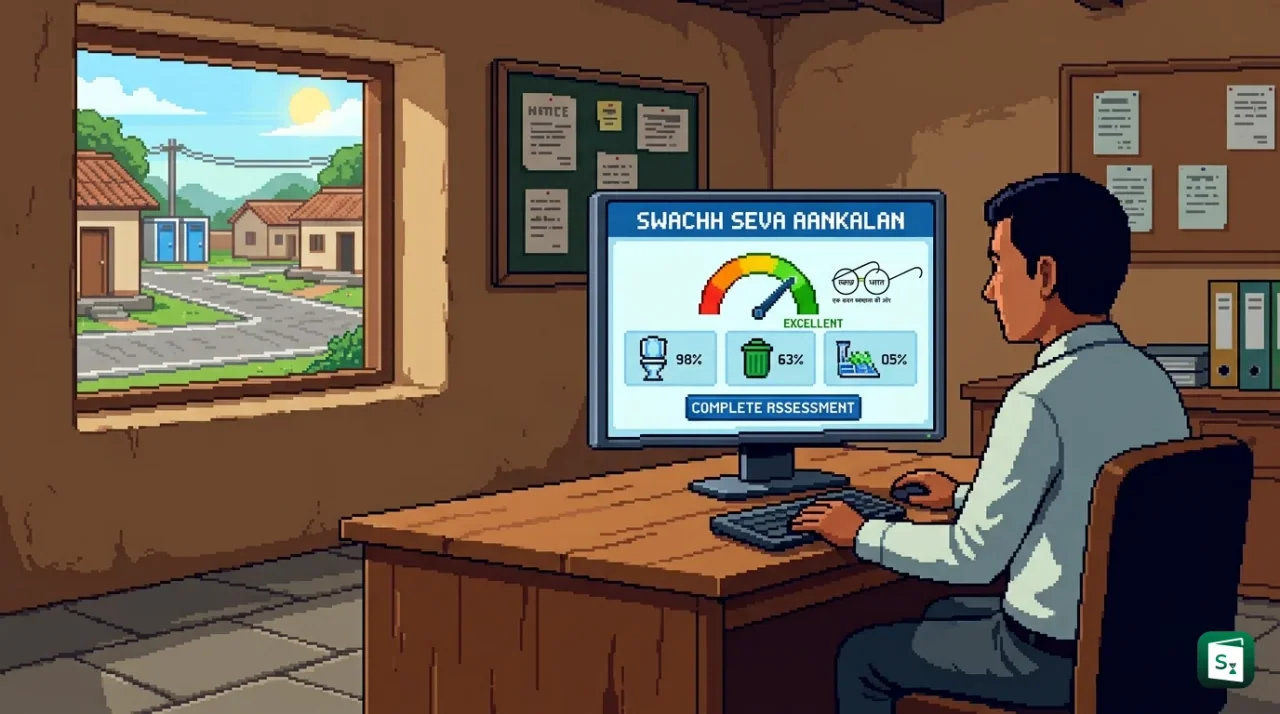
Union Jal Shakti Minister C R Patil launched Swachh Seva Aankalan (SSA) on 15 September 2026 during a virtual meeting with states and Union Territories. The framework is an annual Gram Panchayat level digital self assessment to track sanitation service delivery in rural areas under Swachh Bharat Mission Grameen 2.0. It shifts the focus from one time toilet construction to regular review of cleanliness, waste management and upkeep of assets by villages themselves.
What Is Swachh Seva Aankalan?
Swachh Seva Aankalan is an annual Gram Panchayat level digital self assessment framework developed by the Department of Drinking Water and Sanitation under Swachh Bharat Mission Grameen 2.0. It helps villages assess rural sanitation service delivery, including ODF sustainability, visual cleanliness and solid and liquid waste management.
The Department of Drinking Water and Sanitation (DDWS), which functions under the Ministry of Jal Shakti, developed the framework for assessment and monitoring of sanitation service delivery in rural areas. The Department launched the initiative on 15 September 2026 at a virtual meeting with states and Union Territories. Minister of State for Jal Shakti V Somanna attended the launch along with ministers in charge of rural sanitation, officials and Mission Directors of Swachh Bharat Mission Grameen (SBM-G) from states and Union Territories.
Under the framework, Gram Panchayats that have been declared ODF Plus (Model) will carry out the assessment along with their Village Water and Sanitation Committees (VWSCs) and local communities. ODF means Open Defecation Free, a status where every household uses a safe toilet and no one defecates in the open. ODF Plus (Model) is a higher standard where the village sustains its ODF status and also manages solid and liquid waste, keeps public places visibly clean and displays sanitation messages. The VWSC is the village level body that looks after water and sanitation works in the Panchayat area.
How Will Gram Panchayats Carry Out the Assessment?
The assessment under Swachh Seva Aankalan follows a multi tier process that starts in the village and moves up to the district and state. The Gram Panchayat and its VWSC first fill the digital self assessment for their area. The findings are then placed before the Gram Sabha, which is the meeting of all registered voters of the Panchayat, for discussion and validation. This step brings community participation, transparency and accountability into the process.
The Gram Panchayat will assess four broad areas of service delivery. Solid and Liquid Waste Management (SLWM) refers to the system for collecting, treating and disposing village waste, including household garbage, plastic, grey water from kitchens and bathrooms, and faecal sludge from toilets. Operation and Maintenance (O and M) refers to the regular repair, upkeep and daily functioning of toilets, drains and waste assets so that they remain usable over time.
| Assessment Area | What the Panchayat Will Check |
|---|---|
| ODF sustainability | Whether all households continue to use toilets and no open defecation has returned |
| Visual cleanliness | Whether streets, drains and public places are free from litter, stagnant water and plastic dumps |
| Solid and liquid waste management | Whether systems exist for garbage collection, grey water disposal, plastic management and faecal sludge treatment |
| Functionality and upkeep of assets | Whether toilets, community sanitary complexes and waste assets are working and properly maintained |
After Gram Sabha validation, the results will be available to district and state authorities. They will review the findings in the meetings of the District Water and Sanitation Mission (DWSM) and the State Water and Sanitation Mission (SWSM). These missions are the district and state level bodies that plan and monitor rural water and sanitation programmes. The authorities will use the results to spot service gaps and prepare improvement plans for corrective action at the grassroots level.
What Is Swachh Bharat Mission?
Swachh Bharat Mission is India’s flagship cleanliness programme launched on 2 October 2014 to eliminate open defecation and improve solid and liquid waste management. It has two parts, Swachh Bharat Mission Grameen for rural areas and Swachh Bharat Mission Urban for towns and cities.
The Prime Minister launched the Swachh Bharat Mission on 2 October 2014 from Rajghat in New Delhi on the birth anniversary of Mahatma Gandhi. The launch was planned as a tribute to Gandhi on his 150th birth anniversary in 2019, since cleanliness was close to his ideals. The rural part of the programme rebuilt the earlier Nirmal Bharat Abhiyan into a community led and people oriented drive. Its first aim was to end open defecation in rural India by 2 October 2019 through behaviour change, construction of household and community toilets and regular monitoring of toilet use.
The Mission has two separate nodal authorities. Swachh Bharat Mission Grameen (SBM-G) for villages is handled by the Department of Drinking Water and Sanitation under the Ministry of Jal Shakti. Swachh Bharat Mission Urban (SBM-U) for cities and towns is handled by the Ministry of Housing and Urban Affairs. In Phase I from 2014 to 2019, sanitation coverage in rural India rose from 39 percent to 100 percent. All villages, districts and states declared themselves Open Defecation Free by October 2019 after the construction of more than 10 crore individual household latrines (IHHLs). The programme provides an incentive of ₹12,000 for building a household toilet for eligible poor households.
Swachh Bharat Mission Grameen 2.0 and the ODF Plus Target
Swachh Bharat Mission Grameen Phase II, also called SBM-G 2.0, started on 1 April 2020 to sustain the ODF status and move villages toward full cleanliness. The phase focuses on solid and liquid waste management and visual cleanliness, which means converting villages from ODF to ODF Plus. The programme has now been extended up to the financial year 2026 to 2027. The central government approved a total outlay of ₹1.40 lakh crore for this transformation.
SBM-G 2.0 has five main working areas. These are construction of individual household latrines for left out households, construction of Community Sanitary Complexes (CSCs) for public use, solid waste management, liquid waste management and behaviour change through Information, Education and Communication (IEC). Solid waste work includes biodegradable waste collection, plastic waste management units and GOBARdhan plants. GOBARdhan stands for Galvanizing Organic Bio-Agro Resources Dhan, a scheme that turns cattle dung and organic waste into biogas and slurry. Liquid waste work includes grey water management through drains and soak pits, and faecal sludge management through treatment plants.
ODF Plus progress is recorded in three rising categories. A village moves step by step from Aspiring to Rising to Model as its waste systems improve.
| ODF Plus Category | What It Means |
|---|---|
| ODF Plus Aspiring | Village sustains ODF status and has started work on either solid or liquid waste systems |
| ODF Plus Rising | Village sustains ODF status and has improved waste systems but gaps remain |
| ODF Plus Model | Village sustains ODF status and has both solid and liquid waste arrangements, looks visibly clean with minimal litter and stagnant water, and displays sanitation messages |
By January 2026, states reported more than 12 crore household toilets and 2.68 lakh community sanitary complexes built since October 2014. More than 4.93 lakh villages, which is about 84 percent of villages, were declared ODF Plus Model. More than 5.28 lakh villages reported arrangements for solid waste management and over 5.44 lakh villages reported arrangements for liquid waste management. About 5,334 blocks had plastic waste management units and 977 community GOBARdhan biogas plants were functional.
How Is Swachh Seva Aankalan Different from Swachh Survekshan?
Swachh Seva Aankalan is a self assessment done by Gram Panchayats themselves, while Swachh Survekshan Grameen is an external survey done by an independent agency to rank states and districts. The first guides village improvement plans, the second enables state and district competition.
Swachh Survekshan means a cleanliness survey. Swachh Survekshan Grameen (SSG) was started by the Department of Drinking Water and Sanitation in 2018 to check sanitation conditions on the ground and create healthy competition among states and districts. The operational guidelines of SBM-G Phase II require this annual survey to verify the ODF Plus Model claims made by states and districts and to rank them on key ODF Plus parameters. Swachh Survekshan Grameen 2025 was carried out by an independent agency and used field visits to households, schools and public places, checks of plastic waste units, GOBARdhan plants and faecal sludge plants, desktop verification of state data and citizen feedback through face to face interviews and a mobile app with geo fencing.
Swachh Seva Aankalan works in a different way. It is not a ranking survey by outsiders. It is an annual digital self check by the Gram Panchayat, the VWSC and the local community, confirmed by the Gram Sabha. Its main product is not a national rank list but a village level gap report that the district and state can use for correction. In this sense the two tools support each other. The self assessment builds daily ownership in the village, while the Survekshan provides independent verification and comparison across districts and states.
Why Swachh Seva Aankalan Matters for Rural Sanitation
The biggest value of Swachh Seva Aankalan is that it puts the village in charge of its own sanitation record. In the spirit of the 73rd Constitutional Amendment Act of 1992, which gave constitutional status to Panchayats and entrusted them with local self government, Gram Panchayats and Gram Sabhas can now review their own progress and plan focused improvements. This strengthens community ownership, which is often called Jan Bhagidari, and reduces dependence on costly and occasional third party checks alone.
The timing also links the tool to the wider cleanliness calendar. During Swachhata Hi Seva 2026, special Gram Sabhas planned for 2 October will discuss the outcomes of the campaign, awareness on the Solid Waste Management Rules of 2026, four way source segregation and the assessment of ODF Plus Model status. Swachh Seva Aankalan will give these Gram Sabhas a ready data sheet to discuss. Over time, regular self checks can protect the gains of the past decade. Safe sanitation has already helped crores of people shift to toilet use, cut water and sanitation related disease and save household costs linked to illness and lost workdays. Steady upkeep of drains, waste sheds and treatment assets will decide whether villages look and stay truly clean rather than slipping back.
Key Takeaways
- Swachh Seva Aankalan was launched on 15 September 2026 by Union Jal Shakti Minister C R Patil as an annual Gram Panchayat level digital self assessment for rural sanitation.
- The framework was developed by the Department of Drinking Water and Sanitation under Swachh Bharat Mission Grameen 2.0.
- ODF Plus Model Gram Panchayats will assess ODF sustainability, visual cleanliness, solid and liquid waste management and upkeep of assets along with VWSCs.
- Findings will be validated by the Gram Sabha and reviewed in DWSM and SWSM meetings to prepare village improvement plans.
- Swachh Bharat Mission was launched on 2 October 2014, with the Grameen part under the Ministry of Jal Shakti and the Urban part under the Ministry of Housing and Urban Affairs.
- SBM Grameen Phase II runs from 1 April 2020 to 2026 to 2027 with an outlay of ₹1.40 lakh crore to convert villages from ODF to ODF Plus Model.