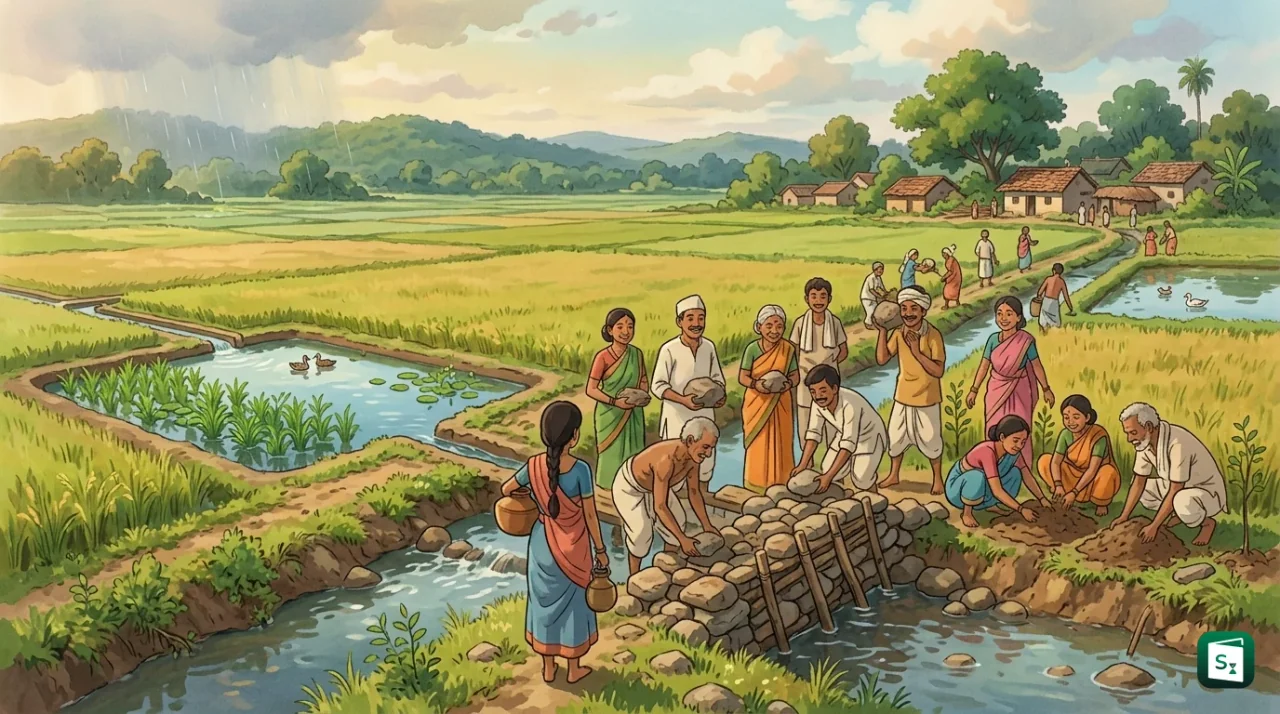
Chhattisgarh has secured the first position in the country in Jal Sanchay Jan Bhagidari 3.0, the community driven water conservation programme under the Catch the Rain campaign. The state completed 77,719 water conservation structures out of 79,775 registered units in this phase. The result was presented at the Ministry of Jal Shakti departmental summit held in New Delhi on 1 and 2 September 2026.
What Is Jal Sanchay Jan Bhagidari?
Jal Sanchay Jan Bhagidari (JSJB) is a community driven water conservation programme of the Ministry of Jal Shakti that builds low cost rainwater harvesting and groundwater recharge structures with public participation. Jal Sanchay means water storage and Jan Bhagidari means public participation.
The Ministry of Jal Shakti launched the first phase of the programme in Surat, Gujarat on 6 September 2024. Prime Minister Narendra Modi joined the launch through video conferencing. The idea grew from the Jal Sanchay model of Gujarat, where the state government mobilised citizens, local bodies, industries and social groups to build recharge structures.
The programme follows three principles known as the 3Cs: Community, Corporate Social Responsibility (CSR) and Cost. Community means local people plan, build and maintain the structures. CSR and public donations provide funds along with government schemes. Cost means the structures are cheap, small and suited to local soil and rainfall, using locally available material. The work includes recharge pits, recharge shafts, borewell recharge units, farm ponds, check dams and revival of defunct borewells.
JSJB has expanded in three stages. JSJB 1.0 ran from 1 April 2024 to 31 May 2025 and crossed its target of 10 lakh structures, with more than 27 lakh artificial recharge structures reported. JSJB 2.0 ran from 1 June 2025 to 31 May 2026 with special focus on over exploited and critical blocks, and more than 1.5 crore structures were reported against a target of one crore. Jal Sanchay Jan Bhagidari: Catch the Rain (JSJB: CTR), often called the third phase or JSJB 3.0, was launched on 1 June 2026 by merging JSJB with the Jal Shakti Abhiyan: Catch the Rain campaign. Progress is tracked on the dedicated portal at jsjb.mowr.gov.in, where district collectors upload details of identified, ongoing and completed structures.
Catch the Rain Campaign Framework
Jal Shakti Abhiyan (JSA) is a time bound water conservation campaign of the Ministry of Jal Shakti. The Ministry of Jal Shakti started JSA in 2019 in 1,592 blocks across 256 water stressed districts. The goal was to increase rainwater harvesting, groundwater recharge, watershed development, revival of water bodies and afforestation through public participation.
Jal Shakti Abhiyan: Catch the Rain (JSA: CTR) is the expanded form of this campaign. Prime Minister Narendra Modi launched it on World Water Day, 22 March 2021, with the tagline Catch the rain, where it falls, when it falls. The message is simple. Rain that falls during the four to five months of monsoon is the main source of water for most parts of India, so every village and city should stop rainwater where it falls and store it underground or in local bodies.
The campaign covers all districts in both rural and urban areas. It has five focused actions. These are water conservation and rainwater harvesting, listing and geo tagging of water bodies with scientific plans for conservation, setting up Jal Shakti Kendras in all districts, intensive afforestation, and awareness generation.
Since 2021, the campaign has run every year with a new theme to sharpen its focus:
| Year | Theme | Special Focus |
|---|---|---|
| 2023 | Source Sustainability for Drinking Water | 150 districts identified by the Jal Jeevan Mission |
| 2024 | Nari Shakti se Jal Shakti | 151 districts identified by the Central Ground Water Board, with emphasis on women led conservation |
| 2025 | Jal Sanchay Jan Bhagidari: Jan Jagrukta ki Or | 148 districts identified by the Central Ground Water Board, with emphasis on grassroots awareness and convergence |
| 2026 | Jal Sanchay Jan Bhagidari: Catch the Rain | Integration of JSJB with Catch the Rain for saturation mode, low cost recharge structures |
The National Water Mission (NWM), which works under the Department of Water Resources, River Development and Ganga Rejuvenation, anchors the campaign. It coordinates states, district collectors, panchayats, industries, non governmental organisations and schools.
Chhattisgarh Moves From Second to First Rank
Chhattisgarh remained among the top states in all three phases of the programme, but it moved to the top only in the third phase. Chief Minister Vishnu Deo Sai presented the state model at the Ministry of Jal Shakti summit held at Sushma Swaraj Bhawan, New Delhi. The summit, held in the presence of Prime Minister Narendra Modi, was the first in a series of departmental summits to strengthen cooperation between the Centre and states.
The state numbers show steady and large scale execution:
| Phase | Registered or Created Structures | Completed Structures | National Rank |
|---|---|---|---|
| JSJB 1.0 | 4,05,561 created | 4,05,561 | Second |
| JSJB 2.0 | 24,07,456 registered | 23,07,768 | Second |
| JSJB 3.0 (JSJB: CTR) | 79,775 registered | 77,719 | First |
Across all three phases, Chhattisgarh has built or registered more than 28 lakh water conservation structures. The completion rate in the third phase is above 97 percent.
District performance pushed the state to the top. Five Chhattisgarh districts feature among the top 10 districts in the country for water conservation. These are Surajpur, Mahasamund, Balod, Balodabazar-Bhatapara and Kabirdham. The spread shows that the work was not limited to one region but covered northern, central and eastern parts of the state.
At the summit, the Chief Minister proposed four practical steps for the national campaign. These were state specific Catch the Rain plans, state water awards to recognise high performers, mapping of water structures through BISAG-N (Bhaskaracharya National Institute for Space Applications and Geo-informatics), and quarterly reviews chaired by the chief secretary. He also said Chhattisgarh is ready to share its practices with other states.
The Centre has set a national target of creating two crore new water structures by 31 May 2027. Chhattisgarh, with its high completion rate and district level depth, is now seen as a lead contributor to that goal.
The Koriya 5 Percent Model Behind the Win
What is the 5 Percent Model. The 5 Percent Model is a simple rule for groundwater recharge. Every farmer voluntarily sets aside 5 percent of agricultural land to build a small recharge structure such as a farm pond, percolation pit or terraced pit. Rainwater collects in that small area and slowly seeps into the ground instead of flowing away. When hundreds of farmers do this in one area, the whole village water table rises.
The model started in Koriya district (also written as Korea) in northern Chhattisgarh. The district administration gave it the local name Aawa Paani Jhonki, which means let us catch the rain in the local Sargujia dialect. Gram sabhas passed resolutions to support it. Jal Sakhis and Jal Mitras, who are local women and youth volunteers for water work, along with panchayats and farmers, led the construction through voluntary labour.
The scale grew fast. The district started with about 2,000 soak pits and expanded to about 30,000 soak pits within a year across farms, backyards and kitchen gardens. More than 1,260 farmers built recharge systems on their own fields. Beneficiaries of rural housing schemes built soak pits beside their homes. Old ponds were also revived, with more than 440 traditional ponds restored through community labour to act as natural recharge points.
The results are measurable. Data quoted by the Central Ground Water Board (CGWB), the central agency that monitors groundwater levels, showed that the post monsoon water level in the district improved from 6.6 metres below ground level in 2024 to 3.89 metres below ground level in 2025. The state water resources department reported a historic rise of up to 5.41 metres in parts of the district and recharge of nearly 2.8 million cubic metres of water in 2025. Groundwater rose by three to four metres in many villages, and springs revived in 17 remote tribal hamlets.
The model also helped daily life. Better soil moisture improved crop survival during dry spells. Stable water supply reduced seasonal migration by an estimated 25 percent in participating villages because families could sustain farming. It also helped the Jal Jeevan Mission, the central programme to provide tap water to every rural home, because piped supply works only when groundwater sources remain alive.
Why Water Conservation and Groundwater Recharge Matter
Why is water conservation important. Water conservation is important because India receives most of its rainfall in a short monsoon season but needs water through the year for drinking, farming and industry. When rainwater runs off quickly, wells dry up, soil loses moisture and farmers depend heavily on deep borewells. Stored and recharged water keeps wells alive, protects crops during dry spells and reduces the cost of drinking water supply.
What is groundwater recharge. Groundwater recharge is the process by which rainwater or surface water moves down through soil and rock to refill underground water layers called aquifers. Natural recharge happens slowly. Artificial recharge speeds it up through pits, shafts, ponds and check dams that hold water long enough for it to seep down. The Koriya model is a form of decentralised artificial recharge because many small structures recharge a wide area together.
What is a catchment area. A catchment area is the land area from which rainfall drains into a common point such as a pond, stream or recharge pit. A clean and well maintained catchment yields more water for storage. In farm level design, the field itself acts as the catchment and the 5 percent pit acts as the storage and recharge point.
Common low cost methods used under the programme match different land types:
| Structure | What It Does | Where It Is Used |
|---|---|---|
| Soak pit and recharge pit | Holds roof or field runoff and lets it seep underground | Homes, kitchens gardens, farms |
| Recharge shaft and borewell recharge unit | Carries filtered rainwater deep into dry borewells | Farms with defunct borewells |
| Farm pond | Stores field runoff for irrigation and slow recharge | Agricultural land, including the 5 percent plot |
| Check dam and gully plug | Slows stream flow so water stays longer and recharges banks | Small streams and slopes |
| Revived village pond | Stores village runoff and recharges nearby wells | Common village land |
Water can also be conserved at home and on farms through simple actions. These include fixing leaks, using drip irrigation, mulching to hold soil moisture, growing less water intensive crops during stress periods, and cleaning catchment channels before the monsoon so rain flows into storage and not into drains.
Institutional Framework and the Way Forward
The Ministry of Jal Shakti is the nodal ministry for water in India. The Ministry of Jal Shakti was formed in May 2019 by merging the Ministry of Water Resources, River Development and Ganga Rejuvenation with the Ministry of Drinking Water and Sanitation. It has two departments. These are the Department of Water Resources, River Development and Ganga Rejuvenation and the Department of Drinking Water and Sanitation.
Three bodies under the ministry play a direct role in this campaign. The National Water Mission plans and coordinates the Catch the Rain campaign. The Central Ground Water Board, established to monitor and guide groundwater use, identifies stressed blocks and measures water level changes. The Central Water Commission provides technical support on water storage and river data. At the state level, the Chhattisgarh Jal Sansadhan Vibhag, which is the state water resources department, executes and geo tags the structures.
Chhattisgarh used three management tools that other states can copy. First, it linked funds from different schemes so one pond could draw labour support, material support and community funds together. Second, it geo tagged structures and reviewed progress regularly up to the chief secretary level. Third, it placed panchayats, women groups and farmers at the centre so maintenance continues after construction.
The way forward is clear from official targets. The national goal is two crore new structures by 31 May 2027. Physical verification of reported structures will remain important to ensure quality. Recognition also matters. The government honoured high performers under JSJB 1.0 during the 6th National Water Awards held in November 2025, and state level awards have been proposed to keep competition healthy. If the Koriya approach spreads, small plots of recharge land in every village can add up to a large and lasting rise in groundwater.
Key Takeaways
- Chhattisgarh secured first rank in Jal Sanchay Jan Bhagidari 3.0 by completing 77,719 structures out of 79,775 registered units.
- Jal Sanchay Jan Bhagidari was launched in Surat on 6 September 2024 and is guided by the 3Cs of Community, CSR and Cost.
- Jal Shakti Abhiyan: Catch the Rain was launched on 22 March 2021 with the tagline Catch the rain, where it falls, when it falls.
- The Koriya 5 Percent Model asks farmers to use 5 percent of farmland for recharge pits and ponds under the local campaign Aawa Paani Jhonki.
- Five Chhattisgarh districts in the national top 10 are Surajpur, Mahasamund, Balod, Balodabazar-Bhatapara and Kabirdham.
- The Ministry of Jal Shakti, formed in May 2019, tracks progress through the portal jsjb.mowr.gov.in toward the goal of two crore new structures by 31 May 2027.