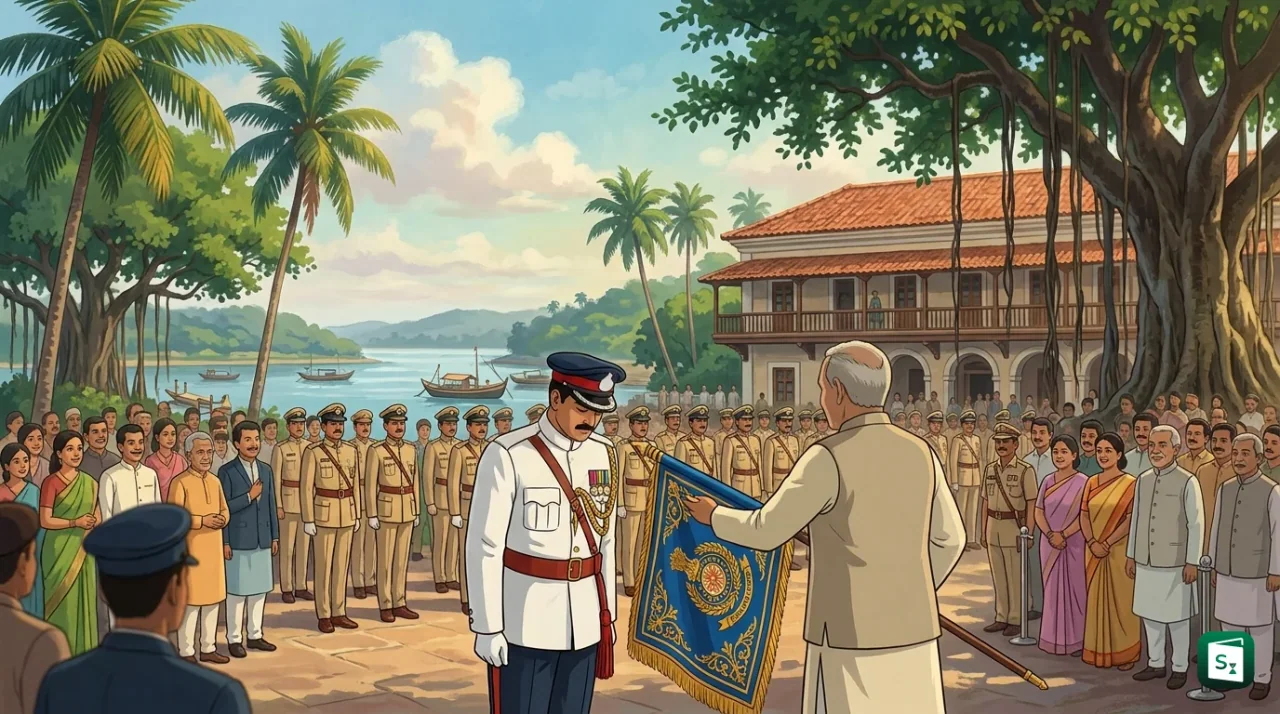
Union Home Minister Amit Shah presented the President Colour to the Goa Police on 7 September 2026 at the Dr Shyama Prasad Mukherjee Indoor Stadium in Bambolim, Panaji. The honour recognises more than 80 years of courage, discipline and dedication to public safety by the state force. With this award, the Goa Police joins a select group of state police forces in India to receive the highest ceremonial honour for a police unit.
What Is the President Colour Award?
The President Colour Award is the highest ceremonial honour given to a military unit, police force or training institution in India. It is known as Nishaan or Rashtrapati ka Nishan in Hindi. The award is a special flag with a golden border and the unit insignia in the centre.
The President of India confers the honour in the capacity as the Supreme Commander of the Armed Forces. For state police forces, the Union Home Minister often presents the Colour on behalf of the President at a ceremonial parade. The honour is not given for a single act of bravery. It recognises long term excellence in professional work, discipline, courage, training standards, humanitarian service and sacrifice in both peace and conflict situations.
A police force, central armed force or training academy must normally complete at least 25 years of distinguished service to become eligible. Once the Colour is awarded, every member of the force is allowed to wear a small replica of the insignia on the left sleeve of the uniform. The original flag, the Nishaan, is kept by the force and paraded on important ceremonial occasions.
The idea of colours comes from ancient practice. Armies once carried the flag or dhwaja of their king into battle to show the position of the ruler and to rally soldiers. Losing the flag meant disgrace, while capturing the flag of the enemy meant great honour. During British rule, Indian regiments carried the King Colour or Queen Colour. A day before India became a Republic, on 25 January 1950, all King Colours were laid up at the Indian Military Academy in Dehradun. The new honour was named the President Colour. The Indian Navy became the first service to receive it from President Rajendra Prasad on 27 May 1951.
President Colour Award 2026: Ceremony for Goa Police in Panaji
The Goa Police received the President Colour on 7 September 2026 at the Dr Shyama Prasad Mukherjee Indoor Stadium in Bambolim, Panaji. Union Home Minister and Minister of Cooperation Amit Shah presented the Nishaan to the force at a ceremonial parade. Goa Chief Minister Pramod Sawant, Union Minister of State Shripad Yesso Naik, the Union Home Secretary, the Goa Chief Secretary and Goa Director General of Police Alok Kumar attended the event along with senior officers, public representatives and police families.
Amit Shah said the award placed the Goa Police in the line of police forces across the country that carry the emblem given by the President. He said state forces earn this honour only for glorious history, professional excellence, courage, discipline and dedication. Pramod Sawant said the day was a matter of pride not only for the police but for all the people of Goa. Alok Kumar said the Colour was recognition of the journey of generations of personnel and added that it would bring greater responsibility to every member of the force.
During the ceremony, Amit Shah paid tribute to police personnel who died in the line of duty. He named Balaram Shinde, Abhishek Sher, Shailesh Gaonkar and Vishwas B. Deykar and said their sacrifice had helped the force earn the honour. The event also included blessings by religious leaders from four faiths, which the Chief Minister described as a reflection of national unity.
At the same programme, Amit Shah launched an AI based voice assistant for the 1930 cyber fraud helpline for Goa. The system allows citizens to register complaints in Konkani, Marathi and Hindi and routes complaints in other languages listed in the Eighth Schedule of the Constitution to the correct authority. The move is important for Goa because the state receives tourists from across India and the world who may need help in their own language.
Goa Police: Overview and Eight Decades of Service
The Goa Police traces its origin to the Policia do Estado da India, which the Portuguese regime created by decree in April 1946. Before that year, the Portuguese military handled all policing in Goa. The new civil force was organised into five territorial divisions, each led by a commissioner who reported to the commander. It handled public security, judicial police work, traffic, municipal policing and civil identification.
The birth year of the force coincided with the rise of the freedom movement in Goa. After Ram Manohar Lohia launched a civil disobedience movement in 1946, much of the force work shifted to containing agitations. The body that had earned a name for efficient town policing thus came to be seen as an arm of Portuguese control.
After the liberation of Goa on 19 December 1961, the Indian administration began to rebuild policing on Indian lines. N. R. Nagu took charge as the first Inspector General of Police of free Goa the day after liberation. Officers of the old force who wished to continue were absorbed, while others were allowed to retire. Portuguese ranks continued for some years. A major change came in 1966 after B. Shetty, an Additional Deputy Inspector General in the Central Bureau of Investigation, studied the system in February and March 1965. His report pointed to gaps in method and a lack of public trust. His suggestions laid the base for the modern Goa Police, which works under Indian laws and follows democratic policing.
The Goa Police works under the Department of Home Affairs, Government of Goa. Its headquarters stands near Azad Maidan in Panaji. The force was led by an Inspector General of Police until 2 February 1999, after which the post of Director General of Police (DGP) was created. The present DGP is Alok Kumar. The guiding motto of the force is Shanti Seva Nyaya, which means peace, service and justice, with special focus on the safety of women and children.
Amit Shah noted that Goa is a small state with a large responsibility. The Goa Police must ensure a safe city, a safe community and a secure maritime border. Goa has a long coastline, a population of more than 15 lakh and millions of domestic and foreign tourists every year. Protecting tourists, coastal areas and the local economy therefore forms a central part of the daily work of the force.
Why Goa Police Was Selected for the Honour
The President Colour is given only after a review of long term record, training, welfare, technology use and public service. The Goa Police qualified on the strength of steady reforms in response time, criminal justice, tourism policing and technology.
Faster Emergency Response and Tourist Safety
The Goa Police cut the average response time of the 112 emergency helpline from 18 minutes to 8 minutes. The force has given prompt help in nearly 20,000 calls. Amit Shah said the addition of more vehicles and two wheelers should bring the time down to less than 6 minutes. The Tourist Police Wing of Goa, which handles the safety of visitors at beaches, hotels and festival sites, was described as a model for other high tourism states.
Technology, New Criminal Laws and Higher Convictions
The Goa Police stayed at the top in the country for several months in putting the three new criminal laws into practice. The Bharatiya Nyaya Sanhita, the Bharatiya Nagarik Suraksha Sanhita and the Bharatiya Sakshya Adhiniyam replaced the colonial Indian Penal Code, Code of Criminal Procedure and Indian Evidence Act from 1 July 2024. The new system links police stations, jails, forensic science laboratories, courts, lawyers and hospitals through technology such as the Inter Operable Criminal Justice System, Crime and Criminal Tracking Network and Systems, e-Summons and forensic support.
| Performance Indicator | Reported Position |
|---|---|
| Implementation of new criminal laws | 93.38 percent, second rank in India after holding first rank for months |
| Performance across parameters | Strong record on all nine parameters, including 100 percent in administrative reforms and system integration |
| Conviction rate | Rise from 23 percent to 53 percent of First Information Reports within one year, a gain of 30 percentage points |
| Speed of justice | Many criminal matters now decided in 6 to 8 months |
Amit Shah said the rise in convictions showed how technology, sensitivity and time bound process can change policing. He also said the Ministry of Home Affairs has prepared a narcotics roadmap for 2026 to 2029 to make every village and city free from drugs. He asked the Goa Police to aim to become the leading force in the country in action against narcotics. He also pointed to the sporting record of the force and asked personnel to start preparing for the International Police Sports Championship, which India will host in 2029.
President Colour in India: History and Past Recipients
For police forces, the President Colour began with the Uttar Pradesh Police, which received the honour in 1952 from Prime Minister Jawaharlal Nehru. The Delhi Police received it from President Rajendra Prasad in 1954. After that, the honour was extended step by step to state forces, central armed forces and training academies. The Central Reserve Police Force was the first central armed force to receive the Colour on 19 March 1950 from Home Minister Sardar Vallabhbhai Patel. The National Disaster Response Force received the Colour on 14 May 2026 in Ghaziabad for its work in disaster relief in India and abroad.
The Goa award forms part of the active President Colour Award 2026 cycle. In early 2026, the Sikkim Police, the Bihar Police and the Odisha Police were also approved for the honour. The Sikkim Police, founded in 1897, was described as the fifteenth state force selected for the award and the third in the Northeast after Assam and Manipur. The Odisha Police received approval around its ninetieth foundation year, the force having been formed in 1936, while the Bihar Police, founded in 1912, was recognised for its long record and institutional growth.
| Force | Year of Honour | Note |
|---|---|---|
| Uttar Pradesh Police | 1952 | First state police force to receive the Colour |
| Delhi Police | 1954 | Presented by President Rajendra Prasad |
| Maharashtra Police | 1961 | Early state recipient |
| Jammu and Kashmir Police | 2003 | Recognised for service in difficult security conditions |
| Tamil Nadu Police | 2009 | Recognised for professional standards |
| Tripura Police | 2012 | Recognised for internal security work |
| Gujarat Police | 2019 | Recognised for law and order record |
| Himachal Pradesh Police | 2021 | Recognised for community policing |
| Assam Police | 2022 | First Northeast force in recent phase |
| Haryana Police | 2023 | Presented by Amit Shah at Karnal academy |
| Sikkim, Bihar and Odisha Police | 2026 cycle | Approved by President Droupadi Murmu |
Once a force receives the Colour, officers wear the replica emblem as a permanent mark of distinction. The award therefore lifts morale and reminds every new recruit of the standard set by earlier generations.
The Way Forward
The Goa Police leadership has said the Colour is a new beginning rather than a final prize. The force plans to reduce 112 response time to less than six minutes with more patrol vehicles and two wheelers. The AI assistant for the 1930 helpline will be expanded to cover all Eighth Schedule languages in full, so that tourists and migrant workers can report cyber fraud without a language barrier.
The larger test lies in full use of the new criminal laws, stronger forensic support and faster charge sheets. Goa will need to hold its high national rank in implementation and turn the recent rise in convictions into a steady trend. Action against narcotics under the 2026 to 2029 national roadmap will be watched closely in a coastal tourist state. Success on these fronts will decide whether the honour of 2026 becomes the base for a safer and more trusted police service in the years ahead.
Key Takeaways
- Union Home Minister Amit Shah presented the President Colour to the Goa Police on 7 September 2026 at Bambolim, Panaji.
- The award honours more than 80 years of service dating back to the Policia do Estado da India of April 1946.
- The President Colour, also called Nishaan or Rashtrapati ka Nishan, is the highest ceremonial honour for a police or military unit in India.
- A force must normally complete 25 years of distinguished service to qualify, and members then wear the replica emblem on the left sleeve.
- The Indian Navy was the first service to receive the President Colour from President Rajendra Prasad on 27 May 1951.
- The Goa Police cut 112 response time from 18 minutes to 8 minutes and raised its conviction rate from 23 percent to 53 percent under the new criminal laws.