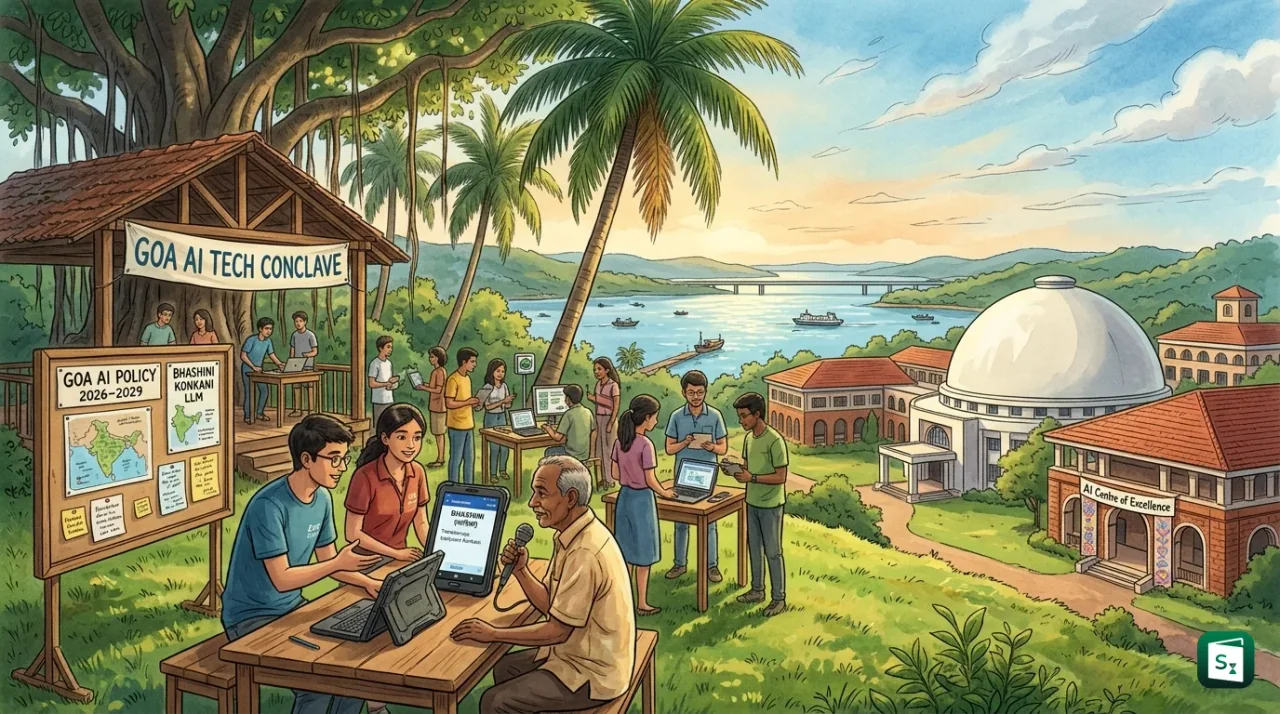
Goa hosted its first Goa AI Tech Conclave 2026 on 22 and 23 October 2026 at INOX Courtyard in Panaji. The Department of Information Technology, Electronics and Communications organised the event under the theme AI for People, Planet and Progress. The conclave unveiled the Goa AI Policy 2026, announced an AI Centre of Excellence with BITS Pilani Goa and launched the BHASHINI Konkani Large Language Model for text and speech in Konkani.
Goa AI Tech Conclave 2026: Theme, Venue and Organisation
The Goa AI Tech Conclave 2026 took place on 22 and 23 October 2026 at the INOX Courtyard in Panaji, in the Zuari Enclave event space. The Department of Information Technology, Electronics and Communications (DITE&C), Government of Goa, organised the two day summit. The theme for the conclave was AI for People, Planet and Progress, which linked technology use to citizen services, environmental care and economic growth.
Chief Minister Pramod Sawant and Information Technology Minister Rohan Khaunte led the inaugural session on 22 October. The programme brought together industry leaders, startups, researchers, students, officials and policymakers. Exhibitors included central digital agencies, large technology firms and local startups working in software services, health tech, clean tech and tourism tech. Officials announced at the closing session that the conclave will return in October 2027 and will become an annual event.
A central attraction was the Goa AI Hackathon. The hackathon listed 100 problem statements from 35 government departments and invited teams to build working AI tools for public service delivery. The design moves beyond demo models. Selected solutions will pass through phased trials and field deployment between December 2026 and March 2027.
| Conclave element | Detail |
|---|---|
| Name | Goa AI Tech Conclave 2026 |
| Dates | 22 and 23 October 2026 |
| Venue | INOX Courtyard, Panaji (Zuari Enclave) |
| Organiser | Department of Information Technology, Electronics and Communications, Government of Goa |
| Theme | AI for People, Planet and Progress |
| Key launches | Goa AI Policy 2026, Goa AI Hackathon, BHASHINI Konkani LLM |
| Next edition | October 2027, planned as annual event |
Goa AI Policy 2026 Framework 2026 to 2029
The Goa AI Policy 2026 sets a three year implementation roadmap from 2026 to 2029. The state cabinet approved the related Goa AI Mission 2027 as the guiding mission, and the policy acts as its execution document. The stated goal is to make Goa a hub for responsible AI and applied innovation in India. The draft was released in May 2026 for public suggestions and the final policy was unveiled on 22 October 2026.
The policy rests on five pillars. These are skilling and capacity building, startups and industry enablement, capital and investment promotion, policy governance and digital infrastructure, and responsible safe and ethical AI. This structure links classroom training, business support, funding, data systems and safety rules in one plan. The policy is aligned with the national IndiaAI Mission, the Digital Personal Data Protection Act 2023 and the India AI Governance Guidelines issued in February 2026.
A defining part is the four tier risk system for responsible AI. Uses are grouped as prohibited, high risk, medium risk and low risk. Prohibited uses are not allowed. High risk uses face strict checks and mandatory AI Impact Assessments. The level of control rises with the level of possible harm to people, rights and public safety. The approach keeps human oversight in decisions that affect welfare, policing, health and finance.
| Policy target | Detail (as of October 2026) |
|---|---|
| Skill goal | 50,000 AI certified professionals by 2030, with special focus on women, youth under 30 and talukas beyond major towns |
| School programme | AI fundamentals for Classes VI to XII from 2027 to 28, with AI labs in up to 50 government schools in phases |
| Innovation support | ₹250 crore Innovation Fund over five years and target of 1,000 startups by 2028 |
| Governance use | Six hackathon solutions for departments by December 2026, with more department problems to be solved by March 2027 |
| Infrastructure | Goa Techno Hub at Porvorim for infrastructure, incubation and shared workspaces |
Goa AI Mission 2027 Goals
The Goa AI Mission 2027 is the state mission that the 2026 policy implements. It seeks to use artificial intelligence to improve public service delivery, support citizen centric governance and create new economic chances. Priority sectors include tourism, health, fisheries, agriculture and creative industries. The mission also supports skilling in colleges, AI and machine learning in undergraduate science and technology courses, and collaboration with central agencies, industry and academia.
AI Centre of Excellence With BITS Pilani
The Department of Information Technology, Electronics and Communications signed a Memorandum of Understanding (MoU) with BITS Pilani Goa at the conclave to set up an AI Centre of Excellence. A Centre of Excellence is a dedicated unit where faculty, students, startups and officials work together on research, training and live projects. The Goa centre will support joint research, skill courses and testing of AI tools for governance and industry.
The centre will strengthen links between the classroom and the technology ecosystem. Students will get access to real department problem statements, while officials will get academic support on vendor checks, bias testing and safe deployment. The state had earlier held discussions with Bengaluru based Sarvam AI, the first startup selected under the IndiaAI Mission to build a sovereign Indian AI model, for policy research and citizen service tools. The BITS Pilani pact takes that academic industry plan forward into a formal institution.
Goa plans three sector Centres of Excellence in coastal and environmental systems, healthcare and life sciences, and tourism and hospitality. These sectors match the strengths of a coastal state that depends on the sea, marine ecology, hospitals and visitors. Minister Rohan Khaunte also spoke about a proposed Centre of Excellence for Indic Knowledge Systems and Heritage Intelligence. That unit would use AI to research, document and preserve manuscripts, languages, traditions and cultural identity, with human review and ethical safeguards.
What Is BHASHINI?
BHASHINI (BHASHa INterface for India) is the National Language Translation Mission of the Government of India for language AI as digital public good. It was launched in July 2022 and is run by the Digital India BHASHINI Division under the Ministry of Electronics and Information Technology.
The full form explains the purpose. BHASHINI means an interface that lets every Indian use the internet and government services in their own language. It was launched by the Prime Minister on 4 July 2022 during Digital India Week 2022 in Gandhinagar, Gujarat. The Digital India BHASHINI Division (DIBD) implements the mission. The division works under the Digital India Corporation (DIC), which is a Section 8 company under the Ministry of Electronics and Information Technology (MeitY).
BHASHINI builds open datasets, AI models, application programming interfaces and apps for Indian languages. An application programming interface, or API, is a software link that lets one app use the power of another app. BHASHINI offers text to text, text to speech, speech to text and speech to speech conversion. This helps a farmer hear a land record in Konkani, a patient read a hospital form in Hindi and an officer reply in English.
BHASHINI AI Platform and Tools
The BHASHINI platform (bhashini.gov.in) brings datasets, models, APIs and apps into one place. Developers, startups, colleges and government departments can use these blocks to build translation tools, voice helpers and multilingual chatbots. The BHASHINI app gives citizens translation on the phone, while Bhasha Daan lets people donate voice and text samples to improve models. Application programming interfaces are free or low cost for public use, which lowers the barrier for small firms and student teams.
Scale makes the platform important. BHASHINI powers more than 800 government websites, has recorded over 9 billion cumulative inferences and handles over 24 million inferences daily (as of October 2026). An inference is one successful AI task, such as one translated sentence. The platform supports 36 Indian languages for text, 23 Indian languages for voice and 35 international languages. This language first public infrastructure places BHASHINI at the centre of multilingual e governance in India.
| BHASHINI fact | Detail |
|---|---|
| Full name | BHASHa INterface for India, National Language Translation Mission |
| Launched | 4 July 2022, Digital India Week, Gandhinagar |
| Nodal ministry | Ministry of Electronics and Information Technology |
| Implementing body | Digital India BHASHINI Division under Digital India Corporation |
| Core tools | Translation, text to speech, speech to text, voice to voice, BHASHINI app, BHASHINI API, Bhasha Daan |
BHASHINI Konkani Large Language Model Features
The BHASHINI Konkani Large Language Model (LLM) was launched at the inaugural session of the conclave in Panaji. A large language model is an AI system trained on very large collections of text and speech so that it can read, write, translate and answer in a language. The Konkani model is built to understand and produce Konkani in both text and speech. It will form the base for local apps for governance, education, tourism and grievance redress.
Konkani needs special care because it lives in many scripts. The official script is Devanagari, while large communities also write Konkani in Roman, Kannada, Malayalam and Perso Arabic scripts. Good AI must learn vocabulary, spoken forms and cultural context across these scripts. The team stressed high quality data, content creation by native speakers and human validation before release. This reduces errors and keeps local meaning intact.
The data plan rests on people participation. Bhasha Daan is BHASHINI’s crowdsourcing drive where citizens, students and language experts donate audio, typed text and translations. The proposed Data Daan pilot in Goa will bring colleges, the Higher Education Department, the Directorate of Official Languages and Konkani communities together to create, digitise and check language data. The complementary tool Granthika will help digitise books, manuscripts, folk tales and memories of senior citizens. Together they will build a richer digital store of Konkani heritage for future apps.
The conclave gave a live proof of use. BHASHINI tools provided real time speech translation and transcription of the addresses by the Chief Minister and the IT Minister. The system handled Konkani to English and English to Konkani translation on stage. At the exhibition stall, an English welcome to the IT Minister was converted into Konkani in real time with speech to speech translation. Visitors also tried the mobile app for text translation and voice help. The demonstration showed how multilingual AI can make meetings, classrooms and service counters work across languages.
What Is Konkani Language?
Konkani is an Indo Aryan language of the Indo European family spoken on the western coast of India. It is the official language of Goa and one of the 22 languages in the Eighth Schedule of the Constitution. It is written in Devanagari, Roman, Kannada, Malayalam and Perso Arabic scripts.
Konkani belongs to the southern branch of the Indo Aryan group. Its home stretches across the Konkan coast, which covers the Konkan division of Maharashtra, Goa and the Uttara Kannada, Udupi and Dakshina Kannada districts of Karnataka. The language carries centuries of trade, migration and cultural exchange, which explains its rich mix of words and many scripts. The key link is simple. Script diversity is the reason Goa needs a dedicated language model and not a copy of a Hindi or Marathi tool.
Konkani won legal recognition after a long movement. The Goa Legislative Assembly passed the Official Language Bill on 4 February 1987, making Konkani the official language of Goa. Konkani was then included in the Eighth Schedule through the 71st Constitutional Amendment in 1992, along with Manipuri and Nepali. The Eighth Schedule today lists 22 languages. Its provisions appear in Articles 344(1) and 351, which guide the promotion of Hindi while supporting the growth of scheduled languages.
Konkani Language Is Spoken in Which State?
Konkani is primarily spoken in Goa, where it is the official language. It is also spoken in coastal Maharashtra, Karnataka and Kerala and in Dadra and Nagar Haveli and Daman and Diu. It was made the official language of Goa in 1987 and added to the Eighth Schedule in 1992.
Goa is the core state, but Konkani is a minority language in neighbouring coastal belts. Large Konkani communities live in Maharashtra, Karnataka and northern Kerala. Speakers use Devanagari in Goa for official work, Roman script in church and popular writing, and Kannada and Malayalam scripts in Karnataka and Kerala. This spread makes data collection hard, because an AI model must learn the same sentence written in different scripts and spoken in different accents.
National AI Framework Link: India AI Mission
The IndiaAI Mission was approved in March 2024 with an outlay of ₹10,371.92 crore for five years. It is implemented by IndiaAI, an Independent Business Division under the Ministry of Electronics and Information Technology. The mission builds compute, datasets, models, startups and safe AI.
The Union Cabinet chaired by the Prime Minister cleared the mission on 7 March 2024. Its vision is Making AI in India and Making AI Work for India. The mission works through seven pillars. These are compute capacity, foundation models, datasets platform, application development, startup financing, future skills and safe and trusted AI. The compute pillar has onboarded more than 18,000 affordable graphics processing units for startups and researchers at reduced cost. A graphics processing unit is a chip that can handle many AI calculations at the same time.
Goa places its state plan inside this national frame. The Goa AI Policy cites the IndiaAI Mission, national responsible AI guidelines and the Digital Personal Data Protection framework as guide rails. The BHASHINI Konkani model shows that link in action. Central language infrastructure meets state data, state colleges and state use cases. For peer comparison, BharatGen is India’s effort for foundational models in Indian languages, while Sarvam AI builds full stack generative AI for India and AI4Bharat works on open language datasets. Goa adds a state layer to this national stack with a focus on tourism, health, fisheries and heritage.
Key Takeaways
- The Goa AI Tech Conclave 2026 was held on 22 and 23 October 2026 at INOX Courtyard, Panaji under the theme AI for People, Planet and Progress.
- The Goa AI Policy 2026 provides a three year framework for 2026 to 2029 built on five pillars and a four tier responsible AI system.
- The state signed an MoU with BITS Pilani Goa to set up an AI Centre of Excellence for research, skilling and governance tools.
- The BHASHINI Konkani Large Language Model was launched to build text and speech AI in Konkani across Devanagari, Roman and Kannada scripts.
- BHASHINI (BHASHa INterface for India) was launched in July 2022 and is run by the Digital India BHASHINI Division under the Ministry of Electronics and Information Technology.
- The IndiaAI Mission was approved in March 2024 with an outlay of ₹10,371.92 crore for five years to build compute, datasets, models and safe AI.