Reema Nanavaty, Director of the Self-Employed Women’s Association (SEWA) of India, received the 2026 Hillary Rodham Clinton Award at Georgetown University in Washington on 15 October 2026. The Georgetown Institute for Women, Peace and Security (GIWPS) honoured her for more than four decades of work in women’s economic empowerment, livelihoods, peace and security. She shared the honour with American designer and philanthropist Tory Burch and Bangladeshi economist Muhammad Yunus.
What Is the Hillary Rodham Clinton Award?
The Hillary Rodham Clinton Award for Advancing Women in Peace and Security is an annual honour presented by former United States Secretary of State Hillary Rodham Clinton at Georgetown University. The Georgetown Institute for Women, Peace and Security confers it on leaders who strengthen women’s rights, peace and security worldwide.
The award is bestowed every year by Clinton along with the Georgetown Institute for Women, Peace and Security (GIWPS). Clinton is the honorary founding chair of the institute. She served as the 67th United States Secretary of State from 2009 to 2013. The institute works on research and action on women’s participation in peace processes, conflict prevention and security.
The honour has been presented at Gaston Hall of Georgetown University in Washington, D.C. since 2014. Past recipients include Nobel laureates, former heads of state and grassroots peacebuilders. They include journalist Maria Ressa, former Australian Prime Minister Julia Gillard, former Lithuanian President Dalia Grybauskaite, Iraqi activist and Nobel laureate Nadia Murad, and Palestinian and Israeli women’s groups Women of the Sun and Women Wage Peace.
The 2026 ceremony was held on 15 October 2026. It focused on women’s economic empowerment. Along with the three Clinton Awards, the institute presented the first Georgetown Ambassadors Award to Muna Sukhtian, board chair of Jordan’s Microfund for Women, for her work on women’s financial inclusion.
Why Was Economic Empowerment the Theme in 2026?
The Georgetown Institute for Women, Peace and Security chose women’s economic empowerment as the theme for the 2026 awards. The institute stated that increasing women’s economic opportunity improves the prosperity, stability and security of their communities.
The idea is direct. When women earn a stable income, households gain food security and children stay in school. Local markets grow. Communities can recover faster from shocks such as earthquakes, conflict or job loss. Research by global bodies has repeatedly linked women’s access to income, credit and property with lower poverty and stronger social stability.
At the 15 October ceremony, GIWPS Executive Director Melanne Verveer opened the event and underlined economic development as a peace issue. Former Secretary Clinton said in her keynote that self reliance and income security are central to peace. Georgetown President Eduardo Penalver noted that the institute’s work matches the university’s focus on public service. Clinton closed the programme by urging students to support such work through full time careers, philanthropy, volunteering or business support.
Who Is Reema Nanavaty and What Is Her Work With SEWA?
Reema Nanavaty is the Director of the Self-Employed Women’s Association (SEWA) of India, the country’s largest union of women workers in the informal sector. She joined SEWA in 1984, became its General Secretary in 1999, and received the Padma Shri in 2013 for social work.
Nanavaty was raised and schooled in Ahmedabad in Gujarat. She completed a bachelor’s and master’s degree in microbiology at Gujarat University, with training as a medical laboratory technician. She cleared the civil services examination for the Indian Administrative Service (IAS) in 1983 to 1984. Before joining the training academy, she accepted an offer from SEWA to work on drought relief in rural Gujarat. She then left the civil service path and took up full time social work.
She began in the rural wing of SEWA in areas such as Radhanpur in Banaskantha district. Her first task was drinking water. She helped turn a local water supply effort into a Women, Water and Work campaign that brought about 40,000 women into local water decisions. The work covered forestry, nursery raising, dairy support and farm income. Women in the region raise close to two million saplings each year.
Under her leadership over the past 25 years, SEWA has grown into a national movement. The Georgetown Institute placed its membership at 3.8 million members (as of October 2026). Nanavaty oversees 4,813 self help groups, 160 cooperatives and 15 economic federations across 18 states in India, with work also reaching seven South Asian countries including Afghanistan, Sri Lanka, Nepal and Bhutan. Her focus is full employment and self reliance through women owned enterprises in energy, agribusiness, food processing, waste recycling, textiles and garment making.
Three programmes show her method clearly. After the 2001 Gujarat earthquake, she negotiated a loan from the International Fund for Agricultural Development (IFAD) to rebuild livelihoods of 60,000 rural women through the Jeevika project. After the 2002 Gujarat riots, she led the Shanta relief and rebuilding programme for 40,000 affected members. She later led training for more than 5,000 Afghan women and support for over 6,000 war affected widows in Sri Lanka in farm and rural skills.
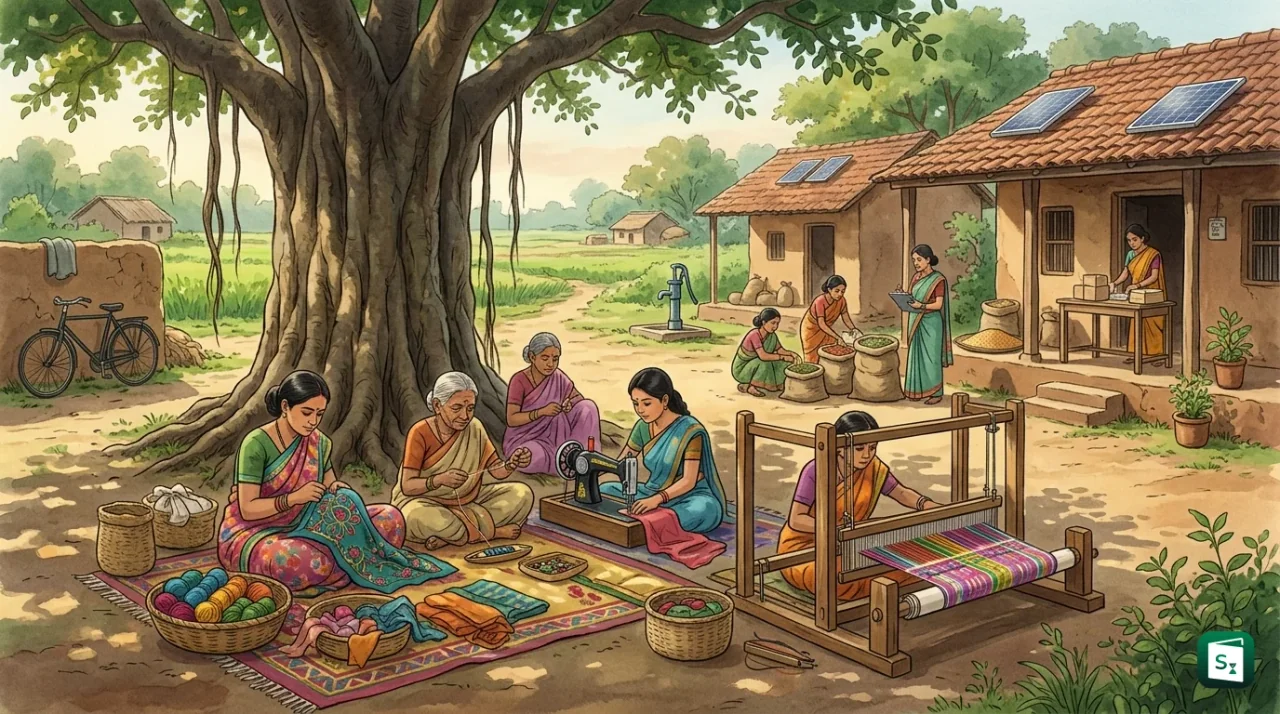
She also built market and energy links for poor producers. She founded the SEWA Trade Facilitation Centre, one of the largest member based textile and craft bodies, which links artisans directly to Indian and global buyers. She started the RUDI rural distribution network, which takes farm produce from women farmers to about one million households without middlemen. She leads the Hariyali Green Energy and Livelihoods Initiative, which aims to give 200,000 farm women access to solar lights, clean cookstoves, solar pumps and tools. She also heads SEWA’s information technology work, including mobile apps for women farmers and links to online retail.
Nanavaty serves on the Advisory Council on Gender of the World Bank Group (as of October 2026). She was the only informal sector representative on the High Level Global Commission on the Future of Work of the International Labour Organization (ILO). The ILO is a United Nations agency headquartered in Geneva, Switzerland and founded in 1919. In 2013, the Government of India honoured Nanavaty with the Padma Shri, India’s fourth highest civilian award, for distinguished service in social work.
What Does SEWA Stand For and How Did It Begin?
SEWA stands for the Self-Employed Women’s Association. It is a national trade union of poor women workers in India’s informal economy based in Ahmedabad, Gujarat. It was founded in 1972 by lawyer and Gandhian organiser Ela Bhatt and registered as a trade union on 12 April 1972.
SEWA grew out of the Women’s Wing of the Textile Labour Association (TLA). The TLA was India’s oldest union of textile workers, founded in 1920 by Anasuya Sarabhai and Mahatma Gandhi. In 1971, women headloaders and cart pullers in Ahmedabad’s cloth market sought help against low wages and harsh contractors. Ela Bhatt (1933 to 2022) took up their case. The women then asked for their own body. SEWA was formed in December 1971 and won registration in April 1972 after arguing that self employed workers without a single employer could still form a union.
The state labour department had first refused registration on the ground that a union needs an employer to act against. SEWA’s argument prevailed. Every year, 12 April is observed as Self-Employed Day by the union. After a split from the TLA in 1981, SEWA stood on its own with about 4,900 members, a small office, a rural centre and a cooperative bank.
The first cooperative promoted by SEWA was the SEWA Cooperative Bank in 1974, which gave savings and credit to illiterate members refused by regular banks. It later supported trade cooperatives of quilt makers, vegetable vendors, waste recyclers, weavers and farmers. The Gujarat State Women’s SEWA Cooperative Federation was registered in 1992 to support these primary groups.
Ela Bhatt served as SEWA’s general secretary from 1972 to 1996. She received the Ramon Magsaysay Award in 1977, the Right Livelihood Award in 1984 and the Padma Bhushan in 1986. SEWA’s model of union plus cooperatives has since inspired similar efforts in South Africa, Ghana and other countries.
Who Are the Other 2026 Recipients?
The Georgetown Institute honoured three Clinton Award recipients in 2026 for the same theme of women’s economic power. The three recipients work in very different fields but share a focus on income, credit and enterprise for the poor.
| Recipient | Known For | 2026 Honour Reason |
|---|---|---|
| Reema Nanavaty | Director, SEWA, India | Organising 3.8 million informal women workers into unions, cooperatives and supply chains |
| Muhammad Yunus | Founder, Grameen Bank, Bangladesh | Pioneering microcredit for poor women |
| Tory Burch | Founder, Tory Burch Foundation and Tory Burch LLC, United States | Backing women entrepreneurs with capital, mentoring and education |
Muhammad Yunus and Grameen Bank
Muhammad Yunus and Grameen Bank jointly received the Nobel Peace Prize for 2006 for efforts to create economic and social development from below. The Norwegian Nobel Committee said lasting peace cannot be achieved unless large groups find ways to break out of poverty, and microcredit is one such means.
Yunus was born on 28 June 1940 in Chittagong, then in British India and now in Bangladesh. He studied economics in Bangladesh and the United States and became professor of economics at the University of Chittagong in 1972. During the Bangladesh famine of 1974, he began lending small sums from his own pocket to poor basket weavers and crafts workers. In 1976 he lent 27 dollars to 42 workers in a village near Chittagong. The experiment grew into a full bank.
Yunus founded the Grameen Bank in 1983. Grameen means rural or village in Bangla. The bank gives small long term loans without collateral, known as microcredit, mainly to poor women to start tiny enterprises. By the time of the Nobel Prize, the bank had lent close to 6 billion dollars to nearly seven million borrowers, with average loans of just over 100 dollars and very high repayment rates. More than 95 percent of borrowers were women. The model has been copied in more than 100 countries.
Yunus was the first Bangladeshi to receive the Nobel Prize. He also received the Ramon Magsaysay Award, the World Food Prize in 1994 and Bangladesh’s Independence Day Award in 1987. He later served as the 5th Chief Adviser of Bangladesh, heading the interim government from 2024 to 2026. His work links directly to the 2026 Clinton Award theme because it showed that credit suited to the poor, plus basic financial discipline, can build incomes and dignity.
Tory Burch and the Tory Burch Foundation
Tory Burch is an American fashion designer and businesswoman and the founder of the Tory Burch Foundation. The foundation works to increase women’s economic power in the United States by helping women entrepreneurs build lasting businesses.
Burch was born on 17 June 1966 in Valley Forge, Pennsylvania. She studied art history at the University of Pennsylvania and worked with fashion houses including Ralph Lauren, Vera Wang and Loewe. She launched her own label, Tory Burch LLC, in 2004 with a small store on Elizabeth Street in New York. The brand has since grown into a global business with more than 250 boutiques and presence in department stores worldwide.
Burch launched the Tory Burch Foundation in 2009 as a non profit body. The foundation runs a Fellows programme that each year selects 50 women entrepreneurs for mentoring, business education and networking. It runs a Capital Programme with Bank of America that provides affordable loans to women owned firms. By the end of 2023, the programme had disbursed 100 million dollars in loans to more than 5,500 women entrepreneurs. The foundation reports repayment rates of about 99 percent. It has set a goal of helping its community add 1 billion dollars to the economy by 2030.
Why the Honour Matters for India
The 2026 award places India’s informal women workers on a global peace and security stage. More than 90 percent of India’s workforce is in the informal economy, and women form a large share of street vendors, home based producers, farm labourers, waste recyclers and care workers. These workers often lack fixed employers, written contracts, health cover and pensions. SEWA’s union plus cooperative model offers one tested answer to that gap. It combines collective bargaining with ownership of banks, supply chains and retail networks.
The honour also continues a link between SEWA and national civilian awards. The Padma Shri is the fourth highest civilian award of the Republic of India, after the Bharat Ratna, Padma Vibhushan and Padma Bhushan. It was instituted on 2 January 1954 and is announced every year on the eve of Republic Day on 26 January. It is given for distinguished contribution in fields including art, education, science, medicine, social work and public affairs. Both founder Ela Bhatt and Reema Nanavaty are part of that roll of honour. Bhatt received the Padma Shri in the social work category in an earlier year before her Padma Bhushan, while Nanavaty received the Padma Shri in 2013 for social work.
For India, the message from Georgetown is practical. Income in women’s hands improves food use, child schooling and loan repayment. Local producer groups such as RUDI keep value inside villages. Clean energy tools cut fuel costs and add work hours. Digital apps and direct market links cut dependence on middlemen. Together, these steps turn daily survival work into stable livelihoods, which in turn supports social peace in stressed regions.
Key Takeaways
- The 2026 Hillary Rodham Clinton Award was presented on 15 October 2026 at Gaston Hall, Georgetown University by the Georgetown Institute for Women, Peace and Security.
- Reema Nanavaty, Director of SEWA (Self-Employed Women’s Association), was honoured for work in women’s economic empowerment, livelihoods, peace and security.
- SEWA was founded in 1972 in Ahmedabad by Ela Bhatt and registered as a trade union on 12 April 1972.
- Nanavaty received the Padma Shri in 2013 for social work after joining SEWA in 1984 and becoming General Secretary in 1999.
- Co recipients in 2026 were Muhammad Yunus, founder of Grameen Bank (1983) and joint winner of the Nobel Peace Prize 2006, and Tory Burch, founder of the Tory Burch Foundation (2009).