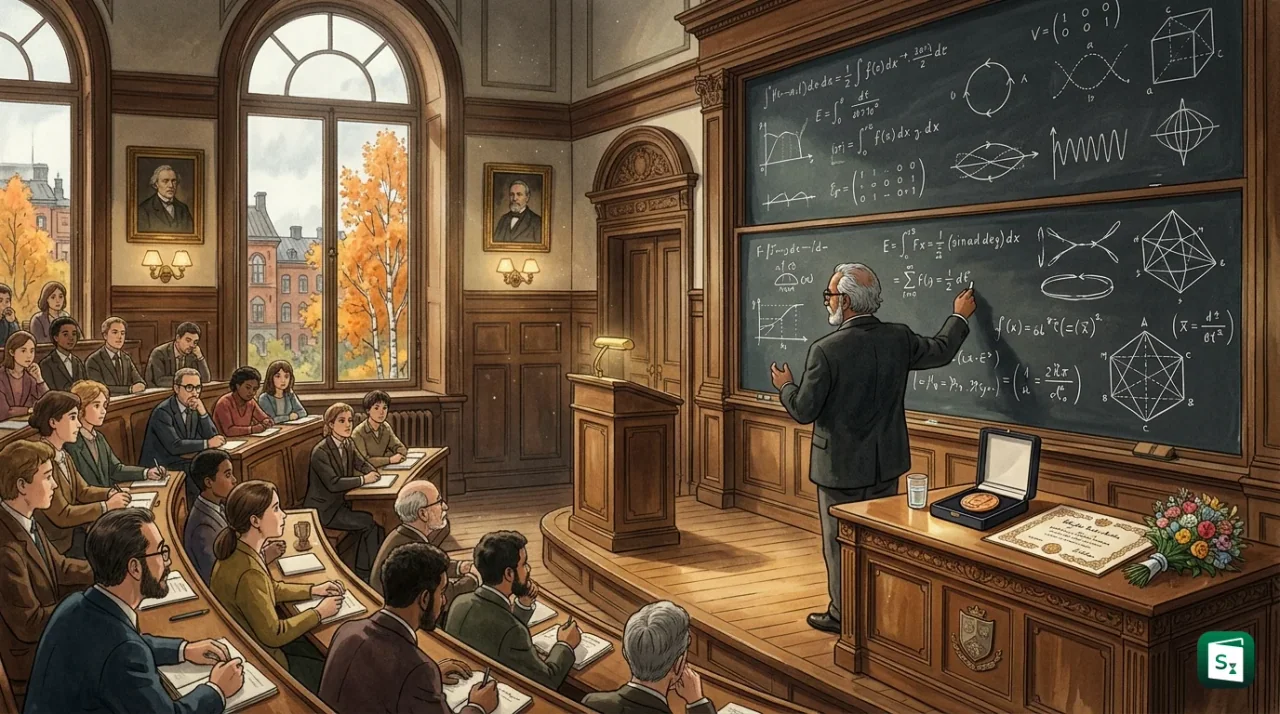
Indian physicist Ashoke Sen has been awarded the 2026 Oskar Klein Medal, becoming the first Indian physicist to receive the international honour. The medal is jointly awarded by Stockholm University and the Nobel Committee for Physics of the Royal Swedish Academy of Sciences. Sen delivered the accompanying 2026 Oskar Klein Memorial Lecture on 22 October 2026 at the AlbaNova University Centre in Stockholm.
Who Is Ashoke Sen?
Ashoke Sen is an Indian theoretical physicist born on 15 July 1956 in Kolkata, West Bengal, and widely regarded as one of the leading architects of modern string theory. The International Centre for Theoretical Sciences (ICTS) announced on 24 October 2026 that Sen had received the 2026 Oskar Klein Medal, the first such recognition for an Indian physicist.
Sen currently holds the ICTS-Infosys Madhava Chair Professorship at the International Centre for Theoretical Sciences (ICTS), Bengaluru, which is a centre of the Tata Institute of Fundamental Research (TIFR). ICTS itself was established in Bengaluru in 2007 as a dedicated home for fundamental sciences under TIFR, which was founded in Mumbai in 1945.
His academic path combines leading Indian and American institutions. Sen studied at Sailendra Sircar Vidyalaya in Kolkata and earned his BSc in Physics from Presidency College, Kolkata in 1975, where teacher Amal Kumar Raychaudhuri deeply influenced him. He completed his MSc in Physics from the Indian Institute of Technology (IIT) Kanpur in 1978 and his PhD in Physics from the State University of New York at Stony Brook in 1982.
After his doctorate, Sen worked as a postdoctoral researcher at the Fermi National Accelerator Laboratory (Fermilab) from 1982 to 1985 and at the Stanford Linear Accelerator Center (SLAC) from 1985 to 1988. He then returned to India, serving at TIFR Mumbai from 1988 to 1995 and as Distinguished Professor at the Harish-Chandra Research Institute (HRI) in Prayagraj from 1995 to 2021, before moving to ICTS Bengaluru. He is also an honorary fellow of the National Institute of Science Education and Research (NISER), a Morningstar Visiting Professor at the Massachusetts Institute of Technology (MIT) (as of October 2026), and a Fellow of the Royal Society, London, elected in 1998.
What Is the Oskar Klein Medal?
The Oskar Klein Medal is an annual international prize in theoretical physics awarded jointly by Stockholm University and the Nobel Committee for Physics of the Royal Swedish Academy of Sciences. The Royal Swedish Academy of Sciences, founded in 1739 and based in Stockholm, is the body that selects the Nobel Prize in Physics.
The medal was established in 1988 in memory of Swedish theoretical physicist Oskar Klein (1894 to 1977). Each year, the organising committee of the Oskar Klein Memorial Lectures invites one distinguished researcher to deliver the memorial lecture and receive the medal. The lecture is hosted by the Oskar Klein Centre for Astroparticle Physics, a joint centre of Stockholm University and the Royal Institute of Technology (KTH), and is usually held at the AlbaNova University Centre in Stockholm.
The honour roll places Ashoke Sen alongside some of the most celebrated names in physics. The first three medals went to Nobel laureates Chen Ning Yang (1988), Steven Weinberg (1989) and Hans Bethe (1990). Later recipients include Stephen Hawking (2003), Peter Higgs (2009), Kip Thorne (2016), Lisa Randall (2019) and Renata Kallosh (2024). No Indian physicist had received the medal before 2026.
What Is String Theory and What Is Ashoke Sen Known For?
String theory is a framework in theoretical physics which proposes that the basic building blocks of nature are not point-like particles but tiny, one-dimensional objects called strings. Different ways in which these strings vibrate appear as different particles. The theory tries to give a single, unified description of all matter and all forces, including gravity described by Albert Einstein’s general theory of relativity and the quantum behaviour of very small particles described by quantum mechanics.
Bringing gravity and quantum mechanics together is one of the hardest problems in physics. Gravity controls planets, stars and black holes. Quantum mechanics controls atoms and subatomic particles. The two theories work well in their own zones but clash when scientists try to describe extreme places like the centre of a black hole. String theory offers a possible bridge because it naturally includes a particle that behaves like the graviton, the hypothetical carrier of gravity.
Ashoke Sen is known for three landmark contributions that shaped this bridge. First, Sen provided striking evidence for S-duality, a strong-weak duality that connects a theory where particles interact strongly with a different description where they interact weakly. Hard calculations in one picture become simple in the other. This work helped show that the five different string theories known in the 1990s are not rivals but different limits of a single underlying theory.
Second, Sen pioneered the study of unstable D-branes and proposed the famous Sen Conjecture on open string tachyon condensation. D-branes are surfaces where open strings can end. His work clarified what happens when unstable branes decay, and his description of rolling tachyons later influenced ideas in string cosmology.
Third, Sen developed the entropy function formalism for the precision counting of black hole entropy. Entropy here means the count of microscopic arrangements that can produce the same large-scale object. A black hole also has entropy, which is linked to the area of its event horizon, the boundary beyond which nothing can escape. Sen showed how to count the microscopic string states responsible for this entropy in certain theoretical black holes and match them with predictions from gravity. This gave physicists a sharper quantum picture of black holes.
Gravity From Strings and Strings From Gravity: The 2026 Memorial Lecture
The 2026 Oskar Klein Memorial Lecture titled “Gravity from strings and strings from gravity” was delivered by Ashoke Sen on 22 October 2026 at the AlbaNova University Centre in Stockholm. The title captures a two-way idea that sits at the heart of Sen’s research. Strings can explain gravity through quantum physics, and the study of gravity, especially black holes, can reveal deeper truths about strings.
Sen’s lecture explored how string theory provides a consistent quantum description of gravity and how that description helps address open questions about black holes. Black holes remain a test ground because their immense gravity traps even light, yet they show quantum features such as entropy and temperature. By counting microscopic string states behind black hole entropy, Sen’s methods let physicists compare large-scale gravitational behaviour with an underlying quantum count in specific theoretical models. The results apply to carefully defined cases, not to every black hole seen in the sky, but they strengthen confidence that string theory is on the right path toward quantum gravity.
The choice of topic also links past and future. It recalls Oskar Klein’s own attempt a century ago to unite gravity with another force through extra dimensions, while pointing to current work on quantum field theory, string field theory and the attractor mechanism that governs certain black holes.
Who Was Oskar Klein and What Is the Kaluza-Klein Theory?
Oskar Klein was a Swedish theoretical physicist remembered for bold attempts to unify the forces of nature. After working with Niels Bohr in Copenhagen in the early 1920s, Klein became professor of theoretical physics at Stockholm University College (now Stockholm University) in 1930 and remained there until retirement. Alongside his work on unification, Klein co-developed the Klein-Gordon equation, the first relativistic version of the quantum wave equation, and the Klein-Nishina formula for the scattering of light by electrons.
The Kaluza-Klein theory is named after German physicist Theodor Kaluza and Oskar Klein. Kaluza in 1919 proposed adding a fifth dimension to Einstein’s four-dimensional spacetime (three dimensions of space plus one of time) to bring gravity and electromagnetism into one set of equations. Klein in 1926 added a quantum twist. He suggested that this extra dimension is curled up into a tiny circle, so small that it is invisible in daily life, with a radius close to the Planck length of the order of 10 to the power minus 33 centimetres. Waves moving in that curled direction would appear in our four-dimensional world as electrically charged particles.
The original five-dimensional model did not match experiments and was set aside by the 1930s. Yet the core idea survived. The notion that extra, compact dimensions can produce familiar forces became a direct ancestor of supergravity in the 1970s and of modern string theory, which often uses ten or eleven dimensions. In that sense, the 2026 lecture on strings and gravity closes a historical loop that began with Klein’s own extra-dimension proposal.
What Prizes Has Ashoke Sen Won Before?
Ashoke Sen has received nearly every major Indian science honour along with several of the world’s top physics prizes. The citation for his 2012 Breakthrough Prize in Fundamental Physics states that Sen uncovered striking evidence of strong-weak duality, opening the path to the realisation that all string theories are different limits of the same underlying theory. The Fundamental Physics Prize was founded by entrepreneur Yuri Milner and in its first year carried prize money of $3 million, about three times the Nobel Prize money at the time.
The table below lists his principal honours in chronological order.
| Year | Award or Honour | Awarding Body and Significance |
|---|---|---|
| 1989 | ICTP Prize | International Centre for Theoretical Physics, for early work in high energy physics |
| 1994 | Shanti Swarup Bhatnagar Prize | Council of Scientific and Industrial Research, India’s top science prize for scientists under 45 |
| 1998 | Fellow of the Royal Society (FRS) | Royal Society, London, the world’s oldest scientific academy |
| 2001 | Padma Shri | Government of India, the country’s fourth highest civilian honour |
| 2009 | Infosys Prize in Mathematical Sciences | Infosys Science Foundation, for contributions to string theory |
| 2012 | Fundamental Physics Prize | Breakthrough Prize Foundation, for S-duality and unification of string theories |
| 2013 | Padma Bhushan | Government of India, the country’s third highest civilian honour |
| 2014 | Dirac Medal | International Centre for Theoretical Physics, named after physicist Paul Dirac |
| 2026 | Oskar Klein Medal | Stockholm University and Nobel Committee for Physics, first Indian recipient |
The Padma Shri (2001) and Padma Bhushan (2013) place Sen among a small group of theoretical physicists to receive two of India’s highest civilian honours. The Padma awards are announced each year on the eve of Republic Day (26 January) by the Government of India and recognise distinguished service in fields including science and engineering.
Indian Physics in Global Context: Nobel Prize and Famous Indian Physicists
Which Indian physicist won the Nobel Prize? The Nobel Prize in Physics 1930 was awarded to Sir Chandrasekhara Venkata Raman for his work on the scattering of light and for the discovery of the Raman Effect. Raman, working at Calcutta University, found in 1928 that when light passes through a transparent material, a small part of the scattered light changes wavelength because photons transfer energy to molecules. This effect is now widely used to study materials. Raman remains the only Indian scientist working in India to win a science Nobel, and the first Asian to win the Nobel Prize in Physics.
This history explains why Ashoke Sen’s 2026 Oskar Klein Medal has drawn wide attention. The medal is not a Nobel Prize, but it is jointly awarded with the Nobel Committee for Physics and its past winners include many Nobel laureates. Queries comparing the Oskar Klein Medal versus the Nobel Prize and the Fundamental Physics Prize versus the Nobel Prize reflect the same curiosity. The answer is simple. The Nobel Prize rewards a specific discovery of lasting benefit to humanity. The Oskar Klein Medal honours sustained distinction in theoretical physics, while the Breakthrough Prize in Fundamental Physics rewards transformative advances with large prize money.
Sen stands in a lineage of famous Indian physicists who shaped modern science. C. V. Raman (1888 to 1970) founded the study of light scattering in India. Satyendra Nath Bose (1894 to 1974) worked with Einstein on quantum statistics, giving his name to bosons and the Bose-Einstein condensate. Meghnad Saha (1893 to 1956) gave the Saha ionisation equation that explains stellar spectra. Amal Kumar Raychaudhuri (1923 to 2005) gave the Raychaudhuri equation central to black hole and cosmology theorems. Among living scientists, Sen’s precision work on black hole microstates and dualities has carried that tradition into string theory and quantum gravity.
Key Takeaways
- Ashoke Sen won the 2026 Oskar Klein Medal, becoming the first Indian physicist to receive the honour.
- The medal is jointly awarded by Stockholm University and the Nobel Committee for Physics of the Royal Swedish Academy of Sciences and was established in 1988.
- Sen delivered the 2026 Memorial Lecture titled “Gravity from strings and strings from gravity” on 22 October 2026 at the AlbaNova University Centre in Stockholm.
- Sen is known for S-duality, the Sen Conjecture on tachyon condensation, and the entropy function formalism for counting black hole microstates.
- Sen previously won the Fundamental Physics Prize in 2012, the Dirac Medal in 2014, the Padma Shri in 2001 and the Padma Bhushan in 2013.