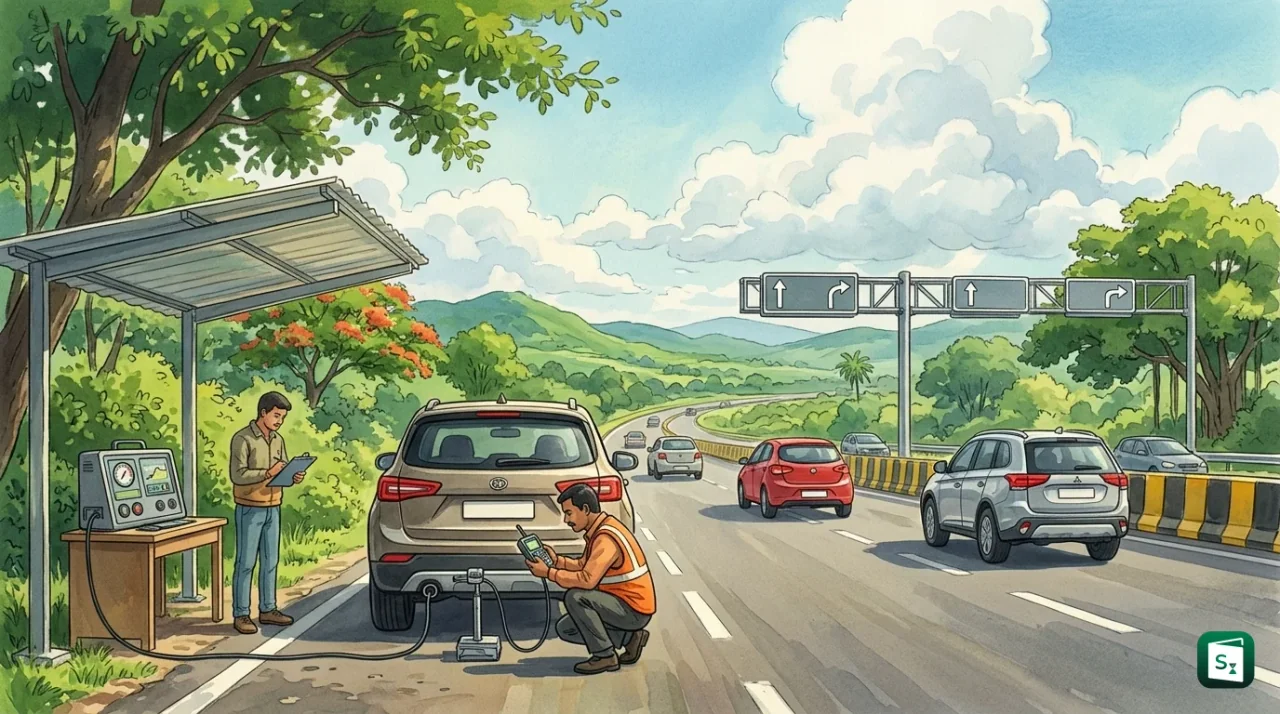
The Ministry of Road Transport and Highways has proposed Bharat Stage VII emission standards for new cars and SUVs manufactured from 1 April 2029. The draft rules, published as G.S.R. 880(E) on 12 October 2026, lay out a three-phase rollout till April 2035 aligned with Euro 7 norms. For the first time, the limits look beyond tailpipe smoke to brake dust, tyre wear, battery life and real driving emissions.
What Are Bharat Stage Emission Standards?
The Bharat Stage emission standards are India’s legal limits on pollutants released by motor vehicles, modelled on European emission norms. The Ministry of Road Transport and Highways (MoRTH) notifies these standards by amending the Central Motor Vehicles Rules, 1989 under Section 110 of the Motor Vehicles Act, 1988. Every new vehicle sold after the notified date must meet them.
Bharat Stage norms control carbon monoxide (CO), hydrocarbons (HC), nitrogen oxides (NOx) and particulate matter (PM). Carbon monoxide is a poisonous gas from incomplete fuel burning. Nitrogen oxides are gases that cause smog and breathing problems. Particulate matter refers to tiny solid particles in exhaust that enter the lungs.
India introduced the first stage, India 2000, in 2000. Coverage expanded in steps. BS-II came in 2005, BS-III in 2010 and BS-IV across India in April 2017. In 2016, the government decided to skip BS-V entirely and move directly to BS-VI in April 2020. That leap brought Indian rules close to Euro 6 and forced a nationwide shift to cleaner BS-VI fuel, diesel particulate filters and stricter on-board diagnostics.
| Stage | Nationwide rollout | Key change |
|---|---|---|
| India 2000 (BS-I) | 2000 | First Euro-based limits for cars |
| BS-II | 2005 | Tighter CO and hydrocarbon limits |
| BS-III | 2010 | Lower NOx and PM, OBD-I introduced |
| BS-IV | April 2017 | 50 ppm sulphur fuel, stricter PM for diesel |
| BS-VI | April 2020 | Skipped BS-V, near Euro 6, particle number limits, real driving checks |
| BS-VI Phase 2 | April 2023 | Real Driving Emissions with portable equipment, stricter OBD thresholds |
BS-VI already requires type approval in the laboratory, conformity of production checks at the factory gate and in-service conformity checks of vehicles on the road. From 1 April 2027, BS-VI cars are tested under the Worldwide Harmonised Light Vehicles Test Procedure (WLTP), a laboratory driving cycle that reflects average real use better than older cycles. The proposed BS-VII builds on this base.
When Will BS-VII Launch in India?
The BS-VII launch date in India is 1 April 2029 for new passenger cars under the MoRTH draft of October 2026. The rollout then adds brake and tyre rules in April 2031 and a single unified brake dust limit in April 2035 over a six-year period.
The proposal is still a draft, not law. MoRTH published draft notification G.S.R. 880(E) on 12 October 2026 to amend the Central Motor Vehicles Rules, 1989. The Ministry invited objections and suggestions within 30 days to the Additional Secretary for Transport and Road Safety in New Delhi. Final limits and dates can change after this consultation.
The draft inserts a new sub-rule 115(23)(i)A for BS-VII. It applies to M1 category vehicles. M1 means passenger cars with up to eight seats besides the driver, which includes most hatchbacks, sedans and SUVs. Only models manufactured on or after 1 April 2029 must comply.
| Vehicle category | Phase I start | Phase II start | Phase III start |
|---|---|---|---|
| M1 (cars and SUVs) | 1 April 2029 | 1 April 2031 | 1 April 2035 |
| N1 (small goods vans and pickups) | 1 April 2030 | 1 April 2032 | 1 April 2035 |
| M2, M3, N2, N3 (buses and heavy trucks) | 1 April 2031 | 1 April 2033 | 1 April 2035 |
For M1 cars, Phase I from April 2029 brings exhaust limits, evaporative emission limits and battery durability rules. Phase II from April 2031 adds brake particle limits, tyre abrasion checks and over-the-air monitoring. Phase III from April 2035 brings a single brake particle limit for all powertrains and further particle number controls. Tyre abrasion numbers and some battery test details will be notified separately.
BS6 vs BS-VII: Emission Limits and Key Changes
BS6 and BS-VII share similar headline gas limits for cars, but BS-VII measures more pollutants, in more conditions, for a longer vehicle life. The BS6 vs BS7 shift is therefore about wider coverage and tighter monitoring rather than a sharp cut in one gas.
For M1 cars, the draft keeps carbon monoxide at 1,000 mg per km for petrol type engines and 500 mg per km for diesel engines. Nitrogen oxides stay at 60 mg per km for petrol type engines and 80 mg per km for diesel engines. Particulate mass stays at 4.5 mg per km for both. Total hydrocarbons are capped at 100 mg per km and non-methane hydrocarbons at 68 mg per km for petrol type engines. The combined hydrocarbon plus nitrogen oxides cap for diesel is 170 mg per km.
| Pollutant | Petrol type (PI) | Diesel type (CI) |
|---|---|---|
| Carbon monoxide (CO) | 1,000 mg per km | 500 mg per km |
| Nitrogen oxides (NOx) | 60 mg per km | 80 mg per km |
| Particulate matter (PM) | 4.5 mg per km | 4.5 mg per km |
| Particle number (PN10) | 6 x 10 to the power 11 per km | 6 x 10 to the power 11 per km |
| Total hydrocarbons | 100 mg per km | covered under combined cap |
| Combined hydrocarbons plus NOx | not applicable | 170 mg per km |
PI means positive ignition, which covers petrol, CNG, LPG, E20, flex fuel, methanol and hydrogen spark engines. CI means compression ignition, which covers diesel engines.
The biggest exhaust change is the particle size rule. BS-VI counts solid particles larger than 23 nanometres (nm). BS-VII counts particles larger than 10 nm, written as PN10. A nanometre is one billionth of a metre. Ultrafine particles below 23 nm slip deep into the lungs and blood. Studies in traffic zones show sub-23 nm counts can equal or exceed larger particles for petrol direct injection and gas engines. Counting down to 10 nm closes that gap.
Compliance also gets stricter. From 1 April 2030, type approval includes on-road testing with Portable Emissions Measurement Systems (PEMS), instruments fitted to the car during real driving. The conformity factor is 1.0 for NOx and particle number. That means on-road results must meet the laboratory limit with no extra margin.
Cars must stay clean far longer. The draft sets a main lifetime of 160,000 km or 8 years and an additional lifetime of 200,000 km or 10 years. Evaporative emissions, which are fuel vapours escaping from the tank and fuel system, are capped at 1.5 g per test. Idle limits and deterioration factors for ageing are also fixed to stop performance from slipping as the car gets old.
Monitoring moves inside the car. On-Board Diagnostics (OBD) detects faults in pollution controls. On-Board Monitoring (OBM) must flag emissions at least 2.5 times the limit. On-Board Fuel and Energy Consumption Monitoring (OBFCM) tracks fuel and electricity use. Fuel data must be readable through the diagnostic port from April 2030, with wider data available over the air from April 2032. Buyers get an Environmental Vehicle Passport (EVP), a digital and in-vehicle record of fuel use, battery health and emissions. Petrol and diesel cars with geofencing that forces clean operation in cities can be approved as BS-VII-G vehicles.
How Is BS-VII Aligned With Euro 7 Norms?
The Euro 7 norms are the European Union rules for vehicle emissions and battery durability under Regulation (EU) 2024/1257. The Council of the EU adopted the regulation on 12 April 2024. It entered into force on 28 May 2024. The regulation covers cars, vans, buses, trucks and trailers in one law and is part of the European Green Deal and Paris Agreement commitments.
Euro 7 keeps Euro 6 exhaust limits for cars and vans but extends particle number counting to particles above 10 nm. The regulation adds real driving emissions testing for all categories, fuel and energy consumption checks, brake particle limits, tyre abrasion rules and minimum battery durability for electric and plug-in hybrid cars. It also introduces the Environmental Vehicle Passport for each vehicle.
The EU applies Euro 7 earlier than India. For cars and vans, Euro 7 applies to new types from 29 November 2026 and to all new registrations from 29 November 2027. For buses, trucks and trailers, it applies to new types from 29 May 2028 and to all new vehicles from 29 May 2029. For C1 car tyres, new types must comply from 1 July 2028.
India’s BS-VII draft mirrors this design. The same PN10 threshold, the same move from only exhaust to brakes and tyres, and the same battery and passport tools appear in both. The main difference is timing. India proposes to start M1 cars in April 2029, about 17 months after the EU start for all new cars. Heavy vehicles also start later in India, in April 2031. The EU also pairs Euro 7 with a separate rule to end tailpipe carbon dioxide from new cars and vans by 2035, while India has not announced a similar combustion engine end date.
Vehicle Coverage, Monitoring and New Rules for Brakes, Tyres and Batteries
The BS-VII draft covers a wide set of fuels in M1 cars. The rules list petrol blended with 20 percent ethanol (E20), diesel, compressed natural gas, liquefied petroleum gas, flex fuel, bi-fuel, methanol, hydrogen and hybrid systems. Pure electric cars and plug-in hybrids are included for energy use, battery durability and brake dust. Existing BS-VI cars on the road are not affected. The rules apply only to new models manufactured after the start date.
Non-exhaust pollution is the clearest break from the past. Brakes release particles as pads and discs wear. Tyres shed material as they rub against the road. Together they now rival exhaust as a source of roadside particulate matter, especially as exhaust gets cleaner and vehicles get heavier with batteries.
| Brake dust rule | From 1 April 2031 | From 1 April 2035 |
|---|---|---|
| Pure electric cars (PEV) | 3 mg per km (PM10) | 3 mg per km for all powertrains |
| Hybrid, fuel cell and combustion cars | 7 mg per km (PM10) | 3 mg per km for all powertrains |
PM10 means particles with diameter up to 10 micrometres. Tyre abrasion limits for C1 car tyres apply from 1 April 2031, but the numerical limits will be notified separately. Particle number limits for brakes will also be notified separately. The Society of Indian Automobile Manufacturers (SIAM) has asked that brake and tyre rules start only in April 2035 after suppliers confirm test methods and readiness.
Battery rules bring electric cars into emission law for the first time. Traction batteries in pure electric and plug-in hybrid M1 cars must retain at least 75 percent of original energy after five years or 100,000 km, and at least 67 percent after eight years or 160,000 km. Detailed test procedures for these Minimum Performance Requirements will be notified separately.
Enforcement rests with MoRTH through type approval, conformity of production and in-service conformity tests under AIS-215 and related automotive industry standards. Independent testing agencies will carry out market surveillance. Anti-tampering rules cover fuel injection, engine control units, batteries, odometers, pollution control devices and software updates, with cybersecurity safeguards for over-the-air data.
Significance and The Way Forward
Road transport remains a major source of nitrogen oxides and fine particles in Indian cities. These pollutants raise asthma, heart disease and premature deaths. Ultrafine particles below 23 nm are especially risky because they penetrate deeper and carry metals from fuel and lube oil. Counting them down to 10 nm will push makers to use improved filters and cleaner combustion across petrol, diesel and gas engines.
The draft also shifts policy from the tailpipe to the full vehicle. Brake and tyre wear already make up a large share of traffic particles in cities with slow stop-and-go driving. Battery durability standards protect buyers of electric cars and reduce early battery waste. The passport, on-board monitoring and fuel use tracking give regulators real data instead of laboratory figures alone.
Costs and readiness are the main concerns. Stricter filters, on-board sensors, low dust brake pads and low abrasion tyres add cost. Carmakers support cleaner exhaust rules but say brake and tyre test methods are still evolving. Suppliers need time to develop materials, build test rigs and prove compliance at vehicle level. Fuel compatibility also matters. Makers must declare and label ethanol compatibility above E20 under AIS-171:2021, while CNG and hydrogen vehicles must meet safety codes AIS-024, AIS-028 and AIS-195.
The way forward runs through consultation and testing rules. The 30-day comment window on G.S.R. 880(E) lets makers, suppliers, testing agencies and citizens flag gaps. MoRTH must then notify final emission limits, tyre abrasion numbers, brake particle number limits and battery test procedures. If the April 2029 date holds, carmakers have about two and a half years to complete design, validation and type approval. Clear test methods, phased supplier deadlines and stable fuel quality will decide whether BS-VII repeats the relatively smooth BS-VI shift of 2020 or faces calls for delay till 2035.
Key Takeaways
- MoRTH proposed BS-VII emission standards for M1 cars and SUVs from 1 April 2029 through draft notification G.S.R. 880(E) dated 12 October 2026.
- BS-VII will roll out in three phases in April 2029, April 2031 and April 2035 and is aligned with EU Euro 7 Regulation 2024/1257.
- The particle number threshold tightens from 23 nm to 10 nm (PN10) with a limit of 6 x 10 to the power 11 per km, while PM stays at 4.5 mg per km.
- Brake dust limits from April 2031 are 3 mg per km for pure electric cars and 7 mg per km for others, converging to a single 3 mg per km limit in April 2035.
- Electric and plug-in hybrid batteries must retain 75 percent capacity for 5 years or 100,000 km and 67 percent for 8 years or 160,000 km, with compliance tracked through OBM, OBFCM and an Environmental Vehicle Passport.