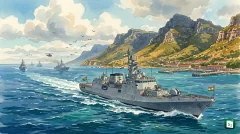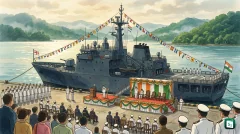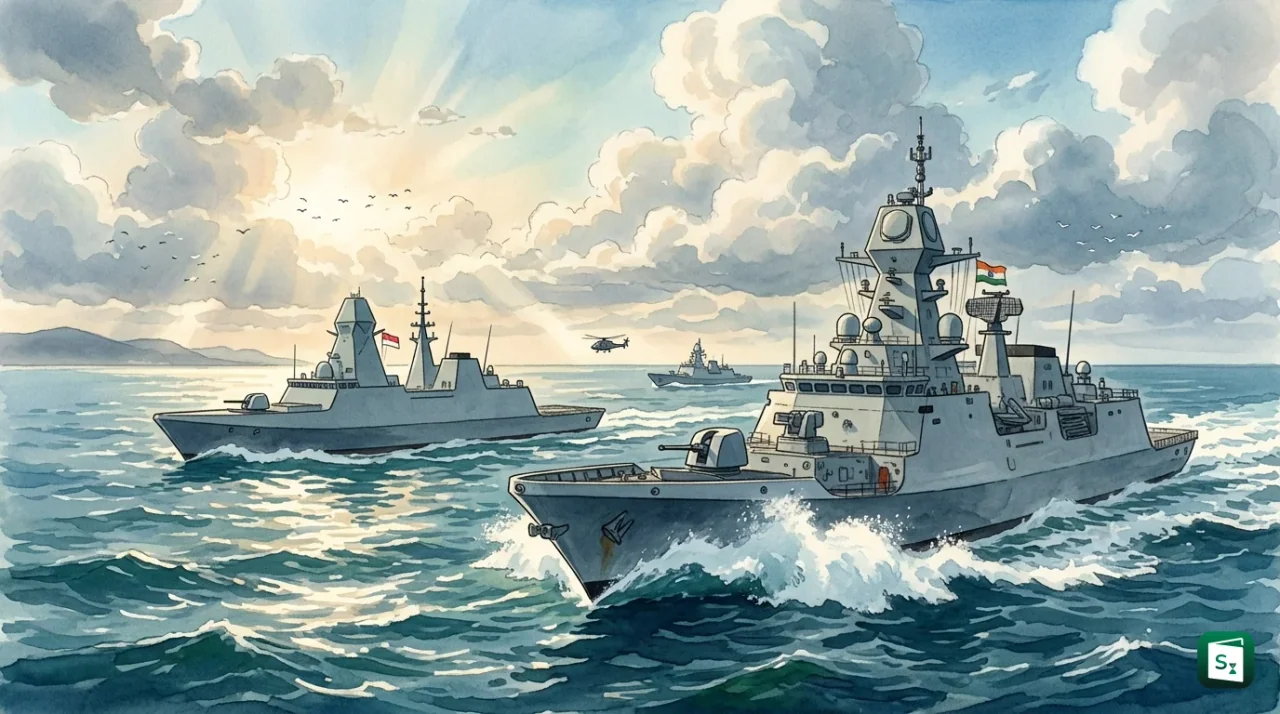
The 33rd edition of the Singapore India Maritime Bilateral Exercise (SIMBEX 2026) is being held at Visakhapatnam from 21 to 26 October 2026. The Indian Navy has deployed its stealth frigate INS Nilgiri and anti-submarine corvette INS Kamorta, while the Republic of Singapore Navy has joined with its frigate RSS Supreme. The six day exercise will move from harbour planning in Visakhapatnam to complex war drills in the Bay of Bengal.
What Is SIMBEX and Which Countries Participate in It?
The Singapore India Maritime Bilateral Exercise (SIMBEX) is an annual naval drill conducted by the Indian Navy and the Republic of Singapore Navy (RSN). The exercise focuses on maritime cooperation, anti-submarine warfare and joint operations to improve interoperability and regional security in the Indo-Pacific.
SIMBEX stands for Singapore India Maritime Bilateral Exercise. The name is sometimes written as Singapore-India Maritime Bilateral Exercise. The exercise is strictly bilateral. The only two participants are India and Singapore. There is no third country involved. The drill is sometimes confused with exercises involving other countries, but that understanding is incorrect. SIMBEX has always been an India Singapore naval exercise.
The Indian Navy is the naval branch of the Indian Armed Forces and protects sea lanes around the Indian Ocean Region. The Republic of Singapore Navy (RSN) is the naval arm of the Singapore Armed Forces and guards Singapore’s sea lines of communication. Both navies use SIMBEX to practise common procedures, speak the same tactical language and operate ships and aircraft together. Over time the SIMBEX military exercise has grown from simple submarine tracking drills into a full spectrum warfare exercise covering air, surface and underwater threats.
When Did SIMBEX Start?
SIMBEX started in 1994 as Exercise Lion King with a focus on anti-submarine warfare. The Indian Navy and the Republic of Singapore Navy have conducted the drill every year since then. The 2026 edition is the 33rd edition, which makes SIMBEX India’s longest continuous bilateral naval exercise.
The first SIMBEX in 1994 involved two Singapore missile corvettes, RSS Victory and RSS Valour, and an Indian Navy submarine. The aim was narrow. Both sides wanted to practise finding and tracking submarines. Anti-submarine warfare, often shortened to ASW, means detecting, following and if needed neutralising enemy submarines.
The SIMBEX exercise scope widened after 2005. Anti-surface and anti-air warfare were added. Anti-surface warfare deals with enemy ships on the sea surface. Anti-air warfare deals with enemy aircraft and missiles. In 2006, both navies signed revised Standard Operating Procedures to cover these new areas. The Silver Jubilee edition was held in 2018 with about 30 ships and aircraft from both sides, the largest participation until that time. Each later edition has added more complex gunnery firings, helicopter operations and maritime security tasks such as boarding and search procedures.
SIMBEX 2026: Dates, Venue and Participants
The SIMBEX 2026 edition is being held at Visakhapatnam from 21 to 26 October 2026 under the Eastern Naval Command. The Eastern Naval Command is headquartered at Visakhapatnam in Andhra Pradesh and controls Indian naval operations in the Bay of Bengal and the eastern Indian Ocean. The opening ceremony took place on 21 October 2026 on board INS Nilgiri and INS Kamorta. Senior officers present included Rear Admiral Manoj Jha, Chief Staff Officer (Operations) of the Eastern Naval Command, and Colonel Bertram Ang, Fleet Commander of the Republic of Singapore Navy.
Three frontline warships form the core of the exercise. The Indian side is represented by two indigenously built ships. The Singapore side is represented by one stealth frigate.
| Ship | Navy | Type and Class | Key Role |
|---|---|---|---|
| INS Nilgiri (F33) | Indian Navy | Stealth guided missile frigate, lead ship of Nilgiri class under Project 17A | Air defence, anti-ship strike and fleet operations |
| INS Kamorta (P28) | Indian Navy | Anti-submarine stealth corvette, lead ship of Kamorta class under Project 28 | Submarine hunting and coastal defence |
| RSS Supreme (73) | Republic of Singapore Navy | Stealth frigate of Formidable class | Multi role combat, air and surface warfare |
Indian Navy Ships: INS Nilgiri and INS Kamorta
INS Nilgiri is the lead ship of the Nilgiri class. The Nilgiri class is being built under Project 17A as the next generation of Indian stealth frigates. The ship was built by Mazagon Dock Shipbuilders Limited (MDL) in Mumbai and was commissioned on 15 January 2025 along with the destroyer INS Surat and the submarine INS Vaghsheer. The frigate displaces about 6,670 tonnes and has a length of 149 metres. Its weapons include 32 Barak 8 surface to air missiles for air defence and 8 BrahMos supersonic cruise missiles for anti-ship strike. The ship also carries torpedo launchers, rocket launchers, a 76 mm naval gun and a helicopter. Stealth shaping reduces its radar, heat and noise signs and helps it survive in high threat zones.
INS Kamorta is the first of four anti-submarine stealth corvettes built under Project 28. The ship was designed by the Indian Navy’s Directorate of Naval Design and built by Garden Reach Shipbuilders and Engineers (GRSE) in Kolkata. INS Kamorta was commissioned on 23 August 2014 at Visakhapatnam with an indigenous content of about 90 percent. The corvette displaces about 3,500 tonnes, is 109 metres long and can reach speeds of more than 25 knots. Its main tools are anti-submarine torpedoes, anti-submarine rockets, the indigenous Revathi surveillance radar and a HUMSA sonar system. The ship can also carry one anti-submarine helicopter. High grade Indian steel called DMR 249A, developed with the Steel Authority of India, was used in its hull.
Singapore Navy Ship: RSS Supreme
RSS Supreme carries pennant number 73 and belongs to the Formidable class. The Formidable class has six ships and forms the First Flotilla of the Republic of Singapore Navy. The class is based on the French La Fayette design and was built between 2002 and 2009 by DCNS in France and ST Engineering in Singapore. RSS Supreme was launched on 9 May 2006 and commissioned on 16 January 2009. The home port is Changi Naval Base.
The frigate displaces about 3,200 tonnes, is 114.8 metres long and sails at speeds in excess of 25 knots with a range of more than 3,500 nautical miles. Its weapons allow fighting in three dimensions. The ship carries Harpoon surface to surface missiles, Aster surface to air missiles in vertical launch cells, Whitehead A244S torpedoes and a 76 mm OTO Melara gun. An S-70B Seahawk naval helicopter gives the ship long range submarine detection and strike power. The motto of RSS Supreme is Surpassing All Always.
How SIMBEX 2026 Is Conducted: Harbour Phase and Sea Phase
The SIMBEX 2026 exercise has two clear parts. The first part builds common understanding on shore. The second part tests that understanding at sea.
The Harbour Phase runs from 21 to 23 October 2026 at Visakhapatnam. During this phase, sailors from both navies take part in professional interactions and planning conferences. Subject Matter Expert Exchanges, called SMEEs, allow specialists to share methods for submarine rescue, maritime air operations and boarding procedures. Cross deck visits let crews visit each other’s ships and study equipment and work routines. Sports fixtures build personal bonds between sailors. The phase ends with pre sail briefings where the sea tasks are planned in detail.
The Sea Phase is scheduled from 24 to 26 October 2026 in the Bay of Bengal. This is the operational heart of the drill. Ships practise anti-submarine warfare with ships, helicopters and sonar systems working together to find a simulated underwater target. Anti-surface drills focus on tracking and engaging enemy ships. Anti-air drills practise defence against aircraft and missile attacks. Seamanship evolutions include refuelling, towing and close manoeuvres. Tactical manoeuvres test how ships move as a group under a common commander. The aim is smooth coordination, so an Indian ship and a Singapore ship can fight as one unit.
Previous Editions and Venue History
The SIMBEX exercise follows an annual cycle. The venue alternates between India and Singapore. When the exercise is held in India, the harbour work is usually at Visakhapatnam and the sea work is in the Bay of Bengal. When Singapore hosts, the harbour work is at RSS Singapura Changi Naval Base and the sea work is often in the southern reaches of the South China Sea.
| Edition | Year | Venue and Sea Area | Main Participants |
|---|---|---|---|
| 31st SIMBEX | 2024 | Visakhapatnam and Bay of Bengal, 23 to 29 October | INS Shivalik with MH-60R helicopter, P-8I aircraft and submarine from India, RSS Tenacious with S-70B helicopter from Singapore |
| 32nd SIMBEX | 2025 | Changi Naval Base and South China Sea, 28 July to 1 August | INS Satpura from India, RSS Supreme and RSS Vigilance with MV Mentor from Singapore, plus F-15SG fighters and Fokker-50 patrol aircraft |
| 33rd SIMBEX | 2026 | Visakhapatnam and Bay of Bengal, 21 to 26 October | INS Nilgiri and INS Kamorta from India, RSS Supreme from Singapore |
The 31st edition in 2024 focused on live weapon firing, anti-submarine training and air operations with fighters and patrol aircraft. The 32nd edition in 2025 was special. Singapore and India marked 60 years of diplomatic ties in 2025. The shore phase at Changi included joint planning, simulator training and exchanges on maritime air operations and compliant boarding. The sea phase included gunnery firing, air defence and maritime security drills and ended with a sail past. Singapore’s Ministry of Defence described SIMBEX as one of its longest running bilateral maritime exercises and India’s longest continuous bilateral naval exercise with any country.
The pattern is clear. Each year builds on the last. Weapons get more advanced. Serials get more complex. Trust between crews gets deeper.
Why SIMBEX Matters for Maritime Cooperation
The Indian Navy uses SIMBEX to strengthen operational readiness in the eastern Indian Ocean. Singapore sits at the eastern end of the Malacca Strait. The strait is one of the world’s busiest shipping lanes and carries a large share of India’s trade and energy imports. Safe passage through this lane is vital for India’s economy. Joint drills with Singapore help both navies guard these routes against piracy, smuggling and other threats at sea.
The Singapore Navy gains deep water training space and experience with a larger ocean going force. The Indian Navy gains a partner with advanced sensors, helicopters and combat management systems. The exchange of tactics improves interoperability. Interoperability means the ability of two different navies to communicate, share radar pictures and fight together without confusion.
The exercise also supports India’s wider maritime outlook. The Vision SAGAR framework, which stands for Security and Growth for All in the Region, calls for cooperative security in the Indian Ocean Region. The Act East Policy seeks closer economic and security links with Southeast Asia and ASEAN. ASEAN is the Association of Southeast Asian Nations, a ten member group headquartered in Jakarta, Indonesia. Singapore co-hosted the first ASEAN India Maritime Exercise in 2023. SIMBEX provides the bilateral skill base that makes such larger group exercises possible. For both countries, the message is steady. The two navies support a free, open and rules based order in the Indo-Pacific.
Key Takeaways
- The 33rd edition of SIMBEX 2026 is being held at Visakhapatnam from 21 to 26 October 2026 between India and Singapore.
- SIMBEX stands for Singapore India Maritime Bilateral Exercise and started in 1994 as Exercise Lion King.
- Indian participants in 2026 are stealth frigate INS Nilgiri (Project 17A) and anti-submarine corvette INS Kamorta (Project 28).
- Singapore is represented by the Formidable class stealth frigate RSS Supreme (pennant 73).
- The Harbour Phase from 21 to 23 October covers expert exchanges and planning, while the Sea Phase from 24 to 26 October in the Bay of Bengal covers anti-submarine, anti-surface and anti-air drills.
- The 32nd edition in 2025 was held at Changi and the South China Sea, while the 31st edition in 2024 was held at Visakhapatnam and the Bay of Bengal.