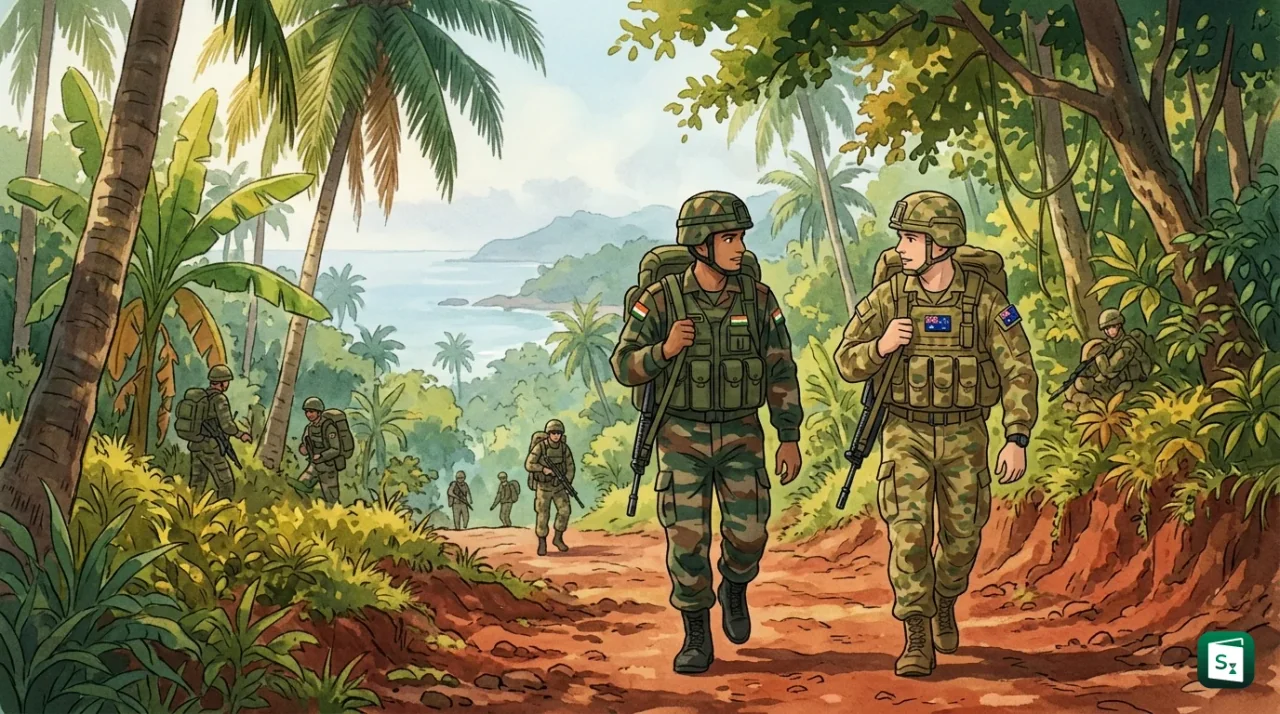
The fifth edition of Exercise AUSTRAHIND began on 19 October 2026 at the Foreign Training Node in Thiruvananthapuram, where about 120 personnel each from the Indian Army and the Australian Army will train until 1 November. The Indian contingent is led by the Garhwal Rifles, while Australia has fielded troops from its 13 Brigade. This year the exercise moves to coastal and island terrain, with a New Zealand observer delegation attending for the first time.
What Is Exercise AUSTRAHIND 2026?
Exercise AUSTRAHIND 2026 is the fifth edition of the annual bilateral army exercise between India and Australia. It runs from 19 October to 1 November 2026 at the Foreign Training Node, Thiruvananthapuram, with around 120 personnel from each side training in sub-conventional island and coastal operations.
The exercise was instituted in 2022 and is held alternately in the two countries. Its name combines “Austra” from Australia and “Hind” from India, a naming pattern India also uses for exercises such as Yudh Abhyas with the United States and Mitra Shakti with Sri Lanka.
AUSTRAHIND is an army-level exercise, but it is not the only military engagement between the two countries. The armies, navies and air forces of India and Australia train together through separate drills, and AUSTRAHIND sits within a wider defence framework that now includes an annual Defence Ministers’ Dialogue and a Mutual Logistics Support Arrangement.
Theme and Training Focus
The 2026 edition is being conducted on the theme “Joint Sub-Conventional Operations in Island and Coastal Environment under Chapter VII of the UN Mandate”. Sub-conventional operations cover military action below the threshold of full conventional war, such as counter-terrorism, counter-infiltration and stability operations.
Troops from both armies will go through joint planning, tactical drills and combat training under realistic conditions, including aerial and maritime dimensions. The training covers four broad areas: coordinated operations in coastal and island environments, surveillance and reconnaissance, protection of vital installations, and response to Humanitarian Assistance and Disaster Relief (HADR) emergencies. The contingents will also exchange professional experience and best practices.
The Indian Army has described the 2026 edition as an amphibious-oriented exercise. This aligns with the Australian Army’s ongoing shift towards littoral manoeuvre, which means the ability to move troops, vehicles and supplies from ship to shore and across coastal areas. For India, the same skill set matters along its long coastline, its island territories and its offshore assets.
The Foreign Training Node in Thiruvananthapuram
The Foreign Training Node (FTN) is an Indian Army facility used to host joint exercises with foreign armies. In Thiruvananthapuram, the Army’s principal establishment is the Pangode Military Station, which is home to the 91 Infantry Brigade. The brigade was raised on 1 October 1966 and marked its 59th raising day in 2025.
The location is operationally useful. Kerala has a densely populated coastline, major ports and a history of monsoon-related disasters, so coastal drills and HADR training have direct relevance. Thiruvananthapuram has previously hosted joint exercises with France (FRINJEX 2023) and the Maldives (Ekuverin), which shows the node’s role in India’s defence diplomacy.
India runs similar nodes at Umroi in Meghalaya, Chaubatia in Uttarakhand, Pune in Maharashtra and Belagavi in Karnataka. Each is chosen according to the terrain a particular exercise is meant to simulate. A coastal exercise in Kerala, for example, cannot be replicated at a semi-desert range in Rajasthan.
Which Regiments and Brigades Are Participating?
Around 120 Indian Army personnel, drawn mainly from the Garhwal Rifles with attachments from other arms and services, are training with about 120 soldiers of the Australian Army’s 13 Brigade. The Indian regiment is an infantry unit recruited from Uttarakhand, while the Australian brigade is an Army Reserve formation based in Perth.
Garhwal Rifles: A Regiment Raised in 1887
The Garhwal Rifles was raised on 5 May 1887 at Almora as the 39th (Garhwal) Regiment of the Bengal Army. Its first battalion moved to Kaludanda later that year, and the cantonment was renamed Lansdowne after the then Viceroy of India. The regimental centre, established at Lansdowne on 1 October 1921, continues to train recruits from the Garhwal division of Uttarakhand.
The regiment’s motto is Yudhaya Krit Nishchaya, meaning “fight with determination”. Its war cry is Badri Vishal Lal Ki Jai, a reference to Lord Badrinath, the presiding deity of the Garhwal Himalayas. Soldiers of the regiment are nicknamed the Snow Leopards.
The Garhwal Rifles has a strong combat record. Naik Darwan Singh Negi of the 39th Garhwal Rifles received the Victoria Cross for gallantry near Festubert in France in 1914, making him one of the earliest Indian recipients of the award. The regiment’s post-Independence battle honours include Tithwal, Nuranang, Buttur Dograndi, Hilli, Batalik, Dras and Kargil. It currently has 21 regular battalions, three Rashtriya Rifles battalions and two Territorial Army battalions (as of October 2026).
Recruitment is rooted in the Garhwal region, covering districts such as Pauri Garhwal, Tehri Garhwal, Chamoli, Rudraprayag, Uttarkashi, Dehradun and Haridwar. This concentration gives the regiment a distinct regional identity and a strong regimental bond.
Australia’s 13 Brigade
The 13 Brigade is an Australian Army Reserve formation headquartered in Perth, Western Australia. It was originally formed in 1912, re-raised in 1988, and now forms part of the Australian Army’s 2nd Division. Its units are spread across Western Australia, including Perth, Geraldton, Kalgoorlie, Albany and Katanning.
The brigade is based at Irwin Barracks in Karrakatta, the same facility that hosted the fourth edition of AUSTRAHIND in October 2025. Its units include the 10th Light Horse Regiment, the 11th/28th Battalion of the Royal Western Australia Regiment, the 16th Battalion of the Royal Western Australia Regiment, which is an amphibious infantry unit, the 13th Engineer Regiment and the 13th Combat Service Support Battalion.
The 10th Light Horse Regiment, raised in 1914, carries battle honours from Gallipoli, Gaza-Beersheba and Damascus. Its motto, Percute et Percute Velociter, means “strike and strike swiftly”.
A New Zealand Observer Delegation
For the first time, an observer delegation from New Zealand is attending AUSTRAHIND. The Ministry of Defence has clarified that the exercise remains a bilateral India-Australia drill, so New Zealand’s role is to observe rather than participate.
The presence of observers is significant because it signals wider regional interest in the format. New Zealand and Australia are close defence partners, and India has been expanding its military engagement across the Indo-Pacific. An observer delegation is often the first step before a country joins a multilateral exercise.
AUSTRAHIND Across Five Editions
AUSTRAHIND has changed its venue, terrain and participating regiment in every edition. The table below tracks the series since it began in 2022.
| Edition | Year | Venue | Dates | Indian Contingent | Training Focus |
|---|---|---|---|---|---|
| 1st | 2022 | Mahajan Field Firing Ranges, Rajasthan | 28 November to 11 December 2022 | Dogra Regiment | Sub-conventional operations in urban and semi-urban terrain |
| 2nd | 2023 | Perth, Australia | 22 November to 6 December 2023 | Gorkha Rifles, with Navy and Air Force personnel | Urban and semi-urban operations under a UN peacekeeping mandate |
| 3rd | 2024 | Foreign Training Node, Pune | 8 to 21 November 2024 | Dogra Regiment, with Indian Air Force personnel | Counter-terrorism, drone and counter-drone drills in semi-urban and semi-desert terrain |
| 4th | 2025 | Irwin Barracks, Perth, Australia | 13 to 26 October 2025 | A battalion of the Gorkha Rifles | Company-level operations in open and semi-desert terrain |
| 5th | 2026 | Foreign Training Node, Thiruvananthapuram | 19 October to 1 November 2026 | Garhwal Rifles, with other arms and services | Joint sub-conventional operations in island and coastal environments |
The first edition in 2022 was a smaller drill at a field firing range in Rajasthan. By 2024, Australia was sending almost three times as many soldiers as in 2022, and the Indian contingent alone comprised 140 personnel. The scope also widened from basic tactical drills to specialised training in drones, counter-drone systems, heli-borne operations and the establishment of a joint operations centre.
The alternating venue is deliberate. Hosting the exercise in both countries exposes troops to different climates, terrain and training infrastructure. It also shares the logistical and financial burden between the two armies. The 2023 edition was notable for including personnel from the Indian Navy and Indian Air Force, along with their Australian counterparts, which gave the drill a tri-service character that year.
The 2025 edition at Perth focused on open and semi-desert terrain. The 2026 shift to Kerala’s coast is therefore a deliberate change of setting, not a routine rotation. It tests the same armies against a very different operational problem: how to fight and sustain forces across water, beaches and islands.
Why Coastal and Island Warfare Is the New Focus
Coastal and island warfare has become central to Indo-Pacific security because the region is largely a maritime space of straits, archipelagos and long coastlines. For India, this means defending offshore assets and island territories. For Australia, it means operating across the sea approaches to its north.
India has a coastline of more than 7,500 km and more than 1,300 islands, including the Andaman and Nicobar group and Lakshadweep. These territories sit close to some of the world’s busiest shipping lanes. The Andaman and Nicobar Islands, in particular, overlook the approaches to the Strait of Malacca, through which a large share of global trade passes.
Coastal security is also a sub-conventional challenge. The 2008 Mumbai attacks showed how a group of terrorists could enter a city by sea and cause mass casualties. Since then, India has built a layered coastal security system involving the Indian Navy, the Coast Guard, coastal police and marine intelligence units. Exercises like AUSTRAHIND rehearse the military component of that response.
There is a disaster-relief dimension as well. The Indian Ocean is prone to cyclones, storm surges and tsunamis, and both India and Australia have deployed military assets for HADR missions in the region. In 2026, the Australian Army is reorganising itself around littoral manoeuvre, with a new Littoral Manoeuvre Group and a 1st Landing Craft Battalion raised in January. Australia plans to induct new medium and heavy landing craft from 2027. Training with the Indian Army gives both forces a chance to compare how they move troops and supplies from ship to shore.
What Chapter VII of the UN Charter Means
Chapter VII of the United Nations Charter, covering Articles 39 to 51, gives the UN Security Council the power to respond to threats to peace, breaches of peace and acts of aggression. Article 39 allows the Council to determine whether such a situation exists. Article 41 covers measures that do not involve armed force, such as economic sanctions. Article 42 permits military action if lesser measures are judged inadequate.
Chapter VII is often associated with peace enforcement rather than traditional peacekeeping. Traditional peacekeeping usually rests on consent from the parties to a conflict. A Chapter VII mandate can authorise forces to use all necessary means, including force, to protect civilians or restore order. India has a long record of contributing troops to UN peacekeeping missions and has served in several operations with robust Chapter VII mandates.
For AUSTRAHIND, the Chapter VII reference gives the training a legal and doctrinal frame. Troops are not simply practising beach landings. They are rehearsing how a UN-mandated force would plan and conduct sub-conventional operations in a coastal setting, where civilian protection, disaster response and armed threats can overlap.
India-Australia Defence Ties Beyond AUSTRAHIND
India and Australia elevated their relationship to a Comprehensive Strategic Partnership in June 2020, and defence cooperation has since become one of its fastest-growing pillars. AUSTRAHIND is one part of a network of dialogues, agreements and exercises that now covers the army, navy, air force and defence industry.
The foundation was laid by the India-Australia Joint Declaration on Security Cooperation of 2009. The 2020 partnership added the Mutual Logistics Support Arrangement (MLSA), which allows the two militaries to use each other’s bases for fuel, provisions and repairs. A Defence Science and Technology Implementing Arrangement was signed at the same time.
High-level consultation has also expanded. The two countries hold a 2+2 Foreign and Defence Ministerial Dialogue, a Defence Policy Talks mechanism and, since 2025, an annual Defence Ministers’ Dialogue. The first edition was held in Canberra in October 2025 and the second in New Delhi on 1 June 2026. During Prime Minister Narendra Modi’s visit to Melbourne in July 2026, the two sides issued a Joint Declaration on Defence and Security Cooperation and announced the Australia-India Partnership on Cyber, Critical Technologies and Supply Chains, known as Australia-India PACTS.
The June 2026 dialogue produced several concrete outcomes. The ministers agreed to begin work on a Memorandum of Understanding on the Provision of Defence Articles and Defence Services, a step towards deeper defence industrial collaboration. They also welcomed India’s first participation in Australia’s Operation Render Safe, an unexploded ordnance clearance mission in the Pacific, and Australia’s invitation for India to join the submarine rescue exercise Black Carillon. A first Joint Staff Talks was scheduled for later in 2026.
Military Exercises Between India and Australia
AUSTRAHIND is the army component of a broader exercise portfolio. The table below lists the main drills that bring the two militaries together, either bilaterally or through multilateral formats.
| Exercise | Domain | Format | Key Details |
|---|---|---|---|
| AUSTRAHIND | Army | Bilateral, annual | Instituted in 2022, held alternately in India and Australia |
| AUSINDEX | Navy | Bilateral | Began in 2015, focuses on anti-submarine warfare and maritime interoperability |
| Malabar | Navy | Quad navies | Began in 1992 as an India-US drill; Japan became a permanent partner in 2015 and Australia rejoined in 2020 |
| Pitch Black | Air Force | Multinational, hosted by Australia | India participates with fighter aircraft; bilateral air-to-air refuelling is being operationalised |
| Kakadu | Navy | Multinational, hosted by Australia | India participated in March 2026 with the frigate INS Nilgiri |
| Milan | Navy | Multinational, hosted by India | Australia participated in the February 2026 edition |
| Talisman Sabre | Joint | Multinational, hosted by Australia | India is set for enhanced participation in the 2027 edition |
Malabar is the most visible of these drills because it brings all four Quad navies together. The Quad, or Quadrilateral Security Dialogue, is an informal grouping of India, the United States, Japan and Australia that coordinates on a free and open Indo-Pacific. It is not a military alliance, and its members do not have mutual defence obligations. Even so, the naval interoperability built through Malabar has strategic weight.
The Economic Pillar
Defence ties are reinforced by trade. The India-Australia Economic Cooperation and Trade Agreement (ECTA) was signed on 2 April 2022 and came into force on 29 December 2022. Bilateral trade stood at $24.1 billion in 2024-25, and India’s exports to Australia rose from $4 billion in 2020-21 to $8.5 billion in 2024-25. From 1 January 2026, all Indian exports to Australia became eligible for zero-duty access.
The two sides are negotiating a broader Comprehensive Economic Cooperation Agreement (CECA) and have set an ambition of $100 billion in bilateral trade by 2030. A stronger economic relationship gives both governments a practical stake in keeping the security partnership stable.
What AUSTRAHIND 2026 Means for the Indo-Pacific
AUSTRAHIND 2026 signals that India and Australia are converting a shared strategic outlook into practised military cooperation. The exercise is small in size, with about 240 personnel in total, but its value lies in standardising procedures that would matter in a real contingency.
The choice of Kerala is notable. India’s western coast faces the Arabian Sea, while its eastern coast opens into the Bay of Bengal and the Andaman Sea. Both are part of the wider Indo-Pacific theatre that Australia also watches. Training in coastal terrain helps the two armies understand each other’s drills for beach landings, surveillance, casualty evacuation and disaster relief.
For Australia, the exercise supports its 2026 National Defence Strategy, which calls for an army optimised for littoral manoeuvre and able to operate across the archipelagos to its north. For India, it complements the Indo-Pacific Oceans Initiative (IPOI), launched in 2019, which focuses on maritime security, marine ecology, trade connectivity and disaster management. India’s SAGAR vision, announced in 2015, similarly emphasises security and growth for all in the Indian Ocean region.
The strategic signal is aimed at more than the two participating armies. India and Australia are both wary of coercive behaviour in the South China Sea and the Indian Ocean. They have not formed an alliance, and neither government describes the relationship in those terms. Instead, they are building what the July 2026 joint declaration calls an advanced, integrated and top-tier defence partnership. Exercises like AUSTRAHIND make that phrase operational.
There are limits worth noting. A 240-person drill does not change the military balance in the region. India continues to guard its strategic autonomy and does not join formal security blocs. Australia, for its part, balances its Quad engagement with deep economic ties to China. AUSTRAHIND is therefore best read as a confidence-building and interoperability measure, not as a commitment to fight together.
The Way Forward
The immediate agenda is already set. The first India-Australia Joint Staff Talks are due later in 2026, and the proposed MoU on defence articles and services could open the door to joint production and supply chain integration. The two sides are also preparing for India’s enhanced participation in Exercise Talisman Sabre 2027 and for deeper cooperation in sensor technologies.
For AUSTRAHIND itself, the amphibious focus is likely to continue. Australia’s new landing craft and littoral units will need partners who can operate alongside them, and India’s island territories offer realistic training ground. The New Zealand observer delegation raises the possibility that the exercise could gradually acquire a wider regional dimension, although both India and Australia have stressed that the 2026 edition remains bilateral.
The larger test lies in sustaining momentum. Exercises generate photographs and statements, but durable defence cooperation needs functioning logistics, shared standards and industrial links. The MLSA, the planned defence services MoU and the CECA negotiations will determine whether the partnership moves beyond annual drills into something more permanent.
Key Takeaways
- The fifth edition of Exercise AUSTRAHIND is being held from 19 October to 1 November 2026 at the Foreign Training Node, Thiruvananthapuram.
- Around 120 personnel each from the Indian Army and the Australian Army are participating, with India represented by the Garhwal Rifles and Australia by the 13 Brigade.
- The 2026 theme is “Joint Sub-Conventional Operations in Island and Coastal Environment under Chapter VII of the UN Mandate”.
- A New Zealand observer delegation is attending AUSTRAHIND for the first time, though the exercise remains bilateral.
- Exercise AUSTRAHIND was instituted in 2022, when the first edition was held at Mahajan in Rajasthan, and it alternates between India and Australia.
- The Garhwal Rifles was raised in 1887, has its regimental centre at Lansdowne in Uttarakhand, and uses the war cry “Badri Vishal Lal Ki Jai”.
- Australia’s 13 Brigade is an Army Reserve formation headquartered in Perth, forming part of the 2nd Division, and is based at Irwin Barracks.
- Chapter VII of the UN Charter, covering Articles 39 to 51, empowers the Security Council to authorise sanctions and military action to maintain or restore international peace and security.