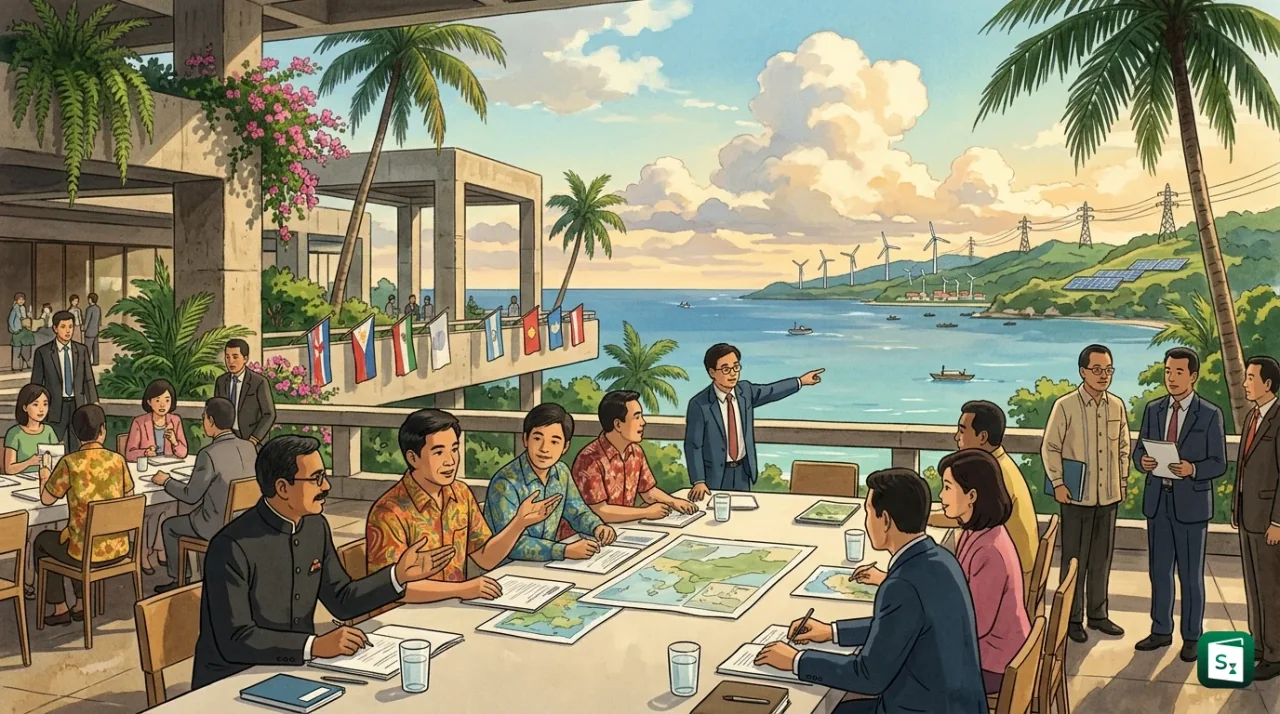
India welcomed the ASEAN Plan of Action for Energy Cooperation (APAEC) 2026-2030 at the 20th East Asia Summit Energy Ministers’ Meeting (EAS EMM) in Manila on 8 October 2026, where Union Minister of State for Power and New and Renewable Energy Shripad Yesso Naik represented New Delhi. The meeting put the ASEAN Power Grid, regional transmission and multilateral power trade at the centre of Southeast Asia’s energy security plans. India used the platform to reiterate training support for 400 professionals and to push a proposed 2,000 MW link that could carry power from India’s northeast to Singapore.
What Is the East Asia Summit and Why Does Its Energy Track Matter?
The East Asia Summit (EAS) is a leaders-led forum of 19 countries across the Asia-Pacific, built around ASEAN and eight dialogue partners. It began in 2005 and discusses strategic, political and economic issues, while its energy ministers handle cross-border power, fuel security and the clean energy transition.
The first EAS was held in Kuala Lumpur on 14 December 2005 with 16 members: the ten ASEAN states, Australia, China, India, Japan, South Korea and New Zealand. The United States and Russia joined at the sixth EAS in Bali on 19 November 2011. Timor-Leste became the 11th ASEAN member on 26 October 2025, which took the EAS to 19 participants. India has participated in every EAS leaders’ meeting since the first summit in 2005.
The forum is not a treaty-based organisation. It works by consultation and consensus, with ASEAN at the centre. That structure explains why the EAS rarely produces binding rules. Its value lies in bringing the region’s major powers, including China and the United States, to the same table.
| Attribute | Detail |
|---|---|
| First summit | 14 December 2005, Kuala Lumpur, Malaysia |
| Membership | 19 countries: 11 ASEAN states and eight partners (Australia, China, India, Japan, New Zealand, South Korea, Russia, United States) |
| Nature | Leaders-led strategic forum, not a treaty organisation |
| Chair | Follows the ASEAN chair; the Philippines chairs in 2026 |
| Energy track | EAS Energy Ministers’ Meeting, held alongside the ASEAN Ministers on Energy Meeting |
| Next leaders’ summit | 21st EAS, Metro Manila, November 2026 |
A Ministerial Track That Feeds the Leaders’ Summit
The EAS Energy Ministers’ Meeting (EAS EMM) is one of the sectoral meetings that prepare the ground for the annual leaders’ summit. It brings energy ministers together with the ASEAN Centre for Energy (ACE), the ASEAN Secretariat and the Economic Research Institute for ASEAN and East Asia (ERIA).
The 20th EAS EMM met in Metro Manila on 8 October 2026, alongside the 44th ASEAN Ministers on Energy Meeting (AMEM) on 7 October and the 23rd AMEM Plus Three meeting, which includes China, Japan and South Korea. Sharon S. Garin, Secretary of the Philippines’ Department of Energy, chaired the meeting (as of October 2026). Malaysia had hosted the 19th edition in Kuala Lumpur in October 2025.
The 20th EAS leaders’ summit was held in Kuala Lumpur in October 2025, while the 20th EAS EMM is a separate ministerial meeting hosted by Manila in October 2026. The 21st EAS leaders’ summit is due in Manila in November 2026.
Why Energy Dominates the EAS Agenda
Energy is one of the EAS priority areas, and for good reason. Southeast Asia is home to nearly 700 million people and is one of the fastest-growing energy markets in the world. The region is also becoming more dependent on imported oil and gas, which makes it vulnerable to price shocks and shipping disruptions.
The 9th ASEAN Energy Outlook, released in Manila on 8 October 2026, cites the 2026 disruption around the Strait of Hormuz as a reminder of how quickly fuel supply routes can become a risk. Cross-border electricity, in contrast, offers a way to share resources over land and under sea without depending on distant shipping lanes. That logic sits behind the prominence of the ASEAN Power Grid at the Manila meeting.
What Happened at the 20th EAS Energy Ministers’ Meeting in Manila?
Energy ministers from 19 EAS countries met in Metro Manila on 8 October 2026 and backed closer work on the ASEAN Power Grid, submarine cables, cross-border electricity trade and gas connectivity. India, represented by Shripad Yesso Naik, welcomed APAEC 2026-2030 and offered capacity building, technology sharing and grid expertise.
The meeting took place in Metro Manila as part of the Philippines’ ASEAN chairship year. Along with the 11 ASEAN member states, it drew representatives from Australia, China, India, Japan, New Zealand, South Korea, Russia and the United States. The ASEAN Secretariat, ACE and ERIA also attended.
Naik linked India’s participation to the Act East Policy and to the ASEAN-India Comprehensive Strategic Partnership, which the two sides established in 2022 on the 30th anniversary of their dialogue relations. India became a full dialogue partner of ASEAN in 1995, and summit-level engagement began in 2002.
India’s main emphasis was cooperation under the ASEAN-India Plan of Action 2026-2030, adopted in July 2025. New Delhi identified the ASEAN Power Grid, regional transmission, multilateral power trade, clean energy and energy security as the priority areas under that plan.
| Area | What India proposed or supported in Manila |
|---|---|
| Regional grid | Operationalise the Enhanced ASEAN Power Grid MoU and deepen multilateral power trade |
| India-Singapore link | Study a 2,000 MW interconnection, including a 3,000 km land corridor through Myanmar, Thailand and Malaysia |
| Capacity building | Train 400 professionals in renewable energy and grid-related matters, announced at the 22nd ASEAN-India Summit |
| Institutions | Build links between ACE and NTPC, POWERGRID, the Central Electricity Authority (CEA), National Institute of Wind Energy (NIWE), National Institute of Solar Energy (NISE) and National Power Training Institute (NPTI) |
| Technology | Energy storage, green hydrogen, renewable forecasting, carbon capture, utilisation and storage (CCUS) and carbon credit trading |
| Fuel security | Strategic petroleum reserves, liquefied natural gas (LNG) and gas supply security, emergency preparedness |
The joint media statement reflected the wider regional consensus. Ministers supported project preparation, technical assistance, capacity building and financing for the ASEAN Power Grid. They also backed the development of cross-border electricity interconnections, the Trans-ASEAN Gas Pipeline (TAGP) and the emerging ASEAN Submarine Power Cable Development Framework. The statement reaffirmed the EAS EMM as an ASEAN-led platform for energy security, affordability, reliability and long-term resilience.
India’s intervention went beyond electricity. Naik offered to share Indian experience in large-scale renewable deployment, grid integration, transmission planning, battery storage and green hydrogen. He also proposed cooperation on CCUS and on India’s Carbon Credit Trading Scheme, while acknowledging that each country’s priorities and circumstances differ.
APAEC 2026-2030: Three Targets, Seven Programme Areas
APAEC 2026-2030 is ASEAN’s five-year energy blueprint, endorsed at the 43rd ASEAN Ministers on Energy Meeting in Kuala Lumpur in October 2025. It aims for 30% renewable energy in primary energy supply, 45% in installed power capacity and a 40% cut in energy intensity by 2030.
The plan carries the five-year theme “Advancing Regional Cooperation in Ensuring Energy Security and Accelerating Decarbonisation for a Just and Inclusive Energy Transition.” It sits under a 20-year vision called “ASEAN Energy Future 2045: Secure, Resilient and Interconnected Low-Carbon Energy Future.”
The ASEAN Centre for Energy (ACE), based in Jakarta, serves as the APAEC Secretariat. ACE coordinated the drafting process through 2024 and 2025 with the ASEAN specialised energy bodies and sub-sector networks. The plan is also aligned with the ASEAN Community Vision 2045 and the ASEAN Economic Community Strategic Plan 2026-2030.
| Target for 2030 | Goal | Earlier plan’s goal |
|---|---|---|
| Renewable share in total primary energy supply | 30% | 23% by 2025 |
| Renewable share in installed power capacity | 45% | 35% by 2025 |
| Reduction in energy intensity | 40% from 2005 levels | 32% by 2025 |
The seven programme areas show where the money and policy attention will go. The ASEAN Power Grid is the first and most prominent. The others cover oil and gas connectivity, cleaner coal, energy efficiency, renewable energy, regional policy and planning, and civilian nuclear energy.
| Programme area | Core focus |
|---|---|
| ASEAN Power Grid (APG) | Cross-border transmission, market frameworks and regional grid planning |
| Oil and Gas Connectivity, Security and Sustainability (OGCSS) | Gas pipelines, LNG access and petroleum security |
| Clean Coal Transformation (CCTR) | Cleaner coal technologies and a responsible coal value chain |
| Energy Efficiency and Conservation (EE&C) | Efficient appliances, buildings and industrial processes |
| Renewable Energy (RE) | Solar, wind, hydro, geothermal and bioenergy scale-up |
| Regional Energy Policy and Planning (REPP) | Policy coordination, data and long-term planning |
| Civilian Nuclear Energy (CNE) | Nuclear safety, financing studies and human resources |
The targets are ambitious because the starting point is weak. ACE’s 9th ASEAN Energy Outlook notes that the region entered 2025 having met none of the three targets of the previous plan. Hitting the 45% renewable capacity goal by 2030 would require about 26 GW of new renewable capacity every year, roughly four times the pace of the past decade.
Why the ASEAN Power Grid Is the Centrepiece
The ASEAN Power Grid (APG) is a plan to link the electricity networks of all 11 ASEAN member states so they can trade power across borders. It aims for fully integrated grid operations by 2045 and is the main route for sharing renewable energy across the region.
The idea is old. ASEAN leaders first proposed the grid at the second ASEAN Informal Summit in Kuala Lumpur in December 1997. A formal Memorandum of Understanding on the ASEAN Power Grid followed in Singapore on 23 August 2007. The ASEAN Interconnection Masterplan Study (AIMS) III, released in 2020, identified 18 priority interconnection projects across the region.
Progress has been gradual. Eight of those 18 interconnections are built and commercially operating. The best-known example is the Lao PDR-Thailand-Malaysia-Singapore Power Integration Project (LTMS-PIP), which began with 100 MW of hydropower from Laos to Singapore through Thai and Malaysian lines and was later scaled to 200 MW. It was the first multilateral and multidirectional power trade in ASEAN.
| Element | Status as of October 2026 |
|---|---|
| Priority interconnections | 18 identified under AIMS III; eight built and commercially operating |
| First multilateral trade | LTMS-PIP from Laos to Singapore via Thailand and Malaysia, scaled to 200 MW |
| New subregional project | Brunei-Indonesia-Malaysia-Philippines Power Integration Project (BIMP-PIP) under development |
| Governance | Enhanced APG MoU completed in 2025 |
| Financing | APG Financing Initiative launched with the World Bank and Asian Development Bank |
| Investment need | About $800 billion in generation and transmission by 2045, according to a World Bank estimate |
| Next planning step | Preparations for AIMS IV to support APG Vision 2045 |
Multilateral power trade means three or more countries buying and selling electricity through a shared network, rather than one country dealing only with its immediate neighbour. It requires common technical standards, compatible market rules and clear arrangements for who pays for transmission. Those are political and regulatory questions as much as engineering ones.
The Enhanced APG MoU, completed at the ASEAN Energy Business Forum in 2025, renewed the original 2007 framework. ASEAN also launched the APG Financing Initiative (APGF), coordinated by the World Bank and the Asian Development Bank, to move projects from concept to construction. A separate Submarine Power Cable Development Framework is being negotiated to govern undersea links, which are new to most of the region.
The grid’s weak point is delivery. Regulations differ from country to country, projects are capital-heavy, and cross-border approvals can take years. Myanmar’s internal conflict adds risk to any overland route through the country. The APG Financing Initiative is designed to address the bankability problem, but it cannot settle political disputes. That is why the Manila meeting stressed practical steps such as project preparation, technical assistance and capacity building rather than new declarations alone.
India’s Proposal: A 2,000 MW Link from Imphal to Singapore
India and Singapore are studying a 2,000 MW cross-border power interconnection, including a land-based corridor of about 3,000 km from Imphal to Singapore through Myanmar, Thailand and Malaysia. The link would allow reliable electricity trade and help move clean power between South and Southeast Asia.
Naik described the proposal as one option under consideration. A land route would run through some of the region’s most difficult terrain and through Myanmar, where armed conflict has disrupted transport and investment. A submarine alternative would avoid Myanmar but raise costs and require the very cable rules that ASEAN is still drafting.
India’s northeast is the land bridge between South Asia and Southeast Asia. Power generated in India, Nepal, Bhutan or Myanmar could move east, while Southeast Asian capacity could flow west during shortages. The link would also complement India’s One Sun, One World, One Grid (OSOWOG) vision, which seeks to connect regional grids so that solar power can be moved across time zones.
The proposal builds on India’s existing neighbourhood grid. India already trades electricity with Nepal, Bhutan, Bangladesh and Myanmar. A 500 MW high-voltage direct current (HVDC) link between Imphal and Tamu in Myanmar is planned, and a 1,000 MW link to Sri Lanka, including an undersea section, is also planned. In June 2025, Nepal began selling up to 40 MW of hydropower to Bangladesh through Indian transmission lines, the first trilateral electricity trade in South Asia.
India’s Domestic Base
India’s presentation in Manila drew on its own power sector record. The table combines the figures Naik cited with India’s cross-border transmission capacity.
| Indicator | Figure | Date |
|---|---|---|
| Installed electricity generation capacity | 558.8 GW | 30 September 2026 |
| Non-fossil capacity | 308 GW, about 55% of the total | 30 September 2026 |
| Non-fossil share crosses 50% | Achieved five years ahead of the 2030 Nationally Determined Contribution (NDC) target | June 2025 |
| PM Surya Ghar rooftop solar | 5.01 million installations benefiting 5.95 million households | 29 September 2026 |
| Non-fossil capacity target | 500 GW | 2030 |
| Cross-border transmission capacity with neighbours | 10,323 MW | September 2025 |
The 500 GW target is part of the five-part Panchamrit commitments announced at the 26th Conference of the Parties (COP26) climate summit in Glasgow in 2021. India also announced that half of its energy requirements would come from renewable sources by 2030, a 1 billion tonne reduction in projected emissions, a 45% cut in emissions intensity of GDP from 2005 levels, and net zero by 2070. Its updated NDC separately targets a 50% non-fossil share in installed power capacity by 2030.
The PM Surya Ghar: Muft Bijli Yojana, launched in February 2024, drives the rooftop solar numbers cited in Manila. The scheme offers subsidised residential rooftop installations and up to 300 units of free electricity a month to participating households.
India’s Neighbourhood Grid
India’s cross-border links give it practical experience that few EAS members have. Bhutan accounts for the largest share because of long-standing hydropower imports, while Nepal and Bangladesh trade in both directions.
| Neighbour | Cross-border transmission capacity | Main features |
|---|---|---|
| Bhutan | 7,560 MW | Hydropower imports from Chukha, Kurichu, Tala and Mangdechhu |
| Nepal | 1,600 MW | Multiple 132 kV and 400 kV links; several more under construction |
| Bangladesh | 1,160 MW | Baharampur-Bheramara 400 kV link with HVDC back-to-back stations |
| Myanmar | 3 MW | Moreh-Tamu 11 kV line; a 500 MW HVDC link is planned |
| Total | 10,323 MW | As of September 2025 |
These figures measure transmission capacity, not the volume of electricity actually traded. They still show why India can speak with credibility about grid integration. India’s national grid is also one of the largest synchronous grids in the world, which gives its engineers experience in balancing variable renewable power across a vast area.
The Green Grids Initiative and OSOWOG were brought together as GGI-OSOWOG at COP26 in November 2021, with support from the International Solar Alliance and the World Bank. The International Solar Alliance, launched by India and France in 2015, is headquartered in Gurugram.
Trade provides the economic backdrop. India-ASEAN bilateral trade reached $128.38 billion in 2025-26, about 10.55% of India’s total global trade. The ASEAN-India Trade in Goods Agreement (AITIGA), signed in 2009, is under review. The 15th AITIGA Joint Committee met at the ASEAN Secretariat in Jakarta in October 2026, and the next round is scheduled in India in January 2027.
The 9th ASEAN Energy Outlook and the Cost of Delay
The 9th ASEAN Energy Outlook (AEO9), launched in Manila on 8 October 2026, projects that Southeast Asia’s final energy demand could rise from about 485 million tonnes of oil equivalent (Mtoe) in 2025 to 2,047 Mtoe by 2060 under current trends. It argues that deeper regional integration can lower system costs and strengthen energy security.
AEO9 is the official ASEAN energy outlook, endorsed by the energy ministers and prepared by ACE. It uses two linked models developed with the Stockholm Environment Institute to compare three pathways rather than to forecast a single future.
| Scenario | What it assumes | Final energy demand in 2060 |
|---|---|---|
| Baseline (BAS) | Current trends continue | 2,047 Mtoe |
| ASEAN Member States Target (ATS) | National policies and targets are met | 1,482 Mtoe |
| ASEAN Coordinated Transition (ACTS) | Deeper regional integration, efficiency and electrification | 1,073 Mtoe |
Coordinated action could hold demand to about half the baseline level while supporting similar economic growth. Under ACTS, electricity would supply 57% of final energy by 2060, compared with less than a quarter today. Renewables would make up 64% of generating capacity, and cross-border interconnection under the ASEAN Power Grid would grow about 20-fold.
ACTS would require average investment of about $405 billion a year to 2060, covering both supply and demand. Under the baseline, ASEAN’s oil import bill would more than double from about $165 billion a year in the late 2020s to $369 billion after 2045, in 2020 prices. Data centres alone account for about one-fifth of the growth in electricity demand between 2025 and 2030.
The International Energy Agency’s Southeast Asia Energy Outlook 2026, published in June 2026, reaches a similar conclusion from a different direction. Southeast Asia has 9% of the world’s population and 4% of its GDP, but it is expected to contribute nearly 20% of global energy demand growth to 2035. Fossil fuels still meet 60% of that incremental demand, even as their share of the energy mix declines.
The region’s energy investment reached just over $100 billion in 2025, which is only about 3% of global energy investment. Grid spending has lagged behind generation. That mismatch is the practical case for the ASEAN Power Grid and for partners such as India, which can offer transmission expertise and experience in large-scale renewable deployment.
ASEAN describes itself as the world’s fifth-largest economy, with projections of fourth place by 2030. Whether that growth is powered by imported fuel or by a connected regional grid will shape both its energy security and its emissions for decades.
What Comes Next After Manila?
The Manila outcomes will feed into the 49th ASEAN Summit and the 21st East Asia Summit in Metro Manila in November 2026. Singapore takes the ASEAN chair in 2027 and will push the submarine cable framework, while India and Singapore study the proposed 2,000 MW link.
The Philippines chairs ASEAN in 2026 under the theme “Navigating Our Future, Together.” Its three priorities are peace and security anchors, prosperity corridors, and people empowerment, with a strong emphasis on the responsible use of artificial intelligence. The energy track has carried that agenda through the 44th AMEM and the 20th EAS EMM.
Several work streams now matter more than new announcements. ASEAN must operationalise the Enhanced APG MoU, complete the work plans of the APG task forces, scale up the LTMS-PIP and move the BIMP-PIP from planning to pilot projects. The submarine cable framework is expected to receive more attention under Singapore’s 2027 chairmanship.
Financing will decide the pace. The APG Financing Initiative has brought the World Bank and the Asian Development Bank into project preparation, but private capital will follow only if tariffs, contracts and payment security are predictable. The Regional Connectivity Fund for Energy in Southeast Asia, with initial support of about $25 million from Australia, Canada, the European Union, Germany and the United Kingdom, is a small but practical step.
For India, the next test is whether the Imphal-Singapore idea moves from an option on paper to a bankable project. New Delhi has promised to train 400 professionals in renewable energy and grid matters. It has also offered institutional partnerships between ACE and Indian agencies. Those commitments will be judged by delivery, not by the number of meetings attended.
The wider strategic picture is not simple. Myanmar’s conflict, friction in the South China Sea and competition among major powers complicate any overland or undersea route. Yet the economics of connecting South and Southeast Asia are becoming harder to ignore. A region whose energy demand could quadruple by 2060 under current trends cannot meet that need reliably with national grids alone.
Key Takeaways
- The 20th East Asia Summit Energy Ministers’ Meeting was held in Metro Manila on 8 October 2026 and was chaired by Philippine Energy Secretary Sharon S. Garin.
- India was represented by Union Minister of State for Power and New and Renewable Energy Shripad Yesso Naik.
- APAEC 2026-2030 sets 2030 targets of 30% renewable energy in total primary energy supply, 45% in installed power capacity and a 40% reduction in energy intensity from 2005 levels.
- The ASEAN Power Grid has 18 priority interconnections under AIMS III, of which eight are built and commercially operating, and aims for fully integrated operations by 2045.
- India and Singapore are studying a 2,000 MW interconnection, including a 3,000 km land corridor from Imphal to Singapore through Myanmar, Thailand and Malaysia.
- India’s installed power capacity stood at 558.8 GW on 30 September 2026, with 308 GW, or 55%, from non-fossil sources.
- The 9th ASEAN Energy Outlook projects final energy demand could rise from 485 Mtoe in 2025 to 2,047 Mtoe by 2060 under current trends.