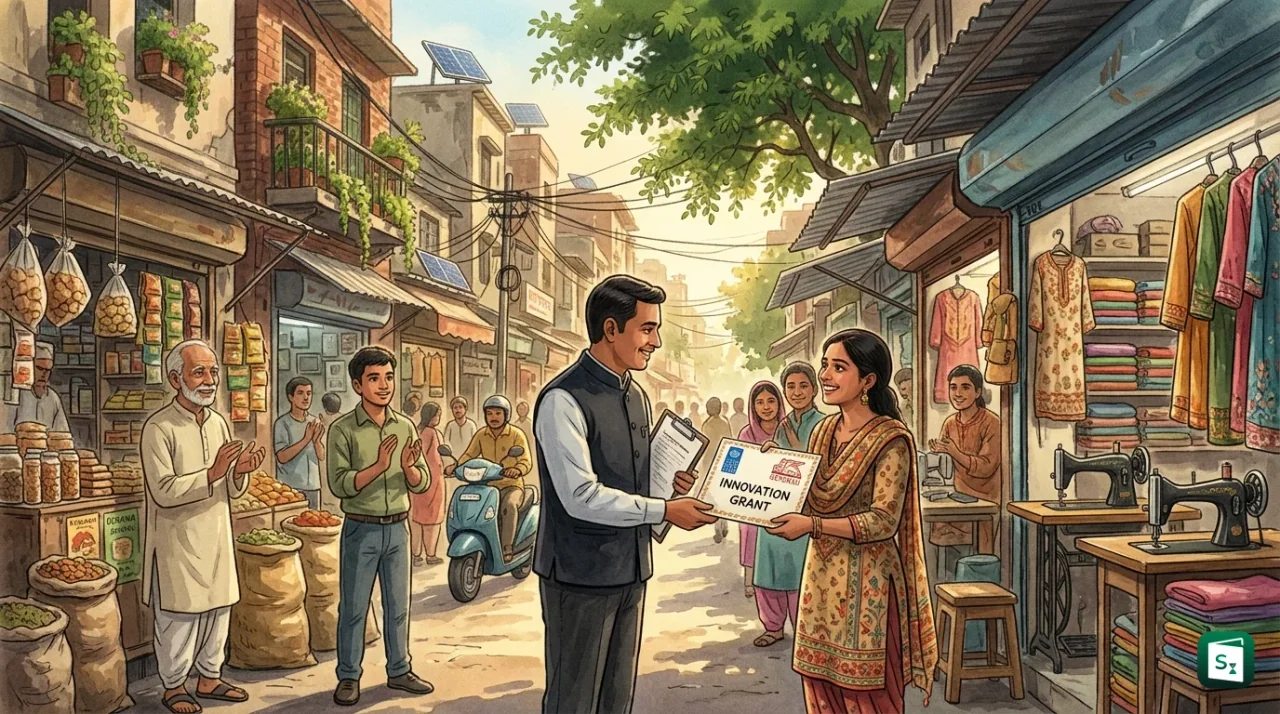
The United Nations Development Programme (UNDP) and Generali Central Insurance Company Limited launched an insurance innovation challenge in New Delhi on 7 October 2026 to strengthen India’s micro, small and medium enterprises. As many as three winning solutions will receive grants of up to $40,000 each, along with support to scale their products. The challenge targets a simple but costly problem: most Indian MSMEs run without any insurance cover, so one health emergency, fire or flood can erase years of savings.
What Is the UNDP-Generali MSME Insurance Innovation Challenge?
The UNDP-Generali MSME Insurance Innovation Challenge is a grant-based competition launched on 7 October 2026 to find and scale insurance products and distribution models that protect Indian MSMEs against health shocks, business interruption and asset loss. Up to three winners receive $40,000 each.
The competition is not looking for business plans on paper. It wants proven insurance products and distribution models that already work and can be expanded to reach many more small businesses. Applicants must show how their solution addresses a real risk faced by an MSME owner or worker, and how the grant will help them grow it.
Generali Central is the Indian general insurance joint venture of the Generali Group, one of Europe’s largest insurers. The company is running the challenge together with UNDP India, which brings development experience, research capacity and links with government departments and industry bodies. The two organisations have already run similar MSME insurance challenges in Malaysia and Thailand.
The winners will be chosen after a review of applications, and the organisers expect to announce them in February 2027. The grant money can be used for product development, pilot rollouts, technology building or other costs involved in taking a working idea to scale.
Why India’s MSMEs Need Insurance Cover
MSMEs are the largest source of jobs in India after agriculture, and they sit at the base of almost every manufacturing and export chain. The Economic Survey 2025-26 puts their contribution to GDP at 31.1%, to manufacturing output at 35.4% and to exports at 48.58%. As of August 2026, 9.16 crore MSMEs were registered on the Udyam platform, employing more than 40 crore people.
That scale also makes them fragile. A small unit typically runs on thin margins, a single owner and a handful of workers. A hospital bill for the owner, a fire in the godown, a flooded workshop or a large buyer delaying payment can shut the business down within weeks. Insurance is the standard way to absorb such shocks, yet Indian MSMEs buy very little of it.
The Protection Gap in Numbers
Research by UNDP and Generali across South and Southeast Asia found that 95% of MSMEs have no financial protection when a market shock or disaster strikes. In South Asia, roughly 90% of micro and informal enterprises are uninsured, and about half of all small and medium enterprises carry no cover at all.
The reasons are not hard to find. Many owners do not know what cover exists. Premiums look expensive when cash flow is tight. Standard fire or marine policies are written for large factories, not for a tailoring unit or a two-machine workshop. Agents rarely visit industrial clusters to sell small-ticket policies, and claim processes assume a level of paperwork that small firms do not maintain.
This is the gap the challenge is designed to address. Its focus on health-related events, business interruption and asset loss maps directly to the three shocks that most often push an MSME into insolvency.
Who Can Apply and What the Challenge Rewards
The challenge is open to any organisation legally registered in India that can design, sell or deliver insurance to small businesses. This includes insurance companies, insurtechs, technology service providers, social enterprises and insurance sales and distribution companies.
Applicants do not have to be insurers themselves. A technology firm that has built a platform for bundling cover with a loan, or a distribution company that has found a low-cost way to sell policies in an industrial cluster, can apply as long as it has a working product or model.
The Four Priority Areas
The organisers will give preference to solutions that meet at least one of four conditions. A solution can use technology to make insurance cheaper or easier to access. It can bundle cover with financial services such as loans, savings accounts or digital payment products. It can create new distribution channels that reach MSMEs beyond traditional agents and branches. It can also build financial literacy so that owners understand the value of cover.
Financial literacy is a recurring theme in UNDP’s MSME work. Low awareness of what a policy covers, and of how to claim, is one reason why owners who can afford cover still do not buy it.
Grant Size and Key Dates
| Item | Detail |
|---|---|
| Number of winners | Up to three |
| Grant per winner | Up to $40,000 |
| Additional support | Help with scaling, including access to the partners’ networks |
| Launch date | 7 October 2026 |
| Application deadline | 20 November 2026 |
| Winners expected | February 2027 |
The emphasis on proven solutions separates this challenge from a typical startup pitch contest. A prototype with no customers is unlikely to qualify; a small but tested product with clear evidence of demand stands a better chance.
What Is Udyam Registration and How Does It Fit In?
Udyam Registration is India’s free, paperless and voluntary online system for registering MSMEs, launched on 1 July 2020. The certificate it issues decides an enterprise’s classification under the MSMED Act and is used by banks to extend priority sector lending and other benefits.
The portal matters to an insurance challenge because it solves a basic identification problem. Insurers often cannot tell which small unit is genuine, how big it is or whether it is creditworthy. A Udyam certificate gives a verified digital identity, which makes it easier to price a policy, bundle it with a loan or process a claim.
MSME Classification Limits After April 2025
The classification was revised by a Ministry of MSME gazette notification dated 21 March 2025, effective 1 April 2025. The new limits are 2.5 times higher for investment and 2 times higher for turnover than the earlier thresholds.
| Category | Investment in plant and machinery or equipment | Annual turnover |
|---|---|---|
| Micro | Up to ₹2.5 crore | Up to ₹10 crore |
| Small | Up to ₹25 crore | Up to ₹100 crore |
| Medium | Up to ₹125 crore | Up to ₹500 crore |
Both conditions must be satisfied. An enterprise that crosses either limit moves to the next category, which is why the definition is called a composite criterion. The earlier micro limit of ₹1 crore investment and ₹5 crore turnover has now more than doubled, bringing many slightly larger firms into the MSME net.
The ministry also runs the Udyam Assist Platform, launched on 11 January 2023, to register informal micro enterprises. These enterprises receive an Udyam Assist Certificate, which makes them eligible for priority sector lending even though they do not maintain formal accounts.
The Policy Backdrop: MSMED Act, 2026 Amendment and Credit Support
The Micro, Small and Medium Enterprises Development Act, 2006 is the parent law for the sector and completed 20 years of enactment in 2026. Parliament passed the MSME Development (Amendment) Bill, 2026 in August 2026, with the Rajya Sabha clearing it on 3 August and the Lok Sabha on 7 August.
The amendment gives the Udyam portal a statutory basis, makes registration free and voluntary for all MSMEs, allows states to run their own digital registration platforms, and strengthens the machinery for recovering unpaid dues. It also decriminalises certain minor offences to improve ease of doing business.
Delayed Payments and MSME Samadhaan
Sections 15 to 24 of the MSMED Act require a buyer to pay a micro or small supplier within 45 days of accepting goods or services. If payment is delayed, the buyer must pay compound interest at three times the RBI bank rate. Disputes go to the state-level Micro and Small Enterprise Facilitation Council.
The 2026 amendment adds online dispute resolution, sets a 90-day limit for mediation and requires the council to refer a failed case to arbitration within 30 days. Courts hearing a challenge to an award must now order payment of at least 50% of the awarded amount if the plea has been pending for more than six months.
Credit Guarantee and Innovation Support
Insurance is one piece of a wider support system. The table below lists the main instruments an MSME can use.
| Mechanism | What It Provides |
|---|---|
| CGTMSE | Collateral-free credit guarantee, with cover for micro and small enterprises raised to ₹10 crore in the 2025-26 Budget |
| PMEGP | Subsidy-linked credit for setting up new micro enterprises |
| MSME Samadhaan | Platform for filing delayed payment cases before the Facilitation Council |
| Udyam | Free registration that unlocks priority sector lending and scheme benefits |
The link between credit and insurance is direct. A lender is more willing to fund a unit whose stock, machinery and owner are insured, because the loan is less likely to turn bad after an accident. CGTMSE was set up in 2000 as a joint initiative of the Ministry of MSME and SIDBI, and it now guarantees a large share of collateral-free small loans. Insurance products that reduce the risk of default therefore support the same objective from a different direction.
About Generali Central Insurance Company Limited
Generali Central Insurance Company Limited was known as Future Generali India Insurance Company Limited until the name change took effect on 30 July 2025, the date recorded with the Registrar of Companies. The company was originally set up in 2006 and holds IRDAI registration number 132.
| Feature | Detail |
|---|---|
| Former name | Future Generali India Insurance Company Limited |
| Name change effective | 30 July 2025 |
| Shareholding | Generali Group 74%, Central Bank of India 24.91%, Future Corporate Resources 1.09% |
| IRDAI registration number | 132 |
| Head office | Mumbai, Maharashtra |
| Managing Director and CEO | K G Krishnamoorthy Rao (as of October 2026) |
The ownership change came first. Future Enterprises Limited, the original Indian partner, held its stake in the joint venture, and after insolvency proceedings the shares were transferred to Central Bank of India on 4 June 2025 with IRDAI approval. The rebrand followed, giving both the general and life insurance businesses a common identity.
The parent, Generali Group, was founded in 1831 and operates in more than 50 countries, with premium income of €95.2 billion and assets under management of €863 billion in 2024. Central Bank of India, established in 1911, was the first commercial bank founded wholly by Indians. Generali Central Insurance reported assets under management of ₹7,938 crore and gross written premium of ₹5,547.5 crore in FY 2024-25.
The group’s life insurance arm is a separate company, Generali Central Life Insurance Company Limited, which holds IRDAI registration number 133 and is led by Managing Director and CEO Alok Rungta. The challenge draws on both businesses, which is why the organisers describe Generali Central as representing the group’s general and life insurance operations in India.
UNDP’s Insurance and Risk Finance Facility and the Wider Partnership
The United Nations Development Programme was established in 1965 and is headquartered in New York. It works in about 170 countries and territories on poverty reduction, governance, climate action and financial inclusion. UNDP’s partnership with India dates back to 1951, making it one of the agency’s oldest country programmes.
The insurance work sits within the Insurance and Risk Finance Facility (IRFF), which is part of UNDP’s Sustainable Finance Hub. The facility helps governments design insurance policy and regulation, builds local industry capacity, and supports products for public assets, businesses, households and farmers. The facility runs active projects in 26 countries, according to its 2025 annual report.
UNDP and Generali have partnered on this agenda since 2022. Under the arrangement, Generali provides technical and financial resources to the IRFF, while UNDP supplies research, country networks and policy access. The partnership has also contributed to the InsuResilience Vision 2025, a global goal to extend climate and disaster cover to 500 million vulnerable people and microinsurance to 150 million.
From Malaysia and Thailand to India
The India challenge follows two earlier editions. Malaysia hosted an Insurance Innovation Challenge Fund from September 2023, and Thailand launched its version in August 2025. In Thailand, TruNord Technologies and Clean Technology and Innovation were each awarded $40,000 in November 2025 to develop local solutions. The next phase of the partnership, announced at a regional conference in Bangkok, explicitly names India as the new market.
Joint research underpins the exercise. A 2024 report, Building MSME Resilience in Southeast Asia, showed that fewer than 5% of MSMEs in the region had any insurance. A 2025 follow-up study used a value chain approach, looking at how buyers, suppliers, lenders and insurers interact, to design cover for specific sectors rather than a single generic product. The India edition of that work examined agricultural value chains and digital platforms such as UPI and e-commerce, which can carry embedded insurance at the point of sale.
A 2024 UNDP country diagnostic on India had already recommended new microinsurance products, alternative distribution models and disaster risk pooling. The challenge is an attempt to turn those recommendations into working businesses.
What This Means for India’s Insurance Market
India is the 10th largest insurance market in the world by premium volume, with a global share of 1.8%. That size hides a shallow base. Insurance penetration stood at 3.7% of GDP in 2024-25, against a global average of 7.3%, and non-life cover accounted for just 1% of GDP. Insurance density was $97 per person, compared with a world average of $943.
The non-life number is the one that matters for MSMEs. Life insurance sells because it is bundled with savings and tax planning. General insurance has to be sold on the value of protection, which is a harder argument for a shopkeeper watching every rupee. Health insurance has grown quickly and now forms 41% of non-life premium, but group cover for small workplaces remains thin.
Policy is moving in the same direction as the challenge. IRDAI has set a vision of “Insurance for All by 2047”, and the Sabka Bima, Sabki Raksha (Amendment of Insurance Laws) Act, 2025 raised the foreign direct investment limit in insurance from 74% to 100%. The IRDAI (Micro Insurance) Regulations, 2015 already provide a lighter regulatory path for small-ticket products and community-based distribution.
A Small Grant Against a Large Gap
A grant of $40,000 is modest when set against a protection gap covering crores of enterprises. Three winners will not change the market on their own. What such competitions can do is prove that a product works at a small scale, which is often the step that persuades an insurer to fund a wider rollout.
The harder problems remain outside the scope of any single grant. Insurers still lack reliable claims and risk data for informal firms. Distribution through agents is expensive when the premium is a few thousand rupees. Many owners trust informal coping mechanisms, such as borrowing from relatives or delaying wages, more than they trust an insurance contract.
The test for this challenge will be whether the winning ideas reach micro enterprises, and not only the better-off small firms that already have bank credit. The February 2027 announcement will show which way the first cohort leans.
Key Takeaways
- The UNDP and Generali Central Insurance Company Limited launched the MSME Insurance Innovation Challenge in New Delhi on 7 October 2026.
- Up to three winners will receive grants of up to $40,000 each, with applications closing on 20 November 2026 and results expected in February 2027.
- India had 9.16 crore Udyam-registered MSMEs as of August 2026, and the Economic Survey 2025-26 estimates the sector’s contribution at 31.1% of GDP, 35.4% of manufacturing output and 48.58% of exports.
- The MSME classification was revised with effect from 1 April 2025: micro enterprises can have investment up to ₹2.5 crore and turnover up to ₹10 crore, while the medium limit is ₹125 crore investment and ₹500 crore turnover.
- India’s insurance penetration was 3.7% of GDP in 2024-25, with non-life insurance at just 1%, far below the global average of 7.3%.
- Generali Central Insurance Company Limited, formerly Future Generali India Insurance Company Limited, is a joint venture with Generali Group holding 74% and Central Bank of India 24.91%, and operates under IRDAI registration number 132.
- UNDP-Generali research found that 95% of MSMEs in South and Southeast Asia have no financial protection against market shocks or disasters.