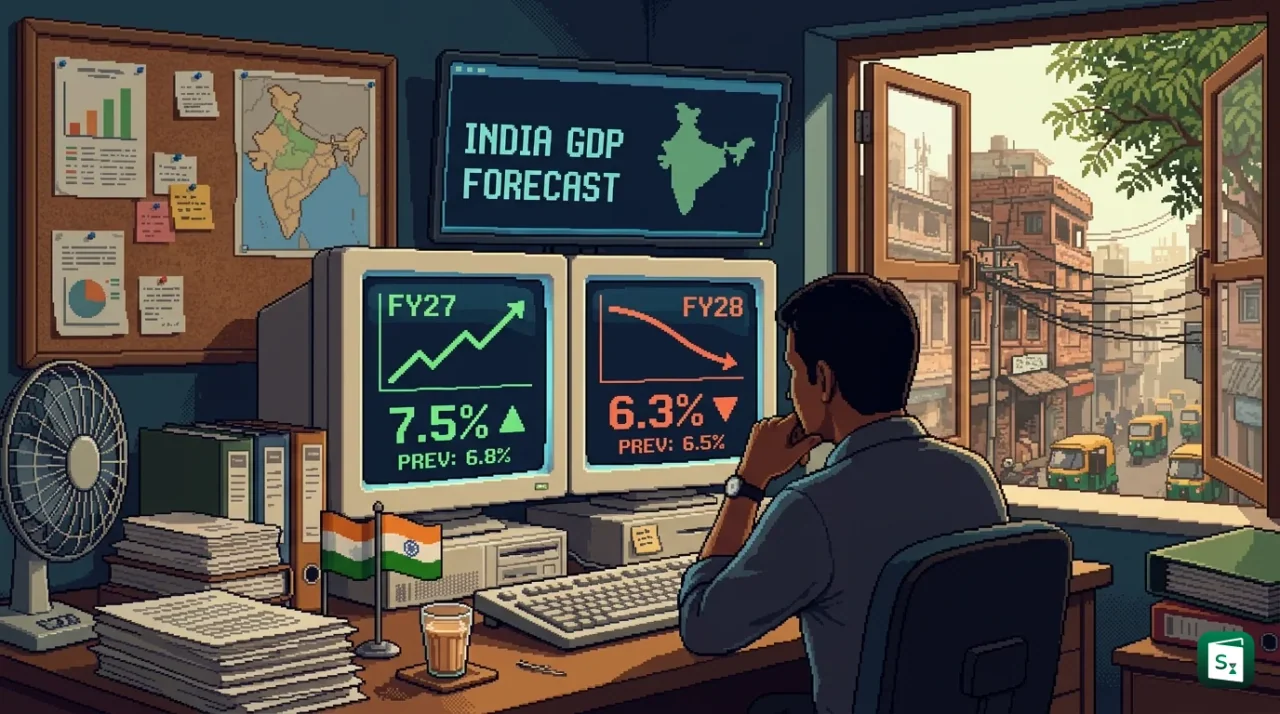
BMI, the country risk and industry research arm of Fitch Solutions, has raised India’s real GDP growth forecast for 2026-27 to 7.5 per cent from 6.8 per cent, while cutting its 2027-28 projection to 6.3 per cent from 6.5 per cent. The upgrade rests on stronger industrial activity and a wave of artificial intelligence-linked investment, while the downgrade reflects worry over household spending, costly oil and a strengthening El Nino. The twin revisions put BMI well above the Reserve Bank of India’s 7.1 per cent forecast for the current year, and make it one of the most cautious voices on the year that follows.
What Is BMI, a Fitch Solutions Company?
BMI, originally Business Monitor International, is a country risk and industry research firm founded in 1984 and acquired by Fitch Group in March 2014. It now operates as a unit of Fitch Solutions, the data and research arm of the Hearst-owned Fitch Group.
The name is often confused with credit rating work, but the two functions sit in different parts of the same organisation. Fitch Ratings assigns sovereign and corporate credit ratings, while BMI produces macroeconomic forecasts, country risk assessments and industry research. Fitch Group also runs Fitch Learning, which trains financial professionals. The group is owned by Hearst, the American media and information company, and works out of New York and London.
Fitch Ratings currently rates India BBB- with a stable outlook (as of October 2026), which is the lowest investment-grade category. A rating of this kind is an opinion on a government’s ability to repay debt. A GDP forecast is a projection of how much output the economy will produce. Markets and policymakers read both, but they answer different questions.
BMI’s Country Risk and Industry Research service is sold to multinational firms, banks, investment funds and government agencies. Its India outlook is watched closely because it feeds into corporate investment decisions and because the firm publishes detailed sector-level assumptions, including oil prices, inflation and interest rates, alongside its growth number.
What Did BMI Change in Its India GDP Forecast?
BMI raised its real GDP growth forecast for FY27 to 7.5 per cent from 6.8 per cent, an upgrade of 70 basis points, and lowered its FY28 forecast to 6.3 per cent from 6.5 per cent, a cut of 20 basis points. One basis point is one hundredth of a percentage point.
| Financial year | Twelve-month period | Earlier forecast | Revised forecast | Revision |
|---|---|---|---|---|
| FY27 | April 2026 to March 2027 | 6.8% | 7.5% | Up 70 bps |
| FY28 | April 2027 to March 2028 | 6.5% | 6.3% | Down 20 bps |
The two revisions point in opposite directions, and the gap between them is large. BMI now expects growth to slow by about 1.2 percentage points between the two years. That is a sharper deceleration than the IMF’s own projections suggest, and it explains why the report has drawn attention even though the headline number is an upgrade.
Reading FY27 and FY28 Correctly
India’s financial year runs from April to March, so FY27 covers April 2026 to March 2027 and FY28 covers April 2027 to March 2028. Forecasts of this kind refer to real GDP, which is output measured at constant prices after stripping out inflation. Nominal GDP, measured at current prices, grows faster whenever prices rise.
The official numbers come from the Ministry of Statistics and Programme Implementation (MoSPI), which released a new GDP series with 2022-23 as the base year on 27 February 2026. Under this series, India’s real GDP grew 7.7 per cent in FY26, while nominal GDP reached ₹346.36 lakh crore with growth of 8.9 per cent. In the first quarter of FY27, nominal GDP stood at ₹88.27 lakh crore.
Why Has the FY27 Forecast Been Raised to 7.5%?
The upgrade reflects high-frequency data that came in stronger than BMI had assumed. The agency’s GDP tracker points to growth of about 8.3 per cent in July to September 2026, helped by accelerating factory output, a surge in vehicle registrations and a large pipeline of artificial intelligence investment.
Industry and Vehicle Sales Beat Expectations
Official data released on 31 August 2026 showed real GDP growing 7.8 per cent in the first quarter of FY27, well above the RBI’s projection of 7.0 per cent for the quarter. Growth was slower than the 8.6 per cent recorded in the previous quarter, but higher than the 6.9 per cent logged a year earlier. Private consumption and investment both held up.
| Indicator | Period | Growth |
|---|---|---|
| Real GDP | Q1 FY27 (April to June) | 7.8% |
| Real GVA | Q1 FY27 | 8.2% |
| Agriculture and allied activities | Q1 FY27 | 3.6% |
| Secondary sector | Q1 FY27 | 8.6% |
| Tertiary sector | Q1 FY27 | 10.0% |
| Private final consumption expenditure | Q1 FY27 | 7.1% |
| Gross fixed capital formation | Q1 FY27 | 11.9% |
The momentum carried into the next quarter. Industrial production growth accelerated from 6.2 per cent in Q1 to 7.7 per cent in July and August, and vehicle registrations rose from 16 per cent in Q1 to 26 per cent in the September quarter. Both are useful early signals because they appear monthly, long before the quarterly GDP estimate is published. A pick-up in vehicle sales usually points to stronger household demand for durable goods.
The AI Investment Cycle and Data Centre Power
BMI identifies artificial intelligence infrastructure as a new and durable growth driver. Reliance Industries has committed $110 billion over seven years to AI-related infrastructure, while Adani Enterprises plans $100 billion by 2035. Amazon Web Services and Microsoft are also expanding their India footprints. Much of this money goes into land, construction, power equipment, cooling systems and servers, all of which enter the investment component of GDP.
The physical scale is growing quickly. India’s data centre capacity rose from about 375 MW in 2020 to roughly 1.57 GW by August 2026, and industry estimates project close to 8 GW by 2030. The Ministry of Power expects electricity demand from data centres to reach about 13.56 GW by 2031-32.
Power supply is the binding constraint, and this is where the SHANTI Act, 2025 comes in. The law’s full name is the Sustainable Harnessing and Advancement of Nuclear Energy for Transforming India Act. It opens nuclear generation to private participation, introduces a graded liability framework and supports small modular and micro reactors, with a stated goal of 100 GW of nuclear capacity by 2047. Small reactors are designed to sit closer to load centres, which makes them relevant for round-the-clock data centre demand. The economic effect is not immediate, since reactors take years to build, but BMI treats the commitments as durable because they are long-term capital projects.
Why Is the FY28 Forecast Lower at 6.3%?
BMI cut its FY28 forecast because the supports behind the FY27 upgrade are expected to fade. GST-related consumption gains and front-loaded exports to the United States should wear off, while high energy prices, tighter monetary policy and a weak monsoon weigh on household demand.
Household Consumption and Sticky Energy Prices
The agency raised its assumed average Brent crude price to $93 per barrel for 2026, up from $83, and to $81 per barrel for 2027, up from $71. India meets most of its crude requirement through imports, and fuel demand does not fall quickly when prices rise. Economists describe this as price inelastic demand: households still need to commute and factories still need to run. A higher import bill therefore weakens the rupee and adds to costs across the economy.
BMI also raised its inflation forecast to 5.6 per cent for FY27 from 5.3 per cent, and to 6.5 per cent for FY28 from 6.2 per cent. It expects the RBI to raise the repo rate by another 75 basis points to 6.25 per cent, on top of the 25 basis point increase already announced in October 2026. Costlier loans tend to slow consumer spending on homes, cars and consumer durables, which is exactly the channel BMI is worried about.
Part of the FY26 and FY27 consumption strength came from a one-time policy boost. The GST overhaul of September 2025 cut rates on 375 items and compressed the four-tier structure into two principal slabs of 5 per cent and 18 per cent. That lift is now fading from the year-on-year comparisons. Exporters had also rushed shipments to the United States ahead of tariff deadlines, and that front-loading cannot repeat indefinitely.
Fiscal support is another constraint. The Centre has already offered fuel tax relief and targeted transfers after the energy price shock, but BMI argues that further expansion is unlikely because revenue losses are mounting. The government has budgeted a fiscal deficit of 4.3 per cent of GDP, or about ₹16.96 lakh crore, for FY27.
El Nino, Monsoon Deficit and Food Inflation
The weather has turned into an economic variable. The 2026 southwest monsoon ended with 759.4 mm of rainfall against a normal of 868.6 mm, a deficit of 12.6 per cent and the lowest seasonal total since 2015. Only 87 per cent of the long-period average was recorded.
The cause is a strengthening El Nino, the warm phase of the El Nino Southern Oscillation. It refers to unusually warm sea surface temperatures in the central and eastern equatorial Pacific, a shift that disturbs atmospheric circulation and typically weakens monsoon rainfall over India. The phenomenon emerged in June 2026, is expected to peak around December 2026 and may persist until February 2027. Some global weather agencies warn it could rank among the strongest events since records began in 1950.
The agricultural signals are already visible. Kharif sowing was 1.1 per cent lower year on year as of 5 October 2026, with rice acreage down 3.5 per cent and total foodgrain acreage down 1.6 per cent. Lower output would hit farm incomes in the same quarter that rural demand is expected to support consumption. It would also keep food prices firm, complicating the RBI’s task of bringing headline inflation back to its 4 per cent target, which sits inside a tolerance band of 2 to 6 per cent.
How Does BMI’s Forecast Compare With Other Agencies?
At 7.5 per cent for FY27, BMI is the most bullish among major forecasters. The RBI, World Bank and OECD project 7.1 per cent, the IMF, ADB, S&P Global Ratings and Moody’s project 7.0 per cent, and Fitch Ratings projects 6.9 per cent.
| Forecaster | FY27 growth projection | Previous estimate |
|---|---|---|
| BMI (Fitch Solutions) | 7.5% | 6.8% |
| RBI | 7.1% | 6.7% |
| World Bank | 7.1% | 6.6% |
| OECD | 7.1% | 6.3% |
| IMF | 7.0% | 6.4% |
| ADB | 7.0% | 6.6% |
| S&P Global Ratings | 7.0% | 6.6% |
| Moody’s Ratings | 7.0% | 6.0% |
| Fitch Ratings | 6.9% | 6.4% |
Almost every institution has revised its number upward since the June quarter data was published. The common thread is that domestic demand held up better than expected against a difficult external backdrop, which included the West Asia conflict, elevated energy prices and tariff uncertainty in the United States. Services exports stayed strong, public capital expenditure kept flowing, and private investment showed signs of a revival after several years of restraint.
The Economic Survey 2025-26, tabled in January 2026, had projected FY27 growth in the range of 6.8 to 7.2 per cent and estimated India’s potential growth at around 7 per cent. Most agencies are now at or above the upper end of that range, which suggests the economy is running close to capacity. That is precisely the condition in which inflation becomes harder to contain.
The sharper disagreement lies in FY28. The IMF expects India to grow 7.0 per cent in that year, while BMI expects 6.3 per cent. The gap of 70 basis points reflects different assumptions about oil prices, the monsoon and how much of the AI investment pipeline actually gets built on schedule.
It is also worth separating BMI’s forecast from Fitch Ratings’ 6.9 per cent projection. Both belong to the same group, but BMI builds a full macroeconomic and industry model, while Fitch Ratings frames its growth view around sovereign creditworthiness. Different mandates produce different numbers, and neither is a contradiction of the other.
What Does the Revision Mean for RBI Policy and the Fiscal Math?
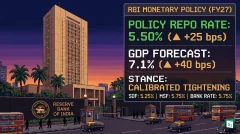
The revision supports the RBI’s decision to raise the repo rate to 5.50 per cent in October 2026 and shift to a calibrated tightening stance. Stronger growth gives the central bank room to prioritise inflation control without triggering a sharp slowdown.
Monetary Policy Has Already Turned Hawkish
The Monetary Policy Committee (MPC) met for its 63rd meeting from 5 to 7 October 2026 and voted unanimously to raise the repo rate by 25 basis points to 5.50 per cent. The repo rate is the interest rate at which the RBI lends short-term funds to commercial banks, and it anchors borrowing costs across the economy. The standing deposit facility rate moved to 5.25 per cent, while the marginal standing facility rate and the Bank Rate moved to 5.75 per cent.
This was the first rate hike since February 2023. The RBI had cut rates by a cumulative 125 basis points during 2025, with the last reduction in December 2025 taking the repo rate to 5.25 per cent, and then held it steady through four reviews in 2026. Governor Sanjay Malhotra said rate cuts were off the table in the near term and that future action would be either a hike or a pause.
The RBI raised its own FY27 growth projection to 7.1 per cent from 6.7 per cent and its inflation projection to 5.2 per cent from 5.0 per cent. It expects consumer inflation to peak near 6 per cent in the December quarter before easing. Core inflation, which excludes food and fuel, is projected at 4.4 per cent.
For households, the transmission is direct. Home, auto and personal loans linked to external benchmarks will reset higher, and small businesses that borrow at floating rates will face costlier working capital. Deposit rates usually rise with a lag, so savers gain slowly while borrowers feel the change quickly.
Fiscal and External Buffers
The fiscal arithmetic still looks manageable. The Centre’s deficit stood at ₹4.55 lakh crore, or 26.8 per cent of the full-year target, at the end of July 2026, lower than the 29.9 per cent recorded at the same stage a year earlier. Higher nominal GDP growth helps here, because tax collections rise even when real output growth slows.
The external account is also holding. India’s current account deficit was $4.2 billion, or 0.5 per cent of GDP, in the June quarter of FY27, up from $3.4 billion a year earlier but still modest. The merchandise trade deficit widened to $86.1 billion from $68.9 billion, driven largely by energy imports. Foreign exchange reserves stood at about $734.6 billion (as of early October 2026), which gives the RBI room to smooth rupee volatility.
Trade policy could provide some offset to the oil bill. The first phase of the India-United States trade agreement is in the final stage of legal drafting, and the India-New Zealand free trade agreement takes effect on 20 October 2026 with duty-free access for all Indian export lines. A free trade agreement with the European Union has also been concluded. None of these removes the oil price risk, but they widen the export base at a time when demand in traditional markets is uncertain.
Key Takeaways
- BMI, a Fitch Solutions company originally founded as Business Monitor International in 1984, raised India’s FY27 real GDP growth forecast to 7.5 per cent from 6.8 per cent.
- BMI lowered its FY28 forecast to 6.3 per cent from 6.5 per cent, citing weak household consumption, elevated oil prices and El Nino risks.
- India’s real GDP grew 7.8 per cent in Q1 FY27, with gross fixed capital formation rising 11.9 per cent and private final consumption expenditure 7.1 per cent.
- The RBI raised the repo rate by 25 basis points to 5.50 per cent on 7 October 2026, its first hike since February 2023, and projected FY27 growth at 7.1 per cent.
- BMI expects the RBI to raise the repo rate by a further 75 basis points to 6.25 per cent and projects CPI inflation at 5.6 per cent for FY27.
- The 2026 southwest monsoon ended with a 12.6 per cent deficit at 759.4 mm, the lowest since 2015, as a strong El Nino suppressed rainfall.
- The SHANTI Act, 2025 supports India’s target of 100 GW of nuclear capacity by 2047, including small modular reactors intended to power data centres.