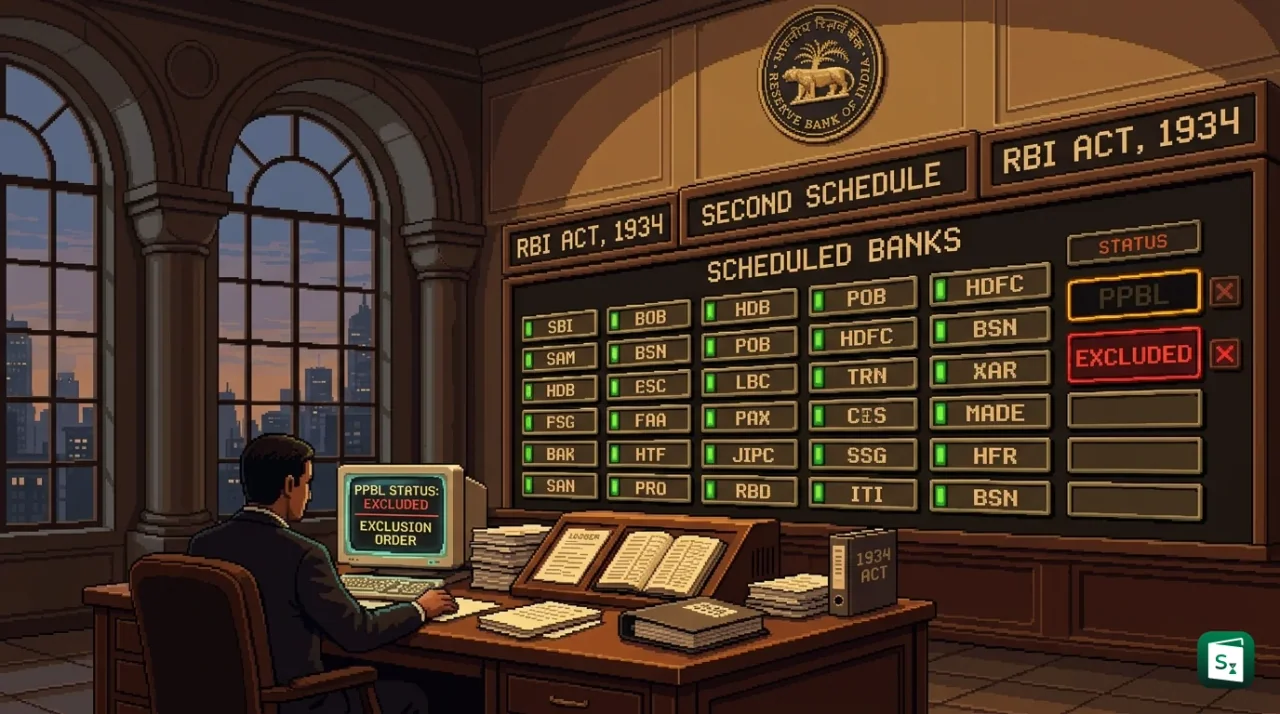
The Reserve Bank of India announced on 7 October 2026 that Paytm Payments Bank Limited (PPBL) stands excluded from the Second Schedule of the RBI Act, 1934. The notification dated 31 July 2026, published in the Gazette of India on 7 September 2026, formally ends its status as a scheduled bank after its banking licence was cancelled on 24 April 2026. The move closes a long regulatory chapter and clarifies what scheduled status means, which banks hold it, and why Paytm Bank can no longer function as a bank.
What Is Paytm Payments Bank?
Paytm Payments Bank Limited is a differentiated bank licensed to accept savings deposits and offer payments and remittance services without lending. It was promoted by One97 Communications and founder Vijay Shekhar Sharma, commenced operations in 2017 after in principle approval in 2015, and functioned as an associate of the Paytm group with headquarters in Noida, Uttar Pradesh.
Payments banks were created after the Nachiket Mor Committee on Comprehensive Financial Services for Small Businesses and Low Income Households (2013 to 2014) recommended a low cost, technology led bank for migrant workers, low income households and small firms. The Reserve Bank issued the Guidelines for Licensing of Payments Banks on 27 November 2014. Under these rules, a payments bank registers as a public limited company under the Companies Act, 2013 and receives a licence under Section 22 of the Banking Regulation Act, 1949.
A payments bank can accept demand deposits up to ₹2 lakh per customer, issue debit cards, and provide fund transfers through channels such as UPI (Unified Payments Interface), IMPS (Immediate Payment Service), AEPS (Aadhaar Enabled Payment System), wallets, FASTags and National Common Mobility Cards. It cannot give loans or issue credit cards. It must maintain a minimum paid up equity capital of ₹100 crore, a capital adequacy ratio of 15 percent and a leverage ratio of at least 3 percent. It also gets scheduled bank status once it starts operations and meets the conditions in Section 42(6)(a) of the RBI Act, 1934.
Why Was Paytm Payments Bank Removed From the Scheduled Banks List?
The Reserve Bank removed Paytm Payments Bank from the scheduled list because it no longer holds a banking licence and has entered winding up. A banking licence and scheduled status are distinct. The licence allows banking business. Scheduled status is a listing in the Second Schedule that gives special facilities. Once the licence was cancelled, the listing could not continue.
The Reserve Bank cancelled the licence of Paytm Payments Bank by order dated 24 April 2026 under Section 22(4) of the Banking Regulation Act, 1949, with effect from close of business that day. The bank was then barred from carrying on banking as defined in Section 5(b) or any additional business under Section 6 of the same Act. The Reserve Bank stated four grounds. The affairs of the bank were conducted in a manner harmful to the bank and its depositors. The general character of its management was harmful to depositors and public interest. No useful purpose would be served by letting it continue. It had failed to meet the conditions of its payments bank licence. These findings relate to Section 22(3)(b), (c), (e) and (g).
This action followed a long period of supervisory curbs. The bank was told to stop adding new customers from 11 March 2022 amid material supervisory concerns. It was also asked to get a full system audit of its IT setup. On 31 January 2024 and 16 February 2024, the Reserve Bank barred fresh deposits, credit transactions and top ups in accounts, wallets, prepaid instruments, FASTags and mobility cards after 15 March 2024, while allowing withdrawals of available balances with interest, cashbacks and refunds. The bank had earlier paid a penalty of ₹5.39 crore in October 2023 for compliance lapses.
| Date | Regulatory Action on Paytm Payments Bank |
|---|---|
| June 2018 | Audit found gaps in customer verification and onboarding controls |
| 11 March 2022 | Barred from onboarding new customers, ordered IT system audit |
| 31 January and 16 February 2024 | Barred from fresh deposits and top ups after 15 March 2024, nodal accounts of One97 Communications and Paytm Payments Services to be closed |
| 24 April 2026 | Banking licence cancelled under Section 22(4), banking business prohibited |
| 8 July 2026 and 22 July 2026 | Delhi High Court ordered winding up under the Banking Regulation Act read with the Companies Act, 2013 |
| 31 July 2026 | Exclusion from Second Schedule notified vide Notification No. DoR.LIC.No.S3674/16.13.215/2026-27 |
| 7 September 2026 | Notification published in Gazette of India Part III Section 4 |
| 7 October 2026 | Reserve Bank press release announced the exclusion publicly |
After licence cancellation, the Reserve Bank moved the Delhi High Court under Sections 38 and 39 of the Banking Regulation Act, 1949 for winding up. Justice Anish Dayal accepted the plea by orders dated 8 July 2026 read with 22 July 2026. The court appointed Girikumar M. Nair, former Chief General Manager of the State Bank of India (SBI), as Official Liquidator. From 8 July 2026, the liquidator exercises all powers of the board and must file a preliminary report under Section 41 within two months.
Paytm Payments Bank is closed as a bank and is not working for deposits or top ups. Customers could withdraw or use available balances through permitted transfers. The wider Paytm app still works through other partner banks for UPI and payment aggregation after separate approvals, including UPI onboarding clearance in October 2024 and a payment aggregator licence for Paytm Payments Services in November 2025. These platforms are separate from the wound up bank.
What Is the Meaning of Scheduled Bank Under the RBI Act, 1934?
A scheduled bank means a bank whose name appears in the Second Schedule of the Reserve Bank of India Act, 1934. The Schedule is the official list of banks that meet the Reserve Bank standards for financial soundness and conduct. Inclusion is governed by Section 2(e) read with Section 42(6)(a) of the Act.
The core entry test is simple. The bank must have paid up capital and reserves of at least ₹5 lakh. It must satisfy the Reserve Bank that its affairs are not conducted in a manner harmful to depositors. It must also meet other statutory and supervisory conditions on ownership, governance, reporting and reserves. A bank that fails these tests stays outside the Schedule and is called a non scheduled bank.
Scheduled status brings both duties and privileges. Every scheduled bank must maintain Cash Reserve Ratio (CRR), which is a share of its net demand and time liabilities kept with the Reserve Bank, and file fortnightly Form A returns under Section 42(2). In return, it becomes eligible for refinance and loans at the Bank Rate from the Reserve Bank and automatically gains membership of the clearing house for cheque and settlement clearing. This is why scheduled status raises public trust. It signals that the bank is under close Reserve Bank supervision with access to central liquidity support.
The Reserve Bank of India, established on 1 April 1935 under the RBI Act, 1934 and headquartered in Mumbai, maintains and updates this list through notifications in the Gazette of India. Removal, as in the Paytm case, is done by a formal exclusion notification after the bank loses its licence or no longer meets the entry conditions.
Scheduled Banks in India: Structure and Payments Bank List
Scheduled banks in India fall into two broad families, Scheduled Commercial Banks and Scheduled Cooperative Banks. Commercial banks include public sector banks, private sector banks, foreign banks, Regional Rural Banks (RRBs), Small Finance Banks (SFBs) and Payments Banks. Cooperative banks include scheduled state cooperative banks and scheduled urban cooperative banks. All of them appear in the Second Schedule and follow Reserve Bank reserve and reporting rules.
Payments banks form a small part of this system. The Reserve Bank gave in principle approval to 11 applicants in August 2015. Only a few started operations and several later closed or merged. After the exclusion of Paytm Payments Bank, the remaining scheduled payments banks include institutions set up by telecom, postal and financial groups to serve remittance and small savings needs.
| Payments Bank in India | Promoter Group and Status |
|---|---|
| India Post Payments Bank | Department of Posts, commenced 2018, active with wide rural access |
| Airtel Payments Bank | Bharti Airtel, commenced 2016, active |
| Fino Payments Bank | Fino PayTech, commenced 2017, active and listed |
| Jio Payments Bank | Reliance Industries, commenced 2018, active |
| NSDL Payments Bank | National Securities Depository, active in niche payments |
| Paytm Payments Bank | One97 Communications and Vijay Shekhar Sharma, licence cancelled 24 April 2026, wound up July 2026, excluded from Second Schedule |
Deposits in a scheduled bank carry protection from the Deposit Insurance and Credit Guarantee Corporation (DICGC). DICGC, a wholly owned subsidiary of the Reserve Bank established in 1961 and headquartered in Mumbai, insures deposits up to ₹5 lakh per depositor per bank with effect from 4 February 2020. In a winding up, the liquidator settles depositor claims under the priority set in the Banking Regulation Act and company law, with insured amounts paid through DICGC.
Scheduled Bank Versus Non Scheduled Bank
A scheduled bank is listed in the Second Schedule, keeps CRR with the Reserve Bank, files statutory returns, can borrow at the Bank Rate and joins the clearing house. A non scheduled bank stays outside this list. It still needs a licence for banking business if it accepts deposits for lending, but it does not get automatic refinance and clearing membership and faces tighter limits on operations. Most local area banks and very small cooperative units operate in this space until they meet the capital and conduct tests for inclusion.
For readers tracking the RBI bank list, the practical lesson is clear. Check the Second Schedule for scheduled status and check the licence list for permission to do banking. Paytm Payments Bank now appears in neither. Its UPI handle or wallet history does not make the Paytm app a bank, since UPI services now run through other partner banks.
The Way Forward
The immediate task is orderly closure. The Official Liquidator will take charge of assets, verify claims, sell property and repay depositors and creditors under court supervision. The preliminary report due within two months of the winding up order will set out cash in hand, asset quality and the queue for payouts. The long gap between the 2024 deposit freeze and the 2026 licence cancellation helped shrink fresh liabilities, since withdrawals were allowed while inflows were blocked.
The larger lesson concerns governance in differentiated banks. Payments banks run on high volume and low value transactions with thin margins. They depend on strong customer verification, technology controls and arm’s length dealings with group firms. The Reserve Bank has stressed that compliance with licence conditions is not optional. Future licensing will likely keep strict checks on related party accounts, IT audits and customer due diligence.
The model itself remains relevant for financial inclusion. India Post Payments Bank and other active players continue to carry remittances, direct benefit transfers and small savings to remote areas. Their survival will depend on fee income, partnerships and low cost digital access points rather than lending spreads.
Key Takeaways
- The Reserve Bank excluded Paytm Payments Bank from the Second Schedule of the RBI Act, 1934 vide notification dated 31 July 2026, published on 7 September 2026 and announced on 7 October 2026.
- The banking licence of Paytm Payments Bank was cancelled on 24 April 2026 under Section 22(4) of the Banking Regulation Act, 1949 for conduct harmful to depositors and public interest.
- The Delhi High Court ordered winding up on 8 July 2026 read with 22 July 2026 and appointed Girikumar M. Nair as Official Liquidator.
- A scheduled bank must have paid up capital and reserves of at least ₹5 lakh and meet the conditions in Section 42(6)(a) of the RBI Act, 1934.
- Payments banks were recommended by the Nachiket Mor Committee (2014), licensed under Section 22 with ₹100 crore minimum capital, and can accept deposits up to ₹2 lakh per customer without lending.