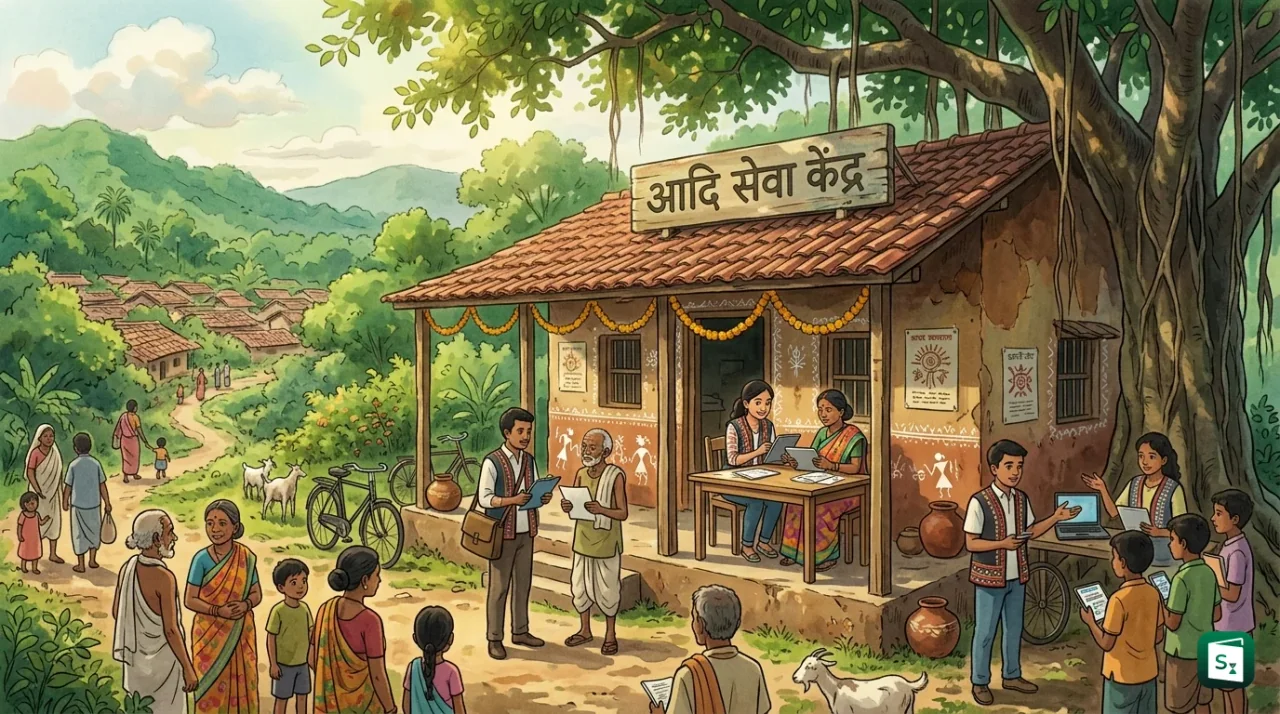
The Ministry of Tribal Affairs has signed a Memorandum of Understanding (MoU) with Karmayogi Bharat to develop and operate the Tribal Affairs Capacity Building Platform under the iGOT Karmayogi framework. The dedicated platform will train the grassroots network of the Adi Karmayogi Abhiyan through structured digital courses, assessments and certificates. The move links more than 76,000 Adi Sewa Kendras and over 1.54 lakh Adi Karmayogi Volunteers to a single national learning system for last mile tribal governance.
What Is iGOT Karmayogi?
The iGOT Karmayogi platform is the national digital learning system for government officials in India. The full form of iGOT is Integrated Government Online Training. It offers online courses, assessments and certificates that officials can access anytime, on any device, in multiple Indian languages.
The Ministry of Personnel, Public Grievances and Pensions anchors the National Programme for Civil Services Capacity Building, which is widely known as Mission Karmayogi. The Union Cabinet approved Mission Karmayogi in September 2020. Its central idea is simple. It seeks to shift civil services training from a rule based system, where everyone learns the same rules, to a role based system, where each official learns the skills needed for the specific post held.
The iGOT Karmayogi portal is the main tool for this shift. The portal hosts courses across three competency groups. Domain competencies cover subject knowledge such as tribal welfare schemes. Functional competencies cover work skills such as file management, budgeting and data use. Behavioural competencies cover conduct such as citizen centricity, communication and teamwork.
Scale makes the platform important for the new tribal agreement. The iGOT Karmayogi portal has crossed 1.7 crore registered users (as of August 2026). It hosts more than 5,600 courses with nearly 6,953 hours of learning. Courses are available in 23 languages, including English and Hindi, with subtitles and transcripts in 11 major Indian languages. More than 7.3 crore enrolments and over 3.35 crore course completions have been recorded so far. New tools such as AI Tutor, AI Sarthi and the AI Capacity Building Plan tool now give personalised course suggestions and role specific learning paths.
What Is Karmayogi Bharat?
The Karmayogi Bharat organisation is a government owned company that owns and operates the iGOT Karmayogi platform on behalf of the government. Karmayogi Bharat designs the digital infrastructure, manages course onboarding, runs assessments and certification, and tracks learner data for ministries and states.
Karmayogi Bharat is legally structured as a Special Purpose Vehicle (SPV). An SPV is a separate company created for one specific task. The Department of Personnel and Training set up this SPV in 2021 to 2022. Karmayogi Bharat was incorporated on 31 January 2022 under Section 8 of the Companies Act, 2013 as a 100 percent government owned not for profit company. It works under the Department of Personnel and Training (DoPT), which is the nodal department for Mission Karmayogi.
Two other bodies complete the institutional design. The Capacity Building Commission (CBC), set up in 2021, sets training standards, helps ministries prepare Annual Capacity Building Plans, and supervises central training institutions. The Prime Minister’s Human Resource Council gives strategic direction, while the Cabinet Secretariat Coordination Unit monitors progress. For rollout in states, Karmayogi Bharat and the Capacity Building Commission sign tripartite MoUs with state governments. By mid 2026, such MoUs covered 30 States and Union Territories, with more than 1.53 crore to 1.7 crore users onboarded from central ministries, states and local bodies.
| Institution | Established | Core Role |
|---|---|---|
| Mission Karmayogi (NPCSCB) | September 2020 | National programme for role based, competency driven civil services reform |
| Department of Personnel and Training | Nodal department | Implements Mission Karmayogi across ministries |
| Capacity Building Commission | 2021 | Sets standards and guides Capacity Building Plans |
| Karmayogi Bharat (SPV) | 31 January 2022 | Owns and operates the iGOT Karmayogi platform |
What Does the New MoU Provide?
The Ministry of Tribal Affairs signed the MoU with Karmayogi Bharat to create a dedicated Tribal Affairs Capacity Building Platform inside the iGOT Karmayogi ecosystem. Karmayogi Bharat will develop the technical space and operate it. The Ministry of Tribal Affairs will provide the domain content, course design inputs and the field network of trainers and volunteers.
The immediate user base is the field force of the Adi Karmayogi Abhiyan. The MoU brings iGOT Karmayogi learning directly to Adi Karmayogi Volunteers (AKVs) and related functionaries. These volunteers will register on the portal, complete role based courses, and download certificates after assessment. Course access will follow the standard iGOT flow of registration with mobile number or email, login with OTP or password, selection of courses, and completion tracking on web and mobile app.
The Ministry of Tribal Affairs was set up in 1999 after bifurcation of the Ministry of Social Justice and Empowerment. It works for the integrated social and economic development of Scheduled Tribes (STs). The Ministry supports schemes of central ministries and state governments and fills critical gaps through financial help. The Tribal Affairs Minister is Jual Oram (as of October 2026). The new platform fits this mandate. It gives the Ministry its own capacity building vertical on iGOT, instead of depending only on generic civil services courses.
Adi Karmayogi Abhiyan and the Scale of Adi Sewa Kendras
The Adi Karmayogi Abhiyan is the parent mission behind the new platform. The word Adi refers to tribal and original communities. Karmayogi means a dedicated worker. The Ministry of Tribal Affairs launched the Abhiyan on 19 August 2025. Prime Minister Narendra Modi formally launched its field phase from Dhar in Madhya Pradesh on 17 September 2025 during Adi Sewa Parv (17 September to 2 October 2025). The Abhiyan was a central part of Janjatiya Gaurav Varsh (15 November 2024 to 15 November 2025) and supports the goal of Viksit Bharat by 2047.
The design rests on three values. Seva means service. Samarpan means dedication. Sankalp means resolve. Field work happens through Governance Process Labs. These are multi department workshops held from state to district, block and village levels. Government officers and tribal communities use these labs to jointly prepare Tribal Village Vision 2030 and village action plans with investment mapping.
An Adi Sewa Kendra (ASK) is a village level facilitation centre in a tribal dominated village. It acts as a single point for grievance help, information on entitlements, and coordination of schemes. Officers and community members devote one to two hours every fortnight as Adi Sewa Samay to solve local issues and mentor youth. An Adi Karmayogi Volunteer (AKV) is a local grassroots facilitator, often tribal youth, who connects households to services and drives citizen engagement.
The national targets show the scale. The Abhiyan aims to reach 1 lakh tribal dominated villages in 550 districts across 30 States and Union Territories. It plans to build 20 lakh change leaders and directly engage nearly 11 crore tribal citizens. The change cadre includes government Adi Karmayogis, non resident mentors called Adi Sahyogis such as teachers and doctors, and resident community supporters called Adi Saathis such as self help group members and tribal elders.
| Adi Karmayogi Element | Scale or Status |
|---|---|
| Target villages | 1 lakh tribal dominated villages |
| Target districts and states | 550 districts, 30 States and Union Territories |
| Target change leaders | 20 lakh |
| Adi Sewa Kendras being institutionalised | Over 76,000 |
| Adi Karmayogi Volunteers networked | Over 1.54 lakh |
| Linked flagship missions | PM JANMAN, Dharti Aaba Janjatiya Gram Utkarsh Abhiyan, National Sickle Cell Anaemia Elimination Mission |
The figure of over 76,000 Adi Sewa Kendras and over 1.54 lakh volunteers marks the shift from campaign to institution. The Ministry now wants these centres to function as permanent village platforms, not temporary camps. Digital training through iGOT gives them a common standard of knowledge on schemes, rights and service procedures.
Why This MoU Matters for Tribal Governance
The core problem in tribal areas is last mile delivery. Schemes exist on paper but households struggle with forms, documents and follow up. The Dharti Aaba outreach between 15 June and 15 July 2025 showed both the gap and the demand. It organised 61,097 camps in 524 districts and reached over 1.55 crore tribal citizens, with 14.33 lakh Aadhaar enrolments, 10.04 lakh Ayushman Bharat health cards and 5.02 lakh PM KISAN registrations. A trained volunteer in every village can convert such one time camps into continuous facilitation.
Convergence is the second reason. Two large missions already run in the same villages. The Pradhan Mantri Janjati Adivasi Nyaya Maha Abhiyan (PM JANMAN), launched on 15 November 2023 from Khunti in Jharkhand, targets 75 Particularly Vulnerable Tribal Groups (PVTGs) in 18 States and one Union Territory with an outlay of ₹24,104 crore. The Dharti Aaba Janjatiya Gram Utkarsh Abhiyan, launched on 2 October 2024, covers 63,843 villages through 25 interventions of 17 line ministries for more than 5 crore tribal persons. Without trained local facilitators, departments work in silos. Adi Sewa Kendras trained through iGOT can act as the common ground where health, education, livelihood, panchayat and tribal affairs staff meet citizens together.
The education link strengthens the case. The Eklavya Model Residential Schools (EMRS) scheme provides residential schooling from Class 6 to Class 12 to Scheduled Tribe students in remote areas. The Ministry has approved 728 schools, with 428 buildings completed and 249 under construction. The National Education Society for Tribal Students (NESTS) manages the network. Volunteers trained on entitlements and scholarships can guide families toward EMRS admission, pre matric and post matric scholarships, and the National Overseas Scholarship for Scheduled Tribe students.
The way forward is standardisation and continuity. The Tribal Affairs Capacity Building Platform can offer courses in Hindi and regional languages, track completion centrally, and use AI tools for personalised learning paths. From reporting year 2025 to 2026, central government employees must complete prescribed iGOT courses that reflect in their Annual Performance Appraisal Reports. A similar learning discipline for the tribal field cadre would make capacity building measurable. If the 76,000 kendras retain trained volunteers with certificates and regular refresher modules, they can become durable institutions for responsive governance rather than short term campaign structures.
Key Takeaways
- The Ministry of Tribal Affairs signed an MoU with Karmayogi Bharat to develop and operate the Tribal Affairs Capacity Building Platform under iGOT Karmayogi.
- The platform will train the Adi Karmayogi Abhiyan field force covering over 76,000 Adi Sewa Kendras and over 1.54 lakh Adi Karmayogi Volunteers.
- iGOT Karmayogi stands for Integrated Government Online Training and anchors Mission Karmayogi, approved in September 2020 for role based civil services reform.
- Karmayogi Bharat was incorporated on 31 January 2022 under Section 8 of the Companies Act, 2013 to operate the iGOT platform, while the Capacity Building Commission was set up in 2021.
- The Adi Karmayogi Abhiyan was launched on 19 August 2025 and targets 1 lakh villages, 550 districts and 20 lakh change leaders across 30 States and Union Territories.
- The Abhiyan converges with PM JANMAN (2023) for 75 PVTGs and the Dharti Aaba Janjatiya Gram Utkarsh Abhiyan (2024) covering 63,843 villages through 17 ministries.