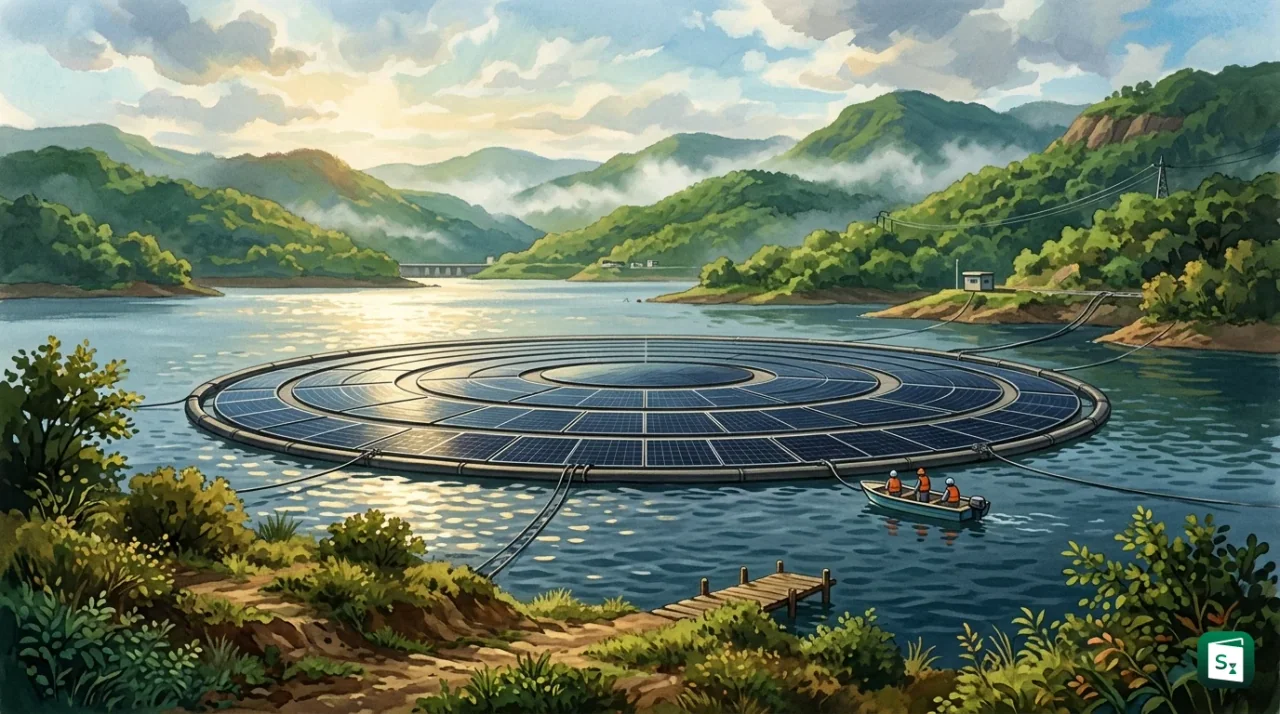
The Tata Power Company Limited has partnered with Norway based Ocean Sun to bring membrane based floating solar technology to India for the first time. The two companies will set up a nearly 300 kilowatt peak (kWp) floating solar pilot at the Mulshi reservoir in Maharashtra. The project will test whether this light, water cooled design can work reliably at scale under Indian conditions.
What Is a Floating Solar Power Plant and How Do Floating Solar Panels Work?
A floating solar power plant is a solar system built on water instead of land. Photovoltaic panels sit on floating platforms on lakes, reservoirs or hydropower dams. The panels convert sunlight into electricity like ground systems, while water cools them and mooring lines hold them in place.
Floating solar, also called floating photovoltaics (FPV), uses the same solar cells as land plants. The difference lies below the panels. Modular blocks of panels are assembled on shore, floated out and fixed with anchors and mooring lines that can handle wind, waves and changing water levels. Power flows through waterproof cables to inverters on the float or on the bank, and then to a substation on shore.
Water gives floating solar three clear benefits. First, it saves land. The plant uses water surfaces that have few other uses, so it avoids farm land disputes and city land costs. Second, water cools the panels. Field studies in warm climates report 5 to 10 percent higher energy yield than similar land plants because cooler cells produce more power. Third, shade from panels cuts evaporation and slows algae growth, which helps reservoirs store more water for drinking, farming and hydropower.
Floating solar works best with hydropower. A reservoir already has roads, transmission lines and a substation. Solar produces strongly in the daytime, while hydropower can be adjusted for night or cloudy hours. Saved water can then be used later for power generation. This pairing improves grid stability and makes fuller use of public infrastructure.
The design also brings trade offs. Continuous motion can wear floats, joints and cables. Developers at Indian sites have reported occasional direct current cable breakage, slippery walkways and limited access during monsoon. Capital cost is higher than ground plants by about 25 percent because of floats, anchors and waterproofing. Strong mooring design and trained maintenance crews are therefore essential for long term safety.
| Feature | Floating Solar | Ground Mounted Solar |
|---|---|---|
| Siting surface | Lakes, reservoirs, hydropower dams | Open land parcels |
| Land need | Very low, mainly for cables and substation | High, with large contiguous plots |
| Cooling effect | Water cooling lifts output by 5 to 10 percent in warm climates | Air cooling, higher cell temperature |
| Water benefit | Reduces evaporation and algae growth | No water benefit |
| Main cost driver | Floats, mooring, waterproof cables | Land purchase and site preparation |
| Main risk | Wave motion, water level change, cable wear | Land disputes and dust related soiling |
What Has Tata Power Agreed With Ocean Sun?
The Tata Power Company Limited signed a collaboration agreement with Ocean Sun on the sidelines of the 2nd India EFTA Prosperity Summit held on 7 October 2026 at Bharat Mandapam in New Delhi. The summit marked one year of the India EFTA Trade and Economic Partnership Agreement (TEPA), which links India with Iceland, Liechtenstein, Norway and Switzerland and carries a commitment to promote $100 billion in investment into India over 15 years. The Tata Power Ocean Sun deal was listed among the key Norway linked investment announcements at the event.
Under the agreement, Tata Power and Ocean Sun will build a pilot of nearly 300 kilowatt peak capacity at the Mulshi reservoir in Maharashtra. The reservoir is owned and operated by Tata Power and already feeds its Bhira hydro system. Ocean Sun has confirmed that the Mulshi unit will be its first installation in India. The pilot is small by design. Its purpose is to collect real operating data under Indian heat, monsoon rain, dust and water level changes before any larger rollout is considered.
The two partners will judge the technology on six clear tests. Tata Power will compare membrane based floating solar with conventional pontoon based floating solar on energy generation, Capacity Utilisation Factor (CUF), installation method and time, reliability, operations and maintenance (O and M) needs, capital cost and overall commercial viability. CUF measures the actual electricity produced as a share of the maximum possible output over a year. O and M covers cleaning, inspection, repair and safety of floats, cables and anchors. Results on these tests will show whether the new design can deliver more power at lower lifetime cost.
The pairing brings together two very different strengths. The Tata Power Company Limited, founded in 1919 and headquartered in Mumbai, is part of the Tata Group and ranks among the largest integrated power firms in the country. Tata Power works across generation, transmission, distribution and solar manufacturing. The company reported total installed or managed capacity of 16,716 MW (as of March 2026), of which 7,856 MW came from clean and green sources such as hydro, solar, wind and waste heat recovery. Its renewable arm, Tata Power Renewable Energy Limited (TPREL), holds a portfolio of more than 11 GW including projects under construction, while Tata Power Solar leads its manufacturing and engineering work.
| Entity | Key Fact |
|---|---|
| Tata Power Company Limited | Founded in 1919, headquartered in Mumbai, part of Tata Group |
| Business spread | Thermal, hydro, solar, wind, transmission, distribution, solar cell and module manufacturing |
| Clean portfolio | 7,856 MW operational clean and green capacity out of 16,716 MW total |
| Ocean Sun AS | Founded in 2016, headquartered in Lysaker near Oslo, Norway, listed on Euronext Growth Oslo |
| Ocean Sun expertise | Patented hydro elastic membrane for floating solar, suited for reservoirs, hydropower dams, nearshore and offshore sites |
| Agreement venue | 2nd India EFTA Prosperity Summit, Bharat Mandapam, New Delhi, 7 October 2026 |
| Pilot details | Nearly 300 kWp at Mulshi reservoir, Maharashtra, first Ocean Sun project in India |
How Ocean Sun Membrane Technology Differs From Conventional Floating Solar
Conventional floating solar plants place panels on thick plastic pontoons. These pontoons are usually made of High Density Polyethylene (HDPE), a strong floating plastic, and hold metal frames that tilt the panels toward the sun. Air remains between the panel and the water. The structures use large volumes of plastic, need many joints and bolts, and occupy large space during transport. More than 90 percent of global floating solar plants use this pontoon method.
Ocean Sun replaces most of that structure with a thin hydro elastic membrane. Hydro elastic means a flexible sheet that moves with waves yet stays strong under load. Solar photovoltaic modules rest almost flat on this membrane, which floats directly on the water surface. A circular HDPE buoyancy ring surrounds the membrane and keeps the whole unit afloat. Inverters and combiners can sit on this ring. A double edged fastening strip, called a keder, slides the modules into place without nuts and bolts. This cuts installation steps and removes weak joint points that can suffer fatigue in wind and waves.
Close contact with water is the core gain. Heat passes directly from the module into the water through the thin sheet. Tests in Singapore and Norway found cell temperatures much lower than on land or on air cooled pontoons. Ocean Sun reports 5 to 10 percent higher energy yield than equivalent land plants in warm climates, which largely offsets the loss from laying panels flat at zero degree tilt. The company recommends frameless glass glass modules, which place the cells in a neutral zone and resist micro cracks from gentle wave motion. Field checks after three years in the Philippines found only one micro crack in 150 sampled panels.
The design also changes logistics and safety. A membrane for a 700 kilowatt system fits inside a single 40 foot container, while HDPE pipes for the ring can be sourced locally. Transport volume is about one tenth of pontoon systems. Assembly happens on shore, after which the floater is towed to its anchors. The low flat profile cuts wind drag. Systems are engineered to withstand winds up to 275 kilometres per hour and waves up to 5 metres, with mooring designed for local depth, current and wind under marine standards. The membrane uses Norwegian made coated PVC with ultraviolet protection and a tested life of more than 20 years. It is certified for use on drinking water. Multiple circular floaters, each of about 280 to 650 kilowatt depending on diameter, can be placed side by side to form multi megawatt plants.
| Feature | Ocean Sun Membrane System | Conventional Pontoon System |
|---|---|---|
| Support base | Thin hydro elastic membrane floating on water | Interlinked HDPE pontoons with metal frames |
| Panel position | Flat at zero degree tilt, in direct contact with cool surface | Tilted on frames with air gap below |
| Cooling | Direct conduction to water, 5 to 10 percent higher yield in warm areas | Air cooling, higher operating temperature |
| Material and transport | Very low plastic use, flat packed, about 10 times lower volume | High plastic use, bulky floats, higher freight cost |
| Installation | Shore assembly, tow to site, slide in modules without bolts | More joints, bolts and on water assembly |
| Weather handling | Low wind drag, rated for 275 kilometres per hour winds and 5 metre waves | More joints exposed to wind and wave stress |
Where Is Mulshi Reservoir in Maharashtra?
Mulshi is a reservoir and dam on the Mula River in Mulshi taluka of Pune district in Maharashtra. It lies about 40 km west of Pune city in the Western Ghats. Tata Power operates the dam and uses its water for the Bhira hydroelectric system.
Mulshi Dam is a masonry and gravity dam on the Mula River in the Krishna River basin. Construction started in 1920 and the dam opened in 1927. The structure stands 48.8 metres high and stretches 1,533 metres long, with six radial spillway gates. The reservoir stores around 570 million cubic metres of water and spreads across the high rainfall belt of the Western Ghats near Lonavala. Water from Mulshi serves both irrigation needs and power generation.
The reservoir feeds the Bhira hydroelectric station, which forms the backbone of Tata Power century old hydro network in Maharashtra. The Bhira complex has a nominal capacity of 300 MW, built around six 25 MW Pelton turbine units from 1927 and a 150 MW pumped storage unit added in 1997. Pumped storage pumps water to a higher level when surplus power is available and releases it when demand rises. Along with the Khopoli and Bhivpuri stations, Bhira forms a historic 447 MW hydro portfolio in the Western Ghats. These plants gave Mumbai some of its earliest clean power and still run at near full availability.
A company owned reservoir makes Mulshi a natural test bed. Tata Power controls access, safety, water level data and grid links, so engineers can track generation, soiling, wind load and cable behaviour without outside delays. The site already has roads, a substation and operating staff. If membrane floats perform well here through a monsoon cycle, the same approach can be studied for other Tata Power reservoirs and for hydropower dams across the country where land is scarce but water area is large.
Why Floating Solar Matters for India: 102 GW Potential and Clean Energy Goals
India faces a land bottleneck in solar growth. Ground plants need three to four times more land than the panel area, while farms, cities and forests compete for the same ground. Floating solar is land neutral. It builds on water the state already owns and spreads clean power to states that have large reservoirs but less desert land. This logic sits at the heart of the first national assessment of floating solar potential.
The National Institute of Solar Energy (NISE), an autonomous institute under the Ministry of New and Renewable Energy (MNRE), published the report titled Solar PV Potential of India (Floating Solar) in June 2026. NISE screened 11,197 inland water bodies through six filters. Only lakes and reservoirs larger than 10 hectares, with water for at least 11 months a year, depth between 3 and 30 metres, sunlight above 4.5 kilowatt hours per square metre per day, and location within 10 km of both roads and substations were kept. The method was first tested on the Hirakud reservoir in Odisha, where 499 square km of water yielded 99.5 square km of usable area.
After applying a self imposed cap of using only 20 percent of any reservoir surface to protect ecology, fisheries and other water uses, NISE identified 682 feasible water bodies with 1,946 square km of usable surface. That translates into 102.18 gigawatt peak (GWp) of floating solar potential. Added to the earlier land based estimate of 3,343 GWp, India total assessed solar potential now stands at 3,445 GWp. The assessment also found that floating plants in warm Indian states can produce 2 to more than 8 percent higher annual energy than optimum tilt ground plants once water cooling is counted.
| State | Floating Solar Potential |
|---|---|
| Maharashtra | 16.28 GWp, highest in the country |
| Madhya Pradesh | 14.89 GWp |
| Karnataka | 13.69 GWp |
| Odisha | 12.81 GWp |
| Telangana | 10.72 GWp |
| Gujarat | 6.32 GWp |
| All India total | 102.18 GWp from 1,946 square km |
Installed capacity is still tiny against this potential. India has only about 0.7 GW of floating solar in operation. The flagship is the Omkareshwar floating solar park on the Narmada River in Khandwa district of Madhya Pradesh. Built in phases toward 600 MW, its operating part of about 278 MW makes it the largest floating solar plant in the country. Other operating plants include the Ramagundam plant in Telangana and the Kayamkulam plant in Kerala built for NTPC. Field notes from Omkareshwar on loosening float joints, uneven buoyancy and cable stress show why technology trials and standards matter before rapid scale up.
Policy support is now catching up. The central government has cleared the Pradhan Mantri Surya Sarovar Yojana, a central sector scheme to build 5,000 MW of floating solar with a total outlay of ₹5,070 crore. The scheme offers central financial assistance of up to ₹1 crore per MW after commissioning and asks every project to pair solar with at least two hours of battery storage. The Solar Energy Corporation of India (SECI), a public sector company under MNRE that runs solar auctions and trading, will implement the scheme. The push links directly to national pledges of 500 GW of non fossil capacity by 2030 and net zero emissions by 2070 under the Panchamrit agenda. A 300 kWp trial like Mulshi may look small, but it builds the cost and performance evidence that lenders, states and regulators need to back these larger goals.
The Way Forward for Membrane Based Solar in India
The Mulshi pilot will succeed only if it answers practical questions for Indian conditions. Engineers will track generation across summer heat, monsoon cloud and winter dust. They will record installation time, labour needs, cleaning frequency, cable health and behaviour during rapid water level changes. Cost data on capital spending and maintenance will decide the Levelized Cost of Energy (LCOE), which is the average lifetime cost of each unit of electricity. A lower LCOE would make membrane plants attractive for tariffs and power purchase deals.
Scale will depend on standards and local supply. Floats, membranes, cables and anchors need clear quality certification for 25 year life in Indian reservoirs. Bathymetry surveys, which map underwater depth and shape, plus studies on ecology and fisheries, must precede site approval. Local sourcing of HDPE pipes and use of domestic engineering teams can cut costs and create jobs near project sites. A public repository of surveyed sites, along with single window clearance across irrigation, power and environment departments, would shorten development time.
The Norway link gives the project wider meaning. Bilateral ties were raised to a Green Strategic Partnership during the Prime Minister visit to Oslo in May 2026, the first such visit in 43 years. The TEPA framework now offers a channel for clean technology, investment and joint manufacturing. If the Mulshi membrane proves reliable, cost competitive and safe for water quality, Tata Power and Ocean Sun can explore larger clusters on hydropower reservoirs where transmission already exists. That path would turn a 300 kilowatt test into a template for land scarce, water rich solar growth.
Key Takeaways
- Tata Power and Norway based Ocean Sun signed an agreement on 7 October 2026 for a nearly 300 kWp membrane based floating solar pilot at Mulshi reservoir, the first Ocean Sun installation in India.
- Ocean Sun AS, founded in 2016 and headquartered in Lysaker near Oslo, uses a patented thin hydro elastic membrane that floats directly on water and can lift yield by 5 to 10 percent.
- Mulshi Dam on the Mula River in Pune district, Maharashtra, opened in 1927 and feeds the 300 MW Bhira hydro complex with 6x25 MW units and a 150 MW pumped storage unit.
- The National Institute of Solar Energy estimated India floating solar potential at 102.18 GWp in June 2026, with Maharashtra leading at 16.28 GWp.
- The Omkareshwar floating solar park on the Narmada in Madhya Pradesh, at about 278 MW and planned for 600 MW, is the largest floating solar plant in India.
- The Tata Power Company Limited, founded in 1919 and headquartered in Mumbai, reported 16,716 MW total capacity with 7,856 MW from clean and green sources.