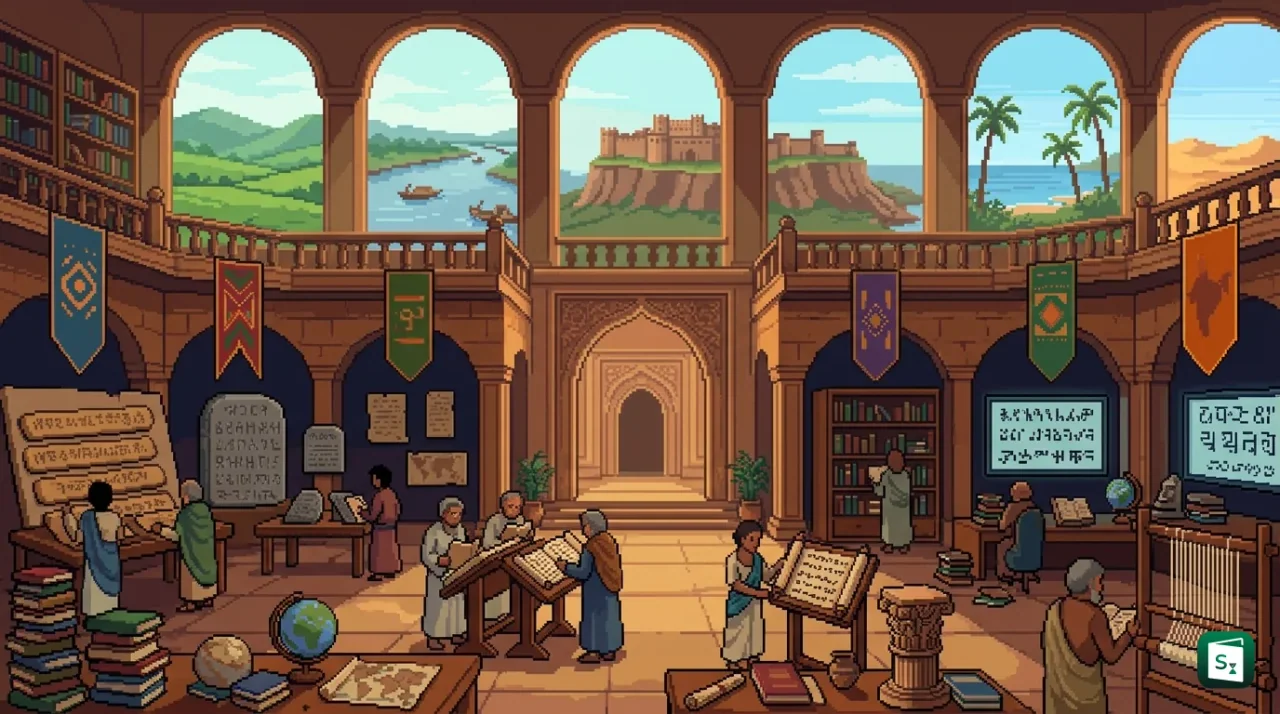
The Department of Higher Education under the Ministry of Education has sanctioned five Centres of Excellence for the study of Classical Assamese, Bengali, Marathi, Pali and Prakrit. The centres will come up at Tezpur University, Visva-Bharati University, Deccan College Pune, Central University of Odisha and Central University of Gujarat. The move gives dedicated institutional backing to the five languages that were granted classical language status in October 2024, taking the total classical languages of India to 11.
What Is a Classical Language?
A classical language in India is a language formally recognised by the central government for its great age, rich body of old literature and distinct literary tradition. The Ministry of Culture frames the rules for this recognition, acting on the advice of a Linguistic Experts Committee (LEC) constituted under the Sahitya Akademi. The Ministry of Education handles promotion and research support through the Central Institute of Indian Languages (CIIL), which is based in Mysuru in Karnataka.
The separate category of classical languages began on 12 October 2004, when Tamil was declared the first classical language of India. The criteria were revised in November 2005 and again in 2024. The 2024 revision removed the older condition that a literary tradition must be original and not borrowed from another speech community. It placed fresh emphasis on knowledge texts and prose, along with inscriptional and epigraphical evidence.
| Classical Language Criteria Under the 2024 Framework | Simple Meaning |
|---|---|
| High antiquity of early texts and recorded history over 1,500 to 2,000 years | The language must have very old written records going back at least fifteen centuries |
| Body of ancient literature valued as heritage by generations of speakers | People across generations must have treasured its old books and writings |
| Presence of knowledge texts, especially prose, besides poetry, inscriptions and epigraphs | The language must have serious prose works on subjects like philosophy and science, not only poems |
| Classical form distinct from the modern form, with possible discontinuity | The old form of the language can look quite different from how it is spoken today |
How Many Classical Languages Are There in India?
India has 11 classical languages (as of October 2026). They are Tamil, Sanskrit, Telugu, Kannada, Malayalam, Odia, Marathi, Pali, Prakrit, Assamese and Bengali. Six were recognised between 2004 and 2014. Five more were added by the Union Cabinet on 3 October 2024.
Tamil, declared in 2004, remains the first classical language of India. It has an unbroken literary record going back over two thousand years, with early works like the Tolkappiyam on grammar and the Tirukkural on ethics. Sanskrit followed in 2005, with a literature that stretches back nearly three thousand years to the Vedas, Upanishads, Ramayana and Mahabharata.
Telugu and Kannada were both added in 2008, Malayalam in 2013 and Odia in 2014. That took the count to six. The tally stayed at six for a decade. On 3 October 2024, the Union Cabinet approved five new entrants together. These were Marathi, Pali, Prakrit, Assamese and Bengali. The Gazette notification for the five was issued on 4 October 2024. So any query on which classical language was added in 2024 has the same answer. All five were added together.
11 Classical Languages of India With Year of Recognition
The Ministry of Culture recognises 11 classical languages of India with year wise dates running from 2004 to 2024. The full chronological order is set out below.
| No. | Classical Language | Year of Recognition | Language Family and Main Region |
|---|---|---|---|
| 1 | Tamil | 2004 | Dravidian, Tamil Nadu |
| 2 | Sanskrit | 2005 | Indo-Aryan, pan India |
| 3 | Telugu | 2008 | Dravidian, Andhra Pradesh and Telangana |
| 4 | Kannada | 2008 | Dravidian, Karnataka |
| 5 | Malayalam | 2013 | Dravidian, Kerala |
| 6 | Odia | 2014 | Indo-Aryan, Odisha |
| 7 | Marathi | 2024 | Indo-Aryan, Maharashtra |
| 8 | Pali | 2024 | Indo-Aryan, Buddhist canonical language |
| 9 | Prakrit | 2024 | Indo-Aryan, Jain and ancient inscriptions |
| 10 | Assamese | 2024 | Indo-Aryan, Assam |
| 11 | Bengali | 2024 | Indo-Aryan, West Bengal |
Marathi is spoken mainly in Maharashtra. Its literary record runs back more than a thousand years, with early devotional writings of saint poets and later prose chronicles. Assamese and Bengali both trace early roots to the Charyapadas, mystic Buddhist verses composed between the 8th and 12th centuries. Assamese draws on the Kamarupa inscriptional tradition and Vaishnavite literature, while Bengali built a vast medieval and modern corpus that later won global attention.
Pali is the answer to the common query on whether Pali is a classical language of India. The government declared Pali classical in October 2024. Pali is a Middle Indo-Aryan language that preserved the Tipitaka, meaning Three Baskets. The three baskets are the Vinaya Pitaka on monastic discipline, the Sutta Pitaka on the discourses of the Buddha and the Abhidhamma Pitaka on philosophy. Pali also carries the Jataka stories of the earlier lives of the Buddha. It remains in ritual and scholarly use in Sri Lanka, Myanmar, Thailand and other Theravada Buddhist regions.
Prakrit refers to a group of Middle Indo-Aryan vernaculars used by common people when Sanskrit was the language of formal learning. The Ashokan edicts of the 3rd century BCE were written in Prakrit forms. Jain scholars preserved their canon, the Agamas, in Ardhamagadhi Prakrit. Court drama, poetry and inscriptions used other forms like Shauraseni and Maharashtri Prakrit. Sanskrit drama itself often gave Prakrit lines to ordinary characters and Sanskrit lines to learned ones.
In world terms, the classical languages of the world are usually listed as Sanskrit, Tamil, Ancient Greek, Latin, Classical Chinese, Classical Hebrew, Classical Arabic and similar tongues with very old written canons. India now accounts for several names on that global list, including Tamil, Sanskrit, Pali and Prakrit.
Five New Centres of Excellence for Classical Languages
The Department of Higher Education issued an Office Memorandum on 1 October 2026 approving the five centres. The Ministry of Education announced the decision on 3 October 2026. Vice Chancellors of the chosen institutions have been asked to start implementation. Each Centre of Excellence will work as a dedicated hub for advanced study of one language.
| Classical Language | Host Institution and Place |
|---|---|
| Classical Assamese | Tezpur University, Tezpur, Assam |
| Classical Bengali | Visva-Bharati University, Santiniketan, West Bengal |
| Classical Marathi | Deccan College Post-Graduate and Research Institute, Pune, Maharashtra |
| Classical Pali | Central University of Odisha, Koraput, Odisha |
| Classical Prakrit | Central University of Gujarat, Gandhinagar, Gujarat |
Tezpur University is a central university set up by Parliament in 1994. It already runs postgraduate teaching in Assamese and linguistics. Visva-Bharati University at Santiniketan was founded by Rabindranath Tagore in 1921 and was declared a central university in 1951. Its archives and Bengali collections make it a natural home for old Bengali manuscripts.
Deccan College in Pune traces its roots to 1821 and is among the oldest centres for archaeology, linguistics and Sanskrit studies in western India. The Central University of Odisha was set up in 2009 under the Central Universities Act, 2009 and is located at Sunabeda in Koraput district. The Central University of Gujarat was also set up in 2009 under the same Act and functions from Gandhinagar. Placing Pali in Odisha links the language of early Buddhism to the land of the Kalinga edicts of Ashoka and the Dhauli rock inscription. Placing Prakrit in Gujarat links it to western Indian Jain manuscript libraries.
The centres will fund research projects, document grammar and vocabulary, and digitise palm leaf manuscripts in partnership with state museums and archives. The plan also covers publication of critical editions, catalogues and translations of classical texts into modern Indian languages and foreign languages. Audio visual records, seminars and training of young scholars will support wider teaching. The aim is to strengthen regional academic ecosystems while building a national pool of scholars, translators, archivists and digitisation experts.
Which Classical Language Is Not in the Eighth Schedule?
Pali and Prakrit are the two classical languages that are not listed in the Eighth Schedule of the Constitution. All other nine classical languages are listed there. The Eighth Schedule today contains 22 languages. It is linked to Articles 344(1) and 351.
The Eighth Schedule lists languages recognised for official purposes. It began with 14 languages in 1950. Sindhi was added in 1967. Konkani, Manipuri and Nepali were added in 1992. Bodo, Dogri, Maithili and Santhali were added in 2003, taking the total to 22. The spelling Oriya was changed to Odia in 2011 through the 96th Constitutional Amendment.
Classical status is different. It is an academic honour for age and literature, not an official language tag. The Ministry of Culture grants classical status. The Ministry of Education supports study and preservation. A language can therefore be classical without being scheduled, as Pali and Prakrit show. The reverse is also true. Many scheduled languages like Hindi, Urdu and Punjabi are not classical languages.
| Point of Difference | Classical Languages | Scheduled Languages |
|---|---|---|
| Governing provision | Government resolutions and Linguistic Experts Committee norms | Articles 344(1) and 351 and the Eighth Schedule |
| Present number | 11 languages | 22 languages |
| Purpose | Honour antiquity and support research and preservation | Guide use in official work, language development and public service examinations |
| Example of non overlap | Pali and Prakrit are classical but not scheduled | Hindi and Urdu are scheduled but not classical |
Benefits Linked to Classical Language Status
Classical status brings three clear forms of support. The central government sets up dedicated research centres, creates teaching chairs in central universities and institutes annual awards for eminent scholars. The awards include two major international awards each year for outstanding work in classical Indian languages.
The model for the five new centres already exists for the older classical languages. The Central Institute of Classical Tamil (CICT) in Chennai was set up in 2008 for Tamil research, translation of texts like the Tirukkural and preparation of study material. Centres for Telugu, Kannada, Malayalam and Odia function under CIIL. The Telugu centre works from Nellore in Andhra Pradesh, the Kannada centre from Mysuru in Karnataka, the Malayalam centre from Tirur in Kerala and the Odia centre from Bhubaneswar in Odisha. Sanskrit is supported through three central universities, namely the Central Sanskrit University in New Delhi, the Shri Lal Bahadur Shastri National Sanskrit University in New Delhi and the National Sanskrit University in Tirupati.
Funds flow through the Ministry of Education. Tamil has received the largest share among the older six, with about ₹15.25 crore in 2023-24 and about ₹14.30 crore in 2024-25 for its institute and projects. The other languages have received smaller annual project grants. The same pattern is expected for the five new languages once their centres become fully functional.
For students and researchers, the benefits are practical. The centres will create openings for doctoral work, manuscript study, translation, archiving, digitisation and publishing. Colleges and universities can draw on new critical editions and dictionaries. Cultural bodies can use fresh translations and digital copies to take old texts to wider readers in India and abroad.
Key Takeaways
- The Department of Higher Education approved 5 new Centres of Excellence for Classical Assamese, Bengali, Marathi, Pali and Prakrit through an order dated 1 October 2026.
- The Assamese centre will be at Tezpur University, the Bengali centre at Visva-Bharati University, and the Marathi centre at Deccan College Pune.
- The Pali centre will be at the Central University of Odisha and the Prakrit centre at the Central University of Gujarat.
- India now has 11 classical languages, with Tamil (2004) as the first and Marathi, Pali, Prakrit, Assamese and Bengali (2024) as the latest additions.
- Pali and Prakrit are classical languages that are not listed in the Eighth Schedule, which contains 22 languages.
- Classical status is decided on the advice of the Linguistic Experts Committee under the Sahitya Akademi, with the Ministry of Culture framing norms and the Ministry of Education funding research.