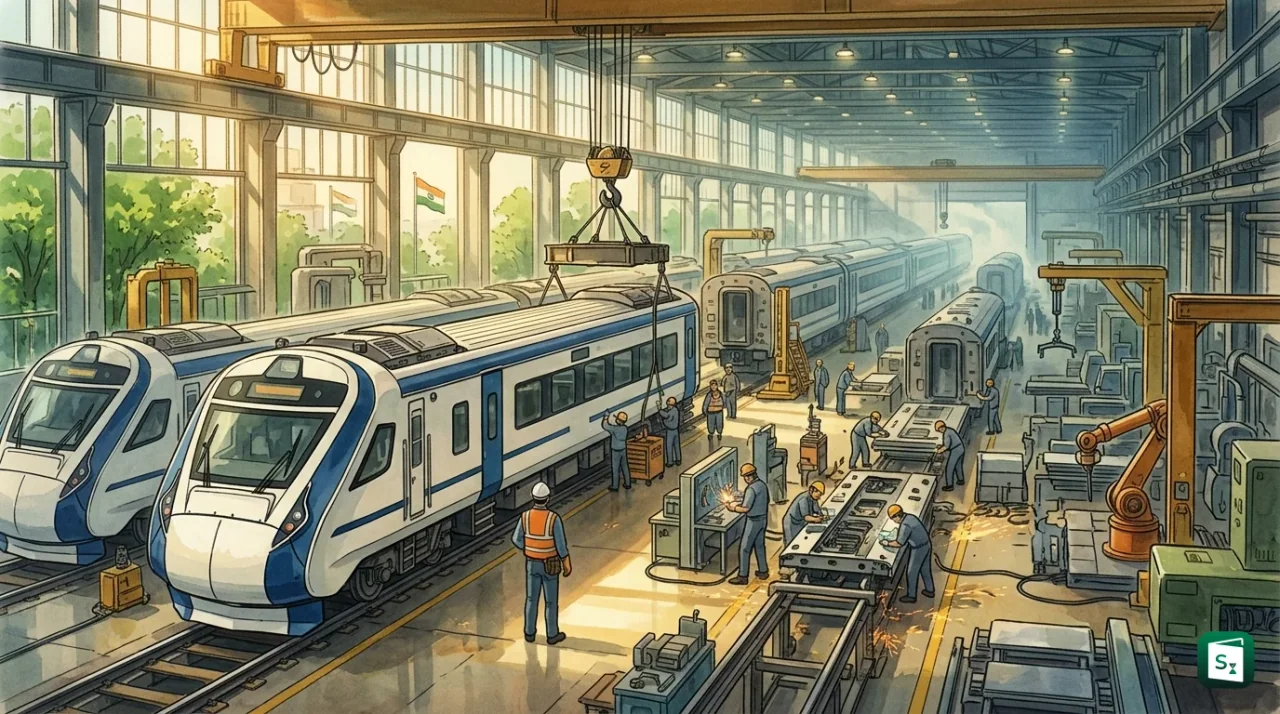
The Department for Promotion of Industry and Internal Trade marked 12 years of Make in India on 25 September 2026. The initiative, launched on 25 September 2014, aims to turn India into a global hub for manufacturing, design and innovation across 27 sectors. Its journey from import dependence in mobiles and defence to record production, exports and investment now shapes the debate on jobs and global supply chains.
What Is Make in India?
Make in India is a national initiative launched on 25 September 2014 to encourage companies from India and abroad to manufacture, design and innovate in India. The programme aims to raise investment, build modern infrastructure and create jobs while turning India into a trusted factory for the world.
The launch came at a difficult moment. Economic growth had slowed sharply before 2014, and business confidence was low. Prime Minister Narendra Modi unveiled the programme at Vigyan Bhawan in New Delhi before top global chief executives. He described foreign direct investment as First Develop India along with Foreign Direct Investment, and urged investors to see India as an opportunity to create jobs, not only as a market to sell goods.
The early plan set clear targets. The objectives of Make in India were to raise manufacturing growth to 12 to 14 percent per year, to create 100 million additional manufacturing jobs by 2022, and to raise the share of manufacturing in gross domestic product to 25 percent by 2022, a deadline later shifted to 2025. The slogan Zero Defect Zero Effect, coined at the launch, summed up the quality goal. It called for goods with no defects and no harmful effect on the environment.
Under Which Ministry Does Make in India Operate?
The Department for Promotion of Industry and Internal Trade (DPIIT) is the nodal body for Make in India. DPIIT works under the Ministry of Commerce and Industry. The Commerce and Industry Minister is Piyush Goyal (as of September 2026). DPIIT coordinates action plans for manufacturing sectors, while the Department of Commerce coordinates the service sectors.
DPIIT does not run factories itself. It sets rules, clears bottlenecks and tracks progress across ministries, states and industry. The National Single Window System (NSWS) reflects this role. The portal lets firms identify approvals and apply through one digital window. It now offers more than 327 central approvals and 3,452 state approvals across 34 states and Union Territories, with over 5.69 lakh business entities onboarded.
The Public Procurement (Preference to Make in India) Order, 2017 gives DPIIT another powerful tool. The order, issued under the General Financial Rules, requires government buyers to prefer goods with local content. Local content means the share of value added in India. The order was revised in 2020 and again in July 2024.
| Supplier Category | Minimum Local Content | Benefit in Government Bids |
|---|---|---|
| Class-I local supplier | 50 percent or more | Gets purchase preference, and sole eligibility where local capacity is sufficient |
| Class-II local supplier | More than 20 percent and less than 50 percent | Can bid where capacity is still developing, ranked below Class-I |
| Non-local supplier | 20 percent or less | Eligible only when global bids are invited |
The margin of purchase preference is 20 percent. In simple terms, a Class-I supplier can win part of an order even if its price is up to 20 percent higher than the lowest bid. Sellers on the Government e-Marketplace (GeM) must declare this local content and can upload a Make in India certificate for GeM to prove it. The India Industrial Land Bank (IILB), a map based portal, supports the same push. By May 2026 the bank had mapped 4,220 industrial parks spread over nearly 8 lakh hectares.
Four Pillars of Make in India
The four pillars of Make in India explain how the programme tries to change the business environment. The pillars are new processes, new infrastructure, new sectors and a new mindset.
New processes focus on ease of doing business. DPIIT pushed online licences with longer validity, self certification of documents and fewer physical touchpoints. Digitised approvals under NSWS and lower compliance burden cut the time firms spend on paperwork. India also moved into the top 100 ranks of the World Bank Ease of Doing Business index during this reform phase.
New infrastructure focuses on physical foundations for factories. The programme supports industrial corridors, smart cities and upgraded rail, road, port and digital networks. PM GatiShakti, the national master plan for multi modal connectivity, helps align these projects on one map. The National Logistics Policy of 2022 builds on the same idea by trying to cut logistics cost and speed up freight movement.
New sectors focus on opening areas that were closed or capped for foreign direct investment. Defence production, construction, railway infrastructure, insurance and medical devices saw higher limits or automatic route clearance. The government now permits 100 percent foreign direct investment through the automatic route in most sectors, except a few strategic areas such as atomic energy and some media and space activities with caps. Special windows such as the Production Linked Incentive (PLI) scheme for 14 sectors then invite firms to set up large plants in electronics, pharma, autos, solar modules, specialty steel and textiles.
New mindset treats government as a partner rather than only a regulator. Ministers and officials hold roadshows in India and abroad, run an investor facilitation cell and follow a zero tolerance line on corruption. The phrase Vocal for Local, which urges Indians to buy local goods, captures this cultural side of the change.
27 Sectors Covered Under Make in India 2.0
The Make in India sectors list began with 25 sectors in 2014. The programme was expanded as Make in India 2.0 in 2021. The current framework covers 27 sectors, with 15 manufacturing sectors and 12 service sectors. DPIIT anchors the manufacturing plans. The Department of Commerce anchors the service plans.
What is Make in India 2.0 in practice. It keeps the original push for investment and ease of business, but adds focus on advanced technology, deeper supply chains and self reliance. The newer phase links closely with Atmanirbhar Bharat, the PLI scheme, the National Single Window System and corridor based infrastructure. It also tracks 24 sub sectors chosen for import substitution, export potential and job creation, from air conditioners and footwear to electric vehicle parts and robotics.
| Manufacturing Sectors (15) | Service Sectors (12) |
|---|---|
| Aerospace and Defence | Information Technology and enabled Services |
| Automotive and Auto Components | Tourism and Hospitality Services |
| Pharmaceuticals and Medical Devices | Medical Value Travel |
| Bio-Technology | Transport and Logistics Services |
| Capital Goods | Accounting and Finance Services |
| Textile and Apparels | Audio Visual Services |
| Chemicals and Petrochemicals | Legal Services |
| Electronics System Design and Manufacturing | Communication Services |
| Leather and Footwear | Construction and Related Engineering Services |
| Food Processing | Environmental Services |
| Gems and Jewellery | Financial Services |
| Shipping | Education Services |
| Railways | Not applicable |
| Construction | Not applicable |
| Renewable Energy | Not applicable |
The shift from 25 to 27 sectors matters. It shows movement from simply inviting factories to building full ecosystems. Electronics now includes design, components and capital goods, not only final assembly. Defence now includes design and export, not only licensed production.
Lion Logo Identity and Symbolism
The Make in India lion logo is one of the most searched images of the programme. The logo shows a striding lion built entirely from cogs and wheels. The cogs signal manufacturing and engineering. The stride signals movement and confidence.
The design draws on the Lion Capital of Ashoka, the national emblem of India. In tradition the lion stands for strength, courage, tenacity and wisdom. The wheel at the centre recalls the Ashoka Chakra, the wheel of progress on the national flag. The creative agency Wieden Kennedy India designed the campaign in about two months before the 2014 launch. The team turned the common phrase Made in India into a call to action, Make in India, and built a family of lions for different sectors such as auto parts and textiles.
The lion debuted on makeinindia.com and on brochures for the 25 original sectors. It gained global visibility at the Hannover Messe industrial fair in Germany in April 2015, where India was the partner country. Posters, airport displays and pavilions carried the mark across the venue. The logo therefore works as more than art. It links an ancient national symbol to a modern factory goal.
Make in India vs Made in India and Make for the World
Many readers mix up Make in India vs Made in India. The two phrases look similar but carry different meanings. Make in India is the name of the policy and the invitation to produce in India. Made in India is the tag on a finished product that has been manufactured in India.
Make for India and Make for the World describe two stages of the same journey. The first stage focused on meeting domestic demand and cutting imports. The second stage, stressed by the Commerce Minister during the 12th anniversary, aims to build products in India for global buyers with global quality. The shift connects with Startup India of 2016 and Atmanirbhar Bharat of 2020, both of which back domestic design, funding and supply chains.
| Term | What It Means | Example |
|---|---|---|
| Make in India | The government initiative that invites firms to invest and manufacture in India | A mobile factory set up in Noida under PLI support |
| Made in India | A label that shows the country of origin of a product | A phone box that carries the Made in India mark |
| Make for the World | The next goal, to export Indian made goods at global scale and quality | Indian phones and defence systems sold in over 80 countries |
A related rule supports this chain. The Make in India Order of 2017 and its 2024 revision and the GeM certificate format ensure that public money rewards firms that add real value in India, not firms that only repackage imports.
Manufacturing Outcomes After 12 Years
The 12th anniversary report underlines expansion in production, investment and capability. Output rose across electronics, autos, pharma, steel, railways and defence. India also built capacity in components, machinery and strategic materials. New windows for semiconductors, mobile phones, industrial parks, specialty steel and rare earth magnets now try to deepen that base.
Electronics and Mobile Phones Lead the Change
Make in India mobile phones form the clearest success story. Electronics production rose nearly sevenfold, from about ₹1.9 lakh crore in 2014-15 to about ₹13.11 lakh crore in 2025-26. Mobile phone production alone jumped from about ₹18,000 crore to about ₹6.27 lakh crore in the same period. India is now the second largest mobile phone manufacturer in the world by volume. Nearly all phones sold in India are made in India, and smartphones emerged as a top export item in 2025.
The change rests on phased manufacturing, the PLI scheme for Large Scale Electronics Manufacturing of 2020 and PLI 2.0 for IT Hardware of 2023. More than 300 mobile manufacturing units now operate in India. Domestic value addition in electronics is estimated at 18 to 20 percent, up from single digits a decade ago. The new Electronics Component Manufacturing Scheme has drawn investment commitments of about ₹1.15 lakh crore against a target of ₹59,350 crore, with expected employment of about 1.4 lakh jobs.
Investment, PLI Support and Defence Growth
The PLI scheme under Make in India covers 14 sectors with an outlay of ₹1.97 lakh crore. By June 2026 the schemes had attracted actual investment of about ₹2.40 lakh crore and generated production and sales of about ₹23.8 lakh crore. Exports linked to PLI stood at about ₹15.2 lakh crore, with more than 14.6 lakh direct and indirect jobs created. The Mobile Phone Manufacturing Scheme approved in July 2026 adds ₹62,500 crore for 2026-27 to 2030-31 to lift domestic value addition further.
Foreign investment also climbed. Cumulative FDI from 2014-15 to 2025-26 reached $843 billion, up 169 percent over the previous 12 year period. Annual inflow hit a record $94.53 billion in 2025-26. The Commerce Ministry links this to liberalised caps, single window clearance and nine trade agreements covering 38 countries.
Defence shows a parallel shift. Annual defence production hit a record ₹1.78 lakh crore in 2025-26, up from ₹46,429 crore in 2014-15. Defence exports touched ₹38,424 crore in 2025-26, up from ₹686 crore in 2013-14, reaching more than 80 countries through 145 exporters. Platforms such as Tejas light combat aircraft, INS Vikrant aircraft carrier, Dhanush and ATAGS artillery guns and Akash missile systems illustrate the move from importer to producer. The government now targets ₹3 lakh crore in production and ₹50,000 crore in exports by 2029.
Is Make in India Successful?
Is Make in India successful is one of the most asked questions on the programme. The record shows strong gains in select sectors alongside shortfalls on the original economy wide goals. A balanced reading helps more than a simple pass or fail tag.
On the positive side, phones, electronics, autos and defence record higher output, exports and private participation. FDI inflows rose sharply. More than 2.23 lakh recognised startups by March 2026 and improved industrial land and clearance systems point to a wider ecosystem. Industry body CII notes deeper local supply chains and closer links with global production networks.
On the weak side, manufacturing value added still stands near 14 to 17 percent of GDP, well below the 25 percent target. The share of workers in manufacturing slipped from 12.6 percent in 2011-12 to 10.9 percent in 2020-21, before a mild recovery to 11.6 percent. Critics argue that growth in manufacturing value and factory output has often trailed overall growth, and that some PLI areas such as solar modules and specialty steel have been slow to take off.
Analysts point to clear lessons. Too many sectors spread attention thin. Final assembly grew faster than components and design. Small firms faced credit and compliance gaps. The 12 year review therefore calls for sharper sector choice, stronger supplier depth and easier finance for small and medium enterprises.
The Way Forward
The next phase moves from making more goods to building deeper capability in India. The focus is on design, components, strategic materials and clean technology. Semiconductors, rare earth magnets, solar supply chains, battery cells and industrial parks top the new project list.
The National Manufacturing Mission, announced in the Union Budget for 2025-26, will anchor this stage. Its roadmap links industrial corridors, ports, power grids and skill clusters. Targets under discussion include lifting annual FDI toward $100 billion and cutting logistics cost toward 8 percent of GDP. Adoption of 5G and 6G networks and internet linked factory systems is expected to raise productivity and traceability.
Closer Centre and state coordination will decide speed. Land, power, labour rules and clearances sit largely with states. Simpler compliance, reliable power and vocational training tied to cluster needs can help Indian firms join global chains as suppliers, not only as assemblers. The stated horizon is Viksit Bharat by 2047, with manufacturing seen as a core engine of a large, high income economy.
Key Takeaways
- Make in India was launched on 25 September 2014 to make India a global hub for manufacturing, design and innovation.
- The nodal body is the DPIIT under the Ministry of Commerce and Industry, which tracks 27 sectors through Make in India 2.0.
- The programme covers 27 sectors, with 15 manufacturing sectors and 12 service sectors, built on four pillars of new processes, infrastructure, sectors and mindset.
- The lion logo made of cogs, designed by Wieden Kennedy India and inspired by the Lion Capital of Ashoka, symbolises strength and manufacturing prowess.
- Electronics output rose from ₹1.9 lakh crore in 2014-15 to ₹13.11 lakh crore in 2025-26, while PLI schemes drew ₹2.40 lakh crore investment and created over 14.6 lakh jobs.
- Cumulative FDI of $843 billion during 2014-15 to 2025-26 and record defence exports of ₹38,424 crore in 2025-26 mark the 12 year outcomes.