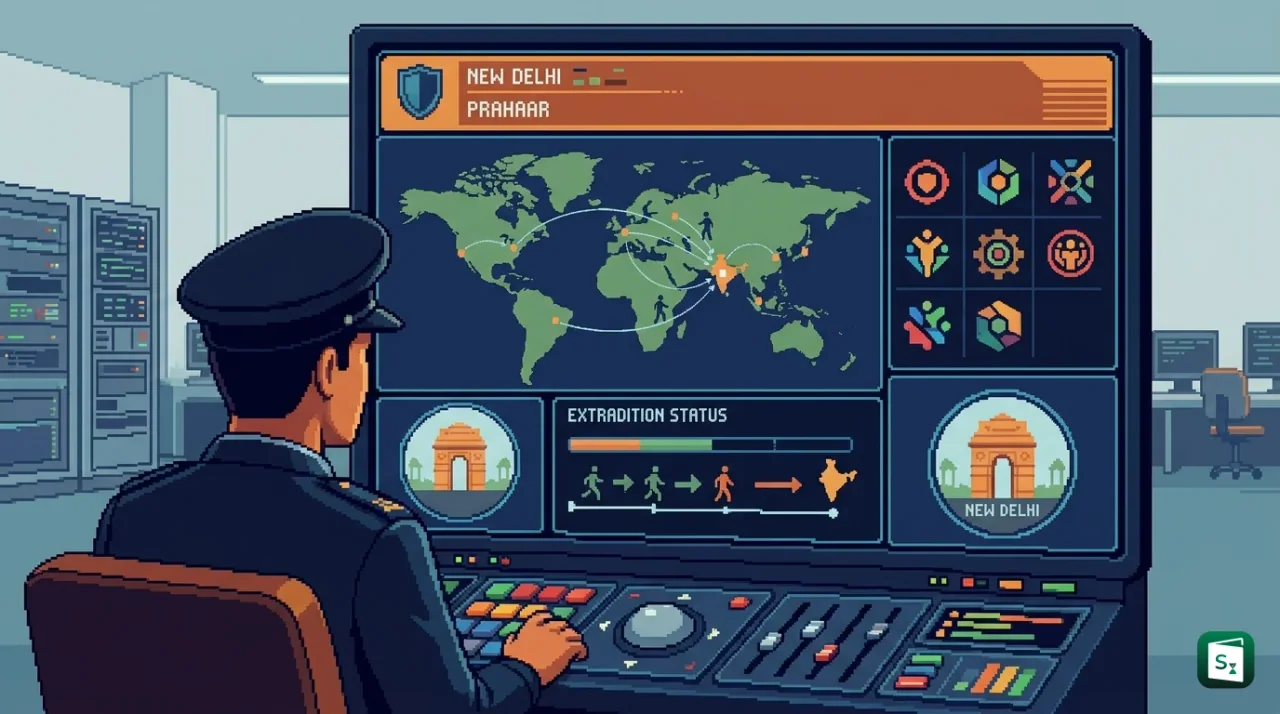
Union Home Minister Amit Shah inaugurated the Conference on PRAHAAR, Counter Terrorism Policy and Strategy on 28 September 2026 in New Delhi and launched a new Extradition Portal to bring fugitives back to India faster. The conference reviewed the seven-pillar PRAHAAR framework that guides India’s first comprehensive national counter terrorism policy, unveiled on 23 February 2026. Together, the doctrine review and the portal signal a shift to intelligence-led prevention at home and stronger legal pursuit of offenders abroad.
What is PRAHAAR?
PRAHAAR is India’s first comprehensive National Counter Terrorism Policy and Strategy, unveiled by the Ministry of Home Affairs on 23 February 2026. The eight-page policy document lays down a unified national framework to prevent terror attacks, respond to incidents and counter radicalisation through coordinated action. The word Prahaar means strike in Hindi, and each letter of the name stands for one pillar of action.
The Ministry prepared the document in consultation with the Intelligence Bureau (IB), the Research and Analysis Wing (RAW), the National Intelligence Grid (NATGRID), the National Investigation Agency (NIA) and anti-terror units of states and Union Territories. The policy states that India follows a zero-tolerance approach to all forms of terrorism and does not link terrorism to any religion, ethnicity, nationality or civilisation. It also records India’s push for a global framework that would criminalise all terrorist acts and deny funds, weapons and safe havens to terrorists and their supporters.
The conference on 28 September 2026 was the first high-level review of this doctrine after its launch. The meeting discussed how to carry the strategy down to the police station level and how to build a strong PRAHAAR mechanism for the next ten years through continuous analysis of terror incidents.
Seven Pillars of the PRAHAAR Counter Terrorism Strategy
The PRAHAAR counter terrorism strategy rests on seven linked pillars. Each pillar covers one stage of the fight against terror, from stopping an attack before it happens to helping society recover after it. The table below gives the full expansion of the PRAHAAR full form.
| Letter | Pillar | Core Aim |
|---|---|---|
| P | Prevention | Stop attacks before they happen to protect citizens and national interests |
| R | Response | Ensure swift and proportionate action when a threat or attack occurs |
| A | Aggregating Internal Capacities | Bring central and state agencies together in one coordinated system |
| H | Human Rights | Follow rule of law based processes while tackling threats |
| A | Attenuating Conditions for Terrorism | Reduce radicalisation and other conditions that breed terrorism |
| A | Aligning International Efforts | Shape global cooperation against cross-border terror |
| R | Recovery and Resilience | Rebuild quickly and make society stronger after an incident |
Prevention under PRAHAAR is intelligence-led and proactive. The Multi Agency Centre (MAC), which works under the Intelligence Bureau, acts as the nodal platform for real-time sharing of counter terror inputs across the country. The revamped MAC network, inaugurated in May 2025 at a cost of more than ₹500 crore, now links 28 organisations and connects districts across states. It uses data analytics, mapping tools and artificial intelligence techniques to spot trends and issue early warnings.
Response follows a clear chain of command. Local police act as first responders. They are backed by specialised state units such as Anti-Terrorism Squads (ATS) and, in major operations, by national forces like the National Security Guard (NSG). The Ministry of Home Affairs has issued standard operating procedures to ensure that central, state and district teams act in the same way during a crisis. At the conference, the Home Minister called for an automated counter terrorism response at every level so that no time is lost.
Aggregating capacities means modernising agencies and closing gaps between them. PRAHAAR calls for uniform anti-terror structures in states, better training, modern weapons and shared databases. The policy also pushes investment in technology and partnership with private firms to track new threats such as drones, encrypted chats, crypto wallets and dark web fundraising. Action against terror financing follows Financial Action Task Force (FATF) standards and focuses on tracing funds, seizing assets and blocking cross-border support networks.
How PRAHAAR Balances Security With Rights and Resilience
The PRAHAAR doctrine places human rights and rule of law at the centre of counter terror work. Investigations run under laws such as the Unlawful Activities (Prevention) Act (UAPA), first enacted in 1967 and amended in 2019 to allow designation of individuals as terrorists, and the NIA Act, 2008, which created the NIA after the Mumbai attacks. The policy stresses legal safeguards, multiple levels of appeal and redress for the accused, and periodic review of laws to keep powers lawful and accountable.
To attenuate conditions that feed terrorism, PRAHAAR prescribes a graded police response to radicalisation. The level of legal action depends on the degree of radicalisation. Community programmes involving doctors, psychologists, lawyers, teachers, non-governmental groups and religious leaders support de-radicalisation and reintegration. The aim is to address social and economic vulnerabilities that make young people easy targets for recruiters, and to disrupt overground worker networks and online propaganda in a sustained way.
Aligning international efforts means using treaties, intelligence exchange and joint forums to deny safe havens abroad. India continues to work with global partners to stop the misuse of information and communication technology by terror groups and to choke state-sponsored funding routes. Recovery and resilience, the final pillar, follows a whole-of-society approach. It brings government bodies, private firms and civil society together to restore normal life quickly, support victims and build local preparedness for future shocks.
What is Extradition and How Will the New Portal Speed Up Returns?
Extradition is the formal legal process by which one country hands over a person accused or convicted of a crime to another country where the crime is to be tried. The request is examined under domestic law and the treaty between the two countries before a court approves surrender and the person is brought back.
The new Extradition Portal launched at the PRAHAAR conference is designed to make this slow paperwork chain faster and better coordinated. The portal will link central agencies with state police forces on a common digital track so files, evidence bundles and assurances move without delay. The Home Minister asked every state police force to set up dedicated teams that will work with central agencies only on bringing back fugitives.
The push builds on recent numbers shared by the government. Between 2019 and 2026, India brought back 288 fugitive criminals from 36 countries. An August 2026 statement had placed the count at 274 fugitives from the same number of countries, covering terrorism, gangster networks, financial fraud, narcotics, murder and offences under the Protection of Children from Sexual Offences (POCSO) Act, 2012. Over the past three years, Red Corner Notices were issued against 401 fugitives through Interpol, with 182 notices issued in 2026 alone. Agencies also used satellite inputs, digital footprint mapping and profile matching to trace offenders who had changed names and identities abroad.
At the conference, the Home Minister also cited action against the Shahzad Bhatti network, which is involved in cross-border smuggling of weapons, explosives and narcotics. More than 40 modules of the network were busted, more than 100 FIRs were registered and 350 persons were arrested across 15 states. The network has been declared a terrorist organisation under the UAPA.
What is an Extradition Treaty?
An extradition treaty is a formal bilateral agreement between two countries that sets the crimes, evidence standards and procedures for handing over fugitives. It creates a legal duty to consider surrender requests and lays down safeguards such as proof of dual criminality and protection against trial for other offences.
India’s treaty network is managed by the Ministry of External Affairs, while the Ministry of Home Affairs and the Central Bureau of Investigation (CBI) handle investigation and coordination. The CBI, established in 1963 and headquartered in New Delhi, acts as India’s nodal bureau for Interpol. Its BHARATPOL portal links more than 1,400 units of state and central agencies and has cut the time taken for sharing inputs with Interpol channels.
The legal base for all such action is the Extradition Act, 1962, which consolidates the law on surrender of fugitive criminals. The Act defines an extradition offence and sets separate procedures for treaty states and non-treaty states. Where no bilateral treaty exists, the central government can treat a multilateral convention signed by both countries as the legal basis for extradition for offences covered by that convention.
India’s Treaty Network and Legal Safeguards
India currently has extradition treaties in force with 48 countries and extradition arrangements with 12 other countries (as listed by the Ministry of External Affairs). Treaties provide a full and speedy process. Arrangements allow cooperation on a reciprocal basis, often limited to specific crime categories such as drug trafficking under the 1988 United Nations convention. The table below shows key partners frequently cited in fugitive cases.
| Partner Country | Year of Treaty | Relevance for India |
|---|---|---|
| United States | 1997 | Covers terrorism, financial fraud and organised crime cases |
| United Kingdom | 1992 | Used in high-profile economic offender and fraud cases |
| United Arab Emirates | 1999 | Important for narcotics, smuggling and gangster cases from the Gulf |
| Bangladesh | 2013 | Key for border-linked insurgency, smuggling and terror transit cases |
Two legal principles often decide outcomes. Dual criminality means the act must be treated as a crime in both countries. Double jeopardy protection means a person already tried for the same act cannot be tried again. Many treaties also bar or limit surrender of a country’s own nationals, so each request must meet the exact evidence and assurance standards of the requested country. Requests now follow standard formats, with written assurances on prison conditions and fair trial safeguards where the foreign court asks for them.
The government has described its current method as a three-pronged approach of global outreach, strong domestic coordination and smart diplomacy. Legal reforms, use of the Prevention of Money Laundering Act, 2002 for asset seizure worth thousands of crores, use of Interpol tools and technology-led tracing have raised annual returns from an average of four per year during 2004 to 2013 to the present pace.
Whole-of-Society Approach and the Way Forward
Whole-of-society approach means countering terrorism is not the job of police and intelligence agencies alone. The PRAHAAR framework calls on ministries, state governments, local bodies, private companies, schools, media and community groups to take part in prevention, vigilance and recovery. Whole-of-government action ensures departments work as one team, while whole-of-society action adds citizens and civil groups to that team.
At the New Delhi conference, the Home Minister set the next steps clearly. He asked agencies to take PRAHAAR principles to the police station level, adopt a proactive result-oriented method for each pillar and institutionalise an automated response at every tier. He also stressed better coordination among stakeholders so that action is never delayed by file work or unclear roles. The government plans phased implementation with regular monitoring, and the annual Anti-Terror Conference organised by the NIA under the Ministry of Home Affairs will review progress, find gaps and suggest legal and institutional reforms.
Key Takeaways
- PRAHAAR is India’s first comprehensive National Counter Terrorism Policy and Strategy, unveiled on 23 February 2026 by the Ministry of Home Affairs.
- The PRAHAAR conference was inaugurated by Union Home Minister Amit Shah on 28 September 2026 in New Delhi to review the seven-pillar strategy for the next ten years.
- The seven pillars of PRAHAAR are Prevention, Response, Aggregating Internal Capacities, Human Rights, Attenuating Conditions for Terrorism, Aligning International Efforts, and Recovery and Resilience.
- A new Extradition Portal was launched at the conference to synergise central and state efforts and expedite the return of fugitives from abroad.
- India brought back 288 fugitive criminals from 36 countries between 2019 and 2026, with Red Corner Notices issued against 401 fugitives in the past three years.
- Fugitive returns in India are governed by the Extradition Act, 1962, supported by treaties with 48 countries and arrangements with 12 other countries.