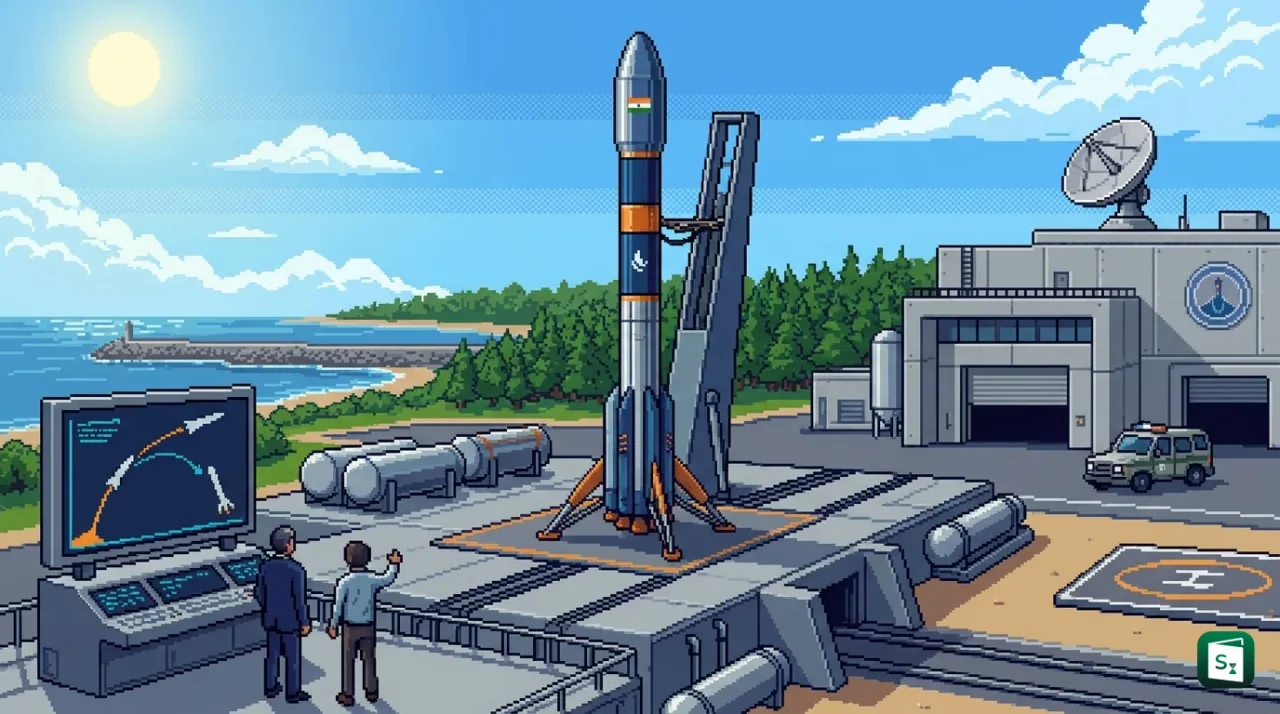
The Technology Development Board under the Department of Science and Technology signed an agreement on 25 September 2026 with Chennai based Agnikul Cosmos to develop a fully reusable version of the Agnibaan launch vehicle. The project will receive ₹200 crore through Optionally Convertible Debentures under the Research Development and Innovation (RDI) Fund. It aims to take the technology from laboratory validation to a flight ready system and cut the cost of frequent small satellite launches for India.
What Is Agnikul Cosmos?
Agnikul Cosmos Private Limited is a Chennai based private space startup incubated at the Indian Institute of Technology Madras. Founded on 1 December 2017, the company builds small satellite launch vehicles and 3D printed rocket engines. It operates from the IIT Madras Research Park and its Rocket Factory 1 in Chennai.
The company was founded by Srinath Ravichandran, Moin SPM and Professor Satyanarayanan R. Chakravarthy of the Department of Aerospace Engineering at IIT Madras. Ravichandran serves as Chief Executive Officer and Moin serves as Chief Operating Officer. The core engineering team works closely with the National Centre for Combustion Research and Development (NCCRD) at IIT Madras and is guided by former scientists of the Indian Space Research Organisation (ISRO).
Agnikul Cosmos follows a clear goal. The company wants launches to be possible from anywhere, at any time and at low cost. To achieve this, the company manufactures its engines in house using additive manufacturing, which is commonly called 3D printing. This method allows Agnikul Cosmos to produce a finished engine in days instead of many weeks. The company also built Dhanush, which is recognised as India’s first private launchpad, and a private mission control centre at the Satish Dhawan Space Centre (SDSC) in Sriharikota, Andhra Pradesh.
What Is Agnibaan and the Agnibaan Reusable Launch Vehicle?
Agnibaan is a two stage orbital class small satellite launch vehicle developed by Agnikul Cosmos. The name means arrow of fire in Sanskrit. It is designed to carry 30 kg to 300 kg payloads to low Earth orbit up to 700 km altitude. A reusable version is under development.
The standard Agnibaan is 18 metres long with a diameter of 1.3 metres and a lift off mass of about 14,000 kg. It uses liquid oxygen and kerosene based fuel. The design is modular. Agnikul Cosmos can cluster engines on the first stage in different numbers to match the weight of the satellite. The vehicle is compatible with a mobile launchpad. This allows launch from more than one site and gives customers flexibility on timing and orbit.
The heart of Agnibaan is the Agnilet engine. Agnilet is a single piece, 3D printed, semi cryogenic engine that produces about 6.2 kN of thrust. A semi cryogenic engine uses super cooled liquid oxygen combined with a refined kerosene fuel, which in this case is aviation turbine fuel. This combination gives higher efficiency than solid fuel and allows finer control over thrust. Agnikul Cosmos holds a patent for the design and manufacture of this single piece engine. The second stage uses a vacuum optimised version called Agnite, which also uses an electric pump fed system for precise fuel flow.
| Feature | Details |
|---|---|
| Vehicle type | Two stage orbital small satellite launch vehicle |
| Length and diameter | 18 metres length, 1.3 metres diameter |
| Payload capacity | 30 kg to 300 kg to low Earth orbit up to 700 km |
| Propellant | Liquid oxygen and kerosene (aviation turbine fuel) |
| Core engine | Agnilet, single piece 3D printed semi cryogenic engine |
| Upper stage engine | Agnite, vacuum optimised version |
| Launch base | Dhanush private launchpad at SDSC, Sriharikota |
Agnikul Cosmos proved its core technology with Agnibaan SOrTeD. SOrTeD stands for SubOrbital Technological Demonstrator. The mission lifted off on 30 May 2024 at 7.15 am Indian Standard Time from Agnikul Launchpad 1 at Sriharikota. The 6.2 metre tall single stage vehicle flew for about 66 seconds and validated the engine, autopilot, wind biasing and mission control systems. The flight recorded several firsts for India. It was the first launch from a private launchpad, the first flight of a semi cryogenic engine built in India and the first flight in the world with a single piece 3D printed engine.
Details of the TDB Agnikul Agreement
The Technology Development Board signed the agreement with Agnikul Cosmos Private Limited on 25 September 2026 in New Delhi. The Technology Development Board will provide ₹200 crore as financial support for the development of the Agnibaan Reusable Launch Vehicle (RLV). The support will flow through Optionally Convertible Debentures (OCD) under the Research Development and Innovation Fund. Agnikul Cosmos was among the first set of startups selected for support under this fund.
The technical goal is to advance the reusable launch architecture from Technology Readiness Level 4 (TRL-4) and above to TRL-8. Technology Readiness Level is a scale from 1 to 9 that measures how mature a technology is. Level 4 means the basic parts have been tested in a laboratory. Level 8 means the full system is complete and proven through tests in real conditions. This jump therefore marks the move from a validated concept to a flight worthy vehicle.
| Project Element | Agreed Position |
|---|---|
| Signing agencies | Technology Development Board and Agnikul Cosmos Pvt Ltd, Chennai |
| Agreement date | 25 September 2026 |
| Financial support | ₹200 crore |
| Funding instrument | Optionally Convertible Debentures |
| Funding umbrella | Research Development and Innovation Fund |
| Technology target | Agnibaan Reusable Launch Vehicle with full system reusability |
| Maturity target | From TRL-4 and above to TRL-8 |
The project aims for full system reusability rather than recovery of only the first stage. Most operational reusable rockets today bring back only the booster. The upper stage is discarded after placing the satellite in orbit. The Agnibaan RLV programme will develop a reusable upper stage architecture along with a descent propulsion system. This includes engines that can restart in flight and reduce thrust precisely during descent, which engineers call deep throttling. These abilities are essential for slowing the vehicle, guiding it back and landing it safely. The programme will also validate technologies for ascent, orbital insertion, controlled descent and recovery as one integrated system. The design is meant to support high frequency and repeatable launches, lower manufacturing and launch costs and reduce space debris.
What Is the RDI Fund?
The Research Development and Innovation Fund is India’s ₹1 lakh crore fund to back private research in sunrise and strategic sectors. It is housed as a Special Purpose Fund under the Anusandhan National Research Foundation. It offers low cost loans and equity for technologies at TRL-4 and above.
The Union Cabinet approved the Research Development and Innovation Scheme on 1 July 2025 with a total outlay of ₹1 lakh crore over six years. An amount of ₹20,000 crore was earmarked for 2025-26. The Prime Minister launched the fund at the Emerging Science Technology and Innovation Conclave in November 2025 as part of the vision for a developed India by 2047. The fund does not give grants or short term loans. It provides long tenure loans at low or nil interest, equity infusion for startups and support for deep tech funds. Support can cover up to 50 percent of the assessed project cost.
The fund works through a two tier structure. The corpus sits with the Anusandhan National Research Foundation (ANRF) as the first level custodian. ANRF is India’s apex body for research funding, established through the ANRF Act of 2023. Funds then flow through Second Level Fund Managers. These managers include the Technology Development Board, the Biotechnology Industry Research Assistance Council, alternative investment funds and non banking finance companies. The Technology Development Board acts as the manager for projects across sunrise and strategic sectors, while the biotechnology council handles biotechnology and allied areas.
Funding Through Optionally Convertible Debentures
Optionally Convertible Debentures are a type of loan instrument that can later be converted into company shares at the choice of the investor. In simple terms, the government first gives the money as a loan. Later, it can choose to keep it as a loan with interest or convert part of it into ownership in the company. This structure shares risk. The startup gets long term capital without immediate pressure to repay, while the public funder retains a chance to benefit if the technology succeeds commercially. The first Technology Development Board call under this fund offered collateral free financing, tenures up to 15 years, interest in the range of 2 to 4 percent and approvals targeted within eight weeks.
Institutional Framework: Technology Development Board, DST and ANRF
The Technology Development Board is a statutory body under the Department of Science and Technology (DST). Parliament created the board through the Technology Development Board Act, 1995, and the board started functioning on 1 September 1996. Its mandate is to support Indian industry in developing and using indigenous technology on a commercial scale and in adapting imported technology for wider domestic use. The board has 11 members and provides equity, soft loans and, in exceptional cases, grants. This is the first organisation within the government created with the sole aim of converting research results into commercial products and services.
The Department of Science and Technology is the nodal department for science policy, research promotion and technology development in India. The Anusandhan National Research Foundation, where ANRF is the short form for Anusandhan National Research Foundation, acts as the apex research funding body and holds the Research Development and Innovation corpus. Under this arrangement, the Technology Development Board functions as a Second Level Fund Manager. It identifies eligible technology entities, which are Indian companies working on research intensive technology at TRL-4 and above, and channels fund support to them after scientific, financial and commercial evaluation. The Secretary of the Technology Development Board is Rajesh Kumar Pathak (as of September 2026). The board had earlier supported Agnikul Cosmos for the development of a modular launch vehicle for small satellites. The present agreement extends that partnership from an expendable vehicle to a reusable system.
Reusable Launch Vehicle Technology Explained
A reusable launch vehicle is a rocket system designed to be recovered after flight and flown again with limited repair. A conventional expendable rocket is used once. Its stages fall into the ocean or burn up after placing the satellite in orbit. A reusable system returns its booster or upper stage to Earth, lands it and prepares it for the next mission. This reduces the need to build a new rocket for every launch and allows faster turnaround between missions.
Reusability demands four linked abilities. The engine must restart in space and vary thrust with high precision. The guidance system must steer the stage back through the atmosphere. The structure must survive heat and mechanical stress during re-entry. The landing system, which includes legs, fins and navigation sensors, must place the vehicle safely on land or on a sea based platform. Agnikul Cosmos is developing these abilities through a reusable upper stage, a descent propulsion system and software that synchronises multiple electric motor driven pumps. The company tested a cluster of three semi cryogenic engines in February 2026 and test fired the larger Agnite booster engine in March 2026 to validate this approach.
India’s national programme provides important context. The Indian Space Research Organisation is developing reusability through the Reusable Launch Vehicle Technology Demonstration Programme. The winged demonstrator, named Pushpak, completed three landing experiments between April 2023 and June 2024 at the Aeronautical Test Range in Chitradurga, Karnataka. In these tests, the vehicle was dropped from an Indian Air Force Chinook helicopter at 4.5 km altitude and landed autonomously on a runway. ISRO is also developing the Next Generation Launch Vehicle (NGLV), a much larger rocket planned to carry up to 30 tonnes to low Earth orbit with a reusable first stage. While ISRO focuses on heavy lift and runway landing, Agnikul Cosmos focuses on small payloads and vertical powered landing of the booster on a barge in the Bay of Bengal.
Private Space Companies in India: Agnikul, Skyroot and the New Race
Private space companies in India have grown rapidly after the space reforms of 2020. The Indian Space Policy 2023 opened the full space value chain to private participation. The Indian National Space Promotion and Authorisation Centre (IN-SPACe), headquartered in Ahmedabad, works as a single window agency to authorise private missions, share ISRO facilities and transfer technology. By June 2026, IN-SPACe had registered more than 4,500 organisations and signed over 100 memoranda of understanding with private entities. The foreign direct investment rules were also eased to allow up to 49 percent automatic investment in launch vehicles and up to 74 percent in satellite manufacturing.
Two startups lead the small satellite launch segment. Agnikul Cosmos in Chennai builds the Agnibaan family with liquid propulsion and 3D printed engines. Skyroot Aerospace in Hyderabad builds the Vikram series of rockets with solid propulsion and carbon composite structures. Skyroot Aerospace conducted the suborbital Vikram-S flight in November 2022 and achieved the orbital launch of Vikram-1 from Sriharikota on 18 July 2026. Vikram-1 can place up to 350 kg into low Earth orbit. Both companies now aim for reusability. Agnikul Cosmos plans to recover the first stage booster on its next orbital mission while keeping the upper stage in space as a revenue earning platform. Skyroot Aerospace has announced work on a fully reusable vehicle covering both booster and upper stage.
| Aspect | Agnikul Cosmos and Agnibaan | Skyroot Aerospace and Vikram |
|---|---|---|
| Headquarters | Chennai, Tamil Nadu, incubated at IIT Madras | Hyderabad, Telangana |
| Flagship orbital vehicle | Agnibaan, 30 kg to 300 kg to 700 km orbit | Vikram-1, up to 350 kg to low Earth orbit |
| Propulsion approach | Liquid oxygen and kerosene, 3D printed Agnilet and Agnite engines | Solid fuel boosters with 3D printed liquid upper stage engine |
| Key milestone | SOrTeD suborbital flight on 30 May 2024 from private launchpad | Vikram-S suborbital flight in 2022, Vikram-1 orbital flight in July 2026 |
| Reusability path | Full system focus with reusable upper stage and barge landing of booster | Fully reusable booster and upper stage under development |
The Small Satellite Launch Vehicle (SSLV), developed by ISRO for payloads up to 500 kg, forms the public sector benchmark in this class. In February 2026, the SSLV technology was transferred to Hindustan Aeronautics Limited in a ₹511 crore deal for industry led production. The Agnikul Cosmos programme therefore sits within a wider shift where public agencies develop core technologies and private firms take them to commercial operations.
Why This Agreement Matters for India
The Technology Development Board agreement gives long term capital to a technology that private venture funding alone struggles to support. Reusable rockets need years of testing, large test facilities and repeated design changes. A ₹200 crore commitment through Optionally Convertible Debentures allows Agnikul Cosmos to sustain this cycle without diluting early ownership. This model of public risk sharing for deep tech development is central to the Research Development and Innovation Fund.
The economic stakes are direct. Global demand for small satellite launches is rising for communication, earth observation and navigation services. A low cost reusable vehicle allows India to offer frequent and affordable rideshare and dedicated launches. Faster turnaround and lower manufacturing costs improve commercial viability. A recoverable upper stage also limits orbital debris, which protects valuable orbital slots.
The strategic value lies in self reliance for access to space. Dependable domestic launch capacity reduces the need to book foreign rockets for Indian satellites. It also builds industrial skills in propulsion, guidance, materials and mission software within the country. If the Agnibaan Reusable Launch Vehicle reaches operational status, India will join a small group of countries demonstrating full system reuse in the small lift class and strengthen its position in the global commercial launch market.
Key Takeaways
- The Technology Development Board signed an agreement on 25 September 2026 with Agnikul Cosmos Pvt Ltd for the Agnibaan Reusable Launch Vehicle.
- The project will receive ₹200 crore through Optionally Convertible Debentures under the Research Development and Innovation Fund.
- The goal is to advance the technology from TRL-4 to TRL-8 with focus on full system reusability including a reusable upper stage.
- Agnikul Cosmos, founded on 1 December 2017 at IIT Madras, built the Agnilet single piece 3D printed semi cryogenic engine.
- The Agnibaan SOrTeD demonstrator flew successfully on 30 May 2024 from India’s first private launchpad Dhanush at Sriharikota.
- The RDI Fund has a corpus of ₹1 lakh crore, was approved on 1 July 2025, and is housed under the Anusandhan National Research Foundation with TDB as Second Level Fund Manager.