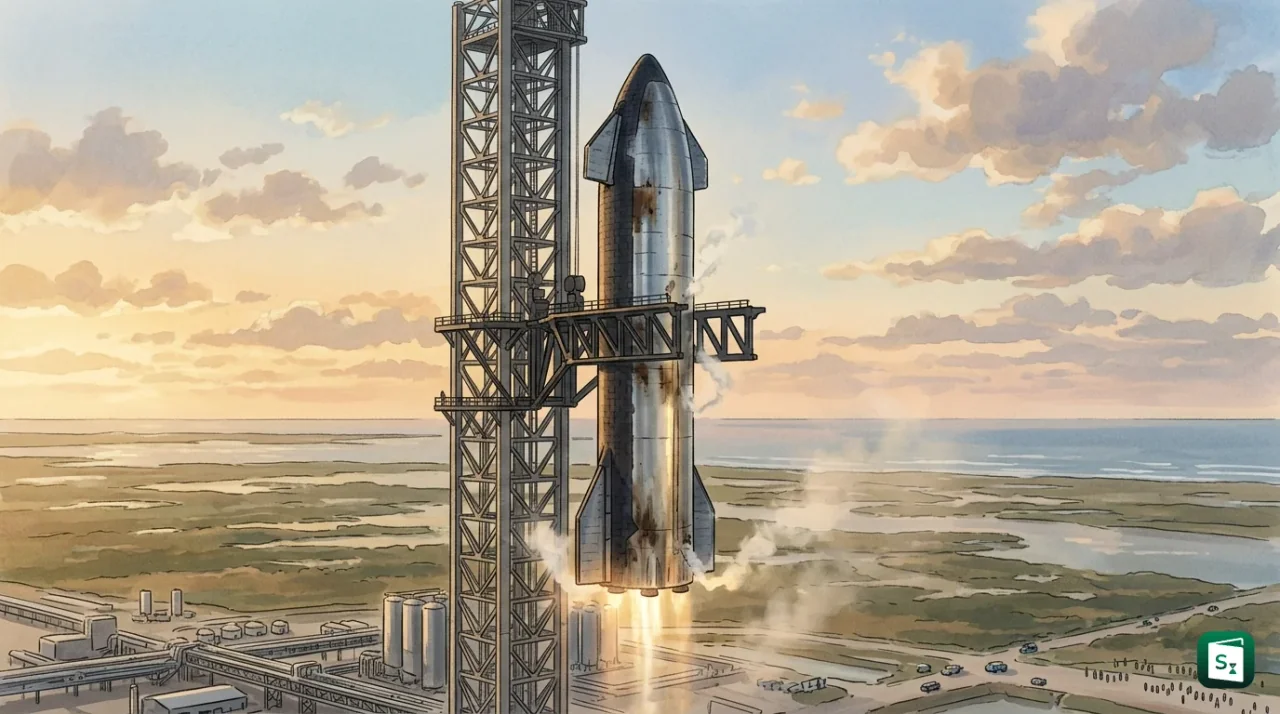
SpaceX caught its Starship upper stage Ship 42 with the Mechazilla launch tower arms at Starbase, Texas, on 14 November 2026. Ship 42 had lifted off on Flight 15 on 13 November, circled Earth 14 times and deployed 26 Starlink V3 satellites. It is the first mid air recovery of an orbital upper stage.
What Is Starship and How Does It Work?
Starship is the spacecraft and upper stage of the SpaceX Starship system. The full system has two parts that launch together. The lower part is the Super Heavy booster. The upper part is the Ship, which carries satellites, cargo or crew.
SpaceX stands for Space Exploration Technologies Corporation. The company was founded in 2002 by Elon Musk and is headquartered in Texas, USA. It developed Starship as a fully reusable transport system for Earth orbit, the Moon and Mars.
The current V3 version of Starship is about 124 metres tall and 9 metres wide. This makes it the largest and most powerful rocket ever built. Super Heavy uses 33 Raptor engines. Ship uses 6 Raptor engines, including three sea level engines and three vacuum engines for space. All Raptor engines burn liquid methane and liquid oxygen.
Starship is designed to carry more than 100 tonnes to low Earth orbit in reusable form. No other orbital rocket reuses both its stages. The American Saturn V, the Space Launch System and the Falcon 9 either discard their upper stages or use them only once. Starship aims to land both stages, inspect them quickly and fly them again.
What Happened During the First Mid Air Recovery of Ship 42?
SpaceX launched Flight 15 from Pad 2 at Starbase in South Texas at 4:47 pm local time on 13 November 2026. The mission used Ship 42 on top of Super Heavy Booster 22. The plan was bold. SpaceX wanted to catch both the booster and the Ship back at the launch site.
The booster part did not succeed. About six and a half minutes after liftoff, Super Heavy showed a low fuel mass alarm during its return burn. The onboard guidance system aborted the tower catch on its own. The booster diverted to the Gulf of Mexico, where it broke apart before splashdown. SpaceX had already caught Super Heavy three times on earlier flights, but the V3 booster has yet to be caught successfully.
Ship 42 continued alone. The Ship entered low Earth orbit at an altitude of about 265 kilometres. It deployed 26 Starlink V3 satellites. Then it began a long coast phase.
The Ship completed 14 orbits over about 22.5 hours. Flight controllers set three safety checkpoints during the flight. At each point, SpaceX could have diverted the Ship to an ocean splashdown near Hawaii or off Chile. The Ship passed all checks, including fresh images of its heat shield sent by cameras on the deployed Starlink satellites.
On 14 November, SpaceX fired a single Raptor engine to leave orbit. Ship 42 reentered over the Pacific, flew across northern Mexico and South Texas, moved out over the Gulf and then lined up with Starbase from the sea side. It appeared through the clouds over the tower at about 3:20 pm local Texas time and settled gently between the tower arms.
How the Mechazilla Tower and Chopsticks Catch Works
Mechazilla is the tall launch and catch tower at Starbase. The steel structure is about 146 metres tall. Two large mechanical arms, called Chopsticks, slide up and down on the tower. The arms act like hands that grab the returning vehicle in the air.
Starship is designed to be fully reusable without landing legs. That is the key idea. Both Super Heavy and Ship have no landing legs. Legs add weight and need a flat landing pad. By catching the vehicles on the tower, SpaceX saves that weight and puts the rocket straight back on its launch mount for inspection and refuelling.
The catch sequence for Ship 42 lasted only seconds. The Ship fell belly first to slow down in the air. Then it lit three sea level Raptor engines, tucked in its flaps and flipped from horizontal to vertical. The engines throttled down from three to two and then to one as the Ship slowed to a hover. The Ship moved sideways between the open arms.
Two small catch pins below the forward flaps of the Ship took the load. The arms closed around them. The last engine shut off only after the tower sensed contact. The whole powered phase, from engine lighting to catch, took about 18 seconds. Ship 42 hung motionless in the arms overnight while engineers inspected it. SpaceX later lowered it and moved it to the hangar for detailed checks.
Why Catching the Ship Is Tougher Than Catching the Booster
Whether Starship is fully reusable depends on which part is discussed. The booster is already partly proven. SpaceX had caught Super Heavy three times before Flight 15 and has reflown two older boosters. The Ship had never been caught before Flight 15.
The difference is speed and heat. The booster separates about two and a half minutes after liftoff and never reaches full orbital speed. It turns back quickly. The Ship goes all the way to orbit at about 27,400 kilometres per hour. To come home, it must survive a fiery reentry.
The Ship reenters belly first at an angle of about 60 to 70 degrees. Four steel flaps steer it like a skydiver uses arms and legs. The wide body creates drag and slows the vehicle without using fuel. The windward side faces temperatures near 1,377 degrees Celsius. Protection comes from about 18,000 hexagonal ceramic tiles fixed to a stainless steel body.
Earlier flights lost many tiles. On Flight 13 in July 2026, the Ship survived to splashdown in the Indian Ocean with far less tile damage, which gave SpaceX confidence to try a tower catch. On Flight 15, the tiles held well enough for the Ship to stay healthy for landing. SpaceX aims for a heat shield that needs no repair between flights, but engineers say more flights and inspections are still needed.
What Ship 42 Did in Orbit: 14 Rounds and 26 Starlink Satellites
Starlink is the satellite internet constellation built by SpaceX. The network uses thousands of small satellites in low Earth orbit to provide broadband internet to user terminals on the ground. By November 2026, more than 11,100 satellites were in orbit and the service had over 13 million subscribers.
Ship 42 carried 26 Starlink V3 satellites. V3 is the third and largest generation of Starlink satellites. Each V3 satellite adds about 1 terabit per second of capacity. A single Starship launch with 26 V3 satellites carries as much capacity as about 10 Falcon 9 launches with older V2 Mini satellites.
The deployment took about 30 minutes. Three of the satellites carried extra cameras. The cameras photographed the heat shield of Ship 42 while it was in orbit. Those images, along with ground tracking, helped flight controllers clear the Ship for a tower catch instead of an ocean splashdown.
Flight 15 was only the second Starship flight to reach orbit. Flight 14 on 28 September 2026 was the first. Flight 14 also deployed 26 V3 satellites but ended early after about three hours with a Pacific splashdown because of an engine issue. Flight 15 more than tripled that endurance, staying in space for 22.5 hours and completing 14 full orbits.
Starship Height, Payload, Cost and Heat Shield in Numbers
The table below gives the basic facts that matter for recall.
| Feature | Detail |
|---|---|
| Full stack height | 124 metres (about 407 feet) for V3 |
| Ship height alone | 52 metres (about 171 feet) |
| Diameter | 9 metres for both stages |
| Liftoff thrust | More than 80 meganewtons, about twice the Space Launch System |
| Engines | 33 Raptor engines on Super Heavy, 6 Raptor engines on Ship |
| Fuel | Sub cooled liquid methane and liquid oxygen |
| Payload to low Earth orbit | 100 tonnes or more in reusable form, up to 60 Starlink V3 satellites in future |
| Heat shield | About 18,000 hexagonal tiles plus a felt layer and backup layer |
| Launch tower height | 146 metres |
| Flight 15 duration | 22.5 hours, 14 orbits, 26 satellites deployed |
| Starship cost per launch | SpaceX has not published a fixed price. The design goal is a much lower cost per tonne than Falcon 9 through rapid reuse |
SpaceX used the Indian Ocean on earlier flights because the zone was empty and safe for testing reentry, the belly flop and the landing flip without risk to people or the launch site.
Why Full Reusability Matters for the Moon, Mars and Starlink
The date for a Starship flight to Mars is not fixed, but SpaceX links the tower catch directly to that goal. A fully reusable Starship can fly often, like an aircraft. Rapid inspection and refuelling at the same pad cuts cost and waiting time. Without reuse of the Ship, every mission would throw away the most valuable part of the rocket.
The near term use is Starlink. SpaceX has applied for up to 100,000 third generation satellites. Building that network needs many heavy launches. Twenty six V3 satellites per Starship flight already matches many Falcon launches. Regular Ship recovery would let SpaceX increase that rate to about one flight per week in 2027.
The longer term use is the Moon. NASA has selected a version of Starship as the lander for the Artemis programme, which plans to return astronauts to the Moon. Missions beyond low Earth orbit also need orbital refuelling, where one Starship refills another in orbit. That technique has not yet been tested. SpaceX points to early 2027 for refuelling tests and for the first reflight of a caught Ship.
The booster abort on Flight 15 shows that full reusability is not yet routine. Engineers are studying the low fuel alarm and early engine shutdown on Booster 22. The Ship catch proves the harder half of the system can be brought home. The next proof must be flying Ship 42, or another caught Ship, a second time without major repairs.
Key Takeaways
- SpaceX caught Ship 42 with Mechazilla chopsticks at Starbase, Texas, on 14 November 2026, the first mid air recovery of an orbital upper stage.
- The Flight 15 mission lifted off on 13 November 2026, completed 14 Earth orbits in 22.5 hours and deployed 26 Starlink V3 satellites.
- The full V3 Starship is 124 metres tall, uses 33 Raptor engines on Super Heavy and 6 Raptor engines on Ship, and lifts more than 100 tonnes to orbit.
- The Ship reenters belly first, protected by about 18,000 hexagonal ceramic tiles, and flips vertical for the tower catch in about 18 seconds.
- The Super Heavy Booster 22 catch was aborted due to a low fuel alarm and ended in a Gulf of Mexico splashdown, while full reuse supports Artemis Moon missions and the Starlink network.