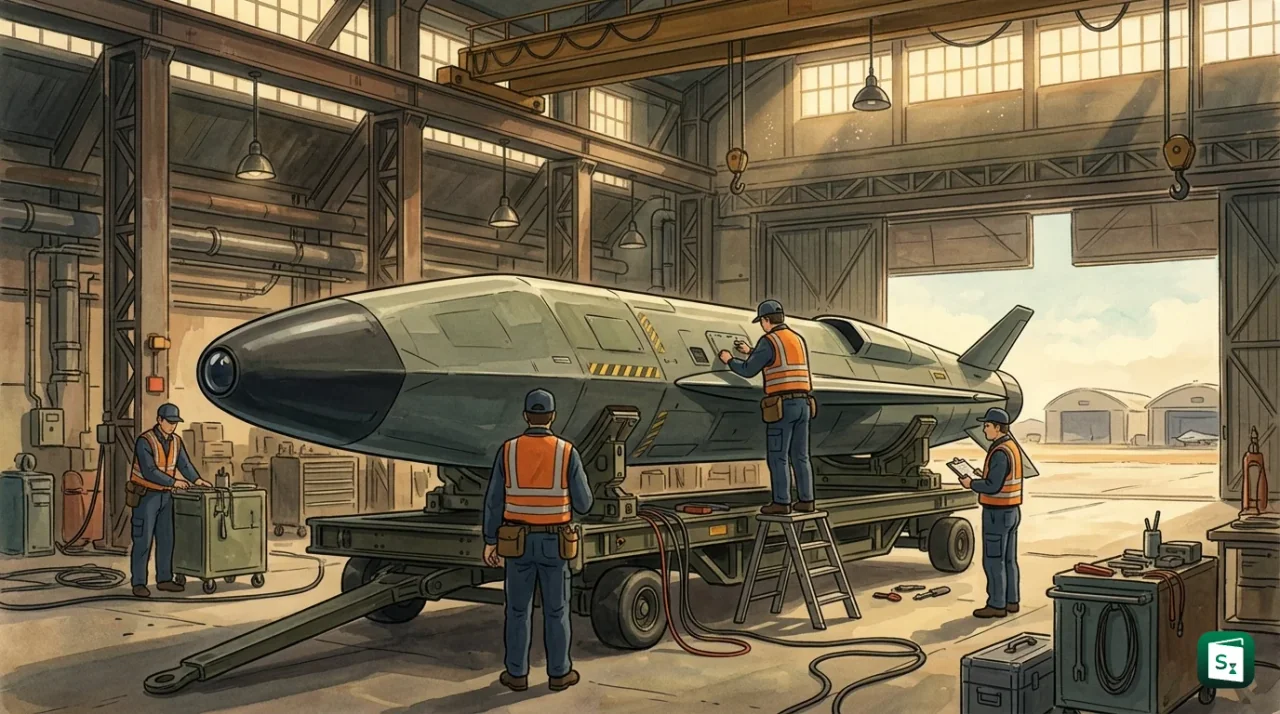
Israel’s Rafael Advanced Defense Systems unveiled SUPER ICE, a new long range cruise missile, on 11 November 2026. The missile carries a 1000 pound (454 kg) MK83 compatible warhead, four times heavier than the 250 pound warhead of its predecessor ICE BREAKER. It can be launched from air, land and sea platforms and is built for long range stand off strikes against high value targets.
What Is a Cruise Missile and How Does It Work?
A cruise missile is an unmanned, self propelled guided weapon that stays inside the atmosphere for most of its flight and uses wings to generate lift like a small airplane. It uses a jet engine for continuous power, flies at low altitude to avoid radar, and follows a pre planned route to hit a target with high precision.
Most cruise missiles use a turbojet or turbofan engine and fly at high subsonic speed. They stay low, often just tens of metres above land or sea. This terrain following and sea skimming flight hides them behind hills and below the view of ground radar, though it burns more fuel than high altitude flight.
Guidance usually combines several systems. Inertial navigation keeps the missile on course, terrain contour matching compares the ground below with stored maps, and satellite navigation provides position updates. Near the target, a seeker takes over. SUPER ICE uses an electro optical imaging infrared seeker with scene matching, which compares live images with stored images to recognise the target even in all weather conditions.
What Is the New SUPER ICE Cruise Missile?
SUPER ICE is a long range, precision guided cruise missile developed by Rafael as an expanded version of the ICE BREAKER family. Rafael presented it on 11 November 2026 as a weapon for complex missions against targets of strategic value at long operating ranges. Company officials described it as a strategic system with extended range and high accuracy.
The missile is noticeably larger and heavier than earlier members of the family. Its size is now comparable to the American Tomahawk cruise missile. Rafael has not disclosed its exact range, speed or price, citing operational secrecy, but has said its range will be longer than the 300 km range of ICE BREAKER and SEA BREAKER and that its price is highly competitive.
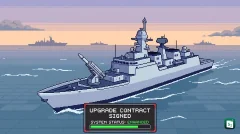
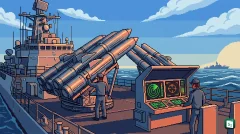
SUPER ICE is designed to hit hardened bunkers, ballistic missile launch sites, air defence systems and large naval vessels. It can fly from fighter aircraft, ground launchers and ships without major changes to the platform. This flexibility lets a customer choose air, sea or land launch while using the same mission planning and logistics system.
How SUPER ICE Compares With ICE BREAKER and SEA BREAKER
SUPER ICE joins Rafael’s existing pair of fifth generation cruise missiles. All three share stealth shaping, autonomous navigation and mission planning software, which lowers training and life cycle cost. The main difference is striking power and size.
| Feature | SEA BREAKER | ICE BREAKER | SUPER ICE |
|---|---|---|---|
| Introduced | June 2021 | July 2022 | November 2026 |
| Primary role | Sea and land strike from ships and ground launchers | Air launched land and sea strike | Multi platform land, sea and air strike |
| Length and weight | About 4 metres, less than 400 kg | About 4 metres, less than 400 kg | Larger and heavier, close to Tomahawk class |
| Warhead | 250 pound penetration, blast and fragmentation warhead | 250 pound penetration, blast and fragmentation warhead | 1000 pound MK83 compatible multi purpose warhead |
| Range | Up to 300 km | Up to 300 km | Longer than 300 km, exact figure withheld |
| Speed | High subsonic | High subsonic | High subsonic |
| Seeker | Imaging infrared with AI scene matching and automatic target recognition | Imaging infrared with AI scene matching and automatic target recognition | Advanced electro optical seeker with high accuracy image matching |
ICE BREAKER is effectively the air launched version of SEA BREAKER, without the booster and launch canister. An F-16 can carry four ICE BREAKER missiles, while an F-15 can carry five. SUPER ICE keeps compatibility with the same launch systems, mission planning infrastructure and logistics, so existing users can add the heavier missile without building a new support chain.
How SUPER ICE Finds Its Target Without GPS
SUPER ICE is built to operate where satellite navigation is jammed and air defences are dense. Rafael describes the missile as GNSS independent and resilient to electronic warfare. It navigates on its own using inertial sensors and terrain comparison, then flies very low to follow the shape of the land or skim the sea surface.
Key features reported by the company include:
- Very Low Observable shaping with a faceted airframe that reduces radar reflection
- Terrain following and sea skimming flight at low altitude to stay below radar cover
- Electro optical homing that uses image matching to identify the target in the final phase
- Artificial intelligence for automatic target acquisition and automatic target recognition, which helps distinguish a warship from a nearby civilian vessel
- All weather operation in day and night conditions
- Two way data link that lets an operator update the mission in flight, abort the strike or collect battle damage information
- Salvo capability, where several missiles attack from different directions at the same time to defeat air defence systems
The missile can complete a mission fully autonomously, while retaining a human in the loop for backup decisions when required.
Why the 1000 Pound MK83 Compatible Warhead Matters
The warhead is the biggest change in SUPER ICE. At 1000 pounds (454 kg), it is four times heavier than the 250 pound (113 kg) warhead on ICE BREAKER and SEA BREAKER. The earlier 250 pound warhead was designed for low collateral damage and could neutralise a frigate sized ship with a single hit. The heavier warhead extends that lethality to hardened and strategic targets such as bunkers, missile sites and large vessels.
MK83 compatible means the warhead matches the size and class of the American Mark 83 general purpose bomb. The Mark 83 is a 1000 pound low drag bomb with a steel casing and about 202 kg of high explosive. It forms the basis for guided weapons such as the GBU-16 Paveway laser guided bomb and the GBU-32 JDAM. Compatibility signals that SUPER ICE can integrate with aircraft that already carry this class of weapon, including types such as F-15, F-16, Tornado and Typhoon, and that it delivers destructive power in the same class as the Tomahawk, which also carries a 1000 pound class warhead.
Who Makes the Missile: Rafael Advanced Defense Systems
Rafael Advanced Defense Systems is an Israeli state owned defence company headquartered in Haifa, Israel. It was established in 1948 as the Science Corps of the Israel Defense Forces and later became the Armament Development Authority. In 2002 it was incorporated as a government owned limited company.
Rafael builds a wide range of air, land, naval, space and digital systems. Its best known products include the Iron Dome air defence system, the Spike family of guided missiles and the Spice guided bomb kits. The ICE BREAKER family draws directly on that experience in electro optics, computer vision and precision guidance. The Air Systems Division, led by Senior Vice President Gad Geva, developed SUPER ICE for integration across many aerial platforms and for launch from sea and ground launchers.
Cruise Missile vs Ballistic Missile
Readers often compare the two main types of long range missiles. The difference lies in how they fly, not only in how far they travel.
| Aspect | Cruise Missile | Ballistic Missile |
|---|---|---|
| Propulsion | Powered by a jet engine for the whole flight | Powered by rockets at launch, then follows an unpowered arc |
| Flight zone | Stays inside the atmosphere | Climbs high and may exit the atmosphere, then re enters |
| Path | Low, guided and manoeuvrable, can change direction | High arching trajectory governed mainly by gravity after boost |
| Altitude | Very low, terrain following or sea skimming | Very high, with boost, midcourse and terminal phases |
| Detection | Hard to detect because it hides below radar | Easier to detect at long range, but very fast in terminal phase |
| Example | SUPER ICE, BrahMos, Tomahawk, Nirbhay, SCALP | Agni, Prithvi |
In short, a cruise missile flies like a small airplane while a ballistic missile flies like a thrown object that is first pushed upward by rockets and then falls toward its target.
Where SUPER ICE Fits Among BrahMos, Nirbhay, Tomahawk and SCALP
SUPER ICE enters a field dominated by a few well known cruise missiles. Placing it beside them helps show what is new and what is familiar.
BrahMos is a supersonic cruise missile developed jointly by India and Russia. It flies at about Mach 2.8, far faster than the high subsonic speed of SUPER ICE, and newer versions extend its range beyond 400 km. Nirbhay is India’s indigenous subsonic cruise missile with a range of about 1000 km, designed for land, sea and air launch.
The American Tomahawk is the closest comparison in size and warhead. It carries a 1000 pound class warhead, flies at about 880 km per hour and reaches about 1600 km in its Block IV version. The French and British SCALP, also known as Storm Shadow, is a long range air launched cruise missile with a range of more than 250 km and a heavy warhead for hardened targets.
SUPER ICE therefore sits between the light 250 pound class of its own predecessors and the heavy long range class of Tomahawk and Nirbhay. Its selling point is not top speed or maximum range, but stealth, AI based image matching without satellite help, and shared launch and planning infrastructure with ICE BREAKER and SEA BREAKER.
Key Takeaways
- Rafael unveiled the SUPER ICE cruise missile on 11 November 2026 as a long range weapon for air, land and sea launch.
- SUPER ICE carries a 1000 pound (454 kg) MK83 compatible warhead, four times heavier than the 250 pound warhead of ICE BREAKER.
- ICE BREAKER and SEA BREAKER have a range of up to 300 km, while SUPER ICE is stated to have a longer range that remains undisclosed.
- The missile uses imaging infrared seekers, AI based scene matching and Very Low Observable shaping to operate in GNSS denied and heavily defended airspace.
- Rafael Advanced Defense Systems, established in 1948 and headquartered in Haifa, also builds the Iron Dome, Spike and Spice systems.