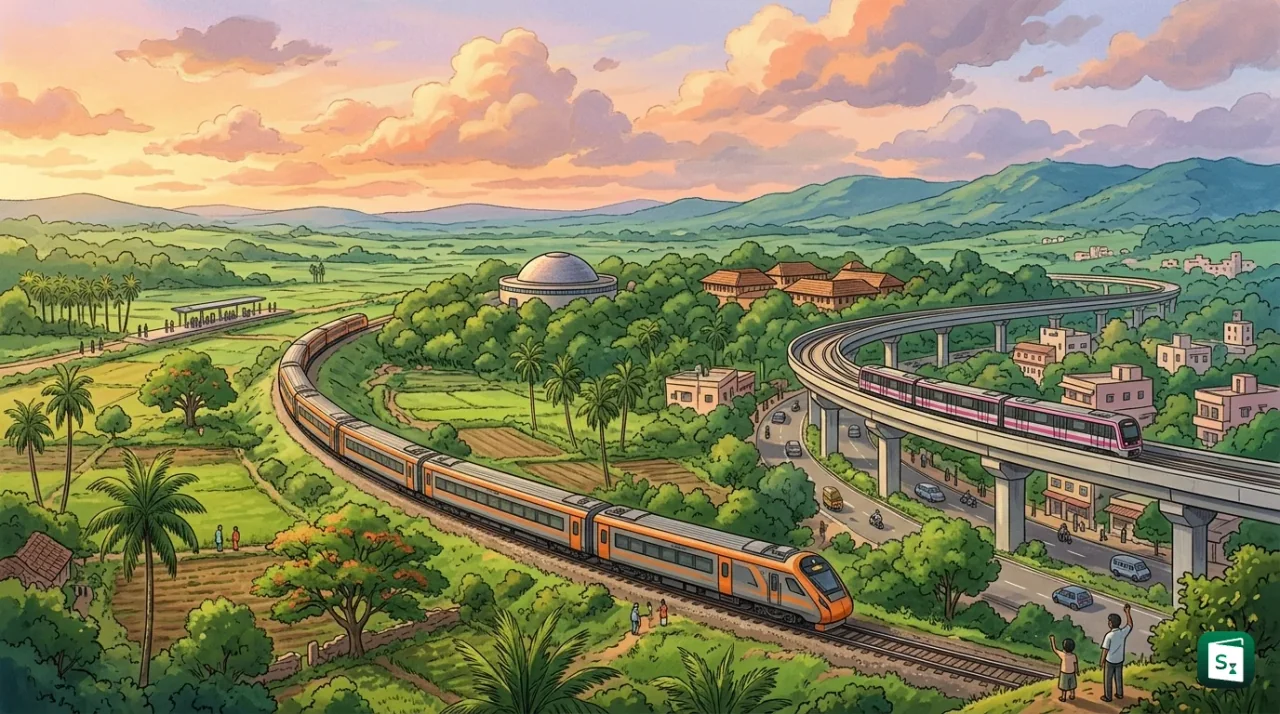
Prime Minister Narendra Modi inaugurated and flagged off development projects worth over ₹15,600 crore in Bengaluru on 13 November 2026. The projects span urban mobility, rail travel, energy security, yoga education and space outreach across Karnataka. The centrepiece was the opening of the first elevated stretch of the Bengaluru Metro Pink Line along with the new Bengaluru Mangaluru Madgaon Vande Bharat Express.
Bengaluru Metro Pink Line: Route, Stations and Opening Date
The Bengaluru Metro Pink Line is a 21.25 km north south corridor of Namma Metro that will link Kalena Agrahara in the south to Nagawara in the north. The full line will have 18 stations, with 6 elevated stations in the south and 12 underground stations through the city centre. Prime Minister Modi opened the first operational part of the line on 13 November 2026. It is a 7.5 km elevated stretch from Kalena Agrahara to Tavarekere, also called S G Palya, built at a cost of about ₹3,470 crore.
The six stations on the opened stretch are Kalena Agrahara, Hulimavu, Bilekahalli IIMB, N S Palya J P Nagar 4th Phase, Jayadeva Hospital and S G Palya. The Bangalore Metro Rail Corporation Limited (BMRCL) is the agency that builds and runs Namma Metro. BMRCL started commercial services on this stretch on 14 November 2026 with five train sets. Fares on the new stretch range from ₹10 to ₹30.
The Pink Line is part of Namma Metro Phase 2, which was approved by the state in 2011 and by the central government in 2014. Japan International Cooperation Agency (JICA) has supported Phase 2 construction through an official development loan for signalling, rolling stock and consulting services. The Jayadeva Hospital station is important because it connects the Pink Line with the Yellow Line. It has become the third interchange in the city after Majestic and R V Road, and it also includes a double decker flyover.
The rest of the Pink Line is a 13.76 km underground section from Dairy Circle to Nagawara. Tunnelling on this section is complete, and BMRCL is now fitting electrical systems, platform screen doors and station interiors. BMRCL has sought safety clearance to start trial runs up to Shivajinagar, and the underground section is expected to open in 2027.
Is the Pink Line Open in Bengaluru
Yes. The elevated part of the Pink Line between Kalena Agrahara and S G Palya is now open to the public. Trains run at 8 minute gaps during peak hours on weekdays and at 10 minute gaps at other times. The remaining underground part to Nagawara is still under construction and is not yet open.
With this opening, the operational metro network in Bengaluru has crossed 100 km and reached about 103 km. Bengaluru has thus become the third urban region in India to cross the 100 km mark after Delhi NCR and the Mumbai region. Namma Metro had a length of only about 17 km in 2014, so this marks a six fold expansion in twelve years.
Bengaluru Mangaluru Madgaon Vande Bharat Express: Route and Timings
Prime Minister Modi flagged off the Yesvantpur Mangaluru Madgaon Vande Bharat Express on the same day. The train runs as 26655 from Yesvantpur to Madgaon and as 26656 on the return leg. It connects Bengaluru with coastal Karnataka and Goa. Regular services started on 15 November 2026.
The train covers 671 km with 12 intermediate stops. The stops are Shravanabelagola, Hassan, Sakleshpur, Subrahmanya Road, Kabaka Puttur, Mangaluru Junction, Udupi, Kundapura, Mookambika Road Byndoor, Murdeshwar, Gokarna Road and Karwar. The route passes through the Western Ghats and then runs along the coast, linking pilgrim and tourist centres such as Udupi, Kollur, Murdeshwar, Gokarna and Karwar.
Train 26655 leaves Yesvantpur at 7:35 am and reaches Madgaon at 8:55 pm, a journey of 13 hours and 20 minutes. It runs six days a week except Wednesday. Train 26656 leaves Madgaon at 8:20 am and reaches Yesvantpur at 9:15 pm, a journey of 12 hours and 55 minutes. It runs six days a week except Thursday. The new service replaces the earlier Madgaon Mangaluru Central Vande Bharat, trains 20645 and 20646, which ran for the last time on 14 November 2026.
| Direction | Train Number | Departure | Arrival | Days of Operation |
|---|---|---|---|---|
| Yesvantpur to Madgaon | 26655 | 7:35 am from Yesvantpur | 8:55 pm at Madgaon | All days except Wednesday |
| Madgaon to Yesvantpur | 26656 | 8:20 am from Madgaon | 9:15 pm at Yesvantpur | All days except Thursday |
What Is Vande Bharat Express
The Vande Bharat Express is India’s first indigenously designed semi high speed train set. Semi high speed means a train that runs faster than normal express trains but slower than a true high speed bullet train. The first Vande Bharat was built by the Integral Coach Factory (ICF) in Chennai in 18 months under the Make in India programme and was flagged off in February 2019 between New Delhi and Varanasi.
Unlike normal trains pulled by a separate engine, Vande Bharat is a self propelled train set with distributed power placed under several coaches. This gives faster acceleration and braking and cuts travel time by 25 percent to 45 percent on many routes. The train can reach a maximum speed of 160 km per hour. It has automatic doors, GPS based passenger information, CCTV cameras, bio vacuum toilets, comfortable chair car seating and regenerative braking that saves energy.
Is Vande Bharat a Bullet Train
No. Vande Bharat is not a bullet train. A bullet train in India refers to the high speed rail project, such as the Mumbai Ahmedabad corridor, designed for speeds of about 320 km per hour on special tracks. Vande Bharat runs on existing tracks at up to 160 km per hour and is best described as a semi high speed chair car service for cities less than 800 km apart.
India’s Largest Underground LPG Storage Cavern in Mangaluru
Prime Minister Modi dedicated to the nation India’s largest underground Liquefied Petroleum Gas (LPG) storage cavern at Mangaluru. LPG is the clean cooking fuel used in most Indian homes. The cavern was built for the Hindustan Petroleum Corporation Limited (HPCL) at Bala in Mangaluru at a cost of over ₹850 crore. It can store 80,000 metric tonnes of LPG, equal to about six lakh barrels or 60 million litres.
The facility was built by Megha Engineering and Infrastructures Limited (MEIL), with Engineers India Limited (EIL) as the project management consultant. It is only the second underground LPG cavern in India. The other cavern of 60,000 tonnes is at Visakhapatnam, operated by HPCL in partnership with TotalEnergies of France. The Mangaluru cavern strengthens energy security because India imports a large share of its LPG needs. Larger storage lets the country buy during low demand periods and maintain steady supply when global prices rise or shipments are delayed.
The structure sits about 156 metres below sea level, with an access tunnel of about 1,083 metres and two main storage galleries. It uses a water curtain system that keeps rock pores filled with water to seal the gas inside. The project passed a month long cavern acceptance test in May and June 2025, which raised internal pressure to 8.31 kg per sq cm and then held it for 100 hours to check for leaks. The cavern was dug below an existing LPG plant, so the same land is used twice, on the surface and below the ground.
What Is an LPG Cavern
An LPG cavern is a man made underground rock chamber used to store liquefied gas under pressure. Engineers dig tunnels deep into hard rock and seal them with water pressure instead of steel tanks. This method is safer, needs less land, cuts evaporation losses and protects fuel from fire, weather and accidents. Such reserves help keep cooking gas supply stable during import disruptions.
S-VYASA Prashanti Kutiram Celebrates 50 Years in Bengaluru
Prime Minister Modi attended the golden jubilee celebrations of Prashanti Kutiram on 13 November 2026. Prashanti Kutiram is the residential campus of the Swami Vivekananda Yoga Anusandhana Samsthana (S-VYASA) in south Bengaluru. S-VYASA works on yoga education, scientific research and health care based on the teachings of Swami Vivekananda.
S-VYASA traces its roots to the Vivekananda Kendra Yoga Therapy centre set up in Bengaluru in the early 1980s by H R Nagendra and R Nagarathna. It was registered as Vivekananda Yoga Anusandhana Samsthana in 1986. The University Grants Commission granted it deemed to be university status in 2002, making it India’s first full fledged yoga university. It offers undergraduate, postgraduate and doctoral programmes and runs a 250 bed yoga therapy hospital called Arogyadhama. The Indian Council of Medical Research has recognised it as a Centre of Advanced Research in Yoga and Neurophysiology.
During the visit, the Prime Minister laid the foundation stone for the Golden Jubilee Administrative Block and launched the off campus centre of S-VYASA at Thiruvananthapuram in Kerala through video link. The event also marked the birth centenary of H V Sheshadri, former general secretary of the Rashtriya Swayamsevak Sangh and author whose Kannada works have been translated into Hindi and English. Six of his books were released at the function. The celebrations carry the theme of movement towards Viksit Bharat 2047, the goal of a developed India by 2047.
COSMOS Mysuru: India’s First LED Dome Planetarium
Prime Minister Modi inaugurated the Cosmology Education and Research Training Center (COSMOS) Mysuru Planetarium on 13 November 2026. It is India’s first Light Emitting Diode (LED) dome planetarium and one of the first such tilted LED domes in the world. The centre was developed by the Indian Institute of Astrophysics (IIA) on the Jayachamarajendra campus of the University of Mysore at the foothills of Chamundi Hills.
A normal planetarium uses a projector to throw images on a passive dome. COSMOS Mysuru has no projector. The dome itself is made of about 6,150 LED panels containing about 4.2 crore LEDs that display images directly like a giant curved television. The 15 metre dome is tilted at 15 degrees and offers true 8K resolution with sharper contrast and richer colours. It can show recorded shows and also live data and visuals from telescopes.
The project cost about ₹116 crore. It received support from the MPLADS funds of Union Finance Minister Nirmala Sitharaman, the Department of Science and Technology, the Department of Atomic Energy and the Office of the Principal Scientific Adviser. The IIA executed the project under an agreement with the University of Mysore. A similar LED dome planetarium is planned at Amaravati in Andhra Pradesh.
Beyond shows, COSMOS Mysuru will work as a training and resource centre. It has exhibition halls, a museum with artefacts from IIA observatories, a lecture hall for more than 150 people, classrooms, a computer lab for astronomical data analysis and telescopes for sun and night sky viewing. Outreach in Mysuru district has already reached about 45,000 people through more than 170 astronomy activities, mostly in Kannada. The opening show is a 12 minute film called Our Home Our Cosmos on Mysuru heritage, screened in English, Kannada and Hindi, followed by licensed shows Cosmos Odyssey and Voyager.
The Indian Institute of Astrophysics, headquartered at Koramangala in Bengaluru, is an autonomous institute funded by the Department of Science and Technology. It traces its origin to the Madras Observatory set up in 1786, which moved to Kodaikanal in 1899. In 1971 the Kodaikanal Observatory became the Indian Institute of Astrophysics, and the headquarters shifted to Bengaluru in 1975. Its main observing stations are at Kodaikanal, Kavalur, Gauribidanur and Hanle in Ladakh.
Key Takeaways
- Prime Minister Narendra Modi inaugurated projects worth over ₹15,600 crore in Bengaluru on 13 November 2026.
- The first operational stretch of the Bengaluru Metro Pink Line is a 7.5 km elevated section from Kalena Agrahara to Tavarekere with six stations and a cost of about ₹3,470 crore.
- The Yesvantpur Mangaluru Madgaon Vande Bharat Express, trains 26655 and 26656, covers 671 km with 12 intermediate stops and runs six days a week.
- India’s largest underground LPG storage cavern at Mangaluru has a capacity of 80,000 metric tonnes and was built for HPCL at a cost of over ₹850 crore.
- The COSMOS Mysuru Planetarium is India’s first LED dome planetarium, developed by the Indian Institute of Astrophysics on the University of Mysore campus with a 15 metre tilted dome and 8K resolution.