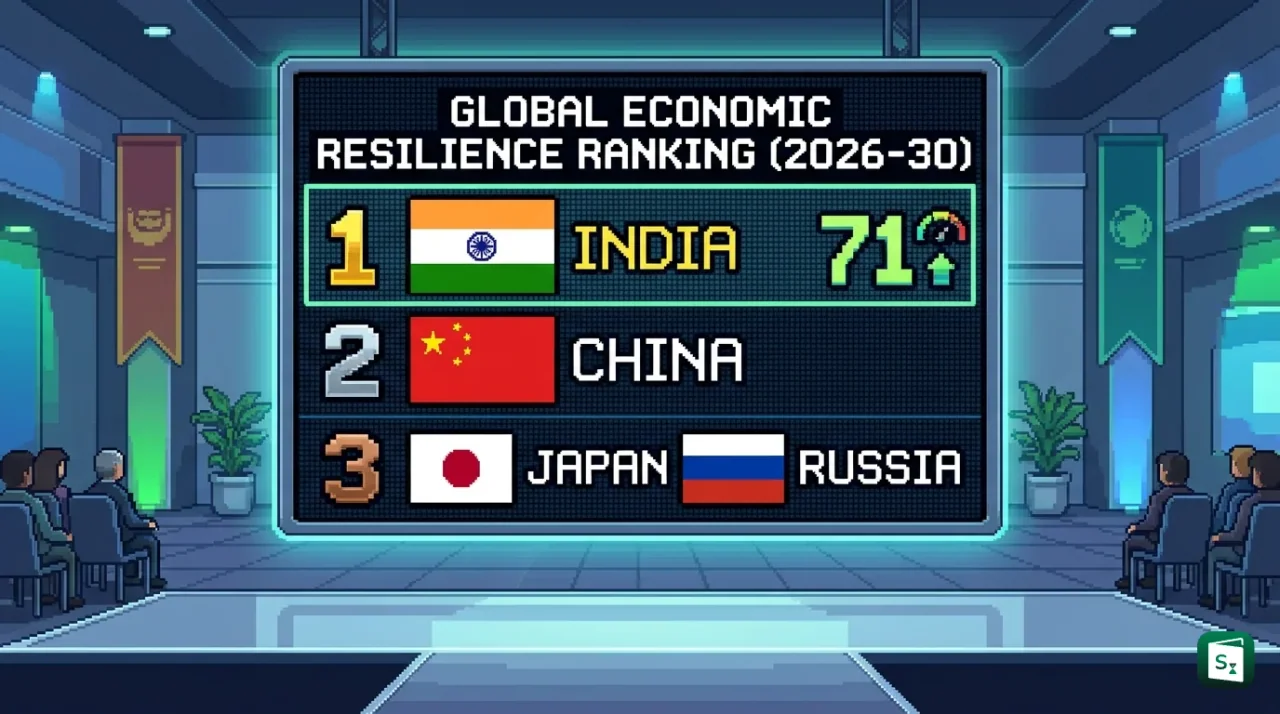
The Associated Chambers of Commerce and Industry of India (ASSOCHAM) released its report titled India’s Economic Edge in the Top Ten Economies on 12 November 2026. The report ranks India first among ten major economies for economic resilience during 2026-30 with a score of 71 out of 100. China stands second with 66, while Japan and Russia share third place with 60 each.
What Is Economic Resilience and How Is It Measured?
Economic resilience is the ability of an economy to prepare for shocks, cope with them, recover quickly and adapt to new conditions. Shocks can include financial crises, wars, oil price spikes, pandemics or climate disasters. A resilient economy limits output and job losses during the shock and returns to its growth path faster.
The ASSOCHAM report measures resilience through a Comparative Macroeconomic Resilience Score scored out of 100. The score is built from 10 macroeconomic indicators covering growth, trade, savings, investment, external balance and government finances. The data comes from the International Monetary Fund (IMF) and its flagship World Economic Outlook database, which is published in April and October every year.
For each indicator, ASSOCHAM ranks the ten economies. The best performer gets the top rank on that indicator. These ranks are then converted into marks and added to form the final score. The method gives equal weight to each indicator. It compares two periods, 2021-25 as the past record and 2026-30 as the forward projection, and it also studies 2025 and 2026 as single years.
What Is ASSOCHAM?
ASSOCHAM stands for the Associated Chambers of Commerce and Industry of India. It is a non-governmental trade association based in New Delhi. It is not a government body. It is a private, not for profit organisation that acts as an interface between industry and government.
ASSOCHAM was established in 1920 by a group of chambers led by the Calcutta Traders Association. It is the oldest apex chamber in the country. Its head office is at the YMCA Cultural Centre and Library Building on Jai Singh Road in New Delhi, with regional offices in cities such as Mumbai, Kolkata, Chennai, Bengaluru, Hyderabad and Ahmedabad. It represents more than 450,000 companies across trade and industry.
The chamber works to promote domestic and international trade and to reduce barriers for business growth. Along with the Confederation of Indian Industry (CII) and the Federation of Indian Chambers of Commerce and Industry (FICCI), it is counted among India’s three apex industry chambers. Its President for 2025-26 is Nirmal K Minda, Executive Chairman of Uno Minda. Its Secretary General is Saurabh Sanyal and its Chief Economist is S P Sharma. The present report was prepared by the ASSOCHAM Global Research and Strategy Centre.
How India Topped the 2026-30 Resilience Ranking
India scored 71 out of 100 in the Comparative Macroeconomic Resilience Score for 2026-30. This is five points ahead of China and 35 points ahead of the United States, which finished last. The table below shows the full ranking for the projection period.
| Rank for 2026-30 | Economy | Score out of 100 |
|---|---|---|
| 1 | India | 71 |
| 2 | China | 66 |
| 3 | Japan | 60 |
| 3 | Russia | 60 |
| 5 | Germany | 59 |
| 6 | Italy | 53 |
| 6 | Brazil | 53 |
| 8 | United Kingdom | 52 |
| 9 | France | 40 |
| 10 | United States | 36 |
India’s rise marks a clear shift from the past. During 2021-25, India ranked third with 66 points, behind Russia at 74 and China at 71. In that earlier period, Germany scored 59, Japan 57, Italy 52, France 50, Brazil 49, the United Kingdom 40 and the United States 32.
India’s top rank for 2026-30 rests on strength in growth and investment indicators and weakness in fiscal indicators:
| Indicator group | India’s rank among 10 economies |
|---|---|
| Real GDP growth | 1st |
| Real GDP per capita growth | 1st |
| Gross national savings | 2nd |
| Gross capital formation | 2nd |
| Export volume growth | 3rd |
| General government debt to GDP ratio | 3rd |
| Primary balance | 5th |
| Current account balance | 7th |
| Structural fiscal balance | 7th |
| Overall fiscal balance | 8th |
China, which finished second overall, ranked first in export growth, gross savings and gross capital formation. It ranked second in real GDP growth and real GDP per capita growth. This close contest shows that India’s lead comes from balanced performance across growth, savings and debt, not dominance in every single indicator.
Why Growth, Savings and Investment Lifted India’s Score
India leads the group on growth. Its real GDP growth is projected at an average of 6.9 percent during 2026-30. That is the fastest among the ten economies in both the past and the projection periods. During 2021-25, India averaged 7.9 percent. Real GDP growth measures the rise in the total value of goods and services after removing the effect of price rises. India also ranks first in real GDP per capita growth. This indicator divides growth by population, so it shows how fast average output per person is rising.
Savings and investment form the second pillar of India’s score. Gross national savings are projected at 35.3 percent of GDP, while gross capital formation is projected at 36.7 percent of GDP. India ranks second on both, just behind China. Gross national savings is the share of national income saved by households, companies and the government combined. It is not the same as household bank deposits alone. Gross capital formation is investment in productive assets such as factories, machinery, buildings and infrastructure. High savings and investment help fund new capacity and sustain growth from domestic resources.
Trade and debt add further support. India’s export volume growth is projected at 4.5 percent, placing it third among the ten. Export volume measures the change in the quantity of goods and services sold abroad. On debt, general government debt is projected at an average of 79.9 percent of GDP during 2026-30, down from 84.8 percent during 2021-25. The report projects the ratio falling from 83.1 percent in 2026 to 77 percent by 2030. A falling debt to GDP ratio means the economy is growing faster than the stock of public debt, which can improve fiscal flexibility.
Where Fiscal Deficit and Oil Dependence Pull India Down
Public finances remain India’s weakest link. The general government fiscal deficit averaged 8.5 percent of GDP during 2021-25. It was the largest deficit among the ten economies. It is projected to narrow to 7.1 percent of GDP during 2026-30. India ranks eighth on overall fiscal balance in the projection period. It ranks fifth on primary balance, which is the fiscal balance excluding interest payments on past debt, and seventh on structural balance, which adjusts for the effect of the economic cycle.
A large deficit means the central and state governments together spend more than they earn. The gap is met through borrowing. Sustained borrowing can keep interest rates higher and leave less room for private investment. ASSOCHAM Secretary General Saurabh Sanyal has flagged fiscal consolidation as the main area to watch. He has pointed to better expenditure efficiency as a way to strengthen the fiscal path.
The external account is the second concern. India’s current account deficit is projected to average 1.4 percent of GDP during 2026-30, up from 1.1 percent during 2021-25, and reach 1.7 percent by 2030. The current account records India’s transactions with the rest of the world. A deficit means India pays more abroad for imports and services than it earns from exports and other inflows. Dependence on imported crude oil makes this position sensitive to global energy prices. Higher crude prices raise import costs, pressure the rupee and push up fuel and transport costs for households.
The report points to energy diversification and renewable power as ways to reduce this risk. India’s renewable energy capacity stood at 274.68 GW in March 2026. The national target is 500 GW of non fossil fuel capacity by 2030. ASSOCHAM Chief Economist S P Sharma has also called for sustaining reforms, stronger private investment, growth in manufacturing and exports, and a globally competitive workforce. He has stressed lower costs of capital, power, compliance, logistics and labour, with special focus on micro, small and medium enterprises (MSMEs).
Where India Stands Among the Top Ten Economies in 2026
Size and resilience are different measures. By size, India is the sixth largest economy in nominal terms in 2026. By resilience, it ranks first for 2026-30. Nominal GDP values a country’s output in current US dollars. The ranking therefore moves with exchange rates as well as domestic growth.
According to the IMF World Economic Outlook of October 2026, the top ten economies by nominal GDP in 2026 are the United States at $32.64 trillion, China at $21.55 trillion, Germany at $5.47 trillion, Japan at $4.34 trillion, the United Kingdom at $4.27 trillion, India at $4.06 trillion, France at $3.55 trillion, Russia at $2.86 trillion, Italy at $2.70 trillion and Brazil at $2.65 trillion. India’s growth in 2026 is projected at about 7 percent, the fastest in this group.
India slipped to sixth in 2026 after revisions to GDP with a new base year of 2022-23 and a depreciation of the rupee of nearly 10 percent against the dollar. The IMF expects India to move past the United Kingdom and Japan by 2027 and overtake Germany by 2031 to become the third largest economy.
The contrast with the resilience ranking is sharp. The United States is the largest economy but ranks last on the resilience score at 36. France, the seventh largest economy, ranks ninth on resilience at 40. The lesson is direct. Total output does not by itself show how well an economy can absorb shocks. Growth momentum, savings, investment, debt control and fiscal balance together shape that ability. The resilience score is a relative comparison of ten economies. It is not a forecast of stock market returns, wages or household prosperity.
Key Takeaways
- The ASSOCHAM report titled India’s Economic Edge in the Top Ten Economies released on 12 November 2026 ranks India first with a score of 71 out of 100 for economic resilience during 2026-30.
- China finished second with 66, while Japan and Russia jointly finished third with 60 each and the United States finished last with 36.
- India improved from third place with 66 points during 2021-25, when Russia led with 74 and China was second with 71.
- India ranked first in real GDP growth at 6.9 percent and per capita growth, second in savings at 35.3 percent of GDP and capital formation, and third in export growth and debt ratio.
- India ranked eighth on overall fiscal balance, with the general government deficit projected to narrow from 8.5 percent of GDP to 7.1 percent.
- ASSOCHAM, established in 1920 and headquartered in New Delhi, is a non-governmental trade association whose Global Research and Strategy Centre built the score from IMF World Economic Outlook data across 10 indicators.