According to the “Global Trade Outlook and Statistics Update: October 2026” report released by the World Trade Organization (WTO), the global merchandise trade growth forecast has been raised to 3.9% for Calendar Year 2026 (CY26), from its previous estimate of 1.9%.
The report projects global trade growth at 4.1% for CY27. Additionally, the global Gross Domestic Product (GDP) growth is projected at 2.6% in CY26 and 2.9% in CY27.

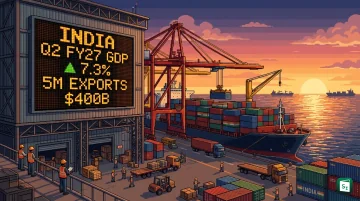
According to the “Trade and Development Report 2026: The Geoeconomics of Development” released by the United Nations Conference on Trade and Development (UNCTAD), the economy of India is projected to grow by 7.3%.
The report projected global economic growth at 2.6% (down from 2.9% in 2025) and growth in developing economies at 4% (down from 4.7% in 2025). Additionally, Asia is expected to contribute 59% of global growth in 2026.
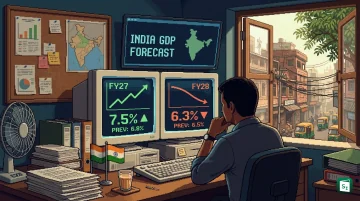
According to a report by Business Monitor International (BMI), a unit of Fitch Solutions Company, the GDP growth forecast of India for FY27 has been raised to 7.5% from 6.8%.
However, the forecast for FY28 is lowered to 6.3% from 6.5% due to concerns over household consumption and external economic risks.
The RBI conducted the 4th Bi-monthly Monetary Policy Committee (MPC) meeting of FY27 under the chairmanship of Governor Sanjay Malhotra.
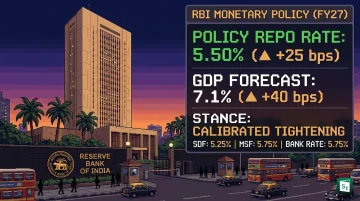
The MPC voted unanimously to increase the policy repo rate under the liquidity adjustment facility (LAF) by 25 basis points (bps) to 5.50%, marking the first rate hike since February 2023.
Consequently, the standing deposit facility (SDF) rate was adjusted to 5.25%, while the marginal standing facility (MSF) rate and the Bank Rate stand at 5.75%. The panel shifted its policy stance from neutral to “calibrated tightening.” The RBI raised the GDP growth forecast of India for FY27 by 40 bps to 7.1%.
Additionally, the central bank set a threshold of ₹25,000 crore under the Standardised Approach for Counterparty Credit Risk (SA-CCR), effective from April 1, 2027, and announced the creation of a Technical Consultative Committee for Financial Markets.
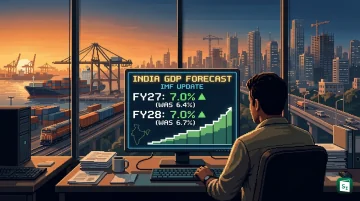
According to the International Monetary Fund (IMF), India’s growth forecast for FY27 has been raised to 7% from the earlier 6.4%. The IMF also revised its growth forecast for FY28 upward to 7% from 6.7%.
American economists Robert E Hall (Stanford University) and Michael Woodford (Columbia University) have been jointly awarded the 2026 Nobel Prize in Economics by the Royal Swedish Academy of Sciences.
The pair was honoured “for microeconomic foundations of macroeconomic stabilisation”. The laureates will share a cash prize of 12 million Swedish kronor ($1.2 million).
According to the results of the Annual Survey of Industries (ASI) 2024-25 released by the Ministry of Statistics and Programme Implementation, the manufacturing Gross Value Added (GVA) increased by 9.59% in FY25. Total employment in the sector grew by 7.19% to reach 2.1 crore.
The report states that the total emoluments paid to the workforce grew by 12.08% compared to FY24. Tamil Nadu ranks top in terms of industrial establishments with 41,221 units. The top five states account for 53.3% of the total industrial establishments in India.
The National Statistics Office (NSO) has signed an MoU with the New Delhi-based Pahle India Foundation (PIF) to enhance cooperation in official statistics, research, and data analysis.
The Ministry of Statistics and Programme Implementation has released the Sub-Sectoral Trial Index of Services Production (ISP) for July 2026, utilizing 2024-25 as the base year to monitor 19 service sub-sectors.
The ISP data indicates that 17 out of the 19 sub-sectors achieved positive growth in July 2026, with 10 sub-sectors recording double-digit growth compared to July 2025. Most categories recorded positive Year-on-Year (YoY) growth, with the exceptions of Air Transport and Repair Services.
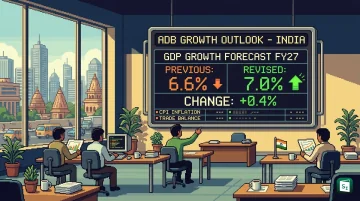
According to the “Asian Development Outlook (ADO) September 2026: Navigating Prolonged Energy Shocks and El Nino” report released by the Asian Development Bank (ADB), the Gross Domestic Product (GDP) growth of India for FY27 is raised to 7% (an increase of 40 basis points from the earlier estimate of 6.6%).
The report also projected the inflation rate of India for FY27 at 5%.
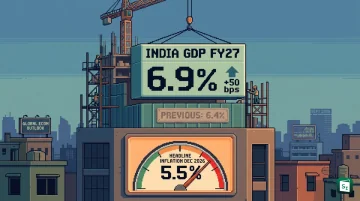
According to the “Global Economic Outlook - September 2026” report released by Fitch Ratings, the GDP growth forecast of India for the FY27 has been raised by 50 bps to 6.9% from the earlier projection of 6.4%.
The rating agency also projected that the headline inflation of India will increase to 5.5% by December 2026.
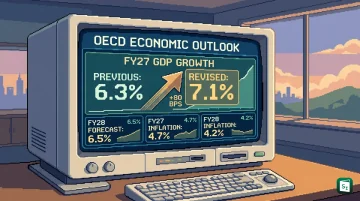
According to the “OECD Economic Outlook, Interim Report September 2026: Weathering Successive Shocks” released by the Organisation for Economic Cooperation and Development (OECD), the Gross Domestic Product (GDP) growth of India for FY27 is revised upwards by 80 basis points (bps) to 7.1% from the earlier 6.3%.
The growth for FY28 is projected at 6.5%. The report also estimated the inflation of India for FY27 and FY28 at 4.7% and 4.2% respectively.
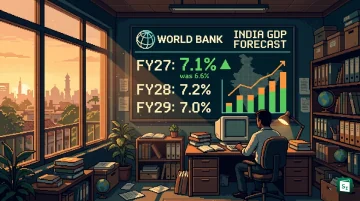
According to the report “Economic Outlook Asia-Pacific Q4 2026: Exports, Domestic Demand Will Shore Up Growth” released by S&P Global Ratings, the GDP growth of India for FY27 is revised upwards to 7% from 6.6%.
The growth for FY28, FY29, and FY30 is projected at 7.2%, 7%, and 6.8% respectively.
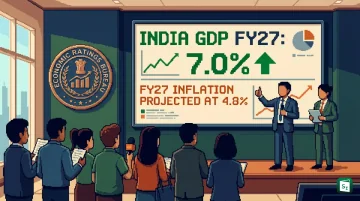
According to a report by Moodys Ratings, the real Gross Domestic Product (GDP) growth forecast of India for the FY27 is revised upwards to 7% from the earlier estimate of 6%. The inflation rate for FY27 is projected at 4.8%.
According to a report by the Asian Development Bank (ADB), the GDP growth forecast of India for FY27 is revised to 7% from the earlier estimate of 6.6% in July.
The RBI has released the June 2026 edition of the biannual “Financial Stability Report” (FSR), which presents an assessment by the Sub-Committee of the Financial Stability and Development Council (FSDC) on risks to the financial system of India.
According to the report, the economy of India grew at 7.7% in FY26. The Monetary Policy Committee (MPC) has revised the inflation projection for the 2026-27 period to 5.1%. The foreign exchange reserves of India were recorded at $672.6 billion as of June 19, 2026.
According to the “National Accounts Statistics (NAS) - 2026” publication released by the Ministry of Statistics and Programme Implementation (MoSPI), FY23 has been adopted as the base year for national account estimates.
The publication consists of 60 statements derived from the updated Final estimates for FY23 and FY24, and the First Revised Estimate for FY25. The revised estimates incorporate new series for the Producer Price Index (PPI), Index of Industrial Production (IIP), and Banking Services Price Index (BkSPI), all of which use the 2022-23 base year.
According to the Quarterly Estimates of the Gross Domestic Product (GDP) released by the National Statistical Office (NSO), the Real GDP of India grew by 7.8% in Q1 FY27 (April-June 2026), compared to 6.9% in Q1 FY26.
This is the first release to use the revised base year of 2022-23 for the National Accounts Statistics (NAS). The GDP at Constant Prices (2022-23) for Q1 FY27 is estimated at ₹81.36 lakh crore, while it stood at ₹75.46 lakh crore in Q1 FY26. The GDP at Current Prices is estimated at ₹88.27 lakh crore (against ₹80 lakh crore in Q1 FY26), reflecting a growth rate of 10.3%.