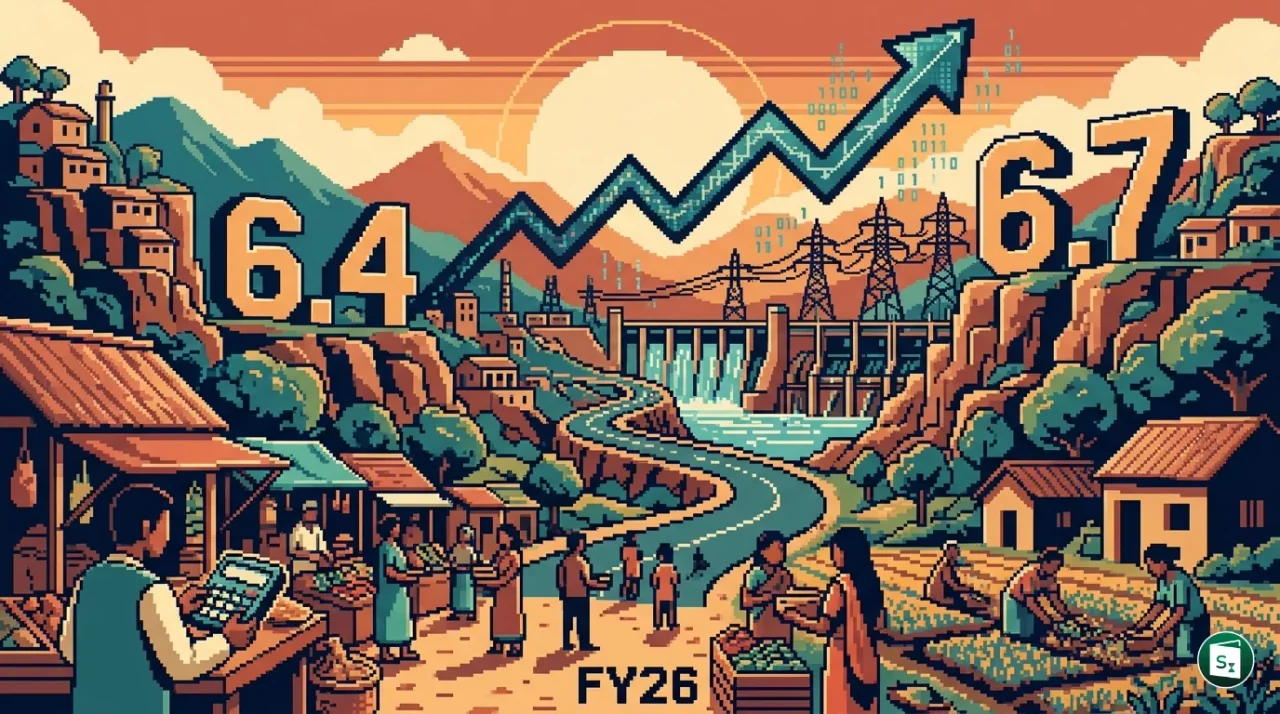
The International Monetary Fund (IMF) released its World Economic Outlook (WEO) Update for July 2026, revising India’s GDP growth projection for FY27 to 6.4% from the 6.5% estimated in April 2026. At the same time, the Fund raised its FY28 forecast to 6.7%, up 20 basis points from the earlier projection, while confirming that India’s economy grew 7.7% in FY26. The update, titled Global Economy in Crosscurrents of War and Technology, paints a picture of a world economy pulled in opposite directions by conflict in West Asia and a technology boom driven by artificial intelligence.
What the IMF’s July 2026 Update Says About India
India’s growth trajectory under the latest WEO Update shows a slight near-term moderation followed by an acceleration. The table below captures the key numbers:
| Fiscal Year | April 2026 Forecast | July 2026 Forecast | Revision |
|---|---|---|---|
| FY26 (actual) | 7.3% (April projection) | 7.7% (provisional estimate) | Upward |
| FY27 | 6.5% | 6.4% | -10 bps |
| FY28 | 6.5% | 6.7% | +20 bps |
The IMF noted that India remains among the fastest-growing major economies in the world. The growth momentum is supported by strong private consumption and robust services activity, which continue to underpin domestic demand. On a calendar year basis, the Fund projects India’s growth at 7.0% in 2026 and 6.4% in 2027.
Why the FY27 Forecast Was Revised Down
The marginal downgrade for FY27 from 6.5% to 6.4% reflects two countervailing forces. On the upside, recent economic data has been stronger than expected. High-frequency indicators through April 2026 point to continued resilience in overall economic activity, as Deniz Igan, Division Chief of the IMF’s World Economic Studies Division, explained during the press briefing.
However, these positive effects have been more than offset for FY27 by higher energy prices in the baseline forecast. The conflict in West Asia has driven up crude oil prices, and the IMF notes a greater pass-through of these higher oil prices to domestic fuel costs in India. As a net oil importer, India faces headwinds from elevated energy costs that weigh on economic activity in the near term.
The IMF’s baseline assumes an average petroleum spot price of $78 per barrel for 2026, roughly 25% higher than pre-war levels. The energy shock directly impacts India’s import bill, widens the trade deficit, and puts upward pressure on domestic inflation, dampening consumer spending power.
Why the FY28 Forecast Was Revised Up
Looking beyond the immediate energy shock, the IMF raised its FY28 projection to 6.7% from 6.5%. This upward revision reflects the expectation that the energy shock will dissipate by 2027, allowing India’s growth momentum to strengthen. The IMF estimates India’s medium-term growth potential at around 6.5%, and expects output to close the gap as temporary headwinds fade.
The stronger FY28 forecast also builds on India’s impressive FY26 performance. The economy expanded by 7.7% in FY26, with Q4 alone recording 7.8% growth. This was driven by double-digit expansion in manufacturing, trade, hospitality, transport, and financial services. Private Final Consumption Expenditure (PFCE) and Gross Fixed Capital Formation (GFCF) both grew by over 7.5%, indicating healthy consumer demand and investment activity.
This strong base provides a solid foundation from which India’s economy can accelerate once energy prices normalise and geopolitical uncertainties recede.
India in a Divided Global Economy
The July 2026 WEO Update presents a global economy pulled in two directions. On one side, the war in West Asia has created a negative supply shock, pushing up energy prices and disrupting supply chains. On the other, rapid advances in artificial intelligence (AI) have triggered a positive technology demand shock, benefiting countries integrated into the global technology value chain.
The impact varies sharply across countries depending on their exposure to the conflict and their position in the technology ecosystem.
| Country/Region | 2026 Growth | 2027 Growth | Key Driver |
|---|---|---|---|
| Global | 3.0% | 3.4% | War and tech forces offset each other |
| India | 6.4% (FY) | 6.7% (FY) | Domestic consumption, services |
| China | 4.6% | - | Higher oil prices, structural headwinds |
| United States | 2.3% | 2.2% | Resilient consumption |
| Euro Area | 0.9% | - | Energy import dependence |
| Vietnam | 7.5% | - | Technology exports |
Global growth is projected at 3.0% in 2026, down from the 3.5% average of 2024-25, before recovering to 3.4% in 2027. The IMF highlighted that global disinflation has stalled, with headline inflation now forecast at 4.7% for 2026 (up 0.3 percentage points from the April forecast), driven mainly by higher energy and food prices.
India stands out because its growth is driven predominantly by domestic demand, private consumption, and services activity rather than external trade. This insulation from global trade disruptions gives India a degree of resilience that many other emerging economies lack.
About the International Monetary Fund
The International Monetary Fund (IMF) is an international financial institution and a specialised agency of the United Nations. It was established in July 1944 at the Bretton Woods Conference in New Hampshire, United States, with 44 founding nations. The IMF began operations in March 1947 and currently has 191 member countries.
Its headquarters is located in Washington, D.C., United States. The Fund is led by a Managing Director, currently Kristalina Georgieva. Day-to-day operations are managed by a 24-member Executive Board. The IMF’s quota system determines each member’s financial contribution, voting power, and access to resources. India holds approximately 2.75% of the total quota, making it the 8th largest quota-holding country.
The IMF’s primary functions include monetary cooperation, promoting exchange rate stability, providing temporary financial assistance to countries facing balance of payments difficulties, and conducting economic surveillance of member economies. The World Economic Outlook (WEO) is the IMF’s flagship publication, released twice a year (April and October) with updates in January and July, providing analysis and projections for global economic developments.
Key Takeaways
- The IMF’s July 2026 WEO Update titled Global Economy in Crosscurrents of War and Technology revised India’s FY27 GDP growth to 6.4% (from 6.5%) and FY28 growth to 6.7% (from 6.5%).
- India’s GDP grew 7.7% in FY26, with Q4 recording 7.8% growth, driven by manufacturing, services, and financial sector expansion.
- The FY27 downgrade is attributed to higher energy prices from the West Asia conflict and their pass-through to domestic fuel costs.
- The FY28 upgrade reflects expectations that the energy shock will dissipate, allowing India’s growth to strengthen toward its medium-term potential of around 6.5%.
- Global growth is projected at 3.0% in 2026 and 3.4% in 2027, with the IMF warning that global disinflation has stalled.
- The IMF was established in 1944 at the Bretton Woods Conference, is headquartered in Washington, D.C., and has 191 member countries.