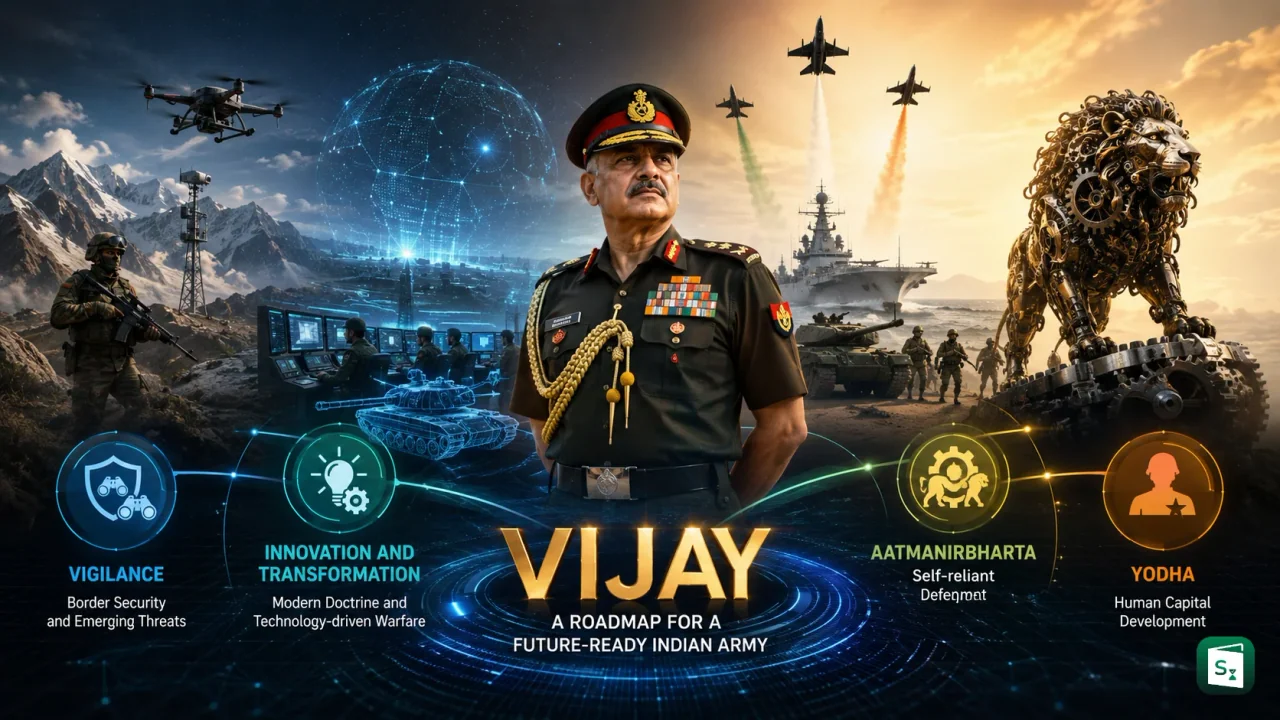
General Dhiraj Seth took over as the 31st Chief of the Army Staff (COAS) on 30 June 2026, succeeding General Upendra Dwivedi, who retired after more than four decades of service. On his first full day in office, he unveiled the VIJAY roadmap, a comprehensive five-pillar strategy to transform the Indian Army into a technology-enabled, future-ready force capable of operating across multiple domains. The framework, built around vigilance, innovation, jointness, self-reliance, and soldier welfare, sets the direction for the Army’s modernisation over the coming years.
Who Is General Dhiraj Seth?
General Dhiraj Seth, PVSM, UYSM, AVSM, is a decorated four-star officer with nearly four decades of service. He is the seventh officer from the Armoured Corps to become Army Chief and the first since General Shankar Roy Chowdhury retired in 1997. Commissioned into the 2nd Lancers (Gardner’s Horse) in December 1986, he is an alumnus of the National Defence Academy (NDA), Khadakwasla, and the Indian Military Academy (IMA), Dehradun.
He is among the few officers to have commanded two operational Army commands along India’s western front. He served as General Officer Commanding-in-Chief (GOC-in-C) of both the South Western Command (Jaipur) and the Southern Command (Pune). Before that, he commanded the XXI Corps (Sudarshan Chakra Corps), one of the Army’s premier strike formations, and served as General Officer Commanding, Delhi Area.
At Army Headquarters, General Seth held key appointments in Strategic Planning and Capability Development, including Colonel Capability Development for Mechanised Forces, Brigadier Perspective Plans and Acquisition, and Additional Director General Capability Development. He is widely regarded as one of the architects of the Army’s modernisation roadmap. He also served as the Vice Chief of the Army Staff (VCOAS) in April 2026 before being elevated to the top post.
General Seth commanded an Armoured Regiment in the desert sector, an Armoured Brigade in the Western Theatre, and a Counter-Insurgency Force in Jammu and Kashmir. He served as a UN peacekeeper with the United Nations Angola Verification Mission III (UNAVEM III) in 1995-1996. His academic credentials include the Higher Command Course, the National Defence College, and the prestigious Command and Staff Course in Paris. He comes from a military family: his father, Lieutenant General K. M. Seth, served as Adjutant General of the Indian Army, and his brother, Rear Admiral Ravnish Seth, is a serving Flag Officer in the Indian Navy.
The VIJAY Roadmap: A Five-Pillar Vision
The acronym VIJAY (meaning “victory”) forms the core of General Seth’s strategic vision for the Indian Army. He presented it on 1 July 2026, his first day in office, after paying homage at the National War Memorial and reviewing a ceremonial Guard of Honour at South Block. The roadmap is aligned with the Decade of Transformation (2023-2032), a broader modernisation initiative envisioned by Defence Minister Rajnath Singh, and draws inspiration from Prime Minister Narendra Modi’s JAI mantra for the armed forces (Jointness, Aatmanirbharta, Innovation).
Vigilance: Border Security Against Emerging Threats
The ‘V’ in VIJAY stands for Vigilance. General Seth emphasised that the Army will maintain constant vigilance along India’s borders and remain alert against emerging threats. He asserted that a high level of operational readiness will be sustained to respond effectively to any challenge to national security. This pillar reflects the need for continuous monitoring of India’s complex border landscape, particularly along the Line of Actual Control (LAC) with China and the Line of Control (LoC) with Pakistan.
Innovation and Transformation: Modern Doctrine and Technology
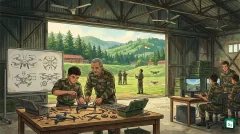
The ‘I’ stands for Innovation and Transformation. General Seth stated that innovation will become an integral part of the Army’s thinking, systems, and capability development. His focus will be on modernising both doctrine and technological solutions to keep pace with the changing character of warfare. This includes the accelerated induction of drones, artificial intelligence, electronic warfare, and counter-UAS systems into mainstream operations rather than keeping them as niche capabilities.
Jointness and Integration: Tri-Services Synergy for Viksit Bharat 2047
The ‘J’ stands for Jointness and Integration. General Seth stressed the need for complete synergy and coordination among the Indian Army, Indian Air Force, and Indian Navy to enhance operational effectiveness. He also highlighted the importance of military-civil fusion and a Whole-of-Nation approach to national security. This integrated approach, he noted, will contribute to nation-building and the national goal of Viksit Bharat 2047, the vision of making India a developed nation by its centenary of independence.
Aatmanirbharta: Winning Wars With Indigenous Solutions
The ‘A’ stands for Aatmanirbharta or self-reliance. General Seth laid down the guiding principle: “Win our wars with indigenous solutions.” Under this pillar, the Army will leverage indigenous capabilities and technologies developed within the country. This aligns with the government’s push for defence indigenisation, including partnerships with DRDO, Indian industry, MSMEs, and start-ups through initiatives like iDEX (Innovations for Defence Excellence) and the Technology Development Fund.
Yodha: Human Capital Development
The ‘Y’ in VIJAY stands for Yodha (warrior). General Seth described every member of the Army, from the Agniveer to the senior-most veteran, as a yodha and the Army’s greatest strength. He said that enhancing the technological threshold and training standards of soldiers will be among his foremost priorities. The welfare of soldiers, veterans, and Veer Naris (widows of fallen soldiers) will remain a key focus area.
The Decade of Transformation: The Bigger Picture
The VIJAY roadmap does not operate in isolation. It is the latest expression of the Indian Army’s Decade of Transformation (2023-2032), a long-term reform agenda declared by the Army and given strategic direction by Defence Minister Rajnath Singh, who declared 2025 as the Year of Reforms. The Decade of Transformation is structured around five pillars of its own: Jointness and Integration, Force Structuring, Modernisation and Technology Infusion, Systems and Processes, and Human Resource Management.
Key structural reforms already underway include the raising of Integrated Battle Groups (IBGs), All-Arms Brigades, Bhairav Battalions, Shaktibaan Regiments, Divyastra Batteries, and ASHNI Drone Platoons. These new formations are designed to enhance precision, surveillance, and multidomain strike capabilities. The Army has also designated 2024-2025 as the Years of Technology Absorption, focusing on integrating niche technologies into operational structures rather than merely inducting new equipment.
General Seth’s appointment comes at a time when the Army is also pushing towards the operationalisation of integrated theatre commands, a reform that aims to bring the three services under unified operational commanders for specific geographic theatres. His experience in strategic planning at Army Headquarters is expected to accelerate progress on this front.
Challenges Ahead
Despite the ambitious vision, General Seth inherits several long-standing challenges. Several core modernisation programmes remain stuck in the procurement pipeline. Major upgrades in armoured platforms, artillery systems, air defence, and tactical mobility vehicles are yet to materialise. Trials for new sniper rifles have dragged on without conclusion, while decisions on advanced towed gun systems and armoured personnel carriers are pending.
The biggest test for General Seth will be converting the Army’s long-term capability roadmap into signed contracts and equipment entering service. At the same time, he must ensure that emerging technologies such as drones, AI, electronic warfare, and counter-UAS systems become integral to the force rather than remaining niche capabilities. His background in capability development and perspective planning places him in a strong position to tackle these issues, but execution will determine the success of the VIJAY vision.
Key Takeaways
- General Dhiraj Seth assumed office as the 31st Chief of the Army Staff (COAS) on 30 June 2026, succeeding General Upendra Dwivedi.
- He is the seventh officer from the Armoured Corps to become Army Chief and the first since General Shankar Roy Chowdhury (1997).
- The VIJAY roadmap, unveiled on 1 July 2026, is a five-pillar strategy: Vigilance, Innovation and Transformation, Jointness and Integration, Aatmanirbharta, and Yodha.
- General Seth is among the few officers to have commanded two operational commands (South Western Command and Southern Command) and previously served as Vice Chief of the Army Staff.
- He was commissioned into the 2nd Lancers (Gardner’s Horse) in December 1986 and is an alumnus of NDA, IMA, DSSC Wellington, Army War College Mhow, and the National Defence College.
- The VIJAY roadmap is aligned with the Decade of Transformation (2023-2032) and the Prime Minister’s JAI mantra (Jointness, Aatmanirbharta, Innovation) for the armed forces.