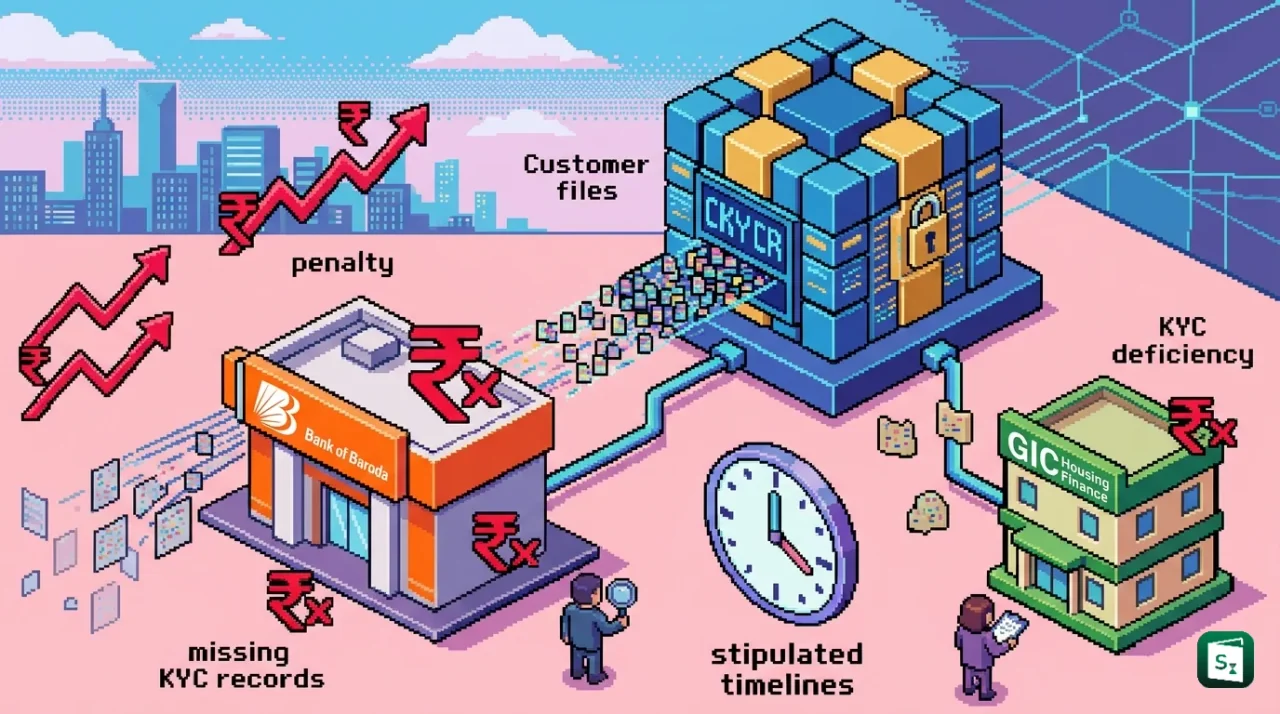
The Reserve Bank of India imposed a monetary penalty of ₹63.60 lakh on Bank of Baroda for charging interest higher than the contracted rates on certain loan accounts and failing to upload customer KYC records to the central registry within the prescribed timeline. The central bank also levied a separate penalty of ₹3.10 lakh on GIC Housing Finance for deficiencies in compliance with KYC guidelines. The penalties were imposed through orders dated June 30, 2026, following statutory inspections conducted with reference to the entities’ financial positions as on March 31, 2025.
Why RBI Imposed the Penalty on Bank of Baroda
The RBI conducted a Statutory Inspection for Supervisory Evaluation (ISE 2025) of Bank of Baroda with reference to its financial position as on March 31, 2025. Based on the inspection findings, the central bank issued a show-cause notice to the lender asking why a penalty should not be imposed for the identified lapses.
After considering the bank’s written reply, additional submissions, and oral arguments made during a personal hearing, the RBI concluded that two specific charges were sustained. First, the bank had collected interest at rates higher than those contractually agreed upon in certain loan accounts. Second, it failed to upload the KYC records of certain customers to the Central KYC Records Registry (CKYCR) within the prescribed timeline.
Bank of Baroda is India’s second largest public sector bank, founded on July 20, 1908 by Maharaja Sayajirao Gaekwad III. It is headquartered in Vadodara, Gujarat and was nationalised on July 19, 1969 along with 13 other major commercial banks. The bank is currently led by Managing Director and CEO Debadatta Chand.
What Is the Fair Practices Code for Lenders
The Fair Practices Code for Lenders is a set of guidelines issued by the RBI in 2003 to promote transparency and fairness in lending by banks and financial institutions. It was based on the recommendations of the Working Group on Lenders’ Liability Laws constituted by the Government of India.
The Code requires lenders to disclose all terms and conditions of a loan upfront, including the applicable rate of interest, processing fees, prepayment options, and penal charges. It mandates that banks convey the sanctioned credit limit along with the terms and conditions to the borrower in writing and keep the borrower’s acceptance on record. Any charge not disclosed initially cannot be levied later.
Charging interest higher than the contracted rate directly violates these provisions. The RBI has regularly issued circulars reinforcing that lenders must adhere strictly to the agreed terms and cannot unilaterally alter the interest rate without the borrower’s consent.
The Central KYC Records Registry Explained
The Central KYC Records Registry (CKYCR) is a centralised database for KYC records of customers in the financial sector. It was operationalised in 2016 following a government notification issued in November 2015 under the SARFAESI Act, 2002. The registry is operated by the Central Registry of Securitisation Asset Reconstruction and Security Interest of India (CERSAI).
When a customer completes KYC with any reporting entity such as a bank, mutual fund, or insurer, a unique 14-digit CKYC Identifier Number (KIN) is generated. This identifier can be used by the customer when establishing a relationship with any other financial institution, eliminating the need to submit KYC documents repeatedly. All regulated entities under the RBI, SEBI, IRDAI, and PFRDA are required to upload KYC records to the CKYCR within prescribed timelines.
The RBI has designated CKYCR as the primary mode for customer verification across the financial sector. Failure to upload records within the stipulated timeline, as happened in Bank of Baroda’s case, amounts to a regulatory breach that invites penal action.
Penalty on GIC Housing Finance for KYC Lapses
The RBI also imposed a penalty of ₹3.10 lakh on GIC Housing Finance Limited for non-compliance with certain provisions of the RBI’s KYC directions. The action followed a statutory inspection conducted by the National Housing Bank (NHB) with reference to the company’s financial position as on March 31, 2025.
The specific lapse identified was the company’s failure to put in place a system for periodic review of risk categorisation of customer accounts, with such reviews required at least once every six months. This requirement flows from Paragraph 12 of Chapter IV of the RBI (KYC) Directions, 2016, which mandates regulated entities to periodically update customer risk profiles.
GIC Housing Finance was incorporated on December 12, 1989 and is headquartered in Mumbai. It is promoted by the General Insurance Corporation of India (GIC Re) along with four public sector insurance companies. The penalty was imposed under Section 52A of the National Housing Bank Act, 1987, which empowers the RBI to penalise housing finance companies for regulatory contraventions.
RBI’s Enforcement Powers Under the Banking Regulation Act
The RBI derives its power to impose monetary penalties on banks primarily from the Banking Regulation Act, 1949. The penalty on Bank of Baroda was imposed under Section 47A(1)(c) read with Section 46(4)(i) of this Act. These provisions allow the central bank to penalise banking companies for non-compliance with its directions.
For housing finance companies, the regulatory architecture is different. The National Housing Bank Act, 1987 originally established the NHB as the regulator for housing finance institutions. However, the Finance Act, 2019 amended the NHB Act and transferred the regulatory authority over housing finance companies to the RBI with effect from August 2019. Since then, the RBI exercises powers under the NHB Act, including Section 52A, to enforce compliance on housing finance companies.
| Entity | Penalty Amount | Violation | Legal Provision |
|---|---|---|---|
| Bank of Baroda | ₹63.60 lakh | Excess interest charges; delayed CKYCR uploads | Section 47A of Banking Regulation Act, 1949 |
| GIC Housing Finance | ₹3.10 lakh | Failure in periodic risk categorisation review | Section 52A of NHB Act, 1987 |
The RBI clarified in both cases that the penalties are based on deficiencies in regulatory compliance and are not intended to pronounce upon the validity of any transaction or agreement entered into by the entities with their customers.
Key Takeaways
- The RBI imposed a penalty of ₹63.60 lakh on Bank of Baroda for charging interest above contracted rates and failing to upload KYC records to CKYCR within the prescribed timeline.
- A separate penalty of ₹3.10 lakh was imposed on GIC Housing Finance for not conducting periodic risk categorisation reviews of customer accounts at least once every six months.
- The Fair Practices Code for Lenders was issued by the RBI in 2003 to ensure transparency in loan terms and prohibit charging undisclosed or excess interest.
- The Central KYC Records Registry (CKYCR), operationalised in 2016 under the SARFAESI Act, 2002, is a centralised KYC database operated by CERSAI that assigns a unique 14-digit CKYC Identifier to each customer.
- The penalty on Bank of Baroda was imposed under Section 47A of the Banking Regulation Act, 1949, while the penalty on GIC Housing Finance was imposed under Section 52A of the National Housing Bank Act, 1987.
- Bank of Baroda was founded on July 20, 1908 by Maharaja Sayajirao Gaekwad III, nationalised in 1969, and is India’s second largest public sector bank headquartered in Vadodara, Gujarat.