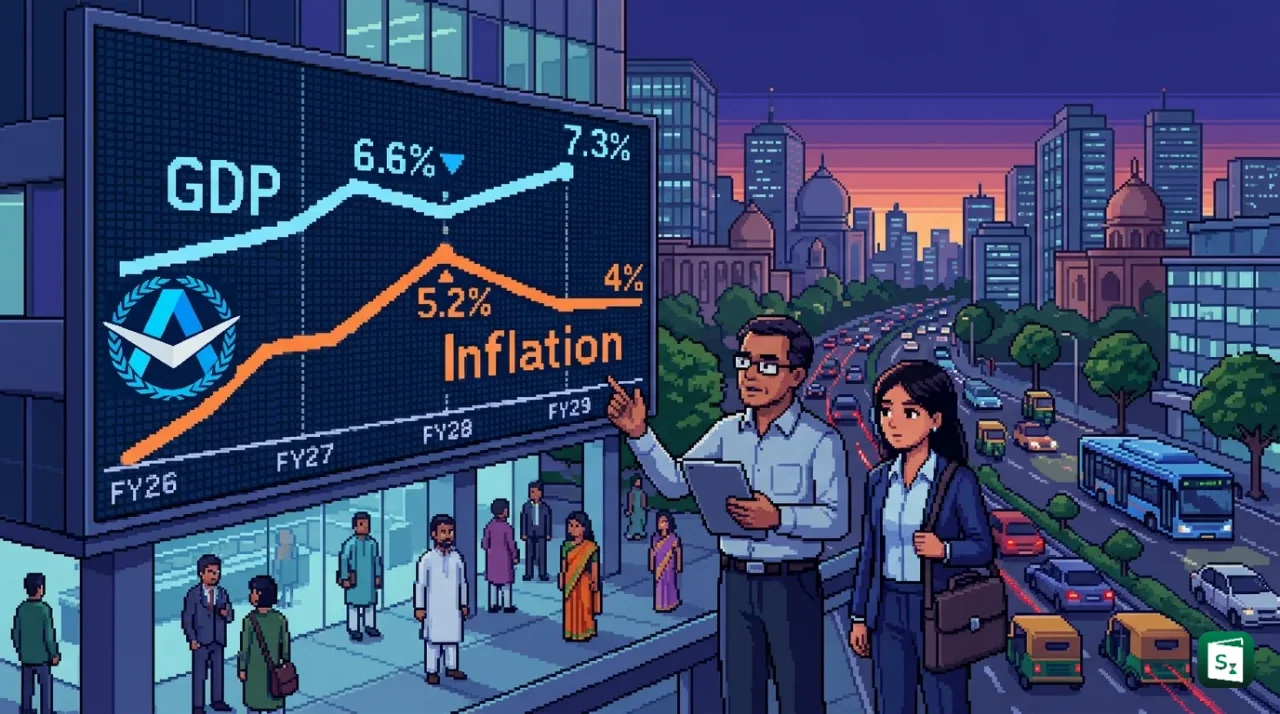
The Asian Development Bank (ADB) has lowered India’s GDP growth forecast for FY27 to 6.6% from 6.9%, reflecting the impact of elevated energy prices from the ongoing Middle East conflict on household spending and private demand. The multilateral lender, in its July 2026 edition of the Asian Development Outlook (ADO), maintained the FY28 growth projection at 7.3% while sharply raising the inflation forecast for FY27 to 5.2%. The revision positions India’s growth below the central bank’s initial estimates but still keeps it among the fastest growing major economies in the world.
What the ADO July 2026 Says
The Asian Development Bank (ADB) is a multilateral development bank headquartered in Mandaluyong, Metro Manila, Philippines. Established on 19 December 1966, it is owned by 69 member countries, of which 50 are from the Asia-Pacific region. The ADB’s current President is Masato Kanda, who assumed office on 24 February 2025. Its flagship publication, the Asian Development Outlook (ADO), provides biannual economic forecasts for developing Asia and the Pacific.
The ADO July 2026, released on 9 July 2026, updated the economic forecasts that were first published in the ADO April 2026 edition. The key revisions for India are summarised below:
| Indicator | FY27 (April 2026 Forecast) | FY27 (July 2026 Revised) | FY28 Forecast (Unchanged) |
|---|---|---|---|
| GDP Growth | 6.9% | 6.6% | 7.3% |
| Consumer Inflation | 4.5% | 5.2% | 4.0% |
The report noted that the downgrade for FY27 was driven by the impact of elevated energy prices, which are squeezing real incomes and dampening private consumption. The growth forecast for FY28 was left unchanged, supported by expectations of improving global conditions and stronger export competitiveness.
Beyond India, the ADB also lowered South Asia’s growth projection for 2026 by 0.3 percentage points to 6.0%, with the revision largely reflecting the downward adjustment to India’s outlook. For developing Asia and the Pacific as a whole, the growth forecast was trimmed to 4.9% for 2026 from 5.1% projected in April, while the 2027 forecast was maintained at 5.1%.
Why the Growth Forecast Was Revised Down
The primary reason for the downward revision is the sharp rise in global energy prices triggered by the Middle East conflict. India imports about 88% of its crude oil requirements, making it highly vulnerable to international oil price shocks. The conflict, which led to the temporary closure of the Strait of Hormuz (a critical maritime chokepoint through which a significant portion of global oil trade passes), pushed India’s crude oil import basket to over $110 per barrel in recent months.
Higher energy prices have affected the Indian economy through multiple channels:
- Squeezed real incomes: Households are spending more on fuel and transportation, leaving less for other consumption.
- Higher input costs: Industries face increased costs for raw materials, chemicals, and logistics, which pressure profit margins.
- Weakened consumer sentiment: Elevated inflation and transportation costs have dampened consumer confidence and private demand.
The ADB also flagged risks to the growth outlook from heightened geopolitical tensions, weather-induced weakness in agriculture, and the possibility of prolonged disruptions in global supply chains. The report noted that the India-specific downgrade was also linked to the impact of a weaker rupee, which has pushed up the cost of imports and added to inflationary pressures.
Despite the downward revision, the ADB expects growth to remain supported by policy measures aimed at attracting foreign investment, fuel tax cuts announced by the government, targeted credit support, robust services exports, and continued public capital expenditure.
Inflation: A Sharp Revision Upward
The ADB raised India’s inflation forecast for FY27 to 5.2% from 4.5% projected in April, a revision of 0.7 percentage points in just three months. This sharp increase reflects the compounding effect of three factors:
First, higher global oil prices have fed directly into domestic fuel and transportation costs. The government had cut excise duty on petrol and diesel by ₹10 per litre in March 2026 to cushion the impact, but the underlying cost pressure remained significant.
Second, a weaker rupee has made all imports more expensive. The Indian rupee depreciated against the US dollar amid capital outflows linked to global risk aversion, adding to the cost of imported crude oil, edible oils, and industrial inputs.
Third, food inflation has added further upward pressure, driven by heatwaves affecting crop output and the fading of favourable base effects from the previous year.
| Inflation Driver | Impact |
|---|---|
| Global oil prices | Passed through to fuel, transport costs |
| Rupee depreciation | Made all imports costlier |
| Food prices | Heatwaves affected output; base effects faded |
The ADB retained its FY28 inflation forecast at 4.0%, assuming that fuel and food prices would normalise as global energy markets stabilise and favourable base effects take hold. However, the lender cautioned that risks to inflation remain tilted to the upside due to potential supply chain disruptions and weather-related shocks.
India’s Growth in the Context of Other Forecasts
The ADB’s revision follows similar moves by other major forecasters in recent weeks. India’s actual GDP growth for FY26 (2025-26) came in at 7.7%, according to the provisional estimates released by the Ministry of Statistics and Programme Implementation in June 2026, providing a strong base. However, the headwinds from the energy crisis have forced multiple agencies to lower their near-term projections.
| Institution | FY27 GDP Forecast | FY27 Inflation Forecast | Date of Revision |
|---|---|---|---|
| ADB | 6.6% | 5.2% | July 2026 |
| RBI | 6.6% | 5.1% | June 2026 |
| IMF | 6.4% | Not specified for FY27 | July 2026 |
| World Bank | 6.6% | 4.9% | April 2026 |
The Reserve Bank of India (RBI) was among the first to revise its projections, lowering its FY27 GDP growth forecast to 6.6% from 6.9% in its June 2026 monetary policy review, while raising inflation to 5.1%. The International Monetary Fund (IMF) projected a slightly lower growth of 6.4% for FY27 in its July 2026 World Economic Outlook update, though it retained India’s status as the world’s fastest growing major economy. The World Bank had earlier projected India’s FY27 growth at 6.6% in its April 2026 India Development Update.
Despite the downgrades, India remains the fastest growing major economy globally, significantly ahead of China’s projected growth of around 4.6% for 2026. This relative outperformance is supported by strong domestic demand, a robust services sector, and sustained public investment in infrastructure.
What Supports India’s Medium-Term Outlook
The ADB maintained its FY28 growth forecast at 7.3%, signalling confidence in India’s medium-term growth story. Several factors underpin this optimism:
Improved global conditions: The ADB expects a gradual normalisation of energy markets and global supply chains by FY28, which would ease the external pressures that have weighed on the economy.
Trade agreements: India has signed trade agreements with key partners including the European Union, the United States, and New Zealand in recent months. These pacts are expected to boost export competitiveness and help diversify India’s trade beyond traditional markets.
Public capital expenditure: The government’s sustained focus on infrastructure spending through increased capital outlay is expected to continue crowding in private investment and supporting manufacturing growth.
Domestic demand: Strong rural demand, rising real incomes (supported by expectations of government salary revisions), and robust services exports are expected to drive consumption and investment.
Policy measures: The government’s interventions, including fuel tax cuts, targeted credit support schemes, and measures to attract foreign direct investment, provide a cushion against external headwinds.
However, the ADB also noted that risks to the outlook remain tilted to the downside. A re-escalation of the Middle East conflict, prolonged supply chain disruptions, additional tariff measures, and weather-related shocks such as El Nino could worsen the growth and inflation trajectory.
Key Takeaways
- The Asian Development Bank (ADB) lowered India’s FY27 GDP growth forecast to 6.6% from 6.9% in its ADO July 2026, while maintaining the FY28 projection at 7.3%.
- The revision was driven by elevated energy prices from the Middle East conflict, which are squeezing real incomes and dampening private consumption.
- India’s FY27 inflation forecast was raised sharply to 5.2% from 4.5%, reflecting higher oil prices, a weaker rupee, and food price pressures.
- The ADB, headquartered in Manila, Philippines, was established in 1966 and is currently headed by President Masato Kanda.
- India remains the fastest growing major economy, with the ADB’s 6.6% forecast aligning closely with the RBI’s projection and exceeding the IMF’s estimate of 6.4% for FY27.
- South Asia’s 2026 growth forecast was trimmed by 0.3 percentage points to 6.0%, largely reflecting the revision to India’s outlook.