Union Finance Minister Nirmala Sitharaman undertook a four-day official visit to France in early July 2026, co-chairing the India-France Economic and Financial Dialogue in Aix-en-Provence with French Minister Roland Lescure. The two sides committed to deepening cooperation on critical minerals, boosting cross-border investments, and holding the next edition of the dialogue in 2027. She also visited the International Thermonuclear Experimental Reactor project at Cadarache, highlighting India’s growing engagement with France across economic, strategic, and scientific domains.
The India-France Economic and Financial Dialogue
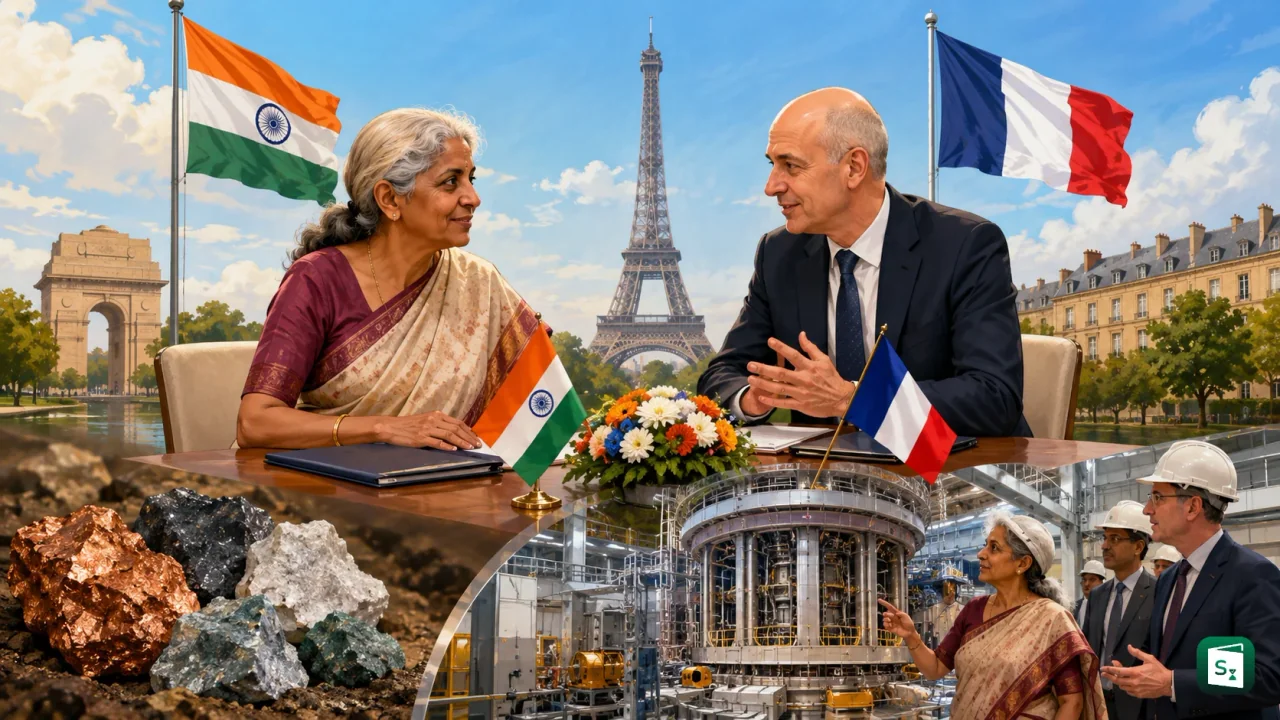
The India-France Economic and Financial Dialogue (EFD) was held on 3 July 2026 in Aix-en-Provence, a historic city in southern France. Sitharaman co-chaired the dialogue with Roland Lescure, France’s Minister of Economy, Finance, Industrial, Energy and Digital Sovereignty. The meeting marked the resumption of high-level bilateral economic exchanges after a gap, reflecting the deepening economic ties between the two countries.
Both ministers reviewed the global economic outlook and discussed ways to strengthen bilateral cooperation across multiple areas. These included critical minerals, cross-border investments, opportunities in the high-speed railway sector building on an earlier declaration of intent on railways, and proposals to increase connectivity between India’s and France’s financial industries.
On multilateral coordination, the two sides discussed greater alignment of their positions within platforms such as the G20 and the Paris Club, particularly in the context of India’s association with France’s G7 presidency in 2026. They also recognised the contribution of the French Development Agency (AFD) to India’s economic development and welcomed its future projects in urban infrastructure, climate action, and energy.
The ministers committed to using the Economic and Financial Dialogue as the principal platform for addressing economic, financial, technological, investment, and trade matters between the two nations. They agreed to explore holding the next edition of the dialogue in 2027.
Critical Minerals: Building Resilient Supply Chains
A key outcome of the dialogue was the agreement to deepen cooperation on critical minerals as part of broader efforts to strengthen economic sovereignty and security. Critical minerals such as lithium, cobalt, rare earth elements, and graphite are essential for manufacturing batteries, electric vehicles, semiconductors, and defence equipment. Their supply chains are currently heavily concentrated in a few countries, making diversification a strategic priority for both India and France.
The agreement builds on the Joint Declaration of Intent on Cooperation in Critical Minerals signed during French President Emmanuel Macron’s visit to India in February 2026, when the two countries elevated their relationship to a Special Global Strategic Partnership. That declaration provided a framework for collaboration in exploration, mining, research and innovation, diversification of value chains, supply chain resilience, and circularity.
Just days after the EFD, the first India-France Joint Working Group on Critical Minerals was held in New Delhi on 6-7 July 2026. It was co-chaired by Benjamin Gallezot, France’s Interministerial Delegate for Strategic Minerals and Metals Supplies, and Kadam Sandeep Vasant, Joint Secretary of India’s National Critical Mineral Mission under the Ministry of Mines. The discussions covered exploration, processing, and recycling of critical minerals and rare earth elements, with a focus on building resilient and sustainable supply chains. The Geological Survey of India and France’s Bureau of Geological and Mining Research (BRGM), which have a long-standing collaboration, identified avenues for joint work across the critical minerals value chain.
The ITER Visit: India’s Role in Fusion Energy Research
On 4 July 2026, Sitharaman visited the International Thermonuclear Experimental Reactor (ITER) facility at Cadarache in southern France. ITER is one of the world’s largest international scientific collaborations, with the goal of demonstrating nuclear fusion as a safe, sustainable, and virtually limitless source of clean energy.
Nuclear fusion is the process that powers the Sun and the stars. It involves fusing two light atomic nuclei (isotopes of hydrogen, deuterium and tritium) at extremely high temperatures to release enormous energy. Unlike nuclear fission, which splits atoms and produces long-lived radioactive waste, fusion produces minimal radioactive byproducts and carries no risk of a meltdown. ITER is designed to produce 500 megawatts of thermal power from just 50 megawatts of input energy, proving that fusion can generate ten times the energy it consumes.
ITER is being built by seven members: the European Union (host), China, India, Japan, South Korea, Russia, and the United States. India joined the project as a full partner in 2005 and contributes 9.1 percent of the construction costs, primarily through in-kind contributions of components and systems. India’s domestic agency for the project is ITER-India, which functions under the Institute for Plasma Research (IPR) in Gandhinagar, Gujarat, and is fully funded by the Department of Atomic Energy (DAE).
During her tour of the facility, Sitharaman visited the Tokamak Pit, the Assembly Hall, and the Cleaning Hall. She commended the work of Indian scientists, engineers, and companies including Larsen & Toubro (L&T), Inox India, Tata Consultancy Services (TCS), Tata Consulting Engineers (TCE), and HCL Technologies, who have been contributing to the project for over two decades. She also interacted with Indian professionals from L&T working on site in Cadarache.
Strengthening the Special Global Strategic Partnership
Sitharaman’s visit must be seen in the context of the rapidly deepening India-France relationship. In February 2026, during French President Emmanuel Macron’s state visit to India, Prime Minister Narendra Modi and Macron elevated the bilateral relationship to a Special Global Strategic Partnership. They exchanged 21 agreements and documents covering defence, critical minerals, clean energy, digital technology, health, and skilling.
Key outcomes of the February 2026 summit included the inauguration of India’s first assembly line for the H125 helicopter at Vemagal, Karnataka, a joint venture between BEL and Safran to produce HAMMER missiles in India, and a new Joint Advanced Technology Development Group for defence and emerging technologies. The two leaders also launched the India-France Year of Innovation 2026 and the India-France Innovation Network.
Sitharaman’s engagements during her visit went beyond the EFD. She participated in a panel discussion titled “How to Promote the Growth of a New Middle Class” at Les Rencontres Economiques d’Aix-en-Provence, one of Europe’s leading forums on global economic policy. She held one-on-one meetings with global CEOs and participated in a roundtable with business leaders to showcase India’s macroeconomic strengths and reform agenda. She also visited Campus Cyber, France’s national hub for cybersecurity innovation and research, and met Renaud Muselier, President of the Provence-Alpes-Cote d’Azur (PACA) Region, to discuss cooperation in clean energy, technology, and regional economic partnerships. The visit concluded with an interaction with members of the Indian diaspora in France.
Key Takeaways
- Finance Minister Nirmala Sitharaman co-chaired the India-France Economic and Financial Dialogue in Aix-en-Provence with French Minister Roland Lescure on 3 July 2026.
- Both nations agreed to deepen cooperation on critical minerals to build resilient supply chains, and committed to holding the next EFD in 2027.
- The first India-France Joint Working Group on Critical Minerals was held in New Delhi on 6-7 July 2026, building on the Joint Declaration of Intent signed during President Macron’s February 2026 visit.
- Sitharaman visited the ITER facility at Cadarache, the world’s largest nuclear fusion experiment involving seven members including India.
- India contributes 9.1 percent of ITER’s construction costs through in-kind contributions, managed by ITER-India under the Institute for Plasma Research (IPR), funded by the Department of Atomic Energy (DAE).
- Indian companies L&T, Inox India, TCS, TCE, and HCL Technologies have been contributing to the ITER project for over two decades.